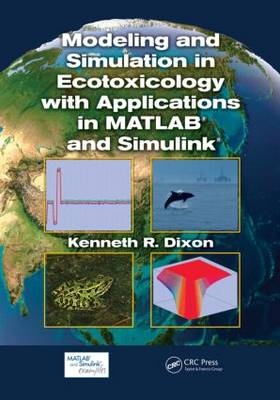
Modeling and Simulation in Ecotoxicology with Applications in MATLAB and Simulink
Crc Press Inc (Verlag)
978-1-4398-5517-1 (ISBN)
Designed for students and professionals with little or no experience in modeling, the book includes:
General principles of modeling and simulation and an introduction to MATLAB and Simulink
Stochastic modeling where variability and uncertainty are acknowledged by making parameters random variables
Toxicological processes from the level of the individual organism, with worked examples of process models in either MATLAB or Simulink
Toxicological processes at the level of populations, communities, and ecosystems
Parameter estimation using least squares regression methods
The design of simulation experiments similar to the experimental design applied to laboratory or field experiments
Methods of postsimulation analysis, including stability analysis and sensitivity analysis
Different levels of model validation and how they are related to the modeling purpose
The book also provides three individual case studies. The first involves a model developed to assess the relative risk of mortality following exposure to insecticides in different avian species. The second explores the role of diving behavior on the inhalation and distribution of oil spill naphthalene in bottlenose dolphins. The final case study looks at the dynamics of mercury in Daphnia that are exposed to simulated thermal plumes from a hypothetical power plant cooling system.
Presented in a rigorous yet accessible style, the methodology is versatile enough to be readily applicable not only to environmental toxicology but a range of other biological fields.
Dr. Kenneth R. Dixon’s current research interests include developing and applying computer simulation models to predict the movement of toxic chemicals in the environment and their effects on human and wildlife populations. He also studies the spatial distribution of toxicants and effects at ecosystem, landscape, and regional scales by integrating models with geographic information systems. Current research projects include developing food-chain models to predict the uptake and effects of pesticides, perchlorate, and explosives; developing spatial models of the spread of infectious diseases; and a mathematical programming model of the effects of pollutants on optimal feeding strategies. Dr. Dixon has taught courses in modeling, geographic information systems, ecosystems analysis, biometry, and wildlife management.
Introduction. Principles of Modeling and Simulation. Introduction to Matlab and Simulink. Introduction to Stochastic Modeling. Modeling Ecotoxicology of Individuals. Modeling Ecotoxicology of Populations, Communities, and Ecosystems. Parameter Estimation. Designing Simulation Experiments. Analysis of Simulation Experiments. Model Validation. A Model to Predict the Effects of Insecticides on Avian Populations. Case Study: Predicting Health Risk to Bottlenose Dolphins from Exposure to Oil Spill Toxicants. Case Study: Simulating the Effects of Temperature Plumes on the Uptake of Mercury in Daphnia. Index.
| Zusatzinfo | 28 Tables, black and white; 167 Illustrations, black and white |
|---|---|
| Verlagsort | Bosa Roca |
| Sprache | englisch |
| Maße | 178 x 254 mm |
| Gewicht | 748 g |
| Themenwelt | Mathematik / Informatik ► Mathematik ► Angewandte Mathematik |
| Naturwissenschaften ► Biologie ► Biochemie | |
| Naturwissenschaften ► Biologie ► Botanik | |
| Naturwissenschaften ► Biologie ► Ökologie / Naturschutz | |
| Naturwissenschaften ► Biologie ► Zoologie | |
| Naturwissenschaften ► Geowissenschaften ► Geologie | |
| Technik ► Umwelttechnik / Biotechnologie | |
| Weitere Fachgebiete ► Land- / Forstwirtschaft / Fischerei | |
| ISBN-10 | 1-4398-5517-X / 143985517X |
| ISBN-13 | 978-1-4398-5517-1 / 9781439855171 |
| Zustand | Neuware |
| Informationen gemäß Produktsicherheitsverordnung (GPSR) | |
| Haben Sie eine Frage zum Produkt? |
aus dem Bereich