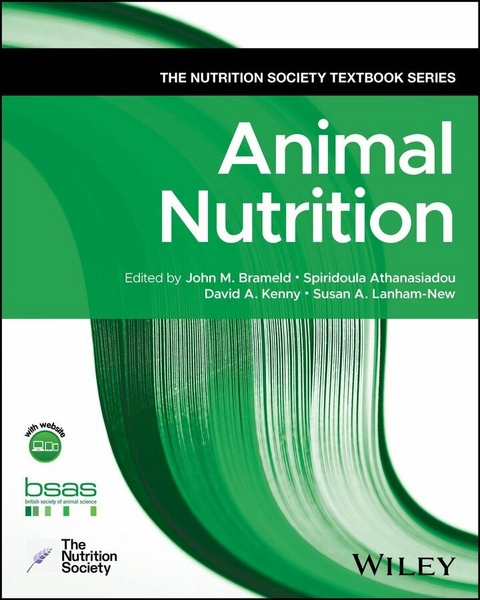
Animal Nutrition (eBook)
1078 Seiten
Wiley (Verlag)
978-1-119-85274-2 (ISBN)
Understand the dietary needs and processes of animals with this comprehensive resource
Animal Nutrition is a single reference volume gathering the latest research into animal nutritional needs, digestion, and metabolism. A seminal new addition to the decorated Nutrition Society Textbook Series, Animal Nutrition covers the nutritional needs of companion animals and livestock, as well as providing detail on a variety of connected subjects. The book discusses the nutritional needs and characteristics of different species, reproduction, husbandry and how nutrition can significantly impact animal quality of life and veterinary outcomes.
Written for the benefit of students, researchers, and practitioners alike, this accessible text offers foundational discussions of both theory and practice. The result is a book which promises to rejuvenate the teaching of this critical field.
Animal Nutrition readers will also find:
- Detailed discussion of topics including feed enzymes, monogastric and ruminant nutrition, macronutrients, and more
- An authorial team comprised of leading researchers and instructors
- A focus throughout on sustainable animal husbandry and care
Animal Nutrition is the essential introduction for undergraduate and postgraduate students of animal biology or veterinary care, as well as an ideal reference for researchers and veterinarians.
John M. Brameld, PhD, is Professor of Nutritional Biochemistry in the Faculty of Science at the University of Nottingham, UK.
Spiridoula Athanasiadou, PhD, is a Professor of Animal and Veterinary Sciences at Scotland's Rural College (SRUC), UK.
David A. Kenny, PhD, is Head of the Animal and Bioscience Department, The Agriculture and Food Development Authority (TEAGASC), Ireland.
Susan A. Lanham-New, PhD, is Professor of Human Nutrition and Head of the Discipline of Nutrition, Exercise, Chronobiology & Sleep at the University of Surrey, UK. She also serves as series editor for the Nutrition Society Textbook Series.
Understand the dietary needs and processes of animals with this comprehensive resource Animal Nutrition is a single reference volume gathering the latest research into animal nutritional needs, digestion, and metabolism. A seminal new addition to the decorated Nutrition Society Textbook Series, Animal Nutrition covers the nutritional needs of companion animals and livestock, as well as providing detail on a variety of connected subjects. The book discusses the nutritional needs and characteristics of different species, reproduction, husbandry and how nutrition can significantly impact animal quality of life and veterinary outcomes. Written for the benefit of students, researchers, and practitioners alike, this accessible text offers foundational discussions of both theory and practice. The result is a book which promises to rejuvenate the teaching of this critical field. Animal Nutrition readers will also find: Detailed discussion of topics including feed enzymes, monogastric and ruminant nutrition, macronutrients, and more An authorial team comprised of leading researchers and instructors A focus throughout on sustainable animal husbandry and care Animal Nutrition is the essential introduction for undergraduate and postgraduate students of animal biology or veterinary care, as well as an ideal reference for researchers and veterinarians.
1
Global Overview of Sustainable Livestock Production
Margaret Gill1, James France2, and Dennis Poppi3
1 School of Biology, University of Aberdeen, Aberdeen, UK
2 Department of Animal Biosciences, University of Guelph, Guelph, Canada
3 School of Agriculture and Food Sustainability, University of Queensland, Brisbane, Australia
Key messages
- Domestication of animals as livestock was an important contributor to our evolution as humans due to the close relationship between the nutritional composition of animal products and those required by humans.
- For millennia, farms included a balance of crops and livestock (and in many countries, this is still the case) but economic drivers and scientific advances supported farm intensification (and hence the spatial separation of crops and livestock) in high‐income countries.
- Despite this separation, crop and livestock sectors remain interdependent, albeit at a national (and through trade internationally) rather than farm level.
- Since the 1990s, progress has already been made in decreasing the environmental footprint of livestock production, supported by research and policy, but further decreases are possible.
- Such decreases need to be monitored and reported in an accessible format to enable consumers and policymakers to make informed decisions about the varied environmental impacts of diets.
- Vegetarianism and veganism are likely to continue to be pushed as ‘solutions’ to reduce the impact of humans on our environment, yet livestock are an integral part of our economic, social and environmental ‘ecosystems’, and little is known about the potential unintended consequences of their removal from food systems.
1.1 The origins of livestock production
In the 21st century, ‘livestock’ is used to refer to domesticated animal species that humans farm mainly for food, such as meat, milk and eggs, yet the history of the relationship between livestock and humans is multi‐faceted. Domestication of animals is estimated to have taken place over 10,000 years ago, enabling ready access to a source of protein. Some anthropologists have argued that access to animal protein and associated micronutrients contributed significantly to the development of human brains, which in turn enabled humans to occupy the ‘skill‐intensive feeding niche’, that forms the basis of farming. Ready access to animal protein from domesticated animals along with farmed crops enabled humans to move from hunter‐gatherer to domesticated groups. Domesticated animals have been depicted in pre‐historic art from many sites, showing their role in the provision of power, food, tools and cultural significance. Others such as the vast number of wildlife species in the various continents have simply been harvested, e.g. kangaroos in Australia, wild herbivores in Africa and bison in North America.
The consumption of ‘meat’ is thus associated with cultural traditions, and authors such as Leroy and Praet (2015) argue that meat consumption is closely linked to the functioning of society both in behavioural and economic terms. Imagining the further evolution of livestock production thus needs to take into account not just biology but also the history and current wider relationship that livestock have with human society.
Once animals were domesticated, humans became responsible for ensuring their livestock were fed, and this led to the development of mixed crop and livestock systems, although in the Middle Ages, as urban areas developed, pigs were also kept in towns and used, e.g. by bakers to convert left‐over wheat, flour and bran into meat. It was in the 17th century that animals started to be kept indoors on a regular basis in the United Kingdom as cropping systems became more sophisticated. The greater efficiency (in terms of food per land area) of crop production was recognised early by the economist Adam Smith who noted that ‘a grain field of moderate fruitfulness produces a larger amount of food for the population than the best pasture of the same size’. As urbanisation accelerated in Europe in the 18th century, the drive for increased productivity took hold, and the importance of good nutrition for livestock was recognised. Advances were made in the growing of fodder crops in the 18th and 19th centuries and this led to increased nitrogen returned to the soil, which in turn increased crop production through efficient rotations. These synergies between crops and livestock at the farm level enabled food production to increase, and mixed farming is still the basis of providing food for more than half of the global human population today. In the 20th century, however, public and private investment in agricultural research facilitated significant independent advances in crop and livestock productivity through, for example, the widespread application of inorganic fertilisers (replacing manure) and the breeding of dairy cattle, pigs and poultry for greater feed conversion efficiency of concentrated feeds, which did not have to be produced locally. Companies focusing on the manufacturing of feed did exist in the 19th century but significant growth did not occur until the mid‐20th century when, e.g. the European Feed Manufacturers’ Federation (FEFAC) was formed. The growth of the feed industry enabled the intensification of livestock production, which increased efficiency (when expressed as kg product per hectare of land) but increased the spatial separation between the production of livestock products (also referred to as animal source foods [ASFs]) and the associated environmental impacts.
1.2 Nutritional demand for livestock products
Agricultural intensification has been driven by increasing demand, which in turn is driven both by population increase and by the evolving relationship between different parts of global society and the components of their diet. Relative to plant‐based products, meat, eggs and milk contain high‐quality protein (an amino acid balance closely aligned with human requirements), essential fatty acids, minerals (Fe, Zn, K, Ca and P) and vitamins (B12, A and riboflavin). These nutrients are also found in plant foods, and a completely plant‐based diet can provide a healthy diet, but where total calories are in short supply, consumption of a balance of nutrients is particularly important to avoid diseases associated with undernutrition. For this reason, milk and small amounts of meat are recommended in many situations (Salter 2013). Where calories in excess of daily requirements are available and affordable, global organisations such as the World Health Organisation caution against eating red (beef, veal, pork, lamb, mutton, horse and goat) or processed (transformed through salting, curing, fermentation, smoking or other processes to enhance flavour or improve preservation) meat in large quantities or as a high proportion of a diet for health reasons, although the evidence is contested since it is based on observational rather than intervention studies (Raiten et al. 2020). Various authors have made the point that lifestyle factors (obesity, sedentary activity, etc.) are frequently associated with high meat intake and hence may be just as important contributors to poor health as the consumption of meat. There is less association between high intakes of milk and its products and poor health.
The health issues associated with the consumption of red and processed meat have arisen as total calorie consumption has increased (global average was 2,366 kcal/capita in 1970 vs. 2,876 in 2012 or 3,166 to 3,497 in ‘Western Europe’ according to data taken from FAOSTAT Food Balance tables). Many authors have quoted a positive relationship between increasing national income (denoted by gross domestic product [GDP]) and consumption of meat in lower‐income countries levelling out at high levels of GDP per capita, but Figure 1.1 shows that plotting the data just for low‐income countries (<2,000 GDP), using 2012 data shows a less clear relationship. GDP is the sum of gross value added by all resident producers in the economy plus any product taxes and minus any subsidies not included in the value of the products. It is calculated without making deductions for depreciation of fabricated assets or for depletion and degradation of natural resources. Data are in constant 2010 US dollars.
Figure 1.1 serves to remind us of the global diversity in the relationship between meat consumption and increasing national prosperity. Comparison of plots for 1992 and 2012 (a vs. b) shows a wider scatter in terms of meat protein supply (usually taken as a surrogate for consumption), but no particular relationship with GDP above $2,000, while comparison of a with c as well as b with d shows no relationship below $2,000. In higher socio‐economic groups and in high‐income countries, there is unlikely to be a shortage of micronutrients, as there are many sources and the intake of milk and meat is high. However, in lower socio‐economic groups and in low‐income countries, access to ASF can be low or non‐existent and so the opportunity to achieve adequate levels of micronutrients is lower (Raiten et al. 2020). ASF does, however, also play an important role in gender and the principles of Ecohealth (Bagnol et al. 2015), and the livestock industries that deliver them play important roles in poverty alleviation, so their impact goes...
| Erscheint lt. Verlag | 20.11.2025 |
|---|---|
| Reihe/Serie | The Nutrition Society Textbook |
| Sprache | englisch |
| Themenwelt | Veterinärmedizin |
| Schlagworte | Animal feed • animal metabolism • animals for human consumption • companion animals • feed enzymes • hind-gut fermentation • livestock • Macronutrients • Micronutrients • Monogastric nutrition • Nutrigenomics • Ruminant Nutrition • Zoo Animals |
| ISBN-10 | 1-119-85274-9 / 1119852749 |
| ISBN-13 | 978-1-119-85274-2 / 9781119852742 |
| Informationen gemäß Produktsicherheitsverordnung (GPSR) | |
| Haben Sie eine Frage zum Produkt? |
 EPUB (Adobe DRM)
Kopierschutz: Adobe-DRM
Adobe-DRM ist ein Kopierschutz, der das eBook vor Mißbrauch schützen soll. Dabei wird das eBook bereits beim Download auf Ihre persönliche Adobe-ID autorisiert. Lesen können Sie das eBook dann nur auf den Geräten, welche ebenfalls auf Ihre Adobe-ID registriert sind.
Details zum Adobe-DRM
Dateiformat: EPUB (Electronic Publication)
EPUB ist ein offener Standard für eBooks und eignet sich besonders zur Darstellung von Belletristik und Sachbüchern. Der Fließtext wird dynamisch an die Display- und Schriftgröße angepasst. Auch für mobile Lesegeräte ist EPUB daher gut geeignet.
Systemvoraussetzungen:
PC/Mac: Mit einem PC oder Mac können Sie dieses eBook lesen. Sie benötigen eine
eReader: Dieses eBook kann mit (fast) allen eBook-Readern gelesen werden. Mit dem amazon-Kindle ist es aber nicht kompatibel.
Smartphone/Tablet: Egal ob Apple oder Android, dieses eBook können Sie lesen. Sie benötigen eine
Geräteliste und zusätzliche Hinweise
Buying eBooks from abroad
For tax law reasons we can sell eBooks just within Germany and Switzerland. Regrettably we cannot fulfill eBook-orders from other countries.
aus dem Bereich