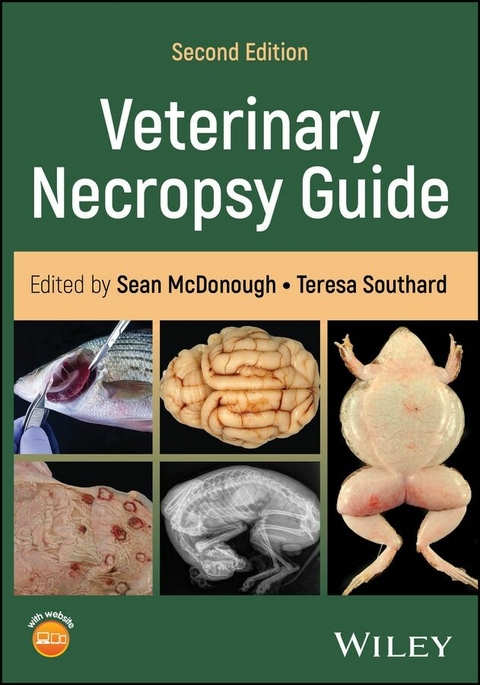
Veterinary Necropsy Guide (eBook)
587 Seiten
Wiley (Verlag)
978-1-394-23714-2 (ISBN)
An updated and expanded guide to performing necropsies on veterinary patients, now covering farm animals and exotics in addition to dogs, cats, and small mammals
Veterinary Necropsy Guide, Second Edition delivers practical guidance on how to perform a postmortem examination in animals. The book includes expanded and updated species coverage, now including cattle, horses, sheep, goats, alpacas, llamas, pigs, and exotics, in addition to dogs, cats, and small mammals. It offers detailed descriptions of the necropsy procedure in small animals, comparative anatomy, modified procedures appropriate for various species, and special postmortem species.
Each chapter covers an organ system and explains dissection, examination, and tissue collection. The authors also include guidelines for sample collection for ancillary testing. Veterinary Necropsy Guide provides:
- A thorough introduction to veterinary necropsy, including when, how, and why to perform a postmortem examination
- Comprehensive explorations of canine, feline, small mammal, farm animal, and exotic animal necropsies
- Practical discussions of comparative anatomy, procedural modifications, and special necropsy techniques
- Complete treatments of the necropsy procedure, organ systems, and additional testing
Veterinary Necropsy Guide is an essential reference for veterinary students, veterinary anatomic pathology residents, and veterinary pathologists, laboratory veterinarians, shelter veterinarians, and veterinary practitioners who perform necropsies.
The authors
Sean McDonough, DVM, PhD, is Associate Professor at Cornell University College of Veterinary Medicine in Ithaca, New York, USA.
Teresa Southard, DVM, PhD, is Associate Professor at Virginia-Maryland College of Veterinary Medicine in Blacksburg, Virginia, USA.
An updated and expanded guide to performing necropsies on veterinary patients, now covering farm animals and exotics in addition to dogs, cats, and small mammals Veterinary Necropsy Guide, Second Edition delivers practical guidance on how to perform a postmortem examination in animals. The book includes expanded and updated species coverage, now including cattle, horses, sheep, goats, alpacas, llamas, pigs, and exotics, in addition to dogs, cats, and small mammals. It offers detailed descriptions of the necropsy procedure in small animals, comparative anatomy, modified procedures appropriate for various species, and special postmortem species. Each chapter covers an organ system and explains dissection, examination, and tissue collection. The authors also include guidelines for sample collection for ancillary testing. Veterinary Necropsy Guide provides: A thorough introduction to veterinary necropsy, including when, how, and why to perform a postmortem examinationComprehensive explorations of canine, feline, small mammal, farm animal, and exotic animal necropsiesPractical discussions of comparative anatomy, procedural modifications, and special necropsy techniquesComplete treatments of the necropsy procedure, organ systems, and additional testing Veterinary Necropsy Guide is an essential reference for veterinary students, veterinary anatomic pathology residents, and veterinary pathologists, laboratory veterinarians, shelter veterinarians, and veterinary practitioners who perform necropsies.
Chapter 2
Necropsy Basics
This chapter provides some background information for the prosector before starting the necropsy, including essential supplies, safety considerations, documentation of necropsy findings, and the physiology and gross manifestations of postmortem change.
2.1 Necropsy Facilities
Most necropsies do not require a specialized facility. Large animal veterinarians routinely perform necropsies in a pasture or a barn. In a small animal clinic or laboratory setting, a stainless-steel table with running water and plumbed to a sanitary sewer line is ideal. The area chosen should be easy to clean and disinfect. The necropsy should be performed at a time and place where there are minimal distractions and foot traffic so as to minimize the chances of cross contamination.
2.2 Necropsy Equipment
The instruments and supplies needed to perform a necropsy are relatively few and inexpensive. The major expense is the investment of an adequate amount of time to perform a complete necropsy. A kit assembled beforehand can facilitate the necropsy process. Next is a suggested list of equipment and supplies:
- Sharp blade for cutting soft tissue: Knife, scalpel
A sharp blade is the most important tool for the prosector. The choice between a knife and a scalpel should depend on availability, size of the animal, and personal preference. A good knife will hold its edge better than a scalpel blade and can be sharpened as needed. Correctly sharpening a knife requires considerable skill and patience. A wooden handle is porous and may absorb pathogens, so a synthetic handle that can be easily disinfected is preferred. A sharpening steel is essential to hone the blade after sharpening and to revive the edge after cutting for a while. The steel should be at least as long as the knife blade. Hold the knife crossways against the steel and tilt the blade until the cutting edge meets the shaft of the steel at a 22.5° angle (hint: hold the blade perpendicular to the steel and then cut the angle in half to 45°; cut the angle in half again to reach the correct angle). Gently draw the blade toward you while gliding it down the length of the steel (Figure 2.1). Repeat 10 to 12 times on each side and then rinse and wipe the blade with a cloth to remove any metal filings. Pull-through knife sharpeners, with the sharpening surfaces fixed at the appropriate angle, are also available. Always be careful when using any type of knife sharpener since inattention can result in serious injury.
Figure 2.1 To hone the edge on a knife, place the edge of the knife against the sharpening steel at an angle of approximately 20° and pull the knife across the steel in a slight arc. Repeat this motion 10 times, alternating sides of the blade.
A scalpel is a good choice for the necropsy of a puppy, kitten, or small mammal. For a medium- to large-sized animal, a knife is usually the best choice for opening the carcass, while a scalpel can be used for more delicate dissection of the organs.
- Sturdy instrument(s) for cutting bone and removing the brain: Bone cutting forceps, pruning shears, hedge clippers, oscillating saw, hand saw, coping saw, reciprocating saw, chainsaw
A complete necropsy requires cutting the bones of the ribs and skull to access the viscera, as well as the femur to examine the bone marrow. The tools needed for cutting the ribs and skull depend on the size of the animal. Recommendations are included in Table 2.1 and illustrated in Figure 2.2. When using an oscillating saw or bone cutting forceps to remove the brain, the head can be held with the nondominant hand and rotated as needed. For the larger tools, and particularly power tools, a head vice (Figure 2.2d) is recommended. A T tool is very helpful for prying off the top of the calvaria after cutting the bone (Figure 2.3).
Table 2.1 Recommended instruments based on animal size.
Size To cut ribs To cut skull To remove skull cap Up to 2 kg Scissors
Bone-cutting forceps
Scissors
Bone-cutting forceps
T tool 2–50 kg Bone-cutting forceps
Pruning shears
Hedge clippers
Bone-cutting forceps
Oscillating saw*
Coping saw
T tool 50–100 kg Hedge clippers Oscillating saw*
Hand saw
T tool
Wedge and hammer
Over 100 kg Hedge clippers
Reciprocating saw*
Chainsaw*
Hand saw
Reciprocating saw*
Chainsaw*
Bandsaw* (split the head longitudinally)
Wedge and hammer *Avoid using power tools in cases of suspected zoonotic disease (such as rabies) to prevent aerosolization of the infectious agent.
Figure 2.2 Instruments for cutting bone. (a) Hedge clippers; (b) Sharpening steels; (c) Hand saws; (d) Head vice; (e) Band saw; (f) Reciprocating saw; (g) Bone-cutting forceps; (h) Pruning shears; (i) Coping saw; (j) Reciprocating saw.
Figure 2.3 T tool is used to loosen the top of the calvaria after the bone has been cut.
- Dissection instruments: Forceps, scissors
Forceps and scissors are helpful tools for dissecting and collecting soft tissue. Rat tooth forceps cause less tissue artifact in histologic sections than forceps that crush the tissue. Scissors with at least one blunt tip are very useful in opening the intestine and other tubular organs without damaging the tissue. The size of the dissection instruments should be scaled to the size of the animal.
- Cutting board
A standard synthetic kitchen cutting board provides a flat surface on which to section tissues and can be used as a background for photographs. Cutting tissues on the cutting board, rather than on a steel table, helps to keep your knife sharp.
- Scale
If possible, the body should be weighed prior to starting a necropsy. Small animals can be weighed on scales that are available in most clinics and laboratories. Weighing a large animal is more difficult and usually requires special equipment such as a crane scale attached to the hoist. In many cases, a recent weight is available from the clinic or owner. Weights of organs, such as the heart and liver, can also provide important information which may influence the diagnosis. A gram scale is a useful piece of equipment when performing a necropsy on a small animal, while a hanging scale, crane scale, or floor scale can be used for large animal organs. A variety of scales are shown in Figure 2.4. Data for normal organ weights (as a percentage of body weight) are included in Appendix 1.
Figure 2.4 Scales to weigh animals and organs. (a) Hanging scale (up to 10 kg); (b) Floor scale (up to 500 kg); (c) Crane scale (up to 1000 kg); (d) Gram scale (up to 5 kg). Also shown are scrub mops and squeegees (e) for keeping the floor clean.
- Digital camera
A digital camera is an amazing tool for recording and sharing findings from the necropsy examination; however, trying to keep the camera clean during the procedure can be difficult. Having a dedicated necropsy camera that remains on the necropsy floor at all times is one solution. The prosector can also wear two pairs of gloves and take the outer layer off when taking photos. Another option would be to invest in a relatively inexpensive waterproof case for your camera, tablet, or smart phone. A camera with a resolution of at least 5 MP should be adequate for gross photography. Photographs should be taken at varying distances (macro and micro) to orient the viewer to the location of lesions.
- Materials for collecting histopathology samples
Samples which will be submitted for histopathology should be collected in a wide-mouth, plastic, leak-proof container (Figure 2.5), with a final ratio of 1 part tissue to 10 parts fixative. The standard fixative is 10% neutral buffered formalin, which is available from any biological supply company. Other useful materials for collecting samples for histology (Figure 2.6) include:
- Wooden tongue depressors to affix samples of nerve, skin, and muscle to help maintain proper orientation during fixation.
- Plastic tissue cassettes to differentiate lymph nodes, identify small tissues, or mark specific lesions. If the tissue is small enough to be placed in a cassette without compression or crushing, do so. If not, clip the cassette to the edge of the tissue. Always label these cassettes with a #2 pencil; other types of markings will wash off in the formalin.
Figure 2.5 Samples for histopathology are collected in 10% neutral buffered formalin. Use a wide-mouth container, so that the tissue can be easily removed when fixed. Smaller containers (a) work well for small animals (cats, dogs, small ruminants), but larger containers (b) may be needed for horses and cattle, particularly for the brain. Initially fill only approximately one-third of the container (see arrows), to make the container bottom-heavy and less likely to spill, and to avoid overflow when tissues are added. Then, top off the container with formalin after the tissues are collected to achieve a final tissue to formalin ratio of 1:10. Scale bar = 2...
| Erscheint lt. Verlag | 18.11.2025 |
|---|---|
| Sprache | englisch |
| Themenwelt | Veterinärmedizin |
| Schlagworte | animal necropsies • canine necropsies • exotic animal necropsies • farm animal necropsies • feline necropsies • large animal necropsies • small animal necropsies • small mammal necropsies • Veterinary necropsy book • veterinary necropsy procedure |
| ISBN-10 | 1-394-23714-6 / 1394237146 |
| ISBN-13 | 978-1-394-23714-2 / 9781394237142 |
| Informationen gemäß Produktsicherheitsverordnung (GPSR) | |
| Haben Sie eine Frage zum Produkt? |
 EPUB (Adobe DRM)
Kopierschutz: Adobe-DRM
Adobe-DRM ist ein Kopierschutz, der das eBook vor Mißbrauch schützen soll. Dabei wird das eBook bereits beim Download auf Ihre persönliche Adobe-ID autorisiert. Lesen können Sie das eBook dann nur auf den Geräten, welche ebenfalls auf Ihre Adobe-ID registriert sind.
Details zum Adobe-DRM
Dateiformat: EPUB (Electronic Publication)
EPUB ist ein offener Standard für eBooks und eignet sich besonders zur Darstellung von Belletristik und Sachbüchern. Der Fließtext wird dynamisch an die Display- und Schriftgröße angepasst. Auch für mobile Lesegeräte ist EPUB daher gut geeignet.
Systemvoraussetzungen:
PC/Mac: Mit einem PC oder Mac können Sie dieses eBook lesen. Sie benötigen eine
eReader: Dieses eBook kann mit (fast) allen eBook-Readern gelesen werden. Mit dem amazon-Kindle ist es aber nicht kompatibel.
Smartphone/Tablet: Egal ob Apple oder Android, dieses eBook können Sie lesen. Sie benötigen eine
Geräteliste und zusätzliche Hinweise
Buying eBooks from abroad
For tax law reasons we can sell eBooks just within Germany and Switzerland. Regrettably we cannot fulfill eBook-orders from other countries.
aus dem Bereich