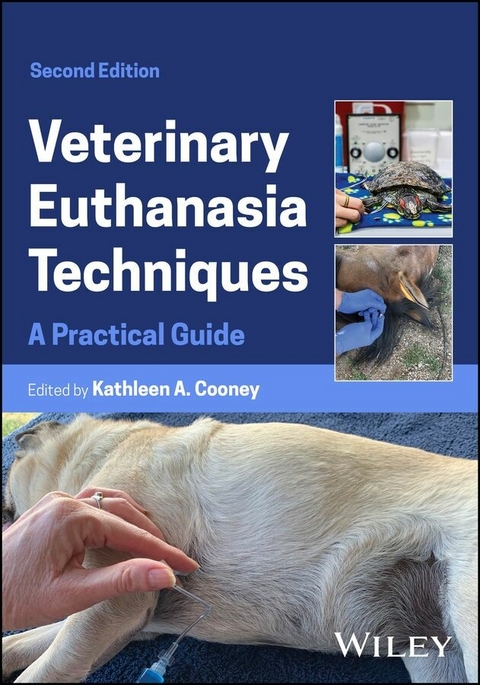
Veterinary Euthanasia Techniques (eBook)
433 Seiten
Wiley (Verlag)
978-1-394-26389-9 (ISBN)
Practical how-to guidance to compassionately and confidently care for various species of animals through euthanasia
Veterinary Euthanasia Techniques offers how-to guidance for performing euthanasia techniques in dogs, cats, exotic animals, horses, production animals, and, in this new edition, zoo and marine animals. This edition has been reorganized by species to make it easier to find information, with each species-specific chapter covering restraint, equipment, sedatives, and techniques. Sections discussing drugs and data have been updated throughout, with new discussions on how to handle pentobarbital shortages and animal welfare considerations.
Veterinary Euthanasia Techniques includes information on:
- Pre-euthanasia sedation and anesthesia, covering unconscious and sedation assessment
- Euthanasia techniques, including inhalant, injectable, and physical techniques, with guidance on how death is achieved, positioning and restraint, and how to choose an appropriate method
- Burial aftercare, covering the burial process, composing, cremation/incineration, alkaline hydrolysis, and rendering
- Client considerations concerning companion animals
- The history of the field, current research, and emerging trends
Offering complete information and specific advice to improve skills and aid in decision making, Veterinary Euthanasia Techniques is a must-have reference for anyone involved in animal welfare work and veterinary euthanasia, including general practice vets, specialists, students, and veterinary technicians.
Kathleen A. Cooney, DVM, CHPV, CPEV, DACAW, is Senior Director of Medical Education at the Companion Animal Euthanasia Training Academy (CAETA) and Affiliate Faculty Member in the Department of Clinical Sciences, College of Biomedical Sciences, Colorado State University in Fort Collins, Colorado, USA.
1
Euthanasia Standards in Modern Times
Kathleen A. Cooney
1.1 A Brief Look at Euthanasia’s History
This book is written to be a practical guide for veterinarians and all professionals performing or assisting with euthanasia, especially during times they find themselves in unfamiliar situations. It is meant to help readers form a foundation of euthanasia best practices, while building confidence in the procedure and all it entails. To achieve this goal, it’s important to understand a bit of euthanasia’s history and appreciate how veterinary medicine has evolved to protect the animal’s experience and support those who witness the death.
1.1.1 Defining Euthanasia and Original Methods
As with any significant movement in the right direction, changes take time. Euthanasia is a very old term, Greek in origin, combining the words εὖ (eu), meaning good, and Θᾰ́νᾰτος (thanatos), meaning death. The first use of it dates back to around 121 CE to describe the ideal human death; loved ones gathered around, affairs in order, and comfortable. It referred to a natural passing, not tied to the act of purposefully ending life like it is today (Dowbiggin 2007). The meaning changed in the late 1800s when it was suggested that suffering persons of the world would be better served with a quick death. Veterinary medicine eventually took on the word to describe intentional, active (not passive) animal death. It reflects the veterinarian’s desire to bring about the best possible outcome for the animal, including to end its life if mental and/or physical suffering persists (Figure 1.1).
Early euthanasia methods were physical in nature (e.g. blunt force trauma, drowning) until pharmaceutical drugs, both gas and injectable, became available. Some poisons were tried as euthanasia agents (e.g. strychnine, cyanide) but proved to be highly distressing to the patient. With attention placed on reducing pain, anxiety, and fear, euthanasia methods began to put more emphasis on producing rapid unconsciousness, the hallmark of any safe killing method.
Some of these early euthanasia methods were less than ideal and understandably resulted in what today would be referred to as “dysthanasia,” or a bad death. Dysthanasia is what practitioners aim to avoid, not only for the animal’s sake but for those who are present during the procedure and may experience emotional harm. The following illustrates the terms’ differences:
Figure 1.1 A cat owner grappling with the reality of the euthanasia decision and hoping things progress smoothly.
Source: CAETA (2025).
Euthanasia:
- The animal feels minimal to no anxiety, pain, or fear.
- Proper technique is delivered.
- The procedure is in line with professional and societal animal welfare expectations.
- Observers feel safe and supported.
Dysthanasia:
- The animal feels unacceptable pain, anxiety, and/or fear.
- Improper technique is used.
- Observers experience distress and anguish.
- Support among the patient, client, and veterinary team breaks down.
Through improved research, euthanasia methods and techniques are more reliable than ever before. While there is always room for improvement, evidenced by new research coming out each year, practitioners find themselves with effective options for a multitude of circumstances. Many euthanasia methods are the same as they were decades ago to great success. However, others are set to change for the better or fade out of use altogether.
1.1.2 The Guidelines We Follow
To help euthanasia practitioners, animal industries have developed guidelines that follow the collective body of euthanasia research. These industries (e.g. food animal production, research, wildlife management, small animal general practice) create euthanasia best practices for the species they care for, with the vast majority of them drawing some, if not all, of their information from the American Veterinary Medical Association (AVMA). When the first AVMA Euthanasia Panel report was published in 1963, the panel members drew from only 14 known reference articles related to euthanasia. It was clear there was much to improve upon, and in time, more research and superior euthanasia methods would emerge. By 2001's AVMA panel report, the number of utilized articles, presentations, and books had grown to over 200. The 2020 document, titled Guidelines for the Euthanasia of Animals, took the expertise of more than 70 individuals and included references near the 700 range.
The AVMA developed categories to help classify euthanasia methods for veterinary practitioners to follow. The euthanasia methods are either “acceptable,” “acceptable with conditions,” “unacceptable,” and “adjunctive.” The following description is shared directly from the 2020 AVMA Guidelines for the Euthanasia of Animals:
Euthanasia methods are classified in the Guidelines as acceptable, acceptable with conditions, and unacceptable. Acceptable methods are those that consistently produce a humane death when used as the sole means of euthanasia. Methods acceptable with conditions are those techniques that may require certain conditions to be met to consistently produce humane death, may have greater potential for operator error or safety hazard, are not well documented in the scientific literature, or may require a secondary method to ensure death. Methods acceptable with conditions are equivalent to acceptable methods when all criteria for application of a method can be met. Unacceptable techniques are those methods deemed inhumane under any conditions or that the panel found posed a substantial risk to the human applying the technique. The Guidelines also include information about adjunctive methods, which are those that should not be used as a sole method of euthanasia, but that can be used in conjunction with other methods to bring about euthanasia.
Practitioners determine which euthanasia method to use based on their knowledge of these categories and what they feel is suitable for their patients. The methods themselves have already been reviewed by experts using a criteria checklist with these considerations:
- Ability to induce loss of consciousness and death without pain or anxiety
- Time required to induce loss of consciousness
- Reliability
- Safety of personnel
- Irreversibility
- Compatibility with requirement and purpose
- Documented emotional effect on observers and operators
- Compatibility with use of tissue, examination
- Drug availability and human abuse potential
- Compatibility with species and health status
- Ability to maintain equipment in working order
- Safety for predators/scavengers should the body be consumed
- Legal requirements
- Environmental impacts of the method or carcass disposition
Most euthanasia technique publications around the world use these criteria as their basis for acceptable methods. If a particular technique does not meet one or more criteria, the technique becomes less acceptable, therefore requiring additional reflection and precaution to be taken. For example, an intracardiac (IC) injection of a euthanasia drug must be preceded by the administration of an anesthetic because, by itself, the euthanasia drug injection will induce pain in the animal. Another example is the gunshot technique of a client‐owned horse. This may have an emotional effect on the observers but may be necessary to keep euthanasia drug out of the body when burial is the aftercare choice (Figure 1.2).
Figure 1.2 A deceased horse following firearm euthanasia. Afterward, loved ones were invited to approach and safely say goodbye.
Source: CAETA (2025).
It is the practitioner’s responsibility to examine available methods to make the best judgment on how to proceed. It is important to remember that guidelines are not considered the law or legally bound. However, practitioners would be expected to justify why they performed euthanasia outside of a guideline’s recommended methods, especially since the methods are rooted in scientific justification. Note that euthanasia methods are viewed differently from slaughter or depopulation killing methods. The AVMA deliberately created separate guidelines for them, and they are not described further in this book.
In 2017, the Companion Animal Euthanasia Training Academy (CAETA) created the 14 Essential Components of Companion Animal Euthanasia for private practitioners to follow (Table 1.1). The components are appropriate for a variety of euthanasia settings when bonded clients are present and are meant to be a blueprint for veterinary teams to follow as they prepare for the euthanasia appointment. They can be used to help develop a euthanasia manual, discussed later in this chapter.
1.1.3 How Death is Achieved
Euthanasia techniques are divided by methodology, relating to how death is achieved within the body. Based on current knowledge of the body, death can occur through three mechanisms:
- Direct depression of neurons necessary for life (pharmaceutical agents that shut down the body’s nervous system). Examples include:
- Barbiturate overdose via the kidney
- Lidocaine overdose into the subarachnoid space
- Carbon dioxide...
| Erscheint lt. Verlag | 29.10.2025 |
|---|---|
| Sprache | englisch |
| Themenwelt | Veterinärmedizin |
| Schlagworte | Animal welfare • cat Euthanasia • dog Euthanasia • Euthanasia animals • exotic animal Euthanasia • horse Euthanasia • marine animal Euthanasia • pentobarbital shortages • production animal Euthanasia • zoo animal Euthanasia |
| ISBN-10 | 1-394-26389-9 / 1394263899 |
| ISBN-13 | 978-1-394-26389-9 / 9781394263899 |
| Informationen gemäß Produktsicherheitsverordnung (GPSR) | |
| Haben Sie eine Frage zum Produkt? |
 EPUB (Adobe DRM)
Kopierschutz: Adobe-DRM
Adobe-DRM ist ein Kopierschutz, der das eBook vor Mißbrauch schützen soll. Dabei wird das eBook bereits beim Download auf Ihre persönliche Adobe-ID autorisiert. Lesen können Sie das eBook dann nur auf den Geräten, welche ebenfalls auf Ihre Adobe-ID registriert sind.
Details zum Adobe-DRM
Dateiformat: EPUB (Electronic Publication)
EPUB ist ein offener Standard für eBooks und eignet sich besonders zur Darstellung von Belletristik und Sachbüchern. Der Fließtext wird dynamisch an die Display- und Schriftgröße angepasst. Auch für mobile Lesegeräte ist EPUB daher gut geeignet.
Systemvoraussetzungen:
PC/Mac: Mit einem PC oder Mac können Sie dieses eBook lesen. Sie benötigen eine
eReader: Dieses eBook kann mit (fast) allen eBook-Readern gelesen werden. Mit dem amazon-Kindle ist es aber nicht kompatibel.
Smartphone/Tablet: Egal ob Apple oder Android, dieses eBook können Sie lesen. Sie benötigen eine
Geräteliste und zusätzliche Hinweise
Buying eBooks from abroad
For tax law reasons we can sell eBooks just within Germany and Switzerland. Regrettably we cannot fulfill eBook-orders from other countries.
aus dem Bereich