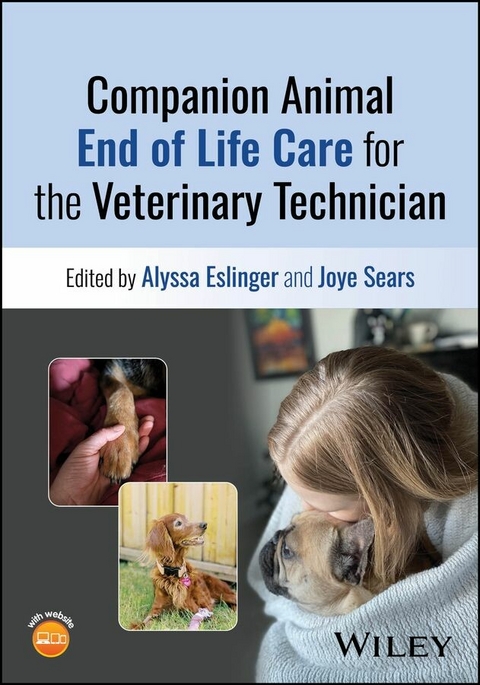
Companion Animal End of Life Care for the Veterinary Technician (eBook)
694 Seiten
Wiley (Verlag)
978-1-394-26607-4 (ISBN)
A practical, one-stop resource for veterinary technicians offering end-of-life services for companion animals
In Companion Animal End of Life Care for the Veterinary Technician, an experienced interdisciplinary team delivers a comprehensive guide for veterinary technicians seeking a resource covering all aspects of the veterinary technician's role in companion animal end-of-life care. The book explores everything from palliative nursing strategies to euthanasia techniques, with special attention to supporting and communicating with caregivers throughout the end-of-life period.
The editors offer invaluable support, knowledge, and skills to enhance your ability to provide patients with comfort and offer empathy to caregivers in challenging situations. In this book, you will find a practical approach and user-friendly format, a handy and accessible reference for daily veterinary practice. you will also discover:
- Hospice and palliative care principles, philosophy, and methods of delivery
- A thorough exploration of quality of life and end-of-life decision-making
- Practical communication skills and case study applications
- Euthanasia best practices
- The valuable role of veterinary social work and perspectives on pet loss support
- Grounded approaches to maintain technician and team wellbeing
- Careful alignment with evolving standards of end-of-life care and client expectations
- Distillations of expert insights from authoritative texts and current literature, providing access to the most relevant information for technicians in the field of end-of-life care
Perfect for practicing veterinary technicians with a desire to improve their standard of end-of-life care, Companion Animal End of Life Care for the Veterinary Technician will also benefit students of veterinary technology start their careers with the mindset and tools to lean into the meaningful experiences that can be accessed through compassionate end-of-life care.
Alyssa Eslinger is a certified hospice and palliative care veterinarian with over 10 years of clinical experience. She founded a dedicated mobile end-of-life service before joining Dalhousie University as a full-time instructor in the Veterinary Technology Program. Dr. Eslinger now passionately shares her calling to end-of-life care with her students.
Joye Sears is a veterinary technician with 10 years experience in companion animal practice prior to becoming an instructor at Dalhousie University in 2015. She has a special interest in teaching compassionate end-of-life communication skills to future technicians.
A practical, one-stop resource for veterinary technicians offering end-of-life services for companion animals In Companion Animal End of Life Care for the Veterinary Technician, an experienced interdisciplinary team delivers a comprehensive guide for veterinary technicians seeking a resource covering all aspects of the veterinary technician s role in companion animal end-of-life care. The book explores everything from palliative nursing strategies to euthanasia techniques, with special attention to supporting and communicating with caregivers throughout the end-of-life period. The editors offer invaluable support, knowledge, and skills to enhance your ability to provide patients with comfort and offer empathy to caregivers in challenging situations. In this book, you will find a practical approach and user-friendly format, a handy and accessible reference for daily veterinary practice. you will also discover: Hospice and palliative care principles, philosophy, and methods of deliveryA thorough exploration of quality of life and end-of-life decision-makingPractical communication skills and case study applicationsEuthanasia best practicesThe valuable role of veterinary social work and perspectives on pet loss supportGrounded approaches to maintain technician and team wellbeingCareful alignment with evolving standards of end-of-life care and client expectationsDistillations of expert insights from authoritative texts and current literature, providing access to the most relevant information for technicians in the field of end-of-life care Perfect for practicing veterinary technicians with a desire to improve their standard of end-of-life care, Companion Animal End of Life Care for the Veterinary Technician will also benefit students of veterinary technology start their careers with the mindset and tools to lean into the meaningful experiences that can be accessed through compassionate end-of-life care.
1
Introduction to Animal Hospice and Palliative Care
Alyssa Eslinger
Veterinary Technology Program, Dalhousie University, Bible Hill, NS, Canada
1.1 Introduction
The foundational philosophy of animal hospice and palliative care (AHPC) requires a perspective shift from traditional veterinary practice. It is more often about the approach to care than specific medicine and nursing techniques. Animal hospice embraces life in the face of death such that dying patients and their loved ones live life to the fullest until the moment of death. Animal hospice aims to improve and maintain quality of life (QOL) throughout the end‐of‐life (EOL) journey while also supporting the human–animal bond. This continues until the time of death and beyond, with a focus on quality of dying and a meaningful EOL transition for the animal and their loved ones.
EOL care has always been a part of veterinary medicine, but it is relatively recent that AHPC has emerged as a dedicated area of study and practice. The roots of human hospice date back centuries, and modern human hospice has its origins in the 1960s. By contrast, AHPC is a young discipline, beginning in the 1980s [1] with 2009 marking the founding of the International Association of Animal Hospice and Palliative Care (IAAHPC). The IAAHPC offers certification for both veterinarians and technicians and is making efforts toward establishing AHPC as a recognized veterinary specialty.
The effective provision of AHPC not only improves animal QOL and supports the human–animal bond, it also reduces caregiver decisional regret at EOL. Animal hospice or EOL care offers an opportunity to bridge the gap between care provided at a veterinary facility and the potential for inadequate treatment at home or premature euthanasia due to a lack of other options [1]. Hospice‐supported natural death can also be offered as an alternative to euthanasia with appropriate veterinary supervision (see Chapter 9). Caregivers may feel abandoned by their veterinary teams if there is a perceived lack of treatment alternatives discussed beyond aggressive treatment and/or euthanasia [2]. They are often unaware of the possibilities of animal hospice, home‐based care, and hospice‐supported natural death. Offering caregivers more options and more support during the EOL period allows families to feel more in control of an unpredictable situation and remain more connected with their pet during this meaningful time.
1.2 Terminology and Definitions
Hospice and palliative care are inseparable within the context of EOL care, but they are defined differently. Hospice is the care provided from the time of a terminal diagnosis through to the time of death, including support for the caregiver after death. Palliative care is simply the provision of non‐curative therapies that improve patient comfort. It can be offered to any patient experiencing any type of discomfort and is not restricted to EOL patients (Pro Tip 1.1). Technicians should be mindful that misconceptions about the nature of palliative care will be common among caregivers (Communication Corner 1.1).
You can offer palliative care without hospice,
but you cannot offer hospice without palliative care.
The terms hospice and EOL care will be used interchangeably throughout this guide. It includes palliative care, hospice‐supported natural death or humane euthanasia, body care, memorialization, and grief support. In addition to prioritizing patient welfare and QOL, hospice also considers the caregiver’s needs and values. A peaceful and smooth euthanasia may be a goal for many caregivers, but it is not the ultimate measure of successful EOL care. It may be one of the goals for a particular patient, but the ultimate successful outcome is a caregiver who feels no regret in the wake of their beloved animal’s death.
There can be conflict at times between the caregiver’s perspectives and desires and the animal’s welfare, but hospice does not involve prolonging the life of the animal to help the caregiver avoid processing their grief. Hospice can involve veterinarian‐supervised, hospice‐supported natural death where euthanasia is always available if required for animal welfare [1]. However, it must be understood that hospice does not involve natural death without supervision or intervention.
Pro Tip 1.1 Palliative Care Outside of Hospice
The focus of this guide is EOL care, but many of the nursing strategies discussed in Part I may be effectively applied in a palliative care program for patients that are not at the end of their life.
- Case 1: A horse receiving massage therapy, acupuncture and pain medication while awaiting surgery for a torn ligament is receiving palliative care. Neither the massage nor the pain medication will cure the torn ligament, but both improve the patient’s comfort pre‐ and postoperatively.
- Case 2: An overweight cat may struggle to groom itself and experience matting of the fur, fecal balls or urine scald around its perineal region. Grooming and hygiene management for this cat would be appropriate palliative care while a weight management program seeks to address the underlying problem.
- Case 3: A miniature dachshund with hind end paresis secondary to intervertebral disc disease has an improved QOL with the use of a wheelchair for mobility and physiotherapy to preserve muscle mass and nerve function.
Consider palliative care options in every patient’s individualized care. Technicians are important advocates for animals’ QOL.
Communication Corner 1.1 Palliative Care Misconceptions
Be mindful and intentional when using the word palliative outside of EOL care. Many people immediately associate this word with terminal illness, even though it is not defined that way. Offer appropriate explanation and context to avoid triggering negative responses unnecessarily.
- Example: “Many people associate the word palliative with end of life, but it just means to provide comfort care. Your pet is not at the end of their life but is an excellent candidate for palliative care to improve and maintain their quality of life.”
A successful outcome in EOL care is supporting quality of life through to quality of dying in such a manner that patient welfare is attended throughoutand caregivers experience no decisional regret.
1.3 Psychosocial Considerations
In hospice care, the patient unit includes not just the animal, but also its caregivers. While the needs and welfare of the animal patient are always the first priority, the needs and values of the caregivers are also thoroughly explored and prioritized. This consideration of the caregiver’s perspective is key to a shared decision‐making paradigm. The EOL care team and caregivers are partners who share information and determine the appropriate course of action together (see Section 1.4). The ideal treatment plan is of no use if the caregivers are not able to implement and maintain the plan. Table 1.1 will help guide technicians through the exploration of the caregiver’s perspective, which will help inform the veterinarian’s individualized care plan.
Caregivers experience a burden of care when supporting their EOL companion animals that can have a significant impact on their own QOL. This burden can be complicated by guilt when a caregiver’s psychosocial concerns impact their ability to care for their pet. Caregivers often experience guilt when they have to make treatment decisions based on their lifestyle and resources rather than purely based on the needs and welfare of their pet. Offering caregivers the opportunity to express their concerns and limitations may help address any guilt about how psychosocial factors must inform treatment choices. Factoring caregiver burden into EOL decision making will be discussed in Chapter 8.
1.4 The Interdisciplinary Team
Veterinary professionals involved in EOL care provide better care for animals and caregivers when they are part of a larger team. The medical needs of the animal and the emotional support needs of the family can be diverse and complex. No one has the capacity or knowledge to be everything to everyone. The establishment of an interdisciplinary team (IDT) can improve the care provided to animals and families while also reducing burnout and empathic strain in EOL care professionals [3]. (Empathic strain will be discussed in detail in Chapter 17.)
Table 1.1 Caregiver psychosocial considerations.
| Physical |
The physical abilities and limitations of the caregiver should be considered when developing, implementing, and reevaluating EOL care plans.
|
| Erscheint lt. Verlag | 13.10.2025 |
|---|---|
| Sprache | englisch |
| Themenwelt | Veterinärmedizin |
| Schlagworte | companion animal veterinary care • End of life veterinary care • palliative veterinary care • pet loss • Pet Loss Support • veterinary end-of-life • veterinary end-of-life book • veterinary end-of-life care guide • veterinary euthanasia |
| ISBN-10 | 1-394-26607-3 / 1394266073 |
| ISBN-13 | 978-1-394-26607-4 / 9781394266074 |
| Informationen gemäß Produktsicherheitsverordnung (GPSR) | |
| Haben Sie eine Frage zum Produkt? |
 EPUB (Adobe DRM)
Kopierschutz: Adobe-DRM
Adobe-DRM ist ein Kopierschutz, der das eBook vor Mißbrauch schützen soll. Dabei wird das eBook bereits beim Download auf Ihre persönliche Adobe-ID autorisiert. Lesen können Sie das eBook dann nur auf den Geräten, welche ebenfalls auf Ihre Adobe-ID registriert sind.
Details zum Adobe-DRM
Dateiformat: EPUB (Electronic Publication)
EPUB ist ein offener Standard für eBooks und eignet sich besonders zur Darstellung von Belletristik und Sachbüchern. Der Fließtext wird dynamisch an die Display- und Schriftgröße angepasst. Auch für mobile Lesegeräte ist EPUB daher gut geeignet.
Systemvoraussetzungen:
PC/Mac: Mit einem PC oder Mac können Sie dieses eBook lesen. Sie benötigen eine
eReader: Dieses eBook kann mit (fast) allen eBook-Readern gelesen werden. Mit dem amazon-Kindle ist es aber nicht kompatibel.
Smartphone/Tablet: Egal ob Apple oder Android, dieses eBook können Sie lesen. Sie benötigen eine
Geräteliste und zusätzliche Hinweise
Buying eBooks from abroad
For tax law reasons we can sell eBooks just within Germany and Switzerland. Regrettably we cannot fulfill eBook-orders from other countries.
aus dem Bereich