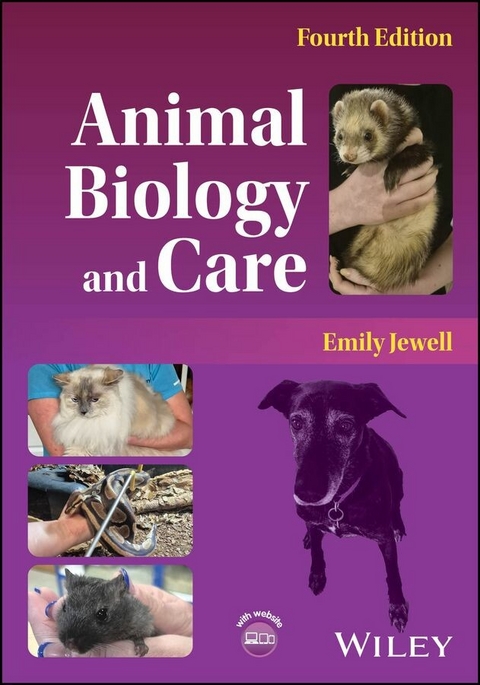
Animal Biology and Care (eBook)
857 Seiten
Wiley (Verlag)
978-1-394-27719-3 (ISBN)
The essential companion for animal care and animal management students
The Fourth Edition of Animal Biology and Care introduces the biology and care of species that students learning to work with animals will commonly encounter. It has been written in line with course curricula including animal management, animal care and veterinary care assistant qualifications and is divided into logical sections including biology, health, and husbandry. Step-by-step guidance is provided for the common practical procedures carried out in various roles, whilst chapter summaries enable readers to remember key points and objectives. All sections are complemented by visual diagrams, flowcharts and new chapter glossaries to aid in reader comprehension. A companion website features interactive MCQs to help learners test their knowledge.
Revised and expanded, the new edition includes updates based on the increase in exotic pets, changes to animal welfare related guidance and legislation, the introduction of Technical (T-Level) Qualifications, and revisions to existing curricula. The author has also included a new chapter on the animal industry, with information on employability skills and potential vocational pathways, for readers to understand the further application of their studies as they embark on their careers in the animal industry.
Written by an experienced teacher and examiner, Animal Biology and Care includes information on:
- Cells and basic tissues, movement of materials in the body, body systems and functions, body areas, and basic genetics
- First aid, basic bandaging, quarantine and isolation, hospitalization, temperature, pulse, respiration, and administration of pharmaceutical drugs
- Animal welfare, disease transmission and control, microbiology, zoonotic diseases, canine and feline diseases, zoonotic diseases, and parasitology
- Animal husbandry, hygiene, nutrition, handling, grooming, and coat care
Animal Biology and Care is a foundational text for Level 2 and 3 qualifications in Animal Care and Management. It will also benefit veterinary nursing students seeking to develop their knowledge base.
Emily Jewell, BSc (Hons) MSc. Cert. Ed. is Progress and Personal Development manager at Reaseheath College, Cheshire, UK. She has over 20 years of experience in delivering animal management qualifications. She previously had responsibility for curriculum across many species and has taught on a wide range of subjects from Levels 1-6. She also works as a marking examiner for City and Guilds and was formerly an external verifier in animal management for the Pearson Edexcel education and examination awarding body.
The essential companion for animal care and animal management students The Fourth Edition of Animal Biology and Care introduces the biology and care of species that students learning to work with animals will commonly encounter. It has been written in line with course curricula including animal management, animal care and veterinary care assistant qualifications and is divided into logical sections including biology, health, and husbandry. Step-by-step guidance is provided for the common practical procedures carried out in various roles, whilst chapter summaries enable readers to remember key points and objectives. All sections are complemented by visual diagrams, flowcharts and new chapter glossaries to aid in reader comprehension. A companion website features interactive MCQs to help learners test their knowledge. Revised and expanded, the new edition includes updates based on the increase in exotic pets, changes to animal welfare related guidance and legislation, the introduction of Technical (T-Level) Qualifications, and revisions to existing curricula. The author has also included a new chapter on the animal industry, with information on employability skills and potential vocational pathways, for readers to understand the further application of their studies as they embark on their careers in the animal industry. Written by an experienced teacher and examiner, Animal Biology and Care includes information on: Cells and basic tissues, movement of materials in the body, body systems and functions, body areas, and basic geneticsFirst aid, basic bandaging, quarantine and isolation, hospitalization, temperature, pulse, respiration, and administration of pharmaceutical drugsAnimal welfare, disease transmission and control, microbiology, zoonotic diseases, canine and feline diseases, zoonotic diseases, and parasitologyAnimal husbandry, hygiene, nutrition, handling, grooming, and coat care Animal Biology and Care is a foundational text for Level 2 and 3 qualifications in Animal Care and Management. It will also benefit veterinary nursing students seeking to develop their knowledge base.
Chapter 1
Cells and Basic Tissues
Learning goals
In this chapter, the learning goals are:
- To identify the essential functions required to sustain life
- To identify the structure and function of animal cells and tissues
- To explain the diversity of animal cells and tissues in existence
- To explain how animal cells work in partnership to form systems
What Is Biology?
Biology is the study of life and living organisms
How do we define life?
To be considered a living organism, an organism must be able to perform all the following essential functions of life:
- Movement – The organism can move itself or a part of itself.
- Reproduction – The organism can reproduce itself so that the species doesn’t die out.
- Sensitivity – The organism can react to stimuli in its surroundings to avoid life-threatening events in its environment.
- Growth – The organism can sustain growth from within itself via processes that involve taking in new materials from the outside and incorporating them into its internal structure.
- Release of energy from respiration – The organism can use nutritional sources to release a usable form of energy in a controlled way to sustain life.
- Excretion – The organism can excrete waste metabolic products from itself.
- Nutrition – The organism can ingest nutritional materials that provide energy to maintain life and growth.
A cell is the simplest functional unit of all tissues. Each cell can individually perform all the essential life functions identified previously. Organisms may be single-celled or multi-celled. Within multicellular organisms, the component cells show a wide range of specialisations, thereby contributing to cell diversity within an organism.
Cells can therefore be deemed to be the building blocks of the body, and therefore, the following can be stated:
- Cells form …
- Tissues, and tissues form …
- Organs – organs work together to form systems within the body.
- Systems have a specific function to perform in living organisms using the diverse range of cell specialisations.
Cell Diversity
Animal cells are not all identical (Figure 1.1), but they all have the same basic structure because they are all derived from a type of cell called a Stem Cell. Stem cells have the potential to become any type of cell within the body, and once they become specialised, they are said to have differentiated. Cells become specialised so that they are more efficient in the role that they have within the body. Stem cells are not only found in the embryo but can also be found in a range of locations across the adult mammalian body, e.g. bone marrow, liver, heart, brain, muscles, and skin.
Figure 1.1 Basic cell structure.
Individual components of animal cells are called organelles, and each organelle is described in the following section:
- Cell/Plasma membrane – All animal cells are surrounded by a membrane which contains all the other organelles of the cell as without it, the cell contents would spill out. This membrane can be referred to as either the cell membrane or the plasma membrane.
Cell/plasma membranes are approximately 0.00001 mm (10 nm) in thickness. The cell/plasma membrane is the boundary keeping the cytoplasm of the cell contained.
The role of the cell/plasma membrane is to be a barrier that separates the external environment of the cell from the internal environment, along with controlling what enters/exits the cell (cell exchange). The cell/plasma membrane allows certain chemicals to pass in and out of the cell by the exchange processes of diffusion, osmosis, or active transport. The cell/plasma membrane is selectively permeable, i.e. it chooses what can/can’t come in/out of the cell according to the needs of the cell.
- Nucleus – There is usually one nucleus in the cell, which is located near the centre of the cell. Its role is to be the brain of the cell and control its activities. The nucleus is surrounded by a double membrane called the nuclear envelope. Inside the nucleus is an area called the nucleolus, which contains the genetic material [deoxyribonucleic acid (DNA) and ribonucleic acid (RNA)] of the cell, which is important for cell reproduction. Chromatin is found in the nucleus and condenses to form chromosomes. The nuclear envelope is interspersed with nuclear pores, which allow material in/out of the nucleus itself. It is important to note here that red blood cells do not contain a nucleus.
- Cytoplasm – A gel-like material that supports the organelles within the cell between the cell/plasma membrane and the nucleus. Cytoplasm is where chemical reactions occur within the cell for metabolic purposes. Cytoplasm also allows the organelles to move around and move molecules between them.
- Chromosomes – These are rod-shaped components that contain the hereditary information of an organism. This hereditary material is called DNA and it controls the characteristics that an organism inherits from its parents. Chromosomes exist as thin strands of DNA and are usually found in pairs. Chromosomes are subdivided into genes.
- Mitochondria – These are energy-producing organelles where cell respiration takes place. Energy is generated from nutritional sources such as carbohydrates, fats, and proteins to create a usable form of energy. Mitochondria are often called the powerhouses of the cell. Mitochondria are surrounded by a double membrane. The outer membrane is the surface of the mitochondrion. The inner membrane has many folds called cristae, which increase the surface area to maximise the energy produced by cell respiration. Due to the energy that they need to swim, sperm cells contain many mitochondria. This is an example of cell specialisation. It is important to note that a single mitochondria is called a mitochondrion.
- Endoplasmic reticulum (ER) – ER is a series of tubules acting as a transport and packaging system in the cell. ER may be rough ER or smooth ER. Rough ER has ribosomes attached to it where proteins are synthesised. This protein can be used by the cell to synthesise enzymes, hormones, antibodies, and muscle. Smooth ER has no ribosomes and is used to synthesise and transport lipids (fats) and steroids made within the body.
- Ribosomes – Ribosomes build proteins within the cell. These proteins then join to form amino acids which are essential for growth and repair in the body. Ribosomes are found in the cell’s cytoplasm. Ribosomes contain RNA.
- Centrosome – The centrosome is an area found near the nucleus in animal cells that helps with the ability of the cell to change its shape such as in cell division and during phagocytosis (cell eating). It is responsible for the organisation of microtubules in the cell. The centrosome is made up of two centrioles. Centrioles are important during cell division and the formation of the cilia and flagella of certain cells (the slender projecting hairs responsible for movement of single-celled organisms). Centrioles can only be seen during cell division; otherwise, the centrosome is seen.
- Lysosomes – Lysosomes are small vesicles (fluid-filled spheres) in cells that contain numerous types of enzymes responsible for splitting complex chemical compounds into simpler ones (known as lysis, meaning ‘to break up’) followed by digestion. They help to destroy worn-out organelles within the cell and recycle them for further use. Lysosomes are created by the Golgi apparatus, and the enzymes within them are produced in the endoplasmic reticulum.
- Golgi apparatus – The Golgi apparatus is a series of flattened sacs that extend from the endoplasmic reticulum throughout the cytoplasm of the cell. The sacs are where different chemical reactions occur. It is responsible for moving molecules from the ER to elsewhere in the cell. The Golgi apparatus is also involved in labelling some vesicles with proteins or carbohydrates complexes so that they are transported to the correct locations. The Golgi apparatus is also referred to as the Golgi body/Golgi complex.
- Peroxisomes – Peroxisomes are mainly involved in breaking down lipids and toxic molecules, such as hydrogen peroxide, made during digestion into safer molecules. Peroxisomes are similar to lysosomes but have a slightly different structure and contain different lysing enzymes.
- Cilia – Cilia are hair-like projections on a cell, which aid absorption or movement of fluids away from a cell. Cilia are only found in animal cells and are made up of microtubules. They are usually found in groups or as a border on cell surfaces.
- Flagella – Flagella are long whip-like structures that can be found as part of microbial and animal cell structures. They tend to be longer and less dense than cilia. Sperm cells have a flagellum for movement.
Most of the organelles listed are common to virtually all cells, but the shape, form, and contents of individual cells be differentiated according to its intended function, as previously explained. The structural characteristics of a particular cell are closely related to its functions...
| Erscheint lt. Verlag | 8.10.2025 |
|---|---|
| Sprache | englisch |
| Themenwelt | Veterinärmedizin |
| Schlagworte | animal bandaging • animal body systems • animal cells • Animal diseases • animal drugs • animal first aid • animal functions • Animal Genetics • animal hospitalization • animal husbandry • animal isolation • animal quarantine • animal tissues • Animal welfare |
| ISBN-10 | 1-394-27719-9 / 1394277199 |
| ISBN-13 | 978-1-394-27719-3 / 9781394277193 |
| Informationen gemäß Produktsicherheitsverordnung (GPSR) | |
| Haben Sie eine Frage zum Produkt? |
 EPUB (Adobe DRM)
Kopierschutz: Adobe-DRM
Adobe-DRM ist ein Kopierschutz, der das eBook vor Mißbrauch schützen soll. Dabei wird das eBook bereits beim Download auf Ihre persönliche Adobe-ID autorisiert. Lesen können Sie das eBook dann nur auf den Geräten, welche ebenfalls auf Ihre Adobe-ID registriert sind.
Details zum Adobe-DRM
Dateiformat: EPUB (Electronic Publication)
EPUB ist ein offener Standard für eBooks und eignet sich besonders zur Darstellung von Belletristik und Sachbüchern. Der Fließtext wird dynamisch an die Display- und Schriftgröße angepasst. Auch für mobile Lesegeräte ist EPUB daher gut geeignet.
Systemvoraussetzungen:
PC/Mac: Mit einem PC oder Mac können Sie dieses eBook lesen. Sie benötigen eine
eReader: Dieses eBook kann mit (fast) allen eBook-Readern gelesen werden. Mit dem amazon-Kindle ist es aber nicht kompatibel.
Smartphone/Tablet: Egal ob Apple oder Android, dieses eBook können Sie lesen. Sie benötigen eine
Geräteliste und zusätzliche Hinweise
Buying eBooks from abroad
For tax law reasons we can sell eBooks just within Germany and Switzerland. Regrettably we cannot fulfill eBook-orders from other countries.
aus dem Bereich