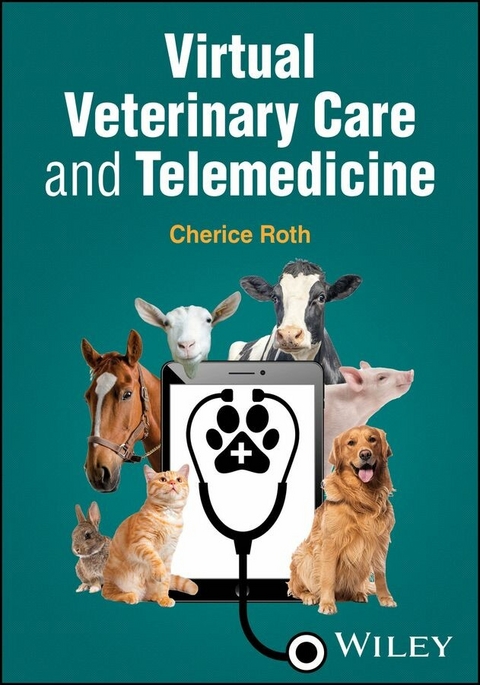
Virtual Veterinary Care and Telemedicine (eBook)
606 Seiten
Wiley (Verlag)
978-1-394-28020-9 (ISBN)
Practical guide to integrating telemedicine into veterinary practice, with information on medical standards, care delivery, business strategy, and team dynamics
Based on real industry experience in practice, leadership, and business, and featuring case studies throughout, Virtual Veterinary Care and Telemedicine offers practical tools and strategies for successfully implementing virtual care in veterinary practice, blending historical insights, medical standards, care delivery, business strategy, and team dynamics. The book covers triaging protocols, guidelines for antibiotic use, chronic medication refills, conducting digital and physical exams, optimizing technician appointments, medical record documentation, and maintaining medical quality standards in virtual environments.
This book also focuses on technology, identifying current features of virtual care software, assisting in tool selection for practices, and discussing future trends. It addresses the common challenge of integrating virtual care into hands-on practices and provides a 10-step implementation process and strategies for extending care beyond physical boundaries, ensuring regulatory compliance and continuous quality control.
The final section addresses a critical aspect often overlooked in veterinary practice: monetization. It emphasizes the importance of developing a business model and effective marketing strategies, ensuring growth and enhanced client experiences.
Virtual Veterinary Care and Telemedicine includes information on:
- Benefits of virtual care, including accessibility, cost-effectiveness, and improved patient care and outcomes
- Clinical decisions that must be documented and aligned before team training
- Methods for educating clients and navigating ethical considerations
- Long-term financial implications of integrating virtual care
- Challenges, misconceptions, common hurdles, and false perceptions surrounding virtual care
Virtual Veterinary Care and Telemedicine is a must-have resource for any veterinarian interested in improving care quality and increasing practice revenues using telemedicine.
The author
Cherice Roth, DVM, MS, is passionate about leveraging technological advancements to improve and increase access to care and is based in Oregon, USA.
Practical guide to integrating telemedicine into veterinary practice, with information on medical standards, care delivery, business strategy, and team dynamics Based on real industry experience in practice, leadership, and business, and featuring case studies throughout, Virtual Veterinary Care and Telemedicine offers practical tools and strategies for successfully implementing virtual care in veterinary practice, blending historical insights, medical standards, care delivery, business strategy, and team dynamics. The book covers triaging protocols, guidelines for antibiotic use, chronic medication refills, conducting digital and physical exams, optimizing technician appointments, medical record documentation, and maintaining medical quality standards in virtual environments. This book also focuses on technology, identifying current features of virtual care software, assisting in tool selection for practices, and discussing future trends. It addresses the common challenge of integrating virtual care into hands-on practices and provides a 10-step implementation process and strategies for extending care beyond physical boundaries, ensuring regulatory compliance and continuous quality control. The final section addresses a critical aspect often overlooked in veterinary practice: monetization. It emphasizes the importance of developing a business model and effective marketing strategies, ensuring growth and enhanced client experiences. Virtual Veterinary Care and Telemedicine includes information on: Benefits of virtual care, including accessibility, cost-effectiveness, and improved patient care and outcomes Clinical decisions that must be documented and aligned before team training Methods for educating clients and navigating ethical considerations Long-term financial implications of integrating virtual care Challenges, misconceptions, common hurdles, and false perceptions surrounding virtual care Virtual Veterinary Care and Telemedicine is a must-have resource for any veterinarian interested in improving care quality and increasing practice revenues using telemedicine.
CHAPTER 1
The Evolution of Veterinary Medicine: From Traditional to Virtual
LEARNING OBJECTIVE
History and transition toward virtual care.
BRIEF OVERVIEW OF THE HISTORY OF VETERINARY MEDICINE
Veterinary medicine has gone through many iterations. As early as 658 BC, traditional Chinese veterinary medicine was being used (Harrison and Churgin, 2022). In ancient Greece, there were classes of doctors called horse doctors, dating back to as early as 2000 BC (Bowen, 2018). From the distinct belief that animals that were sick benefited best from not having human interruption/interaction to the current belief that animals, particularly those that we have now segregated as “pets,” are ultimately reliant on humans and veterinary medicine in a preventative manner to thrive. Moreover, as an industry, we have rightfully ascribed regulatory and legislative protections to be sure that those we serve, both human and animal alike, are safe receiving veterinary services. From Jeremy Bentham coining the phrase, “The question is not, Can they reason? nor, Can they talk? but, Can they suffer?” in 1780 (Bentham, 1789), through the Animal Welfare Act of 1966 (Cardon, Bailey and Bennett, 2012), to Lizzie’s Law (Team, 2023), and many other being passed as the text is read, we have decided to point our attention toward decreasing unnecessary animal suffering. In fact, those professionals who enter the field as a doctor, much like human medical doctors, have to swear an oath first adopted by the AVMA in 1969 (American Veterinary Medical Association, n.d.), swearing to the fact that by:
“Being admitted to the profession of veterinary medicine, I solemnly swear to use my scientific knowledge and skills for the benefit of society through the protection of animal health and welfare, the prevention and relief of animal suffering, the conservation of animal resources, the promotion of public health, and the advancement of medical knowledge.
I will practice my profession conscientiously, with dignity, and in keeping with the principles of veterinary medical ethics. I accept as a lifelong obligation the continual improvement of my professional knowledge and competence.”
It is the lifelong obligation to the continual improvement of professional knowledge and competence that has likely drawn readers to this book in particular. As a profession of mostly “type A” rule followers, we strive for better ways to diagnose disease, offer treatments, and prevent animal suffering on a daily basis. We have turned to regulatory bodies such as state veterinary medical boards to help govern and protect the public we serve during this pursuit. As veterinarians, we rely on creating a relationship with the animal owners that has now been defined as the veterinary–client–patient relationship (VCPR) to come to an agreement for us to provide care, and the owners of the animal heeding our advice and following the subsequent instructions. Those who make up our regulatory bodies are, in the authors’ experience, historically practice owners, deeply entrenched in the way that things have always been done. There is little room in the historical protection of animal owners for care delivery innovation. As a rule, veterinarians are sworn by the above oath to innovate in the direction of what is best for the relief of their patients’ suffering. The difficulty, however, is that we also rely on those regulatory bodies to keep up with progress and inform the veterinary professionals as to what our responsibilities are in the creation and maintenance of the veterinary–client–patient relationship and most policies on average are not re-evaluated quickly enough … at least not at the speed at which technology develops. What we have been left with is a major ambiguity around veterinary–client–patient relationships, particularly in the United States, as it varies from state to state. Some state regulatory bodies, as of this publication, do not mention how VCPR should be created at all (www.op.nysed.gov, n.d.). Some clearly state that it should not be created solely electronically (Texas.gov, 2001). In between, there are states that require the animal to be “seen” or that the veterinarian be “acquainted” with the animal (Nmlegis.gov, 2024). Other state practice acts state that there has to be a “physical exam,” although there is no legal or regulatory definition of physical exams that currently includes proximity (Justia Law, n.d.). As disruption of any established field goes, many explored both sides of the regulatory and legislative landscape. Some companies refused to take advantage of the ambiguity and chose. The ambiguity in VCPR creation opened the door for early veterinary telemedicine start-ups such as Fuzzy Pet Health, Dutch Pet, and Vetster to give pet families a taste of what it was like to have unlimited access to basic veterinary care on their schedule. The pet families served love the services and told their friends, which has made the expansion of true veterinary telemedicine a reality. There are both incredible pros and cons to delivering veterinary care virtually VVCA, 2024 (Veterinary Virtual Care Association). There are many reliable methods of developing VCPR. If, as an industry, we could set regulations and statutes that would allow for the widening of access to care simply by making the requirements clearer (Neal and Greenberg, 2024). Despite the clear evidence that our clients want to connect with veterinary knowledge remotely, their veterinary care teams still do not seem to understand that clients will go elsewhere if the knowledge we can provide is not easily accessible—even if that means going to a source of information that is not as reliable (Hart et al., 2017).
HISTORY OF TELEMEDICINE
Virtual care and telemedicine are certainly not new. Dating back to the 1970s, NASA used mobile health units for rural communities, specifically those in the Papago Nation—now called Tohono O’odham Nation—with a program called Space Technology Applied to Rural Papago Advanced Health Care, or STARPAHC, using satellite communications with medical professionals (spinoff.nasa.gov, 1996). They also routinely used remote diagnostics for vital signs and the overall health of astronauts, as well as animals, who were sent into space (Simpson, Doarn, and Garber, 2020). In the 1980s, the AMC in New York actually launched very early using telemedicine, utilizing satellite communication for remote consultations with specialists (Mars and Auer, 2006). They also revolutionized digital radiography telepathically in the 1980s, utilizing the technology that was available during that time. In the 1990s, we started to see Internet adoption. More people gained email addresses and started having online portals to share medical records as well as images (Abu-Seida, 2024). We also started to see remote interpretations of radiographs by specialists who were not necessarily housed in the same location as the images were being taken. The 1990s were also the time of teleconferencing technology, giving very early use of real-time video and audio for remote consultations. This is also the same decade we started seeing electronic medical record systems emerging in veterinary medicine. All of these aspects were also being utilized to support rural practices’ access to specialists by being able to send images and messages (VBA, 2024). The 2000s brought access to broadband Internet, decreasing the use of the very slow, often unreliable dial-up Internet. We also started to see launches of early telemedicine platforms, such as pet raises for radiography (Mars and Auer, 2006). This was also the decade when individuals started carrying around their own technology in their pockets, so the use of PDAs and early smartphones with remote access to the Internet started to emerge, making the technology easier to access from one veterinary professional to another. We also started to see increases in cloud-based solutions. This is the digital storage of records, images, and files for the ability to share them from one location to another instantly. This has revolutionized doctors’ ability to see their patients’ medical records, not only in humans but also in veterinary medicine. This was also a time that we started to see things like teledermatology and telecardiology move into the forefront with veterinary medicine. Online courses and webinars, because of the availability of broadband Internet, were also made available during the 2000s.
The 2010s gave rise to smartphones and applications such as Vetster or TeleVet to allow pet families to have consultations from wherever they were or wherever their device was (Summitanimalhospitalil.com, 2024). We also started to see the first generations of wearable technology for animals, such as Fit Bark, which allowed us to start to have an idea of what remote monitoring of health metrics meant for companion animals. There was also a movement to start cloud integration, particularly with telemedicine platforms and practice management software in veterinary medicine. Artificial intelligence tools for image analysis and chatbots for veterinary-based discussions also started to emerge at this time (Abu-Seida, Abdulkarim, and Hassan, 2024). Because of all of the adoption, we also started to see organizations such as the American Veterinary Medical Association, as well as state veterinary medical examining boards, began to pay attention and create guidelines specifically around telemedicine and veterinary–client–patient requirements. This was also a time when we started to see an overall normalization...
| Erscheint lt. Verlag | 12.9.2025 |
|---|---|
| Sprache | englisch |
| Themenwelt | Veterinärmedizin |
| Schlagworte | Veterinary telemedicine appointments • Veterinary telemedicine business strategy • Veterinary telemedicine care • Veterinary telemedicine exams • Veterinary telemedicine standards • Veterinary telemedicine triaging |
| ISBN-10 | 1-394-28020-3 / 1394280203 |
| ISBN-13 | 978-1-394-28020-9 / 9781394280209 |
| Informationen gemäß Produktsicherheitsverordnung (GPSR) | |
| Haben Sie eine Frage zum Produkt? |
 EPUB (Adobe DRM)
Kopierschutz: Adobe-DRM
Adobe-DRM ist ein Kopierschutz, der das eBook vor Mißbrauch schützen soll. Dabei wird das eBook bereits beim Download auf Ihre persönliche Adobe-ID autorisiert. Lesen können Sie das eBook dann nur auf den Geräten, welche ebenfalls auf Ihre Adobe-ID registriert sind.
Details zum Adobe-DRM
Dateiformat: EPUB (Electronic Publication)
EPUB ist ein offener Standard für eBooks und eignet sich besonders zur Darstellung von Belletristik und Sachbüchern. Der Fließtext wird dynamisch an die Display- und Schriftgröße angepasst. Auch für mobile Lesegeräte ist EPUB daher gut geeignet.
Systemvoraussetzungen:
PC/Mac: Mit einem PC oder Mac können Sie dieses eBook lesen. Sie benötigen eine
eReader: Dieses eBook kann mit (fast) allen eBook-Readern gelesen werden. Mit dem amazon-Kindle ist es aber nicht kompatibel.
Smartphone/Tablet: Egal ob Apple oder Android, dieses eBook können Sie lesen. Sie benötigen eine
Geräteliste und zusätzliche Hinweise
Buying eBooks from abroad
For tax law reasons we can sell eBooks just within Germany and Switzerland. Regrettably we cannot fulfill eBook-orders from other countries.
Immer aktuell - unsere Fachbuch-Highlights der Veterinärmedizin im Deutschen Tierärzteblatt!
aus dem Bereich