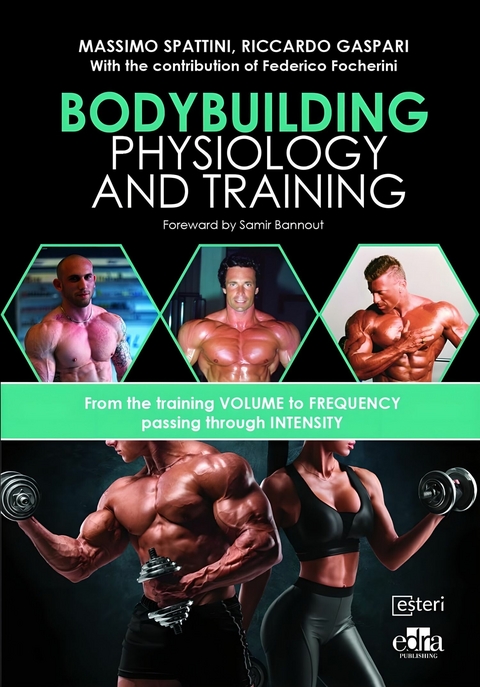
Bodybuilding Physiology and Training (eBook)
350 Seiten
EDRA Publications LLC (Verlag)
978-1-957260-60-0 (ISBN)

This volume clarifies the importance of training techniques and methods for those looking for a notable hypertrophic response within a body recomposition process. Too often, the world of bodybuilding and fitness is the victim of myths or false beliefs; in recent years, in the seductive perspective of proposing fast results with little effort, unfortunately, there has been a real demonization of the volume of training in favor of techniques that require very little. While it is true that the intensity of training is a fundamental variable and that normally must be inversely proportional to the volume, there is however a meeting point which, in our opinion, in order to optimize the results, should not penalize the volume. This book reports the results of the most accredited research and the best scientific studies carried out on the volume and intensity of training, all enriched by personal experiences and training plans, to understand the fundamental aspects and the great importance that both the volume and intensity of training, and understand how to use them and, above all, how to derive maximum benefits.
CHAPTER 1
The muscular system
The muscle is a contractile organ that performs a motor function in animals. It consists of muscular tissue capable of contracting, determining the intrinsic movement of some organs or the movement of limbs, and, in general, locomotion. This property is due to the structures of the muscle tissue, both morphological and chemical. There are three types of muscle tissue (smooth, striated, cardiac) (Fig. 1.1), all of which have, to some extent, elongated, contractile and elastic cells, called muscle fibers.
Smooth muscle tissue is present in involuntary muscles, and striated tissue in voluntary muscles; cardiac muscle tissue is an exception, as it is striated and involuntary.
Figure 1.1 Types of muscle tissue.
Striated muscle is made up of a long series of fibers. Each of these is made up of other thinner filaments, called myofibrils, which are composed of two proteins, actin and myosin. At the ends of the muscle bundle, there are tendons, which connect the muscle to the bones.
When we decide to make a movement, we send an electrical impulse to the muscle through the nervous system. This impulse comes from the brain and causes the actin and myosin filaments to slide. In this way, the filaments shorten, causing the contraction of the entire muscle bundle that moves the bones.
The muscle exerts effort, thus requiring energy expenditure. This energy is supplied by a phosphorus compound, called adenosine triphosphate (ATP), produced by a cellular organelle called the mitochondria starting from the sugars that reach the muscle through the blood. The mitochondrion can produce ATP in two different ways: in the first case it uses oxygen, which is aerobic work; in the second case it resorts to lactic acid, thus resulting in an anaerobic workout. There are more than 600 muscles and they make up about 40% of our body weight (Fig. 1.2); from the large muscles of the shoulders and legs to the small muscles located in the eye sockets that move the eye, each one contributes to the body’s extraordinary range of motion and have the ability to contract and release successively.
Figure 1.2 The major muscles of the body.
Muscles are connected to the bones through robust formations of fibrous tissue, called tendons, which shorten when the muscle contracts, resulting in the convergence of the two bones on which they are inserted and, consequently, movement.
Muscles can be subdivided into deep muscles when they are connected/attached only to bones, and superficial muscles, when one of the attachment points is the skin. The latter are the muscles of the face, or mimics, as their contraction changes the construct of the skin of the face, producing facial expressions.
Skeletal muscles are voluntary muscles, which means that they contract on our command, although they can also contract following an involuntary reflex stimulus.
On the other hand, smooth muscles are involuntary and found in visceral structures. Without our intervention, they allow automatic motility of the organs, that is, the one that regulates the progression of food in the digestive tract or that controls changes in the size of the arterial vessels for the regulation of blood circulation. These are muscles that contract less quickly than skeletal ones, but in which the state of contraction can last longer.
The third type of muscle tissue is found exclusively in the heart and constitutes the myocardium. It combines the characteristics of striated and smooth muscles, and is therefore capable of rapid and repeated, but involuntary contraction.
Trauma
Excess lactic acid in the muscle can cause a contracture. In this case, one or more muscle fibers remain blocked and hardened to the touch. Although it often causes acute pain, a contracture has limited duration. Rest and massages are required to increase blood flow.
Muscle fibers can also tear. In this case, depending on the extent of the damage, stretching or a tear may occur. Cold compresses, immobilization, and rest are required for thorough healing.
In certain cases, serious injuries, such as tearing of muscle and supporting connective tissue, may occur, thus requiring immediate medical attention and possible surgery.
Muscle fibers
With the due limitations dictated by generalization, there are two basic types of muscle fibers (or cells) of the skeleton: slow-twitch fibers (type I, toned, red) and fast-twitch fibers (type II, phasic, white). The identification of these two types of muscle fibers was made possible by a laboratory technique called muscle biopsy. During a muscle biopsy, a sample of muscle tissue is taken using a needle inserted into the muscle. The fragment of tissue taken is placed on a slide and colored, to then be observed under a microscope.
Each type of fiber has its own characteristics. Type I fibers contract more slowly than type II fibers, they have many mitochondria and have a high aerobic capacity, so they are resistant to fatigue; moreover, type I fibers have a smaller cross-section than type II fibers. Type II fibers are divided into two subgroups: type IIa and type IIx.Type IIa fibers are called “oxidant fast-twitch”, because they have a greater quantity of mitochondria; type IIx fibers are called “fast-twitch glycolytic”. However, type IIa fibers do not have the same aerobic capacity as slow-twitch fibers.
Regarding the distribution of the two types of fibers, the following two considerations apply. The first is that in each individual the distribution of slow and fast fibers is different in different muscles; for example, the relationship between the two types of fibers is different between the biceps and quadriceps, as well as between the deltoids and triceps. The second consideration is that in the same muscle of different individuals it is very likely that there is a different percentage of the two types of fibers; one person may have a high percentage of type II fiber in the quadriceps, while another may have a low one. As an indication, strength athletes such as weightlifters have 60-90% fast-twitch fibers in the muscles that are used mostly for their sport.
On the other hand, endurance athletes such as long-distance runners probably have 60-90% slow-twitch muscle fibers in their most stressed muscles.
Coaches should know that training can modify the metabolic structure of the fibers. With training, type IIa (intermediate) fibers gradually take on the characteristics of IIx (fast) fibers or type I (slow) fibers. It should be noted that in trained people type IIx fibers are larger than type IIa fibers: the transformation of IIa into IIx, with training, contributes to the increase in the volume of the trained muscle, called muscle hypertrophy (increase in the size of cells but not in their number).
The characteristics of the types of fibers and their response to training are very complex, and to highlight them it is necessary to consult specific treatises. It is important to underline that, in an individual, the composition of muscle cells is genetically determined; with training, it is possible to partially change the percentage of fiber by changing one type of fiber into another. However, without a doubt, the starting percentage does affect performance and coaches must design individual training programs and understand the reasons why different people respond differently to the same training program. There are no major differences between males and females regarding the distribution of the different types of muscle fibers, but from various studies, it seems that men have a slightly lower percentage of type I fibers than women, while type IIa fibers are higher in men than in women. Apart from this, male muscles are physiologically identical to female ones.
Skeletal muscles
Although type II fibers contract faster than type I, both slow-twitch and fast-twitch types always contract via the same mechanism. Muscles are made up of many single muscle fibers. By observing a muscle fiber under a microscope, it can be seen that it is made up of numerous repetitive elements, called sarcomeres. In addition, chains of proteins called myofibrils are found throughout the muscle fiber. In a myofibril, there are numerous proteins, but the only ones that are important in the contraction process of a muscle are the aforementioned actin and myosin, also known as contractile proteins.
Muscle contraction
In order for a muscle to contract, there must be a sufficient amount of ATP in the vicinity of the actin and myosin proteins, and a command must be given by the central nervous system (CNS). When these two factors are present, the thin ends (heads) of the myosin attach themselves to the actin, forming an actin-myosin cross-bridge, a process explained in the “flowing filament theory”.
The energy of the ATP causes the ends of the myosin to rotate towards the center of the sarcomere, dragging the actin filament attached to them, so that the actin slides inwards, towards the center of the sarcomere.
This process causes each sarcomere to shorten along the entire muscle; since all sarcomeres shorten at the same moment, there is a reduction in the length of the entire muscle fiber. When many fibers...
| Erscheint lt. Verlag | 1.8.2023 |
|---|---|
| Sprache | englisch |
| Themenwelt | Veterinärmedizin |
| ISBN-10 | 1-957260-60-2 / 1957260602 |
| ISBN-13 | 978-1-957260-60-0 / 9781957260600 |
| Informationen gemäß Produktsicherheitsverordnung (GPSR) | |
| Haben Sie eine Frage zum Produkt? |
 EPUB (Ohne DRM)
Digital Rights Management: ohne DRM
Dieses eBook enthält kein DRM oder Kopierschutz. Eine Weitergabe an Dritte ist jedoch rechtlich nicht zulässig, weil Sie beim Kauf nur die Rechte an der persönlichen Nutzung erwerben.
Dateiformat: EPUB (Electronic Publication)
EPUB ist ein offener Standard für eBooks und eignet sich besonders zur Darstellung von Belletristik und Sachbüchern. Der Fließtext wird dynamisch an die Display- und Schriftgröße angepasst. Auch für mobile Lesegeräte ist EPUB daher gut geeignet.
Systemvoraussetzungen:
PC/Mac: Mit einem PC oder Mac können Sie dieses eBook lesen. Sie benötigen dafür die kostenlose Software Adobe Digital Editions.
eReader: Dieses eBook kann mit (fast) allen eBook-Readern gelesen werden. Mit dem amazon-Kindle ist es aber nicht kompatibel.
Smartphone/Tablet: Egal ob Apple oder Android, dieses eBook können Sie lesen. Sie benötigen dafür eine kostenlose App.
Geräteliste und zusätzliche Hinweise
Buying eBooks from abroad
For tax law reasons we can sell eBooks just within Germany and Switzerland. Regrettably we cannot fulfill eBook-orders from other countries.
aus dem Bereich