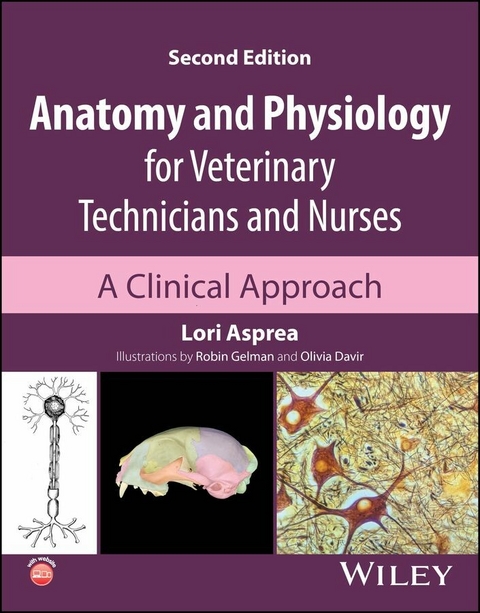
Anatomy and Physiology for Veterinary Technicians and Nurses (eBook)
724 Seiten
Wiley (Verlag)
978-1-394-22921-5 (ISBN)
Updated anatomy guide for veterinary practitioners and students with case studies, detailed dissection images, and review questions
The Second Edition of Anatomy and Physiology for Veterinary Technicians and Nurses is a comprehensive guide to veterinary anatomy and physiology applicable to clinical practice, with case studies, detailed dissection images, review question, and supporting drawings, tables, and diagrams often overlooked in many comparable lab manuals available.
This new edition consists of twenty-six chapters. It has been reorganized to provide a better flow of chapters and includes new chapters on special senses and sensory physiology as well as extended coverage of feline species. The book has also been updated with relevant diseases in each physiology chapter, more detailed and frequent images, more added online images, and additional study materials for students.
In Anatomy and Physiology for Veterinary Technicians and Nurses, readers will find:
- Matching materials for the physiologic functions of the systems dissected, labeled, and observed to combine both didactic and psychomotor learning concepts
- Information on skeletal, joint, cardiovascular, respiratory, and muscle anatomy as well as the anatomy of the nervous, endocrine, digestive, reproductive, and urinary systems
- Discussion on cells and immunity, functions of common integument, osteology, physiology of joints and muscles, neurophysiology, and renal physiology
- Details pertaining to both mammal and non-mammal species such as avians
- New, detailed case studies and critical thinking questions
The updated edition of Anatomy and Physiology for Veterinary Technicians and Nurses is an essential reference for veterinary technicians and nursing students seeking clear guidance on the subject.
Lori Asprea, MS, LVT, Assistant Professor, Clinical Coordinator of Veterinary Technology, Long Island University, USA.
1
Directional and Anatomical Terms
Clinical Case: Georgia, a 5‐Year‐Old Female Spayed Domestic Short Hair
A veterinary technician is assisting a doctor with an appointment. While handling the patient, the technician notices a lump on the patient’s hind leg, as shown in Figure 1.1. While reading this chapter, think about the appropriate terminology that should be noted in the patient record for an accurate description of the mass.
Figure 1.1 Our clinical case with the area of concern noted in red on the hind limb.
Introduction
The study of anatomy is, put simply, the study of the structure of organisms. It involves looking at architecture, at the different positions, shapes, and sizes of various living tissues. As one might imagine, the anatomy of different species has some things in common and some things that are quite diverse. The structure of the heart is very similar in dogs and cats; it is quite different in equines and reptiles. The kidneys of the dolphin look very different from those of the dog, although they function in the same way. By understanding the differences in anatomy among animals, we can have a greater appreciation for how their body systems function. This understanding is the basis of recognizing states of health and disease.
There are a number of different ways to organize how one looks at anatomy. Gross anatomy refers to features that can be seen with the naked eye. Developmental anatomy is the study of how anatomy changes as the fetus becomes a puppy or a kitten. Topographic anatomy refers to the relation to the parts of the whole (e.g., how the different parts of the kidneys and the connecting conduits make up the urinary system). Regional anatomy refers to the structures of a given area of the body; if one looks at the head, for example, as one unit, it will involve the study of all the muscles, blood vessels, bones, and other tissues that are present. Imaging anatomy refers to the anatomical features as they are seen on a good radiograph. Applied anatomy refers to the anatomy that is most important surgically or for medical treatment. In planning orthopedic surgery, for instance, it is necessary to know not only the structure of the bones but also the local muscles and blood vessels. Most of us use a systems approach when learning anatomy. For example, we study all the bones in the skeletal system, all the muscles in the muscular system, or all the organs in the urinary system.
One of the most important issues in studying anatomy is the understanding of directional terms. If one is asked to find a particular spot on an animal, describing it as “on the leg” is not precise enough. Describing a location using appropriate directional terms makes this much clearer. While the acquisition of vocabulary can be tedious, it is integral to effectively communicate with our clients, veterinarians, and other members of the patient‐care team as well as keep accurate medical records. In other words, good anatomic vocabulary contributes to excellent patient care.
Directional Terms
Directional terms in veterinary medicine are very different from those used in human medicine. The human head is “up” from the hips, while it is “forward” in the dog. This is another reason why it is important to use the proper terms. It is also important to understand that many of these terms are used while referring to, or in relation to, anatomical landmarks to make the description clear. This is the same as when one is giving directions for travel. We don’t say, “The store is far away on Main Street.” We say, “The store is on Main Street, in between avenue A and avenue B, across from the diner.” This tells us exactly where the store is using landmarks around it; in the same way, we use anatomical directional terms to be specific about which body part we are discussing.
Anatomical terminology has many unique terms, prefixes, and suffixes which are derived from Latin and Ancient Greek. As such, these terms for direction can correlate to the terms for the location on the body. Going toward the head is cranial or moving cranially, referring to the cranium or skull. Going in the opposite direction, toward the tail, is caudal or moving caudally, from the Latin word “caud” meaning tail. Going toward the top of the animal that faces the ceiling is moving in a dorsal direction, referring to moving toward the dorsum or “back/spine.” From the top downward is moving in a ventral direction referring to the ventrum or ground‐facing side of the animal from the Latin term for “belly.” Moving toward the center or midline of the animal or a specific limb is considered medial, while moving from the midline toward the side of the animal is lateral.
On the appendages, such as the limbs and tail, or even pinna (ear flaps), we use some special terms. Closer to the body on the appendage is proximal, while moving away from the body on the appendage is moving in a distal direction (Figure 1.2). For example, the elbow is proximal (nearer to the body) than the carpus (wrist). Alternately, you could say the carpus is distal (further from the body) to the elbow. When using these terms to describe a lesion, mass, or injury, we could say, “There is an approximately 6 cm wound immediately distal to the lateral elbow on the right forelimb” (Figure 1.3). This tells us the size of the wound, that it is just below (or farther away from) the elbow on the lateral (outer facing) side of the animal on the right leg. Being described in such a way leaves no room for error when communicating with anyone on the patient care team or in written records.
There are other specialized terms used for direction on the limbs and head. Previously, we discussed that the term cranial was moving toward the head, but once we reach the head, a different term is used: rostral. Rostral is used in the place of cranial only on the head and means toward the nose, derived from Middle English and Old French to mean the “bony beak.” The term rostral remains paired with caudal as its opposite on the head. As an example, one could say “The nose is rostral to the eyes” or “The ears are caudal to the nose” (Figure 1.3).
Additional Terminology
Features of the limbs also get special names. The front legs are referred to as the thoracic limbs, while the rear legs as the pelvic limbs. The shoulder and elbow in dogs are, in medical terms, the scapulohumeral and humeroradioulnar joints, respectively, although they are commonly referred to as shoulder and elbow in discussions with clients and others on the patient care team. The next joint distal to the elbow is the carpus, which is the equivalent of the human wrist. On the pelvic limb, the joint between the femur and tibia is the femorotibial joint, commonly known as the stifle, which is equivalent to the human knee. The next joint going distally is the tarsus. The common name for the tarsus is the hock, a term generally reserved for large animals, all of which is equivalent to the human ankle.
Figure 1.2 Directional terms as they pertain to the feline/canine skeleton. Also noted are some of the major joints.
Figure 1.3 A laceration is noted on this patient, described as “an approximately 6 cm wound immediately distal to the lateral elbow on the right forelimb.” Note the importance of directional and location terms.
Figure 1.4 The different sections of the thoracic and pelvic limbs with the plantar and palmar surfaces noted.
The part of the thoracic limb from the shoulder to the elbow is referred to as the brachium; the area from the elbow to the carpus is referred to as the antebrachium. The area from the head of the femur (the proximal‐most bone of the pelvic limb) to the stifle is called the femoral area. The area from the stifle to the tarsus is technically called the crus, although this term is not commonly used in a clinical setting; the distal pelvic limb is less precise but often used in general practice (Figure 1.4).
When considering the trunk, we have used terms like caudal, dorsal, and ventral. These terms also apply to the limbs. The front of the leg from the shoulder going distally to the paw is the dorsal section, with the back of that same area as the caudal section. On the thoracic limb, the area from the carpus distally, on the caudal surface, and around to and including the ventral surface of the paw that meets the ground is known as the palmar surface. On the pelvic limb, the analogous area from the tarsus to the bottom of the paw is the plantar surface (Figure 1.4).
There are specific names for other parts of the body. The part of the body that includes the chest and abdomen is referred to as the trunk. As discussed earlier, the proper name for the ventral part of the abdomen is the ventrum, while the proper name for the top of the trunk is the dorsum. The lateral surface of the part of the trunk caudal to the chest is the flank.
The part of the trunk from the neck to the caudal ribs is referred to as...
| Erscheint lt. Verlag | 28.7.2025 |
|---|---|
| Sprache | englisch |
| Themenwelt | Veterinärmedizin |
| Schlagworte | Olivia Davir • Robin Gelman • Veterinary anatomy • veterinary cardiovascular • veterinary digestive • veterinary endocrine • veterinary joint • veterinary nervous • veterinary reproductive • veterinary respiratory • veterinary skeletal • veterinary urinary |
| ISBN-10 | 1-394-22921-6 / 1394229216 |
| ISBN-13 | 978-1-394-22921-5 / 9781394229215 |
| Informationen gemäß Produktsicherheitsverordnung (GPSR) | |
| Haben Sie eine Frage zum Produkt? |
 EPUB (Adobe DRM)
Kopierschutz: Adobe-DRM
Adobe-DRM ist ein Kopierschutz, der das eBook vor Mißbrauch schützen soll. Dabei wird das eBook bereits beim Download auf Ihre persönliche Adobe-ID autorisiert. Lesen können Sie das eBook dann nur auf den Geräten, welche ebenfalls auf Ihre Adobe-ID registriert sind.
Details zum Adobe-DRM
Dateiformat: EPUB (Electronic Publication)
EPUB ist ein offener Standard für eBooks und eignet sich besonders zur Darstellung von Belletristik und Sachbüchern. Der Fließtext wird dynamisch an die Display- und Schriftgröße angepasst. Auch für mobile Lesegeräte ist EPUB daher gut geeignet.
Systemvoraussetzungen:
PC/Mac: Mit einem PC oder Mac können Sie dieses eBook lesen. Sie benötigen eine
eReader: Dieses eBook kann mit (fast) allen eBook-Readern gelesen werden. Mit dem amazon-Kindle ist es aber nicht kompatibel.
Smartphone/Tablet: Egal ob Apple oder Android, dieses eBook können Sie lesen. Sie benötigen eine
Geräteliste und zusätzliche Hinweise
Buying eBooks from abroad
For tax law reasons we can sell eBooks just within Germany and Switzerland. Regrettably we cannot fulfill eBook-orders from other countries.
aus dem Bereich