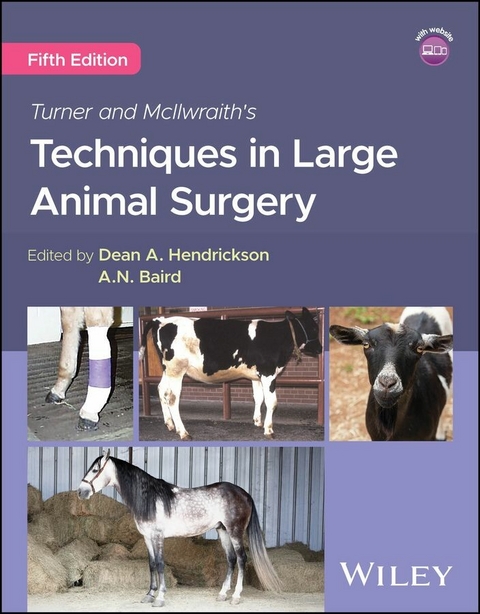
Turner and McIlwraith's Techniques in Large Animal Surgery (eBook)
998 Seiten
Wiley (Verlag)
978-1-394-26195-6 (ISBN)
An indispensable resource for students and practitioners in large animal surgery, updated with new practices and techniques
Turner and McIlwraith's Techniques in Large Animal Surgery provides the critical knowledge needed to confidently approach even the most challenging surgical cases. Authored by highly experienced practitioners, this comprehensive resource offers step-by-step guidance on both routine procedures and complex surgical interventions for cattle, horses, swine, goats, llamas, and camelids. Concise chapters are organized in an efficient table-based format, allowing for rapid reference in both exam preparation and real-world clinical scenarios.
The fifth edition of this classic textbook continues to set the standard for clear and reliable guidance on large animal surgery, equipping readers with the most current knowledge in clinical veterinary practice. Carefully reviewed references and enhanced visuals are accompanied by critical updates on equine orthopedic surgery, veterinary anesthesia, dental surgery, upper respiratory surgery, and more.
Addressing everything from basic pre-surgical care to specialized reconstructive procedures, Turner and McIlwraith's Techniques in Large Animal Surgery:
- Describes the surgical conditions and techniques commonly encountered in large animal practice
- Covers general aspects of surgery including preoperative evaluation, suturing materials and patterns, and postoperative infection
- Contains a wealth of high-quality illustrations that clarify each step in complex surgical procedures
- Features interactive multiple-choice questions for self-assessment and reinforcing key concepts
- Includes downloadable images in PowerPoint format, enabling instructors and practitioners to quickly create customized presentations
Turner and McIlwraith's Techniques in Large Animal Surgery, Fifth Edition is a must-have for veterinary students taking introductory surgery courses such as Principles of Surgery, Clinical Sciences, and Livestock Medicine, as well as for veterinary practitioners in equine and livestock surgery looking for an up-to-date reference.
Dean A. Hendrickson, DVM, MS, DACVS, ACVS, is Founding Fellow, Minimally Invasive Surgery (Large Animal Soft Tissue) and Professor of Surgery at Colorado State University's College of Veterinary Medicine.
A.N. Baird, DVM, MS, DACVS, is Chief of Staff of the Large Animal Hospital, Section Chief of Large Animal Surgery, and Associate Professor of Large Animal Surgery at Purdue University College of Veterinary Medicine.
An indispensable resource for students and practitioners in large animal surgery, updated with new practices and techniques Turner and McIlwraith s Techniques in Large Animal Surgery provides the critical knowledge needed to confidently approach even the most challenging surgical cases. Authored by highly experienced practitioners, this comprehensive resource offers step-by-step guidance on both routine procedures and complex surgical interventions for cattle, horses, swine, goats, llamas, and camelids. Concise chapters are organized in an efficient table-based format, allowing for rapid reference in both exam preparation and real-world clinical scenarios. The fifth edition of this classic textbook continues to set the standard for clear and reliable guidance on large animal surgery, equipping readers with the most current knowledge in clinical veterinary practice. Carefully reviewed references and enhanced visuals are accompanied by critical updates on equine orthopedic surgery, veterinary anesthesia, dental surgery, upper respiratory surgery, and more. Addressing everything from basic pre-surgical care to specialized reconstructive procedures, Turner and McIlwraith s Techniques in Large Animal Surgery: Describes the surgical conditions and techniques commonly encountered in large animal practiceCovers general aspects of surgery including preoperative evaluation, suturing materials and patterns, and postoperative infectionContains a wealth of high-quality illustrations that clarify each step in complex surgical proceduresFeatures interactive multiple-choice questions for self-assessment and reinforcing key conceptsIncludes downloadable images in PowerPoint format, enabling instructors and practitioners to quickly create customized presentations Turner and McIlwraith s Techniques in Large Animal Surgery, Fifth Edition is a must-have for veterinary students taking introductory surgery courses such as Principles of Surgery, Clinical Sciences, and Livestock Medicine, as well as for veterinary practitioners in equine and livestock surgery looking for an up-to-date reference.
1
Presurgical Considerations
Dean A. Hendrickson, DVM, MS, DACVS
OBJECTIVES
- Discuss some of the presurgical considerations that can affect the success of a procedure, including the physiological state and condition of the patient; the predisposing factors for infection; and the limitations of the surgeon, facilities, and equipment.
- Describe the methods of asepsis and antisepsis.
- Describe the classification of different procedures with regard to risk of infection and degree of contamination.
- Discuss the judicious use of antibiotics and their applications in prophylaxis and postoperative infection.
- Describe proper techniques for surgical site preparation.
Preoperative Evaluation of the Patient
Before a surgical procedure, a physical examination is generally indicated. This applies to both emergency and elective surgeries. The following are laboratory tests that are generally indicated for horses based on animal age and systemic status at our clinic:
- For horses younger than 4 years old and healthy:
- Packed cell volume
- Total protein
- Appropriate for horses > 4 years old or those that are systemically ill:
- Complete blood count
- Chemistry
Exactly where to draw the line on laboratory tests is largely a matter of judgment on the part of the surgeon. Obviously, if the surgery consists of castration of several litters of piglets, then for purely economic reasons laboratory tests prior to surgery may not be performed. In many cases, however, additional tests will be necessary. The following are examples of other optional tests and their indications:
- Electrolyte measurement for right‐sided abomasal diseases of the dairy cow
- Urinalysis in the dairy cow to evaluate the presence of ketosis
- Measurement of and creatinine if urinary problems are suspected
- Analysis of peritoneal fluid prior to laparotomy for horses with colic
- Full chemistry panels when there are age or systemic considerations
If any laboratory parameters are abnormal, the underlying causes should be investigated and efforts made to correct them. In “elective” surgery, this is possible, but it may not be possible in an emergency. The owner should be made aware of any problems prior to subjecting the animal to surgery. Risks are always present in normal elective surgery, and these should be explained to the owner. It is always better to have an early, frank discussion with the owner about the possible risks associated with the surgery than to have the discussion after the risk has been realized.
Fluid replacement should be performed if necessary. In the elective case, the surgical procedure should be postponed if the animal’s physical condition or laboratory parameters are abnormal. In some animals, internal and external parasitism may have to be rectified to achieve this goal.
Medical records should be kept at all times. Obviously, this can be difficult in such cases as castration of several litters of piglets. However, record keeping should become an essential part of the procedure for horses and cattle in a hospital, and herd records should be kept in all other situations. Finally, if the animal is insured, the insurance company must be notified of any surgical procedure; otherwise, the policy may be void.
Surgical Judgment
Surgical judgment cannot be learned overnight by reading a surgery textbook, nor is it necessarily attained by years of experience. The surgeon who continually makes the same mistake will probably never possess good surgical judgment. Not only should the surgeon learn from his own mistakes, but he also should learn from the mistakes of others, including those documented in the surgical literature. As part of surgical judgment, the surgeon must ask the following questions:
- Is the surgery necessary?
- What would happen if the surgery were not performed?
- Is the procedure within the capabilities of the surgeon, the facilities, and the technical help?
If the surgeon finds that the procedure is too advanced for his or her capabilities and/or facilities, the surgery should be referred. Some veterinarians have a fear that this will mean the loss of the client’s business in the future, but this is rarely the case. If the surgeon explains why the case should be referred elsewhere, most clients will be grateful for such frankness and honesty. It is inexcusable to operate on a patient and then have complications arise due to inadequate training and facilities, when the surgery could easily have been referred to a well‐equipped, well‐staffed hospital with specially qualified personnel. Clearly, this rule has exceptions—mainly the emergency patient, which may fare better by undergoing immediate surgery than being subjected to a long trailer ride to another facility.
Many of the procedures described in this book can be done “on the farm.” Some, such as arthrotomy for removal of chip fractures of the carpal and sesamoid bones in horses, should be done in a dust‐free operating theater. If clients want these latter procedures to be done “in the field,” they should understand the disastrous consequences of postsurgical infection. The surgeon must be the final judge of whether his facilities or experience are suitable.
Principles of Asepsis and Antisepsis
There are four main determinants for a surgical site infection (SSI): host defense, physiologic derangement, bacterial contamination risk at surgery, and prolonged surgical time.1 Other factors that impact infection of deep structures and organs include hypoalbuminemia and a prior operation.2 Perioperative blood loss also contributes to SSI.3 Control methods include aseptic surgical practices as well as identification of the high‐risk patient, correction of systemic imbalances prior to surgery, and the proper use of prophylactic antibiotics.
We are sometimes reminded by fellow veterinarians in the field that we must teach undergraduates how to do surgery in the real world. By this, they mean that we must ignore aseptic draping and gloving and lower the standard to a “practical” level. This is fallacious in our opinion. Although we recognize that while the ideal may be unattainable in private practice, one should always strive for the highest possible standard; otherwise, the final standard of practice may be so low that the well‐being of the patient is at risk, not to mention the reputation of the veterinarian as a surgeon. For this reason, we believe that it behooves us as instructors of undergraduates to teach the best possible methods with regard to asepsis as well as techniques.
The extent to which the practice of asepsis or even antisepsis is carried out depends on the classification of the operation, as shown in Table 1.1. This classification may also help the veterinarian decide whether antibiotics are indicated or whether postoperative infection can be anticipated.
Table 1.1 Surgical classifications.
| Classification | Description | Examples |
|---|
| Clean | Gastrointestinal, urinary, or respiratory tract is not entered. | Arthrotomy for the removal of a chip fracture of a carpal bone of a horse |
| Clean‐contaminated | Gastrointestinal, respiratory, or urinary tract is entered. There is no spillage of contaminated contents. | Abomasopexy for displaced abomasum in the dairy cow |
| Contaminated‐dirty | Gross spillage of contaminated body contents or acute inflammation occurs. | Wounds abscesses devitalized bowel |
Surgical Classifications
Once the surgeon has categorized the surgical procedure, appropriate precautions to avoid postoperative infection can be determined. In all cases, however, the surgical site is prepared properly, including clipping and aseptic scrubbing.
Whatever category of surgery is performed, clean clothing should be worn. The wearing of surgical gloves is a good policy even if only to protect the operator from infectious organisms that may be present at the surgical site. Surgical gowns, gloves, and caps are recommended for clean surgical procedures, although such attire has obvious practical limitations for the large animal surgeon operating in the field. The purpose of this book is to present guidelines rather than to lay down hard‐and‐fast rules. For example, the decision between wearing caps, gowns, and gloves and wearing just gloves can be made only by the surgeon. Good surgical judgment is required. In general, it is better to be more careful than what may appear necessary in order to be better prepared when problems arise.
Role of Antibiotics
Antibiotics should never be used to cover flaws in surgical technique. The young surgeon is often tempted, sometimes under pressure from the client, to use antibiotics prophylactically. However, the disadvantages of antimicrobial therapy often outweigh its benefits. Extended periods of antimicrobial therapy can select for resistant organisms and adversely affect the gastrointestinal tract by eliminating many...
| Erscheint lt. Verlag | 5.6.2025 |
|---|---|
| Co-Autor | A. N. Baird |
| Sprache | englisch |
| Themenwelt | Veterinärmedizin |
| Schlagworte | equine surgery • large animal surgery textbook • livestock surgery • veterinary dental surgery • Veterinary Dentistry • veterinary orthopedic surgery • veterinary surgery textbook • veterinary surgical techniques |
| ISBN-10 | 1-394-26195-0 / 1394261950 |
| ISBN-13 | 978-1-394-26195-6 / 9781394261956 |
| Informationen gemäß Produktsicherheitsverordnung (GPSR) | |
| Haben Sie eine Frage zum Produkt? |
 EPUB (Adobe DRM)
Kopierschutz: Adobe-DRM
Adobe-DRM ist ein Kopierschutz, der das eBook vor Mißbrauch schützen soll. Dabei wird das eBook bereits beim Download auf Ihre persönliche Adobe-ID autorisiert. Lesen können Sie das eBook dann nur auf den Geräten, welche ebenfalls auf Ihre Adobe-ID registriert sind.
Details zum Adobe-DRM
Dateiformat: EPUB (Electronic Publication)
EPUB ist ein offener Standard für eBooks und eignet sich besonders zur Darstellung von Belletristik und Sachbüchern. Der Fließtext wird dynamisch an die Display- und Schriftgröße angepasst. Auch für mobile Lesegeräte ist EPUB daher gut geeignet.
Systemvoraussetzungen:
PC/Mac: Mit einem PC oder Mac können Sie dieses eBook lesen. Sie benötigen eine
eReader: Dieses eBook kann mit (fast) allen eBook-Readern gelesen werden. Mit dem amazon-Kindle ist es aber nicht kompatibel.
Smartphone/Tablet: Egal ob Apple oder Android, dieses eBook können Sie lesen. Sie benötigen eine
Geräteliste und zusätzliche Hinweise
Buying eBooks from abroad
For tax law reasons we can sell eBooks just within Germany and Switzerland. Regrettably we cannot fulfill eBook-orders from other countries.
aus dem Bereich