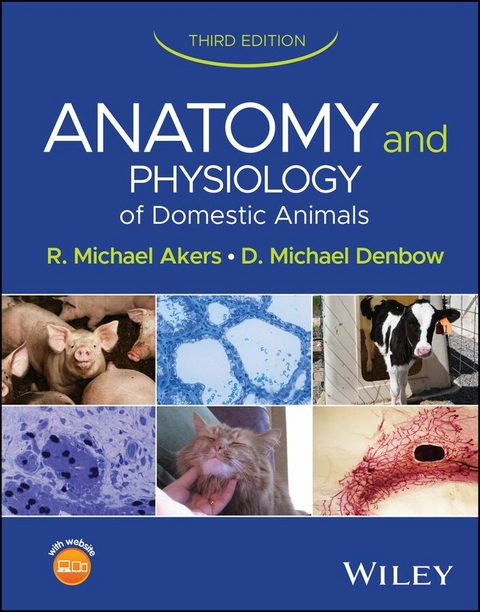
Anatomy and Physiology of Domestic Animals (eBook)
2089 Seiten
Wiley (Verlag)
978-1-394-30426-4 (ISBN)
Comprehensive resource on the anatomy and physiology systems of common domestic animals, with learning resources included throughout
Anatomy and Physiology of Domestic Animals bridges the gap between theory and practice, emphasizing real-world applications. In this newly revised and updated Third Edition, each chapter includes a short section which emphasizes current animal management practices that take advantage of physiological principles discussed in that chapter to improve animal growth, development, or function.
Instructors will gain access to a website with PowerPoint slides of all of the figures, tables, and illustrations used in the book, with one PowerPoint presentation for each chapter. A test bank of potential questions for each book chapter is featured, including short answer, matching, true and false, and discussion questions. Each chapter also includes a study guide located at the end of each chapter and an opening section that provides an outline and listing of key concepts that the reader should get from each chapter.
Some of the key revisions to this Third Edition of Anatomy and Physiology of Domestic Animals include:
- Genetic testing and modification of DNA to improve animal health or performance and the use of RNA to create vaccines
- The dynamic nature of skin, not just as physical protection, but also in its relevance in immunity
- The role of supportive non-neurons and proteins in brain function
- New discoveries in hormone signaling and uses of hormone therapies in domestic animals
- Reproductive strategies to regulate estrus, breeding schemes, and sex of offspring
Anatomy and Physiology of Domestic Animals is an essential up-to-date reference for undergraduate students in animal science, dairy science, pre-veterinary medicine, veterinary technician training, and biology. The book is also relevant as reference/review text for graduate students in animal sciences and physiology.
R. Michael Akers, Ph.D., is the Emeritus Faculty, Horace E. and Elizabeth F. Alphin Professor of Dairy Science at Virginia Tech and Department Head of Dairy Science. He has received numerous university and professional society awards for research excellence including the Young Scientist, Borden, and Pharmacia and Upjohn Physiology Awards from the American Dairy Science Association and the Animal Growth and Development Award from the American Society of Animal Science.
D. Michael Denbow, Ph.D., is Emeritus Professor of Animal Science at Virginia Tech and has received numerous awards for outstanding teaching including Purina Mills Award for Teaching Excellence, Teaching Award of Merit, National Association of Colleges and Teachers of Agriculture, and the W.E. Wine Award for Excellence in Teaching from Virginia Tech.
1
Introduction to Anatomy and Physiology
Although several good anatomy and physiology texts describe humans, there are fewer options focused on animals. The marked differences in physiology and anatomy of animals, compared to humans, mean that such texts are not generally suitable. For example, animals typically walk on four legs, whereas humans walk on two. Ruminant animals and birds have distinct adaptations to their digestive systems that make them unique from humans. The respiratory system of birds differs from that of humans, thus making birds able to fly at high altitudes. The focus of this text is to emphasize the anatomy and physiology of animals to appreciate their unique anatomical and physiological adaptations.
Anatomy and Physiology
Anatomy (rooted in Greek meaning “to cut open”) is the study of the morphology, or structure, of organisms. Consequently, anatomy deals primarily with form rather than function. Although certain anatomical arrangements allow for specialized physiological actions. For example, the counter current circulation in the legs of wading birds protects extremities in harsh weather. Alternatively, the exquisite microscopic structure of kidney nephrons allows the recovery of vital elements from filtered blood. The point is that form and function are intertwined. Appreciation of anatomy aids the understanding of physiology. Anatomy can be divided into macroscopic (gross) or microscopic anatomy. Macroscopic anatomy deals with structures that are visible with the unaided eye, whereas microscopic anatomy deals with structures visible only with the aid of a microscope. Students, researchers, and medical professionals have long recognized the value of viewing tissue samples or smears of biological fluids, e.g., blood smears and pap smears, to evaluate cellular function. However, advances in the use of immunocytochemistry, fluorescence‐labeled markers, multispectral cameras, sophisticated imaging software, etc., are revolutionizing the understanding of cell and tissue biology. Figure 1.1 gives an example of the ability to localize specific proteins within various cell types in the bovine mammary gland.
There are various approaches for the study of macroscopic anatomy. Regional anatomy, as the name implies, deals with all the structures, such as nerves, bones, muscles, and blood vessels, in a defined region such as the head or hip. Systemic anatomy describes elements of a given organ system, such as the muscular or skeletal system. Similarly, the evaluation of groups of organs that work together for a specific function, such as the digestion or elimination of waste products, i.e., the urinary system, is also an appropriate study approach. Surface anatomy looks at the markings that are visible from the outside. These may include knowledge of the muscles, such as the sternocleidomastoid muscle, to be able to find another structure such as the carotid artery.
Microscopic anatomy includes cytology and histology. Cytology is the study of the structure of individual cells that constitute the smallest units of life, at least in the sense of animal physiology. Histology is the study of tissues. Tissues are a collection of specialized cells and their products that perform a specific function. Tissues combine to form organs such as the heart, liver, and brain.
Developmental anatomy is the study of the changes in structure that occur throughout life. Embryology, a subdivision of developmental anatomy, traces the developmental changes prior to birth. The reproductive system is rudimentary at birth, and hence, the need to continue to follow development after parturition. Specific to farm mammals, understanding and management of postnatal development of the mammary gland and reproductive systems are essential for the success of dairies, cow/calf operations, flocks of sheep and goats, piggeries, and so forth. It is now widely accepted that management decisions regarding nutrition, socialization, etc., of prepubertal animals can affect future performance.
Fig. 1.1 Photomicrograph of mammary tissue from a prepubertal female bovine mammary gland. This tissue section stained with 4′,6‐diamidion‐2‐phenylindole (DAPI) shows cell nuclei in blue. Red staining localizes an antibody against tumor protein p40, which is expressed in the nuclei of myoepithelial cells in the bovine mammary gland.
Parsons et al. (2018)/with permission of Elsevier.
Physiology is the study of the function of living systems. Although various systems will be presented separately throughout this book, it is important to recognize that all these systems must work together to maintain normal function. Therefore, the cardiovascular system does not work in isolation from the respiratory or nervous system, but instead, it works in unison to coordinate the distribution of oxygen and the removal of carbon dioxide throughout the body.
Cellular physiology is the study of how cells work. This includes the study of events at the chemical, molecular, and genetic levels. Organ physiology includes the study of specific organs, i.e., cardiac or ovarian. Systems physiology includes the study of the function of specific systems such as the cardiovascular, respiratory, or reproductive systems.
As you study anatomy and physiology, it will become apparent that structure and function have evolved to complement each other. The complementarity of structure and function is an essential concept. At multiple levels, a return to this fundamental idea will hasten your understanding of what sometimes seems to be an overwhelming amount of information and detail. Ultimately, the point is for you to understand how an animal works and to understand its limitations. This relationship between form and function is evident beginning at the cellular level. For example, the epithelial cells lining the internal surface of the small intestine have tight junctions to restrict the movement of materials into the body from the gastrointestinal tract, whereas the epithelial cells lining capillaries (endothelial cells) have modified junctions. Why this difference? The lining of capillaries must be sufficiently porous to allow solutes to move readily in either direction across the capillary wall to nourish the tissues underneath and remove waste products.
As another example, there are structural differences between birds and mammals that allow flight. Birds have pneumatic bones, i.e., bones that are hollow and connected to the respiratory system. These bones include the skull, humerus, clavicle, keel, sacrum, and lumbar vertebrae. In addition, fusion of the lumbar and sacral vertebrae is an adaptation for flight. This illustrates yet another example of the complementary nature of structure and function, and thus the need to consider physiology and anatomy together.
Levels of Organization
The animal body has a complex organization extending from the most microscopic up to the macroscopic (Fig. 1.2). Beginning with the smallest microscopic units of stability, the levels of organization are as follows:
- Chemical Level. Atoms are the smallest units of matter that have the properties of an element. They combine with covalent bonds to form molecules such as molecular oxygen (O2), glucose (C6H12O6), or methane (CH4). The properties of various chemicals have a major influence on physiology. For example, at a low pH, a chemical may not be ionized and can thus cross a cellular membrane, whereas above a certain pH, the same molecule may be ionized and thus unable to cross a lipid bilayer.
- Cellular Level. In animals, cells are the smallest unit of life. However, cells have various sizes, shapes, and properties that allow them to carry out specialized functions. Some cells have cilium that allows them to move materials across their surfaces (i.e., the epithelial lining the bronchioles), whereas other cells are adapted to store lipids, produce collagen, or contract when stimulated.
Fig. 1.2 Levels of organization. (1) Atoms interact to form molecules, which combine to form complex chemicals. (2) Molecules combine to form cells, which can display specific functions depending on the proteins expressed. (3) Cells having a common function combine to form tissue. (4) Tissues combine to perform a common function. (5) Organs can work together for a common function. (6) All the organ systems combine to produce a living animal.
- Tissue Level. A tissue is a group of cells having a common structure and function. The four general types of tissue include muscle, epithelia, nervous, and connective tissue.
- Organ Level. Two or more tissues working for a given function constitute an organ. Each of the tissue types combines to form skin, the largest organ of the body, or the cochlea in the ear, the smallest organ of the body.
- Organ System Level. Organs can work together for a common function. For example, the alimentary canal works with the liver, gall bladder, and pancreas to form part of the digestive system. The pancreas also functions as part of the endocrine system. The organ systems include the integumentary, skeletal, muscular, nervous, endocrine, respiratory, digestive, lymphatic, urinary, and reproductive systems (Fig. 1.3).
- Organismal Level. The organismal level, or the whole animal, includes all the organ systems that work together to maintain homeostasis.
Homeostasis
The 19th‐century French physiologist Claude...
| Erscheint lt. Verlag | 29.5.2025 |
|---|---|
| Sprache | englisch |
| Themenwelt | Veterinärmedizin |
| Schlagworte | animal genetic testing • animal RNA-based vaccines • animal skin • CRISPR technology • cytokines • hormone signaling • immune cell networks • lactation science • Metabolomics • Non-neuronal brain functions |
| ISBN-10 | 1-394-30426-9 / 1394304269 |
| ISBN-13 | 978-1-394-30426-4 / 9781394304264 |
| Informationen gemäß Produktsicherheitsverordnung (GPSR) | |
| Haben Sie eine Frage zum Produkt? |
 EPUB (Adobe DRM)
Kopierschutz: Adobe-DRM
Adobe-DRM ist ein Kopierschutz, der das eBook vor Mißbrauch schützen soll. Dabei wird das eBook bereits beim Download auf Ihre persönliche Adobe-ID autorisiert. Lesen können Sie das eBook dann nur auf den Geräten, welche ebenfalls auf Ihre Adobe-ID registriert sind.
Details zum Adobe-DRM
Dateiformat: EPUB (Electronic Publication)
EPUB ist ein offener Standard für eBooks und eignet sich besonders zur Darstellung von Belletristik und Sachbüchern. Der Fließtext wird dynamisch an die Display- und Schriftgröße angepasst. Auch für mobile Lesegeräte ist EPUB daher gut geeignet.
Systemvoraussetzungen:
PC/Mac: Mit einem PC oder Mac können Sie dieses eBook lesen. Sie benötigen eine
eReader: Dieses eBook kann mit (fast) allen eBook-Readern gelesen werden. Mit dem amazon-Kindle ist es aber nicht kompatibel.
Smartphone/Tablet: Egal ob Apple oder Android, dieses eBook können Sie lesen. Sie benötigen eine
Geräteliste und zusätzliche Hinweise
Buying eBooks from abroad
For tax law reasons we can sell eBooks just within Germany and Switzerland. Regrettably we cannot fulfill eBook-orders from other countries.
aus dem Bereich