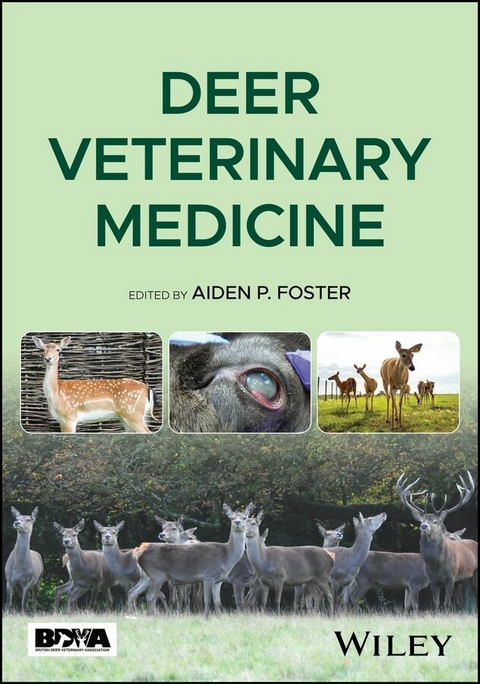
Deer Veterinary Medicine (eBook)
1017 Seiten
Wiley (Verlag)
978-1-394-22135-6 (ISBN)
A guide to the care and treatment of deer for veterinary professionals
Deer Veterinary Medicine is an essential reference for veterinary professionals preparing for deer encounters. Rooted in extensive field experience, the contributions from a range of authors provide details of common conditions across multiple deer species and the knowledge required by the veterinary professionals who deal with them. The book considers the different contexts where deer are encountered, including wild populations, and deer held in captivity (as farm, park and zoo collections).
The chapters topics range from handling and sedating deer through to nutrition and postmortem examination and pathology. They cover key body systems including the gut, nervous, ocular and respiratory systems, and the skin.
Deer Veterinary Medicine readers will also find:
- Detailed consideration of the use of sedation in deer, providing analgesia and methods of euthanasia.
- Coverage of species including red, roe, fallow, water deer, Reeves' muntjac, reindeer and white-tailed deer.
- Coverage of veterinary interventions for reproductive purposes.
- Detailed consideration of the management of parasitic diseases.
- Detailed consideration of notifiable (including TB and CWD) and zoonotic diseases (including E. coli and cryptosporidiosis).
- A detailed drug formulary including, where available, evidence from published studies.
Edited by the past president of the British Deer Veterinary Association (BDVA) this book is a fitting successor to Management and Diseases of Deer: A Handbook for Veterinary Surgeons, last published in 1994 by the Veterinary Deer Society (now the BDVA). Synthesizing key contributions by a range of experts from Europe and the US, the new Deer Veterinary Medicine is ideal for veterinarians, veterinary surgeons and veterinary students, as well as readers interested in the management of captive and wild deer.
Aiden P. Foster, PhD is past president of the BDVA and an honorary senior lecturer at the University of Bristol, UK, having spent his career working in academia and the civil service. His work has focused on veterinary dermatology (including livestock), publishing (as a journal editor and author) and disease surveillance in livestock and wildlife, including deer.
A guide to the care and treatment of deer for veterinary professionals Deer Veterinary Medicine is an essential reference for veterinary professionals preparing for deer encounters. Rooted in extensive field experience, the contributions from a range of authors provide details of common conditions across multiple deer species and the knowledge required by the veterinary professionals who deal with them. The book considers the different contexts where deer are encountered, including wild populations, and deer held in captivity (as farm, park and zoo collections). The chapters topics range from handling and sedating deer through to nutrition and postmortem examination and pathology. They cover key body systems including the gut, nervous, ocular and respiratory systems, and the skin. Deer Veterinary Medicine readers will also find: Detailed consideration of the use of sedation in deer, providing analgesia and methods of euthanasia.Coverage of species including red, roe, fallow, water deer, Reeves muntjac, reindeer and white-tailed deer.Coverage of veterinary interventions for reproductive purposes.Detailed consideration of the management of parasitic diseases.Detailed consideration of notifiable (including TB and CWD) and zoonotic diseases (including E. coli and cryptosporidiosis).A detailed drug formulary including, where available, evidence from published studies. Edited by the past president of the British Deer Veterinary Association (BDVA) this book is a fitting successor to Management and Diseases of Deer: A Handbook for Veterinary Surgeons, last published in 1994 by the Veterinary Deer Society (now the BDVA). Synthesizing key contributions by a range of experts from Europe and the US, the new Deer Veterinary Medicine is ideal for veterinarians, veterinary surgeons and veterinary students, as well as readers interested in the management of captive and wild deer.
Foreword
This book is a triumph and it is a great privilege to have been asked to write its foreword. That so many contributors could find motivation to write in their own time, in their busy lives, is a testament to their enthusiasm, especially to that of Aiden Foster, who has been the editor and organising force.
Its previous iteration, published in 1986, grew out of the Veterinary Deer Society, which today has been renamed as the British Deer Veterinary Association. The Society arose from a conversation that I had with Tom Alexander on the back of a trailer being pulled slowly around Studley Royal park as we tried to approach deer closely enough for me to dart them, initially with a crossbow. That crossbow was the brainchild of the inspirational and brilliant scientist Roger Short. In 1969 I had the extreme good fortune to become a member of a team from the Veterinary School at Cambridge, led by Roger, working with red deer on the Isle of Rum. As well as the wild deer, myself, Gerald Lincoln and Fiona Guinness used a group of hand-reared red deer females to elucidate their oestrous cycle and gestation length and unpick the ways in which testosterone controlled antler growth and rutting behaviour.
I cite this because it is remarkable that, until then, these basic facts were not clearly understood. In America, Caton (1877) had written a scientific treatise about deer and even speculated on their domestication and, in Scotland, Henry Evans (1890) and Fraser Darling (1937) had described the social behaviour and performance of wild red deer in the Highlands and Islands. However, it was not until our work on Rum, followed closely by that on the experimental deer farm at Glensaugh (Blaxter et al. 1974), that in-depth investigations of disease and physiology were published. It was the advent of deer farming that made such research feasible and commercially viable. This book demonstrates just how much has been learnt since that time and when at last we could get our hands on increasingly domesticated living deer.
Humans have kept deer in enclosed ‘parks’ for over two thousand years as status symbols, for sport, and sometimes for venison, but it took the development of wire fences to make actual farming possible and to create, in red deer, probably the first new domesticated livestock species for at least five thousand years (Fletcher 2001).
Most deer species are, in physiological terms, highly seasonal and adapted to northern temperate climates. Where deer and people co-exist, we have always exploited their antlers, their hides and their meat. Otzi the man preserved in ice for over 5000 years in the Austro-Italian Alps ate venison at one of his last meals, walked in deer skin shoes, wore deer hide clothing, kept his antler-tipped arrows in a quiver constructed from roe deer hide and carried an antler tool probably used to shape flints.
In fact, we talk of the Stone Age, but there was an even longer antler age. The Mesolithic flint mines at Grimes Graves in Norfolk were worked with picks made of red deer antlers. Many of these remain, discarded as worn out but still carrying handprints of the miners in the clay that covers them (Clutton-Brock 1984). Many prehistoric monuments depended on the use of antler tools and it has been calculated that each of the many mine shafts would have used up to 400 antlers each year. How were so many cast antlers found? I like to think that with good knowledge of deer behaviour stags might have been gathered by feeding them browse, such as ivy, which the deer could not reach. There is pollen evidence that ivy was being stored in human settlements (Simmons & Dimbleby 1974) and if the deer were encouraged to stay in the same area during the short period of antler casting, then collecting them before they were covered by the growth of spring vegetation would have been made very much easier. Perhaps such systems foreshadowed future deer parks.
Because deer remained largely inaccessible and only fleetingly glimpsed, they have always been fertile ground for myths and, because the antlers could be seen to regrow each year, deer became symbols of rejuvenation and longevity wherever they existed from Japan to Ireland.
And where have we come to now? The beliefs that motivated deer farming are clear: in their natural environment are not deer better adapted to seasonal climates than the alien cattle and sheep? Yet they remain wild in that they have a rut, which can be difficult to manage on farms, and they are active and carry antlers making handling and containment more expensive. However, they have not been bred and managed to the point where they are subject to the many diseases of overproduction and their meat is better suited to modern human needs than that of conventional livestock, being leaner and high in polyunsaturated fats and iron.
In the United Kingdom, most of the deer industry relates to the production of venison from farms and parks and, especially, by far the largest source, from wild shot deer. There is substantial pressure to reduce deer numbers throughout most of Britain. Notoriously difficult to count, there is no doubt that the native roe, invasive and non-native muntjac, and naturalised fallow deer, in particular, have extended their range whilst their numbers have also grown steadily for decades to reach perhaps the largest cumulative populations at any time in history. These deer are impacting agriculture, forestry and horticulture, the natural environment and causing road traffic accidents with their human toll. Several people die each year in Britain as a result of collisions with deer and many more are injured.
All the governments within the United Kingdom wish to increase woodland in order to lower net greenhouse gas emissions and reduce our dependence on timber imports. Ecologists press for the planting of native woodland to improve biodiversity. Deer of all species negatively impact on tree planting, thus venison from culled deer represents the most sustainable meat available and consumption is rising.
Wild deer provide over 95% of the venison coming to market in Britain and might be assumed to provide a much cheaper source than either farmed or park venison. However, much of this wild venison is derived from red deer in Scotland, and the costs of shooting wild deer and especially the recovery of the carcases are substantial. Across the UK market, the quality is inevitably highly variable, not least because it comes from a variety of different species as taxonomically removed from each other as cows are to sheep, yet all labelled generically, as venison. The costs of creating a hygienic, marketable product from a carcase that has been eviscerated before it has been skinned and which will usually have sustained damage from the bullet are also high. These factors combine to make farmed venison produced consistently to a uniform standard under stringent quality assurance regulations, killed humanely and processed hygienically, likely to command strong prices in a growing market.
This book wisely avoids much discussion of the worldwide industries that revolve around deer, but antlers drive much of their exploitation. To the outsider the values placed on large antlers as trophies may seem bizarre, yet for many ‘hunters’, who shoot deer in enclosures at close range in order to hang the trophy on the wall, the sky seems to be the limit. Some veterinarians have used artificial reproductive techniques to enable deer breeders to pursue their remorseless quest for ever heavier antlers, fostering the production of some white-tailed deer which can no longer lift their heads from the ground.
The trophy business is probably no larger than the extraordinary farming of deer in much of Asia for the production of the growing antlers harvested by amputation when the growth is at its maximum. In Russia and beyond, wealthy men drink, or even bathe in, the fresh blood as it spurts from the cut surface. The most widely traded commodity is slices of dried growing antler. This velvet is prized by the traditional Chinese medicine trade and is produced in New Zealand with very stringent welfare safeguards. Despite substantial investment, there is no very convincing peer-reviewed literature to substantiate claims of the medicinal value of velvet antlers. The same is true of the many other deer products that are marketed, including sinews, tails and fetuses. Within the United Kingdom and most of Europe, the amputation of growing antlers is illegal except where it may alleviate suffering.
It is the steady growth of the farmed deer industry that has provided the impetus for this book and stimulated the knowledge and veterinary science which also benefit the wild, park and zoo deer.
John Fletcher
Harthill, Reediehill Deer Farm, Auchtermuchty, Fife, KY14 7HS, Scotland
References
- Blaxter KL, Kay RNB, Sharman GAM, Cunningham JMM and Hamilton WJ (1974) Farming the Red Deer – the first report of an investigation by the Rowett Research Institute and the Hill Farming Research Organisation. Department of Agriculture and Fisheries for Scotland, Her Majesty’s Stationery Office, Edinburgh.
- Caton JD (1877) The Antelope and Deer of America. A comprehensive scientific treatise upon the natural history, including the characteristics, habits, affinities and capacity for domestication of the Antilocapra and Cervidae of North America. Cambridge, MA, USA: The Riverside Press.
- Clutton-Brock J (1984) Excavations at Grimes Graves, Norfolk, 1972–1976, Fascicule 1: Neolithic Antler Picks from Grimes Graves, Norfolk, and Durrington Walls, Wiltshire: A Biometrical analysis. London, UK: British Museum Press.
- Evans H (1890) Some Account of Jura Red Deer. Carter,...
| Erscheint lt. Verlag | 15.5.2025 |
|---|---|
| Sprache | englisch |
| Themenwelt | Veterinärmedizin |
| Schlagworte | Anatomical pathology • antler • deer on farm • deer reproduction • deer systemic disease • handling deer • managing deer • muntjac • orphan calf • orphan fawn • Park deer • reindeer • Ticks • wild deer • wildlife rehabilitation • zoological collection |
| ISBN-10 | 1-394-22135-5 / 1394221355 |
| ISBN-13 | 978-1-394-22135-6 / 9781394221356 |
| Informationen gemäß Produktsicherheitsverordnung (GPSR) | |
| Haben Sie eine Frage zum Produkt? |
 EPUB (Adobe DRM)
Kopierschutz: Adobe-DRM
Adobe-DRM ist ein Kopierschutz, der das eBook vor Mißbrauch schützen soll. Dabei wird das eBook bereits beim Download auf Ihre persönliche Adobe-ID autorisiert. Lesen können Sie das eBook dann nur auf den Geräten, welche ebenfalls auf Ihre Adobe-ID registriert sind.
Details zum Adobe-DRM
Dateiformat: EPUB (Electronic Publication)
EPUB ist ein offener Standard für eBooks und eignet sich besonders zur Darstellung von Belletristik und Sachbüchern. Der Fließtext wird dynamisch an die Display- und Schriftgröße angepasst. Auch für mobile Lesegeräte ist EPUB daher gut geeignet.
Systemvoraussetzungen:
PC/Mac: Mit einem PC oder Mac können Sie dieses eBook lesen. Sie benötigen eine
eReader: Dieses eBook kann mit (fast) allen eBook-Readern gelesen werden. Mit dem amazon-Kindle ist es aber nicht kompatibel.
Smartphone/Tablet: Egal ob Apple oder Android, dieses eBook können Sie lesen. Sie benötigen eine
Geräteliste und zusätzliche Hinweise
Buying eBooks from abroad
For tax law reasons we can sell eBooks just within Germany and Switzerland. Regrettably we cannot fulfill eBook-orders from other countries.
aus dem Bereich