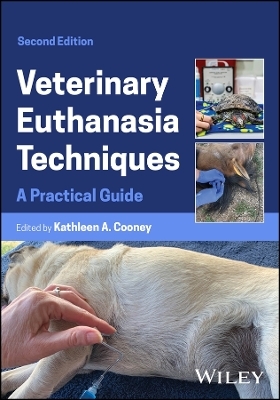
Veterinary Euthanasia Techniques
John Wiley & Sons Inc (Verlag)
978-1-394-26388-2 (ISBN)
Veterinary Euthanasia Techniques offers how-to guidance for performing euthanasia techniques in dogs, cats, exotic animals, horses, production animals, and, in this new edition, zoo and marine animals. This edition has been reorganized by species to make it easier to find information, with each species-specific chapter covering restraint, equipment, sedatives, and techniques. Sections discussing drugs and data have been updated throughout, with new discussions on how to handle pentobarbital shortages and animal welfare considerations.
Veterinary Euthanasia Techniques includes information on:
Pre-euthanasia sedation and anesthesia, covering unconscious and sedation assessment
Euthanasia techniques, including inhalant, injectable, and physical techniques, with guidance on how death is achieved, positioning and restraint, and how to choose an appropriate method
Burial aftercare, covering the burial process, composing, cremation/incineration, alkaline hydrolysis, and rendering
Client considerations concerning companion animals
The history of the field, current research, and emerging trends
Offering complete information and specific advice to improve skills and aid in decision making, Veterinary Euthanasia Techniques is a must-have reference for anyone involved in animal welfare work and veterinary euthanasia, including general practice vets, specialists, students, and veterinary technicians.
Kathleen A. Cooney, DVM, CHPV, CPEV, DACAW, is Senior Director of Medical Education at the Companion Animal Euthanasia Training Academy (CAETA) and Affiliate Faculty Member in the Department of Clinical Sciences, College of Biomedical Sciences, Colorado State University in Fort Collins, Colorado, USA.
Author Biographies xiii
Foreword from the Editor xv
Preface xvii
Acknowledgments xix
1 Euthanasia Standards in Modern Times 1
Kathleen A. Cooney
1.1 A Brief Look at Euthanasia’s History 1
1.1.1 Defining Euthanasia and Original Methods 1
1.1.2 The Guidelines We Follow 2
1.1.3 How Death is Achieved 4
1.2 Ethics and a Focus on Animal Welfare 5
1.2.1 Ethical Considerations 5
1.2.2 Euthanasia and Its Relationship to Animal Welfare 6
1.2.3 The Importance of Training Euthanasia Methods 7
1.3 Writing Today’s Euthanasia Story: The Who, What, When, Where, Why, and How 8
1.3.1 Deciding to Euthanize an Animal Is Hard 9
1.3.2 Establishing Rapport, Building Trust, and Supporting Grief 10
1.4 Euthanasia Technique Selection 12
1.4.1 Choosing an Appropriate Euthanasia Method 12
1.4.1.1 Comfort with the Technique 12
1.4.1.2 Available Supplies 12
1.4.1.3 Presence of Clients and Observers 13
1.4.1.4 Type and Amount of Euthanasia Drugs 13
1.4.1.5 Animal’s State of Consciousness 13
1.4.1.6 Signalment and Physical Condition of the Patient 13
1.4.1.7 Need for a Postmortem Examination 14
1.4.1.8 What’s Allowed by Governing Bodies 14
1.4.2 The Growing Use of Pre- Euthanasia Sedation and Anesthesia 14
1.4.2.1 Sedation is Not the Same as Anesthesia 15
1.4.2.2 Assessing for Unconsciousness 16
1.4.3 A Concise List of Euthanasia Techniques 17
1.5 Professional Best Practices to Support Euthanasia 18
1.5.1 Euthanasia Standard Operating Procedures 18
1.5.2 Finding Meaning and Purpose in Euthanasia Work 21
References 22
2 Canine and Feline Euthanasia 25
Kathleen A. Cooney
2.1 Species- Specific Considerations 25
2.2 Equipment and Handling 27
2.2.1 Positioning and Restraint 27
2.2.2 Medical Supplies 29
2.3 Pre- Euthanasia Sedation and Anesthesia 30
2.4 Euthanasia Techniques 32
2.4.1 Overview of Non- inhalant Pharmaceutical Euthanasia Agents – Pentobarbital, Potassium Chloride, Lidocaine, Magnesium Sulfate, and Propofol 33
2.4.1.1 Pentobarbital Sodium 34
2.4.1.2 Potassium Chloride (KCl) 35
2.4.1.3 Magnesium Sulfate (MgSO4) 35
2.4.1.4 Propofol 35
2.4.1.5 Lidocaine and Mepivacaine 35
2.4.2 Euthanasia Injection Methods – Intravenous, Intracardiac, Intrahepatic, Intrarenal, Intraperitoneal, and Intrathecal 36
2.4.2.1 Intravenous Injections 36
2.4.2.2 Intraorgan Injections 38
2.4.2.3 Intraperitoneal Injections 44
2.4.2.4 Intrathecal Injections of Anesthetic Agents (e.g. lidocaine) 45
2.4.3 Oral Administration of Pentobarbital Euthanasia Solution 46
2.4.4 Miscellaneous Pentobarbital Administration Routes 47
2.4.5 Euthanasia by Inhalant Gas Methods in Dogs and Cats 48
2.4.6 Physical Methods 49
2.4.6.1 Gunshot 49
2.4.6.2 Captive Bolt 50
2.5 Special Circumstances 50
2.5.1 The Euthanasia of Unbirthed Young 50
2.5.2 Aggressive Dog and Cat Euthanasia 51
2.5.3 Undesirable Physical Euthanasia Methods 51
References 53
3 Exotic Pet Euthanasia 57
Angela M. Lennox
3.1 Species- Specific Considerations 57
3.2 Equipment and Handling 59
3.2.1 Handling Exotic Companion Mammals 60
3.2.1.1 Ferrets and Rabbits 60
3.2.1.2 Guinea Pigs, Rodents, Sugar Gliders, and Hedgehogs 60
3.2.1.3 Pet Pigs 61
3.2.1.4 Unusual and Potentially Dangerous Exotics 63
3.2.2 Handling Birds 64
3.2.3 Handling Reptiles and Amphibians 66
3.2.4 Handling Fish 68
3.2.5 Handling Native Wildlife 68
3.3 Pre- euthanasia Sedation and Anesthesia 70
3.3.1 The Use of Inhalants for Induction of Anesthesia 70
3.3.2 Injectable Anesthetic Protocols 70
3.3.3 Nasal, Oral, and Intracloacal Administration 71
3.3.4 Immersion Bath and Topical Anesthetic Application 72
3.4 Euthanasia Techniques 72
3.4.1 Delivery of Euthanasia Solutions 72
3.4.1.1 Small Mammals 73
3.4.1.2 Birds 76
3.4.1.3 Reptiles and Amphibians 77
3.4.1.4 Fish 79
3.4.1.5 Invertebrates 80
3.4.2 Physical Methods of Euthanasia in Exotic Species 80
3.5 Special Circumstances 82
3.5.1 Ensuring the Patient is Deceased 82
3.5.2 Aftercare 83
References 83
4 Equine Euthanasia 85
Bruce A. Connally
4.1 Species- Specific Considerations 85
4.1.1 The Importance of Horses in Society 85
4.1.2 Preparation and Planning 85
4.1.2.1 Deciding the Right Time to Euthanize 85
4.1.2.2 Deceased Horse Body Care 87
4.2 Equipment and Handling 89
4.2.1 Safety First 89
4.2.2 Public Events and High- Profile Emergency Situations 90
4.2.3 Working with Untrained Horses 90
4.3 Pre- Euthanasia Sedation and Anesthesia 91
4.4 Euthanasia Techniques 93
4.4.1 Non- inhalant Pharmaceutical Agents – Pentobarbital, Magnesium Sulfate, Potassium Chloride, Lidocaine 93
4.4.1.1 Pentobarbital Sodium 93
4.4.1.2 Magnesium Sulfate (MgSO4) 96
4.4.1.3 Potassium Chloride (KCl) 96
4.4.1.4 Intrathecal Lidocaine 97
4.4.2 Physical Methods of Euthanasia – Gunshot, Captive Bolt, and Exsanguination 99
4.4.2.1 Gunshot 99
4.4.2.2 Penetrating Captive Bolt 102
4.4.2.3 Exsanguination 103
4.5 Special Circumstances 104
4.5.1 Euthanasia of the Aggressive or Highly Fearful Horse 104
4.5.2 Blunt Force Trauma 104
4.5.3 Pithing 104
4.5.4 Helping Two or More Horses at the Same Time 105
References 105
5 Livestock Euthanasia 107
Jan K. Shearer
5.1 Species- Specific Considerations 107
5.1.1 Methods of Euthanasia 109
5.1.1.1 Euthanasia by Lethal Injection 109
5.1.1.2 Physical Methods of Euthanasia 110
5.2 Equipment and Handling 110
5.2.1 Supply Needs for Lethal Injection 112
5.2.2 Firearm Selection 112
5.2.3 Captive Bolt 113
5.3 Pre- Euthanasia Sedation and Anesthesia 114
5.3.1 Cattle 114
5.3.2 Sheep and Goats 115
5.3.3 Swine 116
5.3.4 Llamas and Alpacas 117
5.4 Euthanasia Techniques 118
5.4.1 Noninhalant Pharmaceutical Agents – Intravenous Injections (Pentobarbital, KCl, Lidocaine) 118
5.4.1.1 Cattle 118
5.4.1.2 Sheep and Goats 121
5.4.1.3 Swine 122
5.4.1.4 Llamas and Alpacas 123
5.4.1.5 Technical Challenges (Sheep, Goats, Swine, and Camelids) 125
5.4.2 Physical Methods 125
5.4.2.1 Gunshot in Cattle 125
5.4.2.2 Captive Bolt in Cattle 127
5.4.2.3 Gunshot or Captive Bolt 128
5.4.2.4 Exsanguination 131
5.4.2.5 Pithing 132
5.5 Special Circumstances 132
References 133
6 Zoo Species Euthanasia Considerations and Techniques 135
David S. Miller and Grey Stafford
6.1 Sociocultural Considerations 135
6.2 Institutional and Professional Community Considerations 136
6.3 End- of- Life Considerations 139
6.3.1 Lifetime Considerations 139
6.3.2 Euthanasia Decision- making Considerations 141
6.3.2.1 Whether to Conduct Euthanasia 141
6.3.2.2 When to Conduct Euthanasia 142
6.3.2.3 How to Conduct Euthanasia 143
6.3.2.4 Selection of Euthanasia Methods 146
6.4 Taxon- Based Euthanasia Overview 152
6.4.1 Fish 152
6.4.2 Amphibians 152
6.4.3 Reptiles 153
6.4.4 Birds 153
6.4.5 Mammals 154
6.5 Postmortem Considerations 156
6.5.1 Confirmation of Death 156
6.5.2 Grieving and Postmortem Handling 156
References 158
7 Post- Death Considerations and Closing Thoughts 161
Kathleen A. Cooney
7.1 The Evolving Landscape of Deceased Pet Aftercare 161
7.1.1 Client Expectations 161
7.1.1.1 Spending Time with the Body 161
7.1.1.2 Reviewing Aftercare Choices and Memorialization 162
7.1.1.3 Respectful Body Handling 163
7.1.2 Aftercare Ordering Models 167
7.1.3 Reducing Risk and Improving Accuracy 167
7.2 Types of Aftercare: Current options 168
7.2.1 Overview of Aftercare Goals 168
7.2.1.1 Verifying Death 169
7.2.1.2 Destruction of Drugs and Safe Transport 171
7.2.2 Cremation 173
7.2.3 Alkaline Hydrolysis 173
7.2.4 Burial 175
7.2.5 Composting and Rendering 177
7.2.6 Body Preservation 179
7.2.7 Educational Memorial Donation 179
7.2.8 Consuming the Body as a Purposeful Food Source 180
7.3 Closing Thoughts on the Future of Euthanasia 180
References 181
Index 185
| Erscheinungsdatum | 02.12.2025 |
|---|---|
| Verlagsort | New York |
| Sprache | englisch |
| Maße | 18 x 244 mm |
| Gewicht | 340 g |
| Themenwelt | Veterinärmedizin ► Kleintier |
| Veterinärmedizin ► Pferd | |
| ISBN-10 | 1-394-26388-0 / 1394263880 |
| ISBN-13 | 978-1-394-26388-2 / 9781394263882 |
| Zustand | Neuware |
| Informationen gemäß Produktsicherheitsverordnung (GPSR) | |
| Haben Sie eine Frage zum Produkt? |
aus dem Bereich