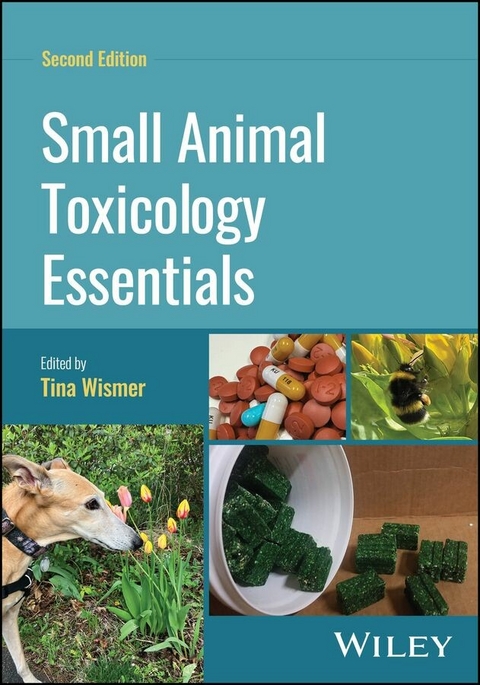
Small Animal Toxicology Essentials (eBook)
1158 Seiten
Wiley (Verlag)
978-1-394-18013-4 (ISBN)
A one-stop reference for veterinary clinicians in small animal practices
Veterinary technicians play a vital role in the successful operation of any small animal practice. One of the most important types of case they will face is an emergency call related to a possibly toxic exposure, which demands that they assess clinical urgency, triage calls, offer guidelines for the collection of diagnostic samples, and more. Small Animal Toxicology Essentials offers a foundational, practical guide to the most common small animal toxins, their poisoning risks, and the essential steps required to evaluate client calls and provide timely, effective assistance. Fully updated for reflect the latest research and expand treatment of key subjects, this is the must-own reference for clinical professionals.
Readers of the second edition of Small Animal Toxicology Essentials will also find:
- Updated treatment of all common toxins
- Detailed discussion of topics including differential diagnoses, clinical signs, laboratory sample collection, and many more
- Additional color photographs and tables to facilitate toxin identification
Small Animal Toxicology Essentials is ideal for veterinary technicians and veterinary technician students, for those working in small animal or emergency practice, no matter the length of employment.
Tina Wismer, DVM, MS, DABVT, DABT, is the Senior Director of Toxicology at the ASPCA Animal Poison Control Center (APCC) in Champaign, Illinois. Dr. Wismer earned her undergraduate degree from Ohio's University of Findlay and her DVM from Purdue University in 1994. In July 2003, Dr. Wismer became a Diplomat of the American Board of Toxicology and the American Board of Veterinary Toxicology. She is also an adjunct professor at the University of Illinois, a visiting professor at St. Matthew's University, and a consultant for the Veterinary Information Network.
A one-stop reference for veterinary clinicians in small animal practices Veterinary technicians play a vital role in the successful operation of any small animal practice. One of the most important types of case they will face is an emergency call related to a possibly toxic exposure, which demands that they assess clinical urgency, triage calls, offer guidelines for the collection of diagnostic samples, and more. Small Animal Toxicology Essentials offers a foundational, practical guide to the most common small animal toxins, their poisoning risks, and the essential steps required to evaluate client calls and provide timely, effective assistance. Fully updated for reflect the latest research and expand treatment of key subjects, this is the must-own reference for clinical professionals. Readers of the second edition of Small Animal Toxicology Essentials will also find: Updated treatment of all common toxinsDetailed discussion of topics including differential diagnoses, clinical signs, laboratory sample collection, and many moreAdditional color photographs and tables to facilitate toxin identification Small Animal Toxicology Essentials is ideal for veterinary technicians and veterinary technician students, for those working in small animal or emergency practice, no matter the length of employment.
1
General Toxicologic Principles
Sharon Gwaltney‐Brant
INTRODUCTION
Toxicology is the study of the nature, effects, and detection of poisons and the treatment of poisoning. For the purposes of this textbook, we define clinical toxicology as the diagnosis and treatment of the poisoned patient. Many of the basic principles of toxicology, such as the inherent toxicity of various forms of a chemical, variations in dose–response curves, different mechanisms of toxic action, variations in individual and species sensitivities to chemicals, and how differences in kinetics of chemicals (sometimes referred to as “toxicokinetics”) need to be applied to the successful diagnosis and treatment of poisoning. In clinical toxicology there is a need for the application of good critical care and medical practices (e.g., stabilizing, monitoring, and treating a patient) to achieve a successful outcome.
DEFINITIONS
All special areas of study have unique terminology that is important to master to fully appreciate the discipline. The following definitions provide some needed terminology in order to more effectively utilize this textbook.
Toxicant
A poison or poisonous agent; an intoxicant; any solid, liquid or gas that, when introduced into or applied to the body, can interfere with the life processes of cells or the organism by its own inherent qualities (toxicity) without acting mechanically and irrespective of temperature.
Toxin
A poisonous material that is synthesized or derived from an animal or plant; also referred to as a biotoxin. Zootoxins, bacterial toxins, and phyto (or plant) toxins are subcategories of toxins.
Toxicity
The poisonous characteristics of a substance; the degree to which something is poisonous. Perhaps the best known measure of toxicity of a chemical is its lethal dose or LD50 (Table 1.1).
Acute Toxicity
Intoxication that results from the effects of a single dose or multiple doses of a toxicant given during a 24‐hour period (e.g., a dog got into a box of chocolates or a cat was left in a room contaminated by chemical fumes overnight). The LD50 of a chemical is most often determined during acute exposure studies in which a single dose of a chemical is given.
Subacute Toxicity
Exposure to multiple doses of a toxin or toxicant given for greater than 24 hours but no longer than 30 days (e.g., an animal owner administers ibuprofen to dog for a week).
Subchronic Toxicity
Repeated or continuous exposures to toxicants for a duration of 1–3 months (e.g., a patient on weekly chemotherapy for cancer).
Table 1.1. Classification scheme for relative toxicity
| Classification | Toxicity (LD50 in mg/kg body weight) |
|---|
| Extremely toxic | <1 mg/kg |
| Highly toxic | 1–50 mg/kg |
| Moderately toxic | 50–500 mg/kg |
| Slightly toxic | 0.5–5.0 g/kg |
| Practically nontoxic | 5–15 g/kg |
| Relatively harmless | >15 g/kg |
Chronic Toxicity
Intoxication that results from prolonged exposure, with the duration of exposure being 3 months or longer (e.g., repeated exposure of a cat to low levels of lead as a result of environmental contamination and grooming of contaminated paws or hair).
Dose
The quantity of drug or toxicant administered at one time irrespective of body weight.
Dosage
The regimen governing the size, amount, frequency, and number of doses of a therapeutic agent to be administered to a patient; most commonly measured in milligrams per kilogram (mg/kg), milligrams per pound (mg/lb), or milligrams per square meter of body surface area (mg/m2).
Lethal Dosage (LD)
The lowest dosage that causes death. An LD can be expressed as a percentage of individuals dying (e.g., an LD10 means 10% of individuals will die from this dosage).
Median Lethal Dosage (LD50)
The quantity of an agent that will kill 50% of the test subjects to which it is administered. Note that the LD50 is a fairly rough estimate of overall toxicity and will not tell us at what dosage the first individual will develop signs of toxicosis (minimum toxic dosage or MTD) or die (minimum lethal dosage or MLD).
Parts per Million (ppm)
A weight‐for‐weight (w/w) concentration equal to 1 mg/kg or 1 g/ton (tonne). Used most commonly to express the concentration of toxicants or trace elements in water, feeds, solvents, and tissues. Note that mg/kg can refer to either a concentration in a material or a dosage in a patient; its meaning is dependent on the context of its use.
Parts per million (ppm), parts per billion (ppb), and parts per trillion (ppt) are the most commonly used terms to describe very small amounts of contaminants in our environment. They are measures of concentration or the amount of one material in a larger amount of another material; for example, the weight of a toxic chemical in a certain weight of food. The following example might help conceptually. If you divide a pie equally into 10 pieces, each piece would be one part per 10 or one‐tenth of the total pie. If, instead, you cut this pie into a million pieces, each piece would be very small and would represent a millionth of the total pie or one part per million of the original pie. If you cut each of these million pieces into a thousand little pieces, each of these new pieces would be one part per billion of the original pie. To give you an idea of how little this would be, a pinch of salt in 10 tons of potato chips is also one part (salt) per billion parts (chips). In the pie example, the pieces of the pie are made up of the same material as the whole. However, if there were a contaminant in the pie at a level of one part per billion, one of these invisible pieces of pie would be made up of the contaminant and the other 999,999,999 pieces would be pure pie. Similarly, one part per billion of an impurity in a biological or environmental sample represents a tiny fraction of the total amount of the sample (e.g., water, food, whole blood, urine, or tissue).
Hazard (Risk)
The likelihood that a chemical will cause harm under certain conditions. The hazard can vary for the same chemical. For example, the hazard or risk of intoxication is greater if a potentially toxic product or chemical is not stored properly and thereby the chance for accidental exposure is increased due to greater accessibility. Or the risk of intoxication of a compound may be low if the compound comes in contact with the skin but high if it is ingested.
CLASSIFICATION OF TOXICANTS
Toxins and toxicants are classified in a variety of ways; no one way is better than another and a combination of classification schemes is used in this textbook. Poisons can be classified based on the organ systems that are primarily affected (e.g., hepatotoxicants, neurotoxicants, nephrotoxicants, etc.). The limitation to this scheme is that many toxins or toxicants affect more than one organ system. Alternatively, poisons can be classified based on their chemical structure. For example, alkaloids are cyclic compounds that contain a nitrogen molecule within the ring. Toxic alkaloids are common in plants (e.g., nicotine in Nicotiana spp. or coniine in Conium maculatum). A third classification scheme categorizes poisons according to their use or location. For example, pesticides are subcategorized into rodenticides, insecticides, herbicides, fungicides, avicides, parasiticides, etc. based on the type of target organism for which they were developed. Poison categories based on location might include those found in homes, yards, or industrial sites. Within each of these categories are chemically diverse compounds with quite distinct target organs or mechanisms of toxic action. Finally, poisons can also be categorized according to their mechanism of toxic action. For example, some poisons cause damage via free radical formation or lipid peroxidation of cellular membranes and others inhibit protein synthesis.
SPECTRUM OF UNDESIRED EFFECTS
Toxicants cause damage through a variety of mechanisms, including altering cell and organelle membrane integrity, altering cell energy production, inhibiting protein synthesis or enzyme activity, or damaging DNA (Osweiler 1996). Other undesired effects that need to be considered are discussed below.
Idiosyncratic Reactions
Idiosyncratic reactions to chemicals are defined as genetically determined abnormal reactivity to a chemical (Aleksunes and Eaton 2019). Most commonly, this is caused by an acquired or congenital enzyme deficiency that prevents a toxicant from being processed properly. In some cases, the reason for an idiosyncratic reaction is unknown. See the discussion on genetic polymorphisms below.
Immediate vs. Delayed Reactions
Immediate effects can be defined as those that occur rapidly after a single exposure to a chemical. In contrast, delayed toxic effects are those that occur after some period of time (often, but not always, following repeated exposures). For example, many chemicals can induce cancer, but only after a long latency period of years (Aleksunes and Eaton...
| Erscheint lt. Verlag | 25.4.2025 |
|---|---|
| Sprache | englisch |
| Themenwelt | Veterinärmedizin |
| Schlagworte | fatal suspected poisoning • household toxin • malicious poisoning • Mycotoxin • Pesticide • poisoning in small animal • system-affected approach to toxicology • toxicology history • toxicology information resource • Veterinary toxicology • zootoxin |
| ISBN-10 | 1-394-18013-6 / 1394180136 |
| ISBN-13 | 978-1-394-18013-4 / 9781394180134 |
| Informationen gemäß Produktsicherheitsverordnung (GPSR) | |
| Haben Sie eine Frage zum Produkt? |
 EPUB (Adobe DRM)
Kopierschutz: Adobe-DRM
Adobe-DRM ist ein Kopierschutz, der das eBook vor Mißbrauch schützen soll. Dabei wird das eBook bereits beim Download auf Ihre persönliche Adobe-ID autorisiert. Lesen können Sie das eBook dann nur auf den Geräten, welche ebenfalls auf Ihre Adobe-ID registriert sind.
Details zum Adobe-DRM
Dateiformat: EPUB (Electronic Publication)
EPUB ist ein offener Standard für eBooks und eignet sich besonders zur Darstellung von Belletristik und Sachbüchern. Der Fließtext wird dynamisch an die Display- und Schriftgröße angepasst. Auch für mobile Lesegeräte ist EPUB daher gut geeignet.
Systemvoraussetzungen:
PC/Mac: Mit einem PC oder Mac können Sie dieses eBook lesen. Sie benötigen eine
eReader: Dieses eBook kann mit (fast) allen eBook-Readern gelesen werden. Mit dem amazon-Kindle ist es aber nicht kompatibel.
Smartphone/Tablet: Egal ob Apple oder Android, dieses eBook können Sie lesen. Sie benötigen eine
Geräteliste und zusätzliche Hinweise
Buying eBooks from abroad
For tax law reasons we can sell eBooks just within Germany and Switzerland. Regrettably we cannot fulfill eBook-orders from other countries.
aus dem Bereich