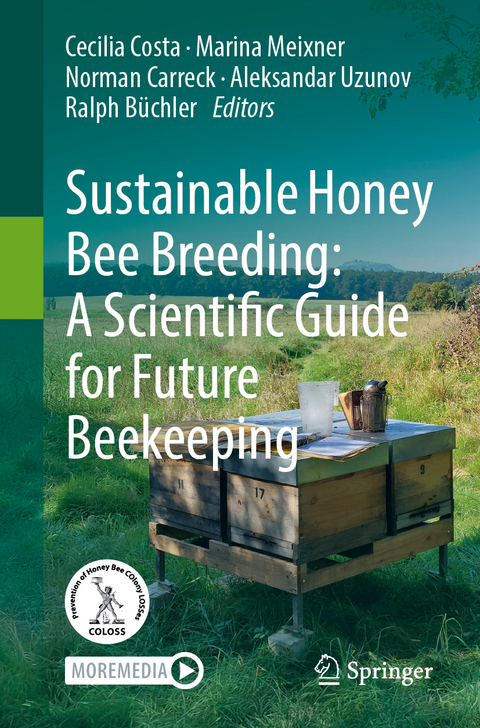
Sustainable Honey Bee Breeding: A Scientific Guide for Future Beekeeping
Springer International Publishing (Verlag)
978-3-031-94203-7 (ISBN)
This book is the result of collaborative efforts which have taken place over the past 20 years within the COLOSS network, when the factor bee origin was first put into the equation of factors involved in colony losses. It aims to provide beekeepers, apicultural students, and beekeeping enthusiasts with the scientific background necessary to understand these new ideas, so that future beekeeping may be based on existing local bee genotypes which can then be improved by selective breeding.
The work is divided into two parts. The first section briefly tells the story of honey bees, their origins and their long association with humans, the development of bee breeding and selection and finally the scientific and anecdotal evidence that show that local bees are better for the environment and for beekeeping itself. The second part provides a practical guide to techniques for sustainable bee breeding and selection, ranging from setting up performance testing, to the cost of selection, through methods for rearing queens and making selection decisions, including many aspects related to the control of the very special mating biology of the honey bee.
Authored by an expert team of more than 30 scientists, extension specialists and beekeepers from 16 countries around the world, the present synopsis provides all theoretical and practical aspects of honey bee breeding. It is rich in figures and vivid case studies, including hands-on interviews with bee breeders and other stakeholders. Final, a supplementary video can be accessed online as well as directly from the print book; simply download the free Springer Nature More Media App and scan the link in the accompanying figure caption.
Cecilia Costa has a degree in Agricultural Science and a PhD in Agricultural Biotechnologies. She fell in love with honey bees as a teenager and started her career keeping bees and working in a local beekeepers association. She then won a position in the bee team of CREA, the Italian Agricultural Research Council, where she has been working for over 20 years, focusing on honey bee breeding and biodiversity of the Italian subspecies Apis mellifera ligustica and Apis mellifera siciliana, with special attention to disease resistance traits, genotype-environment interactions and factors affecting the development and welfare of bee colonies. She is strongly involved in the COLOSS Assocation for the prevention of honey bee colony losses and is coordinating an EU Horizon project. Cecilia is author of about 70 scientific publications and a frequent lecturer in beekeeping events.
Marina Meixner took up beekeeping when she was a student of biology at the university of Frankfurt. After completing her PhD, she worked as a scientist at the universities of Halle and Frankfurt in Germany, and at Washington State University in the U.S. In 2007 she joined the bee institute in Kirchhain, Germany, as deputy head and became head of institute in 2022. Her research interests are in the fields of honey bee diversity and local adaptation, genetics, and honey bee health and pathology. Her scientific achievements include more than 100 peer-reviewed papers, complemented by numerous technical reports. Since 2008, she serves on the editorial board of the journal Apidologie. She also serves as chair of the bee breeding task force of the international research association COLOSS and as chair of the German Bee Research Association.
Norman Carreck has been keeping bees since the age of 15. He read Agricultural Science at Nottingham University and joined Rothamsted Research, United Kingdom, in 1987. Between 1991 and 2006 he was apiculturalist, with responsibility for maintaining about 80 colonies of honey bees and was also fully involved in research on pollination ecology, bee behaviour, bee pathology and forage for bees. Since 2008 he has carried out research at the University of Sussex on bee breeding and pesticides and bees. Between 2007 and 2018 he was Senior Editor of the Journal of Apicultural Research, and between 2009 and 2018 he was Science Director of the International Bee Research Association. He obtained the National Diploma in Beekeeping in 1996, was elected a Fellow of the Royal Entomological Society in 2004, and a Fellow of the Royal Society of Biology in 2011. He is an Independent Science Advisor to the Bee Health Advisory Forum for the De
Part I. The Story of Honey Bees.- Chapter 1. Honey Bee Evolution.- Chapter 2. Honey Bees and Humans: From Honey Hunting to Bee Breeding.- Chapter 3. Beekeeping with Local Bees: Why Does It Make Sense.- Part II. A Practical Guide to Techniques for Sustainable Bee Breeding and Selection.- Chapter 4. Conserving Locally Adapted Honey Bees.- Chapter 5. Getting Ready for Field Testing Your Colonies.- Chapter 6. Field Testing Your Colonies: Criteria and Methods.- Chapter 7. Data Collection and Breeding Evaluation.- Chapter 8. Biology and Rearing of Honey Bee Queens.- Chapter 9. Drone Biology and Rearing.- Chapter 10. Keeping Your Breeding Colonies Healthy.- Chapter 11. Mating Biology.- Chapter 12. Mating Control.- Chapter 13. Instrumental Insemination of Honey Bee Queens.- Chapter 14. The Economics of Sustainable Bee Breeding.- Chapter 15. Different View Points on Honey Bee Breeding and Conservation.- Chapter 16. Sustainable Breeding: A Path Towards Resilient Beekeeping.
| Erscheinungsdatum | 13.06.2025 |
|---|---|
| Zusatzinfo | XXIII, 247 p. 182 illus., 176 illus. in color. |
| Verlagsort | Cham |
| Sprache | englisch |
| Maße | 155 x 235 mm |
| Themenwelt | Veterinärmedizin |
| Schlagworte | apiculture • Apis mellifera • biodiversity • breeding value • conservation • honey bee • Honey bee diversity • mating • Queen rearing • selection • Sustainable Bee Breeding |
| ISBN-10 | 3-031-94203-5 / 3031942035 |
| ISBN-13 | 978-3-031-94203-7 / 9783031942037 |
| Zustand | Neuware |
| Informationen gemäß Produktsicherheitsverordnung (GPSR) | |
| Haben Sie eine Frage zum Produkt? |
aus dem Bereich