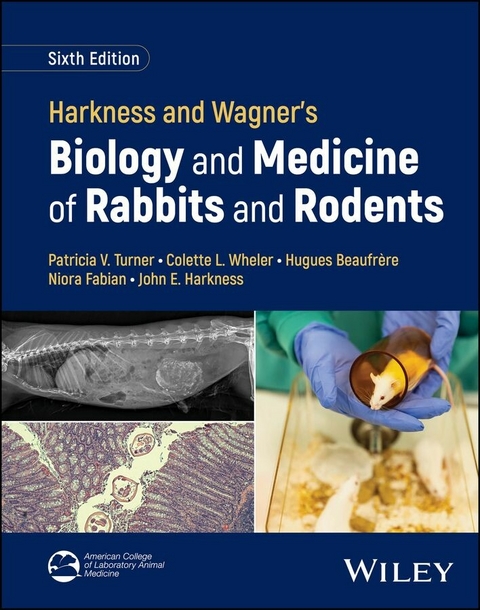
Harkness and Wagner's Biology and Medicine of Rabbits and Rodents (eBook)
1438 Seiten
Wiley (Verlag)
978-1-119-29049-0 (ISBN)
Practical reference on small mammal husbandry and health, now with full-color clinical photographs throughout
The Sixth Edition of Harkness and Wagner's Biology and Medicine of Rabbits and Rodents provides a thorough update to the classic reference on small mammal health and husbandry, now with full-color clinical photographs throughout. Part of ACLAM's series of laboratory animal books, the book is a comprehensive, practical guide to caring for rabbits, guinea pigs, hamsters, gerbils, mice, rats, and chinchillas. Emphasizing biology, contemporary husbandry, diagnostics and clinical procedures, clinical signs, and diseases and conditions, the book is equally useful in the research, companion animal practice, or food animal setting.
New topics for the Sixth Edition include environmental monitoring for rodent health assessments, behavioral management considerations for optimizing animal health, enhanced pain assessment approaches, as well as considerations for creating a welfare-friendly small mammal practice. The Sixth Edition also updates common therapeutics, analgesics, anesthetics, and blood collection methodology, disease biology, husbandry, diagnostic modalities, and references, and covers new techniques for creating and modifying genetically engineered rodents.
Harkness and Wagner's Biology and Medicine of Rabbits and Rodents includes information on:
- General husbandry and disease prevention, covering equipment needs, factors predisposing to disease, and occupational health and safety issues
- Clinical procedures, covering hematology, clinical chemistry, urinalysis, surgery, post-operative care, dentistry, ophthalmology, and imaging
- Clinical signs and differential diagnoses, covering astroviruses, hepatitis E and leporid herpesvirus-4 for rabbits and antimicrobial resistance for commercial rabbits
- Serologic testing and diagnostic sample submission, covering newer methodologies, environmental monitoring, and considerations for large rodent feeder-breeder operations
The Sixth Edition of Harkness and Wagner's Biology and Medicine of Rabbits and Rodents is an essential reference for veterinary professionals dealing with small mammal species in research or practice settings, as well as veterinary students interested in small animals, comparative medicine, or laboratory animal medicine.
The Authors
Patricia V. Turner, BSc, MS, DVM, DVSc, DACLAM, DABT, DECAWBM (AWSEL) is a University Professor Emerita at the University of Guelph in Guelph, Ontario, Canada with over 30 years of experience in clinical practice, education, research, and national and international policy development with research and food animals.
Colette L. Wheler, BSc, DVM, MVetSc, recently retired from her position as Manager of Veterinary Research Services at the Vaccine and Infectious Disease Organization, University of Saskatchewan, Saskatoon, Saskatchewan, Canada. Dr. Wheler has over 20 years' experience in laboratory animal medicine and over 15 years' experience working with small mammal pets.
Hugues Beaufrère, Dr. Med. Vet., PhD, DACZM, DABVP (Avian), DECZM (Avian), is an Associate Professor in the Department of Medicine and Epidemiology at the University of California - Davis, School of Veterinary Medicine, Davis, California, USA.
Niora Fabian, DVM, MS, DACLAM, is a Research/Clinical Veterinarian at the Massachusetts Institute of Technology, in Cambridge, MA, USA.
John E. Harkness, DVM, MS, DACLAM, now deceased, was Professor Emeritus of the College of Veterinary Medicine at Mississippi State University in Mississippi State, Mississippi, USA.
Practical reference on small mammal husbandry and health, now with full-color clinical photographs throughout The Sixth Edition of Harkness and Wagner s Biology and Medicine of Rabbits and Rodents provides a thorough update to the classic reference on small mammal health and husbandry, now with full-color clinical photographs throughout. Part of ACLAM s series of laboratory animal books, the book is a comprehensive, practical guide to caring for rabbits, guinea pigs, hamsters, gerbils, mice, rats, and chinchillas. Emphasizing biology, contemporary husbandry, diagnostics and clinical procedures, clinical signs, and diseases and conditions, the book is equally useful in the research, companion animal practice, or food animal setting. New topics for the Sixth Edition include environmental monitoring for rodent health assessments, behavioral management considerations for optimizing animal health, enhanced pain assessment approaches, as well as considerations for creating a welfare-friendly small mammal practice. The Sixth Edition also updates common therapeutics, analgesics, anesthetics, and blood collection methodology, disease biology, husbandry, diagnostic modalities, and references, and covers new techniques for creating and modifying genetically engineered rodents. Harkness and Wagner s Biology and Medicine of Rabbits and Rodents includes information on: General husbandry and disease prevention, covering equipment needs, factors predisposing to disease, and occupational health and safety issuesClinical procedures, covering hematology, clinical chemistry, urinalysis, surgery, post-operative care, dentistry, ophthalmology, and imagingClinical signs and differential diagnoses, covering astroviruses, hepatitis E and leporid herpesvirus-4 for rabbits and antimicrobial resistance for commercial rabbitsSerologic testing and diagnostic sample submission, covering newer methodologies, environmental monitoring, and considerations for large rodent feeder-breeder operations The Sixth Edition of Harkness and Wagner s Biology and Medicine of Rabbits and Rodents is an essential reference for veterinary professionals dealing with small mammal species in research or practice settings, as well as veterinary students interested in small animals, comparative medicine, or laboratory animal medicine.
Chapter 1
Introduction, General Husbandry, and Disease Prevention
INTRODUCTION
Populations of rabbits, rodents, and other small mammal pets are difficult to estimate; however, a 2017 study conducted by the American Veterinary Medical Association (AVMA) estimated that more than 13% of US families keep these species as companion animals, including approximately 3.2 million rabbits, 1.4 million guinea pigs, 1.1 million hamsters, and 470,000 gerbils. However, only about 1.8% of these owners obtain annual veterinary care for their small mammal companions.
Numbers of animals used in research are also difficult to determine because of the limitations of applicable surveys and estimates where fixed data do not exist. Based on United States Department of Agriculture Animal and Plant Health Inspection Service (USDA‐APHIS) data, approximately 107,000 hamsters, 197,000 guinea pigs, and 144,000 rabbits were used in the United States in research, testing, and teaching in 2021, whereas many fewer numbers of gerbils and chinchillas were used. The numbers of rats and mice used are significantly more difficult to estimate because these data are not collected or reported by US federal agencies. Approximately 1.3 million mice were used in Canada in 2022, and this accounted for 38% of animals used in research (www.ccac.ca). Estimates of mice used in the United States in biomedical research range from 6 to 20 million mice per year. It is even more difficult to find accurate references for numbers of rats used annually in research, although estimates of up to four million have been suggested. Mice and rats are typically thought to account for up to 85% of all animals used in research in the United States, although significant numbers of fish, poultry, swine, and cattle are also used for food and fiber research. Availability of genetically characterized strains and stocks with increased relevance to the diseases being studied, sequencing of the mouse and rat genomes (completed in 2002 and 2004, respectively), development of new transgenic technologies, and ease and economy of housing large numbers of animals have significantly contributed to the popularity of rodents as models for many aspects of biomedical research.
Rabbits are the third most common farmed animal species in the world with almost one billion slaughtered annually, and global production increased by almost 10% between 2008 and 2018. In 2020, China accounted for ~38% of world production of rabbit meat with approximately 314 million rabbits produced annually, followed by Europe at 20% with 117 million rabbits (http://faostat.fao.org/en). Both the United States and Canada account for a negligible amount of world rabbit meat production. Production is by and large proportional to per capita consumption, as rabbit meat is rarely exported from North America; however, increasing amounts of rabbit meat are being incorporated into premium companion animal feeds, necessitating import of frozen rabbit meat from outside of North America. Specific legislation covering meat rabbit production and welfare is lacking in many countries, including the European Union and China, although a new rabbit code of practice was published in Canada in 2018.
With the exception of China, the number of rabbits used for fur, felt, and pelt production is much lower than the number raised for food consumption. Rabbit pelts harvested at slaughter for meat are typically of poor quality, as breed, age at harvest, time of year, and husbandry conditions differ significantly for optimal production of meat compared with pelts. Rex rabbits are the primary breed used for pelt harvest, whereas angora rabbit hair is brushed and shorn regularly for yarn production and weaving. China is the world's largest producer of rabbit pelts and angora fiber today, but the industry lacks national welfare oversight and standards, bringing into question the ethics of angora fur production.
Chinchillas have been used by humans as a source of pelts for clothing for centuries, a practice that drove them to near extinction in the wild in the early twentieth century. In 1983, it was estimated that the United States led production of chinchilla pelts, but by the late twentieth century, South American and eastern European suppliers significantly outpaced US and Canadian production. The industry is decreasing in size with a global estimated production of 80,000 pelts in 2023. Public perception about the use of animal pelts for fashion has led to development of specific industry husbandry guidelines as well as US state bans, and other country bans on fur farming.
While veterinary care is relevant for all the aforementioned reasons, the subjects of this book—rabbits, guinea pigs, chinchillas, hamsters, gerbils, mice, and rats—are becoming increasingly popular as companion animals. As a result, veterinary practitioners should expect to see them as patients, regardless of whether they work in exotic specialty practices or more traditional veterinary animal clinics.
Certainly, the human–animal bond applies regardless of animal size, and companion rabbit or rodent owners are often frustrated in their attempts to find veterinarians who are knowledgeable about their small mammal companions. Problems of management and husbandry are often at the root of several disease conditions and can often be addressed by appropriate client education. Small mammal practice does require a modicum of special knowledge; however, careful extrapolation of experiences from other small animals (i.e., dogs and cats) to rabbits and rodents is often useful and appropriate. Common disease conditions not encountered in dogs and cats must be understood though, before attending to small mammal species, such as specific gastrointestinal conditions, antimicrobial sensitivities, dentistry issues, and various infectious diseases, including some that are zoonotic. Small animal clinicians can become competent with most small mammal problems through continuing professional development, and practitioners inclined to develop a client base in this area should not be deterred because of a perceived lack of specialized veterinary training.
Veterinary clinicians are likely to encounter rabbits and rodents in a wide spectrum of situations, presenting a significant challenge when compiling literature regarding management of health and diseases of these species. For example, rabbits and rodents are produced by commercial breeders for the purposes of research and testing. Most animals raised in this manner are reared in specific pathogen‐free (SPF) barriers that preclude introduction of disease agents, and they are sold to research establishments that maintain highly controlled environments for housing these animals. Because of the sophisticated nature of some research, these animals are usually defined physiologically, genetically, and microbiologically. In contrast, rodents and rabbits in the retail pet trade have less certain genetic identification and health histories, and are often managed in ways that do not limit disease transmission among species and conspecifics, including mixing of species from different sources in large distribution centers. Commercial breeding operations for food and fiber production are intermediate between these two scenarios, emphasizing production as a goal, and employing management schemes that result in yet a third spectrum of disease issues. For example, in rabbits, the prevalence of certain diseases tends to be radically different between companion, laboratory, and meat animals. Therefore, medical challenges for private practitioners evaluating small mammal pets are substantially different from those seen by institutional laboratory animal veterinarians, and veterinarians treating animals in meat or fiber operations.
Early literature describing the attributes of these species originated from the laboratory animal and commercial breeder industry; however, more recent texts have been developed with the private practitioner in mind, adopting an individual animal approach versus a herd health approach to treatment. Although the biology, physiology, and disease susceptibility of animals reared and kept for research or as companion animals are similar, differences in purpose and management requirements should be kept in mind when reviewing the available literature on these animals. For example, housing requirements for mice held in a laboratory animal facility emphasize environmental and microbiological controls for the sake of experimental uniformity. These standards may exceed practical recommendations for owners rearing fancy mice for show or breeding rodent prey for reptile feeding. Diseases described in the laboratory animal literature are typically those seen in specific strains and ages most commonly used for research (i.e., SPF, genetically defined stocks of rodents, and New Zealand white rabbits) and are likely to differ substantially from common conditions of rodents purchased at the local pet store, chinchillas managed in a production setting or neutered geriatric house rabbits. Treatment of animals reared for food or fur production may be limited due to the impact of drug residues or damage to pelts. Thus, it is important to use professional judgment when evaluating the literature and to consider the differences in management and purpose when formulating an appropriate diagnostic and therapeutic plan for each case.
SOURCES OF INFORMATION
References for veterinarians who see rabbits and rodents in private practice are readily available. Web resources abound, but should be regarded with some caution if...
| Erscheint lt. Verlag | 9.4.2025 |
|---|---|
| Sprache | englisch |
| Themenwelt | Veterinärmedizin |
| Schlagworte | ferret care • gerbil care • guinea pig care • hamster care • laboratory animals • mice care • rabbit care • rat care • rodent care • small animal husbandry • small mammal disease prevention • small mammal health • small mammal safety |
| ISBN-10 | 1-119-29049-X / 111929049X |
| ISBN-13 | 978-1-119-29049-0 / 9781119290490 |
| Informationen gemäß Produktsicherheitsverordnung (GPSR) | |
| Haben Sie eine Frage zum Produkt? |
 EPUB (Adobe DRM)
Kopierschutz: Adobe-DRM
Adobe-DRM ist ein Kopierschutz, der das eBook vor Mißbrauch schützen soll. Dabei wird das eBook bereits beim Download auf Ihre persönliche Adobe-ID autorisiert. Lesen können Sie das eBook dann nur auf den Geräten, welche ebenfalls auf Ihre Adobe-ID registriert sind.
Details zum Adobe-DRM
Dateiformat: EPUB (Electronic Publication)
EPUB ist ein offener Standard für eBooks und eignet sich besonders zur Darstellung von Belletristik und Sachbüchern. Der Fließtext wird dynamisch an die Display- und Schriftgröße angepasst. Auch für mobile Lesegeräte ist EPUB daher gut geeignet.
Systemvoraussetzungen:
PC/Mac: Mit einem PC oder Mac können Sie dieses eBook lesen. Sie benötigen eine
eReader: Dieses eBook kann mit (fast) allen eBook-Readern gelesen werden. Mit dem amazon-Kindle ist es aber nicht kompatibel.
Smartphone/Tablet: Egal ob Apple oder Android, dieses eBook können Sie lesen. Sie benötigen eine
Geräteliste und zusätzliche Hinweise
Buying eBooks from abroad
For tax law reasons we can sell eBooks just within Germany and Switzerland. Regrettably we cannot fulfill eBook-orders from other countries.
aus dem Bereich