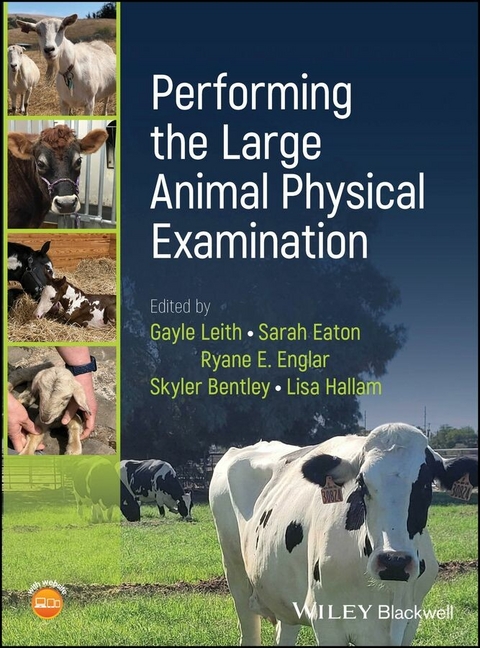
Performing the Large Animal Physical Examination (eBook)
625 Seiten
Wiley-Blackwell (Verlag)
978-1-119-83036-8 (ISBN)
Easy-to-follow guide to performing physical examinations on horses and ruminants, with a comprehensive collection of color photographs demonstrating important concepts and procedural techniques.
Featuring hundreds of full-color images demonstrating the observation and hands-on clinical skills described, Performing the Large Animal Physical Examination offers a step-by-step guide to all aspects of assessing the health and wellbeing of equine patients and ruminants. Cattle, sheep, and goats are emphasized, with vital commentary about camelids included when applicable.
Each section begins with information on observing, approaching, and safely handling patients, then discusses how to systematically evaluate each body system. A companion website features video clips demonstrating key concepts.
Performing the Large Animal Physical Examination includes information on:
- Equine and ruminant behavior, including feeding, social, herd, and separation behaviors, sleep and rest disturbances, other stereotypies
- The distance examination, observation, and efficient methods to approach and restrain patients, with emphasis on flight zones and point of balance, safety of personnel, and animal welfare
- Big picture considerations with respect to the patient's body, coat, and skin, including coat color and markings, weight and height estimations, and forms of patient identification
- Evaluation of the head (eyes, ears, nose, and throat) as well as the cardiovascular, respiratory, lymphatic, gastrointestinal, reproductive, musculoskeletal, and nervous systems, plus considerations specific to the lameness exam
- Basic clinical procedures and common clinical conditions specific to each body system in horses, small and large ruminants
Performing the Large Animal Physical Examination is an essential resource for students and other veterinary team members to develop comfort and confidence observing, approaching, handling, and examining equine and ruminant patients, as well as for experienced practitioners who may wish to refine their skills and clinical acumen.
The editors
Gayle Leith, MS, DVM, MA, DABVP (Equine Practice) is an Associate Professor of Practice at the University of Arizona College of Veterinary Medicine in Oro Valley, Arizona, USA.
Sarah Eaton, DVM, DACT, CVA, DABVP (Equine Practice), is an Associate Professor of Practice Faculty at the University of Arizona in Oro Valley, Arizona, USA.
Ryane E. Englar, DVM, DABVP (Canine and Feline Practice), is a dual appointment Associate Professor of Practice and the Executive Director of Clinical and Professional Skills at the University of Arizona College of Veterinary Medicine in Oro Valley, Arizona, USA.
Skyler Bentley, BS (Veterinary Science) is the Animal Care Manager on-site at the Campus Agricultural Center (CAC) in Tucson, Arizona, USA for the University of Arizona College of Veterinary Medicine.
Lisa Hallam has been working in veterinary medicine as a Certified Veterinary Technician (CVT) since 1999.
Easy-to-follow guide to performing physical examinations on horses and ruminants, with a comprehensive collection of color photographs demonstrating important concepts and procedural techniques. Featuring hundreds of full-color images demonstrating the observation and hands-on clinical skills described, Performing the Large Animal Physical Examination offers a step-by-step guide to all aspects of assessing the health and wellbeing of equine patients and ruminants. Cattle, sheep, and goats are emphasized, with vital commentary about camelids included when applicable. Each section begins with information on observing, approaching, and safely handling patients, then discusses how to systematically evaluate each body system. A companion website features video clips demonstrating key concepts. Performing the Large Animal Physical Examination includes information on: Equine and ruminant behavior, including feeding, social, herd, and separation behaviors, sleep and rest disturbances, other stereotypiesThe distance examination, observation, and efficient methods to approach and restrain patients, with emphasis on flight zones and point of balance, safety of personnel, and animal welfareBig picture considerations with respect to the patient s body, coat, and skin, including coat color and markings, weight and height estimations, and forms of patient identificationEvaluation of the head (eyes, ears, nose, and throat) as well as the cardiovascular, respiratory, lymphatic, gastrointestinal, reproductive, musculoskeletal, and nervous systems, plus considerations specific to the lameness examBasic clinical procedures and common clinical conditions specific to each body system in horses, small and large ruminants Performing the Large Animal Physical Examination is an essential resource for students and other veterinary team members to develop comfort and confidence observing, approaching, handling, and examining equine and ruminant patients, as well as for experienced practitioners who may wish to refine their skills and clinical acumen.
| Erscheint lt. Verlag | 31.3.2025 |
|---|---|
| Sprache | englisch |
| Themenwelt | Veterinärmedizin |
| Schlagworte | equine behavior • equine body • equine body systems • equine coat • equine coat color • equine halters • equine health • equine markings • equine patient • equine practitioner • Equine safety • equine skin • restraint equine • ruminant patient |
| ISBN-10 | 1-119-83036-2 / 1119830362 |
| ISBN-13 | 978-1-119-83036-8 / 9781119830368 |
| Informationen gemäß Produktsicherheitsverordnung (GPSR) | |
| Haben Sie eine Frage zum Produkt? |
 PDF (Adobe DRM)
Kopierschutz: Adobe-DRM
Adobe-DRM ist ein Kopierschutz, der das eBook vor Mißbrauch schützen soll. Dabei wird das eBook bereits beim Download auf Ihre persönliche Adobe-ID autorisiert. Lesen können Sie das eBook dann nur auf den Geräten, welche ebenfalls auf Ihre Adobe-ID registriert sind.
Details zum Adobe-DRM
Dateiformat: PDF (Portable Document Format)
Mit einem festen Seitenlayout eignet sich die PDF besonders für Fachbücher mit Spalten, Tabellen und Abbildungen. Eine PDF kann auf fast allen Geräten angezeigt werden, ist aber für kleine Displays (Smartphone, eReader) nur eingeschränkt geeignet.
Systemvoraussetzungen:
PC/Mac: Mit einem PC oder Mac können Sie dieses eBook lesen. Sie benötigen eine
eReader: Dieses eBook kann mit (fast) allen eBook-Readern gelesen werden. Mit dem amazon-Kindle ist es aber nicht kompatibel.
Smartphone/Tablet: Egal ob Apple oder Android, dieses eBook können Sie lesen. Sie benötigen eine
Geräteliste und zusätzliche Hinweise
Buying eBooks from abroad
For tax law reasons we can sell eBooks just within Germany and Switzerland. Regrettably we cannot fulfill eBook-orders from other countries.
aus dem Bereich