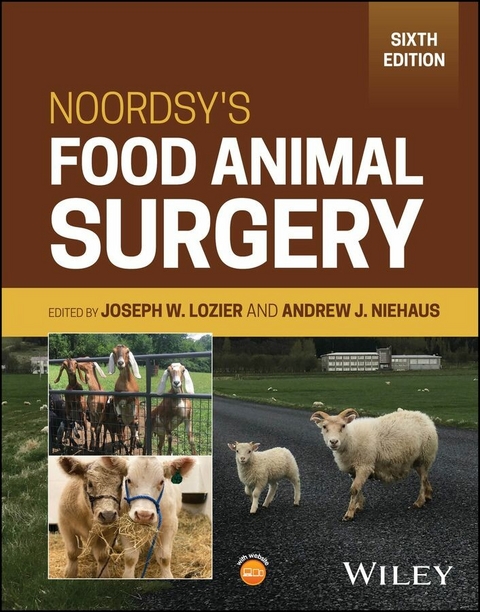
Noordsy's Food Animal Surgery (eBook)
871 Seiten
Wiley (Verlag)
978-1-119-93036-5 (ISBN)
Fully updated new edition of a classic quick reference to common surgical procedures in farm animals
Noordsy's Food Animal Surgery, Sixth Edition is a classic quick reference to surgical procedures in livestock and companion farm animals. With a practical outline format, this book makes it easy to locate essential information on common surgical techniques, presenting 39 chapters across 6 sections for ease of navigation. The book is a helpful memory refresher for procedures or species encountered less frequently, enabling readers to build confidence in learning new surgical techniques.
Chapters review presurgical preparation, perioperative care and restraint, and surgical procedures of the major body systems, and the Sixth Edition has been updated throughout to remove outdated procedures and equipment, making way for new techniques and a focus on evidence-based best practices. Most illustrations have been updated to more accurately depict anatomy, providing surgeons with a clearer understanding of how to perform the procedures, and numerous clinically relevant photographs and illustrations have been added to better convey concepts and techniques.
A companion website allows readers to view and download figures from the text and contains study questions from the end of each chapter along with the answers to those questions.
Noordsy's Food Animal Surgery includes information on:
- Surgical restraint, local, epidural, general, and postoperative anesthesia/analgesia, surgery of the head and neck, and surgical treatment of cattle with ocular disease
- Umbilical hernias and infections, laparotomy, rumenotomy, fistulation, cannulation, pericardiotomy in cattle, abomasal surgery, surgical treatment of intestinal disease, and rectal prolapse repair
- Surgical treatment of the male and female urogenital systems including conditions associated with urolithiasis and mammary surgery
- Ligament and tendon surgery, foot and claw surgery, joint surgery, and common fractures and dislocations
Noordsy's Food Animal Surgery is an essential resource for veterinary students and large animal practitioners who care for farm animals.
The editors
Joseph W. Lozier, DVM, MS, DACVS-LA, is a Clinical Associate Professor in the Department of Veterinary Clinical Sciences at The Ohio State University in Columbus, Ohio, USA.
Andrew J. Niehaus, DVM, MS, DACVS-LA, is a Clinical Professor in the Department of Veterinary Clinical Sciences at The Ohio State University in Columbus, Ohio, USA.
Fully updated new edition of a classic quick reference to common surgical procedures in farm animals Noordsy s Food Animal Surgery, Sixth Edition is a classic quick reference to surgical procedures in livestock and companion farm animals. With a practical outline format, this book makes it easy to locate essential information on common surgical techniques, presenting 39 chapters across 6 sections for ease of navigation. The book is a helpful memory refresher for procedures or species encountered less frequently, enabling readers to build confidence in learning new surgical techniques. Chapters review presurgical preparation, perioperative care and restraint, and surgical procedures of the major body systems, and the Sixth Edition has been updated throughout to remove outdated procedures and equipment, making way for new techniques and a focus on evidence-based best practices. Most illustrations have been updated to more accurately depict anatomy, providing surgeons with a clearer understanding of how to perform the procedures, and numerous clinically relevant photographs and illustrations have been added to better convey concepts and techniques. A companion website allows readers to view and download figures from the text and contains study questions from the end of each chapter along with the answers to those questions. Noordsy s Food Animal Surgery includes information on: Surgical restraint, local, epidural, general, and postoperative anesthesia/analgesia, surgery of the head and neck, and surgical treatment of cattle with ocular diseaseUmbilical hernias and infections, laparotomy, rumenotomy, fistulation, cannulation, pericardiotomy in cattle, abomasal surgery, surgical treatment of intestinal disease, and rectal prolapse repairSurgical treatment of the male and female urogenital systems including conditions associated with urolithiasis and mammary surgeryLigament and tendon surgery, foot and claw surgery, joint surgery, and common fractures and dislocations Noordsy s Food Animal Surgery is an essential resource for veterinary students and large animal practitioners who care for farm animals.
Chapter 1
General Surgical Considerations
Andrew J. Niehaus
Veterinary Clinical Sciences, College of Veterinary Medicine, The Ohio State University, Columbus, OH, USA
Determining Surgical Candidacy
A formula for determining if a patient is a surgical candidate does not exist, but the following should be considered:
- Patient factors
- Does the diagnosis warrant surgery?
- Do nonsurgical options exist?
- Is the patient healthy enough for surgery? What are the risks of surgery to the patient? Risks of not performing surgery? (Note these risks may be different depending on the surgical procedure, approach, anesthesia employed, etc.).
- Owner factors
- Do expected outcomes meet the client's expectations?
- Available finances versus cost of the procedure.
- External factors
- Facilities and equipment available.
- Knowledge and surgical expertise available.
- Is the animal insured? – Contact the insurance company before procedure.
Preoperative Procedures
Medical History (Anamnesis)
- Assessment of all patients should begin with a detailed history.
- Begin with broad, open‐ended questions that allow the client to elaborate on their observations. Focus on objective observations related to the case; avoid tunnel vision associated with owner interpretations of the findings.
- Important historical information includes clinical signs, chronicity, onset, information regarding nutrition, the patient's environment, age, parity, stage of lactation (if applicable), and previous disease.
- Ascertain if treatment has been attempted. What was the response to treatment?
- A medical history template can aid clinicians in gathering an accurate history (Figure 1‐1).
FIGURE 1‐1. An example template that can be used to guide history taking on a farm animal.
Physical Examination (PE)
- Arguably the most important diagnostic tool. Most conditions are diagnosed with a PE.
- Develop a systematic approach – avoids tunnel vision once problems are identified and keeps the clinician from forgetting elements of PE. PE should be thorough but efficient; efficiency will increase with experience.
- Start PE with an observational assessment of the animal.
- A templated datasheet can be helpful to record information as well as guide the clinician and avoid omissions (Figure 1‐2).
- In cattle, end PE with an examination of the head as this is most likely to make the patient nervous.
Clinical Diagnostics
- Prioritize tests that are likely to impact therapy.
- Consider tests that can be performed patient side and yield quick and accurate results. Examples include urine dipstick and fecal occult blood.
- Diagnostic imaging may not be an option in field situations; however, portable, digital, radiographic equipment is becoming common. Portable units usually are limited to imaging of extremities; portable machines lack the power to image the proximal limbs of cattle or the chest/abdomen of large patients. Portable ultrasound units are common in large animal reproductive work; however, their utility may be extended to other nonreproductive applications.
Examination Template
A physical exam template may be useful to guide clinicians in performing a PE. Many templates exist and often should be modified by the clinician to suit their individual needs. Figure 1‐2 is an example of a physical exam template that may be used.
Surgical Facilities
- In a farm setting, a properly selected surgical location will improve the surgical outcome.
- The ideal surgical facility should take into account:
- Accessibility of the patient, surgical personnel, and equipment
- Adequate and safe patient restraint (see Chapter 2)
- Footing for the standing patient and adequate drainage
- Adequate lighting to safely and efficiently perform the procedure
- If utilizing sunlight, consider time of day and estimated procedure length as the lighting may change.
- Access to clean, hot, and cold running water
- Protection from environmental conditions:
- Rain
- Temperature extremes
- Wind
- Dust
- Flying insects
Restriction of Food and Water in Elective Surgery
- Ruminants placed in lateral or dorsal recumbency should have restricted intake:
- Roughage for 48 hours.
- Concentrate for 24 hours.
- Water for 12 hours.
- Note that over‐fasting ruminants may result in rumen contents that are more watery than normal and are more easily regurgitated.
- Neonates or animals fed exclusively a milk diet require no food or water restriction.
FIGURE 1‐2. An example template that can be used to guide a complete physical exam on a farm animal.
- Monogastric patients should have restricted intake:
- Feed for 24 hours.
- Water for 12 hours.
Preoperative Medications
- Antibiotics
- Preoperative antibiotics are indicated for patients with likely surgical contamination (e.g., umbilical abscess and open wounds).
- Sedatives and tranquilizers
- Keep animals calm before anesthesia; doing so will reduce aesthetic complications and produce a smoother recovery.
- Ruminants frequently do not require sedation prior to surgical procedures.
- See Chapter 5 for details of drugs used and dosages.
- Over‐sedated livestock may lie down.
- Commonly used drugs (often used in combination)
- Acepromazine maleate
- Xylazine
- Ketamine
- Butorphanol tartrate
- Effect depends on dose and route of administration.
- Analgesics
- Butorphanol tartrate
- May be used alone or in combination with sedatives and tranquilizers.
- Not approved by the United States Food and Drug Administration (FDA) for food animals.
- May cause excitement and a rough recovery from general anesthesia.
- Flunixin meglumine
- A nonsteroidal anti‐inflammatory drug (NSAID) that has a label for food animals (unless justification exists) should be the first NSAID used.1
- Dose = 1 mg/kg (IV or transdermal only in cattle; IM in pigs).
- Does not have FDA approval for all food animal species.
- Pharmacodynamic properties.
- Analgesic
- Antipyretic
- Anti‐endotoxic
- May be ulcerogenic at high doses or with prolonged use.
- Meloxicam
- No label for food‐producing species in the United States (all use is considered ELDU); Animal Medicinal Drug Use Clarification Act (AMDUCA) regulates extra‐label use of FDA‐approved drugs.1
- Labeled for use in Canada and the European Union2
- 1.0 mg/kg PO for analgesia following castration in calves.
- 0.5 mg/kg SC for analgesia following dis‐budding and abdominal surgery.
- Other NSAIDs
- Aspirin is not recommended due to low efficacy, short duration, and ulcerogenic properties.
- Phenylbutazone (bute) not recommended in ruminants.
- All use is considered extra label.
- Erratic pharmacokinetic properties with variable elimination across species leads to long withdrawal times.
- Prohibited from use in dairy cattle 20 months of age and older.
- Butorphanol tartrate
Preparing the Surgical Site
- General Considerations
- Prepare surgical site with wide margins (at least 6 inches adjacent to the intended surgical incision).
- Be neat: A client’s interpretation of surgery is often based on the appearance (i.e., the neatness) of the surgical site and skin sutures.
- Supplies needed
- Cotton rope clothesline (10 foot length)
- Soft brush or curry comb
- Surgical clipper blade (#10 or #40)
- Stiff scrub brush
- Dish soap
- Chlorhexidine or iodine‐based surgical scrub
- 70% isopropyl alcohol
- Disposable or reusable cloth sterile surgical drapes
- With a soft brush and comb, remove all loose debris from the animal.
- Remove excess hair with a #10 or #40 head clipper. Dirty animals may require “pre‐clipping” with a larger clipper.
- For cattle undergoing standing procedures, secure the tail to the side with a tail tie to prevent contamination of the surgical site by the tail (see Chapter 2).
- Rough scrub with liberal amounts of soap or surgical scrub and water. Dish detergent works well to remove debris and natural oils from the skin. Commercially available antiseptic scrubs also contain detergents that are effective.
- Following a rough scrub, a minimum of two scrub and rinse cycles with an antiseptic scrub solution is recommended. Most commonly chlorhexidine or...
| Erscheint lt. Verlag | 12.3.2025 |
|---|---|
| Sprache | englisch |
| Themenwelt | Veterinärmedizin |
| Schlagworte | farm animal surgery • large animal analgesia • large animal injury • large animal surgery • livestock analgesia • livestock hernia • livestock injury • livestock intestinal obstruction • livestock reproductive system • livestock surgery |
| ISBN-10 | 1-119-93036-7 / 1119930367 |
| ISBN-13 | 978-1-119-93036-5 / 9781119930365 |
| Informationen gemäß Produktsicherheitsverordnung (GPSR) | |
| Haben Sie eine Frage zum Produkt? |
 EPUB (Adobe DRM)
Kopierschutz: Adobe-DRM
Adobe-DRM ist ein Kopierschutz, der das eBook vor Mißbrauch schützen soll. Dabei wird das eBook bereits beim Download auf Ihre persönliche Adobe-ID autorisiert. Lesen können Sie das eBook dann nur auf den Geräten, welche ebenfalls auf Ihre Adobe-ID registriert sind.
Details zum Adobe-DRM
Dateiformat: EPUB (Electronic Publication)
EPUB ist ein offener Standard für eBooks und eignet sich besonders zur Darstellung von Belletristik und Sachbüchern. Der Fließtext wird dynamisch an die Display- und Schriftgröße angepasst. Auch für mobile Lesegeräte ist EPUB daher gut geeignet.
Systemvoraussetzungen:
PC/Mac: Mit einem PC oder Mac können Sie dieses eBook lesen. Sie benötigen eine
eReader: Dieses eBook kann mit (fast) allen eBook-Readern gelesen werden. Mit dem amazon-Kindle ist es aber nicht kompatibel.
Smartphone/Tablet: Egal ob Apple oder Android, dieses eBook können Sie lesen. Sie benötigen eine
Geräteliste und zusätzliche Hinweise
Buying eBooks from abroad
For tax law reasons we can sell eBooks just within Germany and Switzerland. Regrettably we cannot fulfill eBook-orders from other countries.
aus dem Bereich