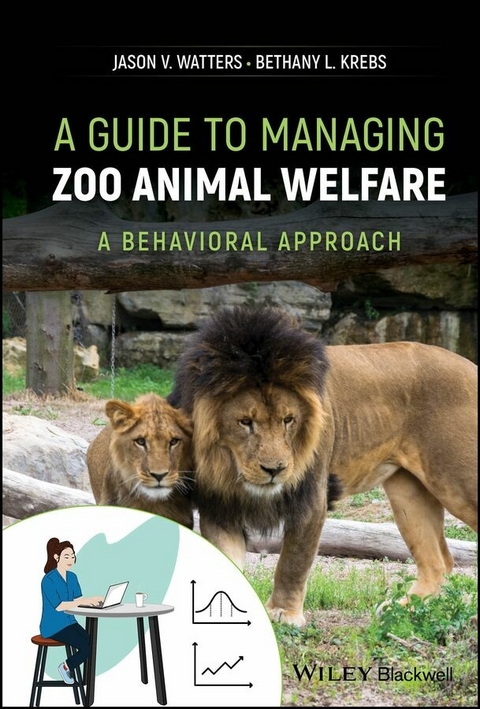
A Guide to Managing Zoo Animal Welfare (eBook)
348 Seiten
Wiley-Blackwell (Verlag)
978-1-118-88481-2 (ISBN)
Comprehensive reference detailing behavioral assessment techniques, behavioral approaches, and practical tools for animal welfare across different species
A Guide to Managing Zoo Animal Welfare delivers a step-by-step guide to behavioral assessment approaches, techniques, and tools for animal welfare with an emphasis on animals living in zoos and aquaria. The authors develop a unique 'balance-based' approach that can be used to assess and enhance the welfare of a diverse range of species. Backed by extensive scientific literature, this book also provides foundational context to help readers to understand why the authors give these recommendations and guidelines.
This book is divided into three sections. Section I details background concepts and goals, discussing the animal mind through neuroscience, psychology, and behavior, even questioning wild animal behavior's validity as a template for captive animal behavior. Section II details the core behavioral Needs of animals, investigating, acquiring rewards, and exerting control. Section III explains how to practically assess if animals' Needs are met and address deficiencies, covering topics like food, space, and social rewards and methods to make environments dynamic.
A Guide to Managing Zoo Animal Welfare includes information on:
- Proximate and ultimate reasoning for the existence of each of the Needs
- Welfare benefits of meeting the Needs, including positive affect, maintaining homeostasis, passing on genes, and learning through reinforcement
- The highly variable personalities of individual animals and different animal species, as well as why personality is an important facet of animal welfare
- A guide for assessing animal welfare using the Three Needs model
Presenting highly unique insight and a novel approach, A Guide to Managing Zoo Animal Welfare is an essential learning resource for professional animal behaviorists in zoos and aquaria, researchers in animal behavior and animal welfare, and students in veterinary sciences and zoology programs of study.
Jason V. Watters, Adjunct Associate Professor, Animal Science, University of California, Davis, California, USA
Bethany L. Krebs, Executive Editor of Zoo Biology, San Francisco, California, USA
Comprehensive reference detailing behavioral assessment techniques, behavioral approaches, and practical tools for animal welfare across different species A Guide to Managing Zoo Animal Welfare delivers a step-by-step guide to behavioral assessment approaches, techniques, and tools for animal welfare with an emphasis on animals living in zoos and aquaria. The authors develop a unique balance-based approach that can be used to assess and enhance the welfare of a diverse range of species. Backed by extensive scientific literature, this book also provides foundational context to help readers to understand why the authors give these recommendations and guidelines. This book is divided into three sections. Section I details background concepts and goals, discussing the animal mind through neuroscience, psychology, and behavior, even questioning wild animal behavior s validity as a template for captive animal behavior. Section II details the core behavioral Needs of animals, investigating, acquiring rewards, and exerting control. Section III explains how to practically assess if animals Needs are met and address deficiencies, covering topics like food, space, and social rewards and methods to make environments dynamic. A Guide to Managing Zoo Animal Welfare includes information on: Proximate and ultimate reasoning for the existence of each of the NeedsWelfare benefits of meeting the Needs, including positive affect, maintaining homeostasis, passing on genes, and learning through reinforcementThe highly variable personalities of individual animals and different animal species, as well as why personality is an important facet of animal welfareA guide for assessing animal welfare using the Three Needs model Presenting highly unique insight and a novel approach, A Guide to Managing Zoo Animal Welfare is an essential learning resource for professional animal behaviorists in zoos and aquaria, researchers in animal behavior and animal welfare, and students in veterinary sciences and zoology programs of study.
1
Background Concepts and Goals
Keeping Animals
For many reasons, people manage numerous species of animals in what we most frequently refer to as captive conditions. Now, more than ever before, there is a major emphasis on the psychological well‐being of the animals cared for in any industry of which they are a part. In this book, it will seem as if we make a distinction between wild or exotic captive animals and domestic animals and focus our examples on the former. This is not to say that the concepts developed here are not also applicable to domestic animals. Our focus on exotics is aimed at the development of a general approach. We develop this approach for two primary reasons. One reason is that the environments and behavioral outcomes associated with them that non‐domestic animals live in under human care are a traditional focus of inquiry when it comes to assessing the psychological state of these animals. Less frequently do we compare the domestic animal’s environment with their wild counterpart’s. Such comparisons are not realistic because, due to artificial selection for domestication, there is no naturally selected wild counterpart to a derived domestic animal. Who is to say that the behavior of the feral mustang is the standard to which the barnyard stallion should be held? A dog is not the same animal as a wolf. Instead, but for subtly different reasons, we compare domestic animals to what we know of their wild ancestors – who are most commonly extinct. The dog and the wolf may have shared an ancestor in the form of some ancient extinct wolf, but they have since gone their separate ways. Nevertheless, an understanding of the evolutionary history of the dog and the wolf is likely to support, not guarantee, caring for either animal in the modern world – regardless of the environment we find them in. Thus, by focusing on wild, exotic animals, we hope to emphasize the point that the psychological care of animals is not dependent on the exact replication of the environmental conditions under which the animals live in the wild. We also hope to emphasize that it is possible to develop a general approach to thinking about and supporting animals’ psychological well‐being that can be used to care for individuals of numerous species, wild and domestic.
As a result of evolution’s slow progression of tinkering on a core blueprint, there are fundamental similarities across species that support the application of a general approach to promoting animal welfare. Most of us are aware of some of these similarities, such as the generalized vertebrate body plan, but they also include subcortical emotional circuitry that is also widespread in the animal kingdom. The Cambridge Declaration on Consciousness (2012) resulted from a gathering of prominent neuroscientists with varied specializations in anatomy, physiology, pharmacology, and cognition. In developing the Declaration, these experts considered the convergence of evidence that indicates that nonhuman animals, both vertebrate and invertebrate, possess the neuroanatomy that generates and processes affective states. Experimental evidence shows that when these subcortical brain structures are stimulated, behaviors expressed are like those expressed when humans or other animals experience rewarding or punishing affective situations. The Declaration indicates that these emotional brain regions are present in all mammals and birds and that the neural circuits necessary to promote attentiveness, sleep, and decision‐making arose long enough ago that they are also present in insects and cephalopod mollusks.
The Declaration states that “emotional feelings” arise from a set of subcortical brain regions that are similar across species and that there is adequate evidence to suggest that humans and nonhuman animals possess “evolutionarily shared primal affective qualia.” This is to say that intrinsic self‐assessment of positive and negative feelings is evolutionarily old. All animals do this. While the Declaration makes no statement regarding reptiles, amphibians, or fish, the inclusion of insects, cephalopods, birds, and mammals suggests that these taxa would also be included in the thesis of the Declaration were there adequate data to provide examples. Today, evidence is starting to arise that suggests this is the case. This support comes from studies that demonstrate phenomena such as cognitive bias in bees (Bateson et al., 2011) and anticipatory behavior in fish (Reebs and Lague, 2000, Galhardo et al., 2011) and other species (Anderson et al., 2015, McGrath et al., 2016, Clegg et al., 2018, Podturkin et al., 2023). Animal welfare scientists consider these behavioral responses to reflect animals’ own perception of their affective state (Moe et al., 2006, Van der Harst and Spruijt, 2007).
A description of the core mind here may help to understand some of the justification and techniques described in the chapters that follow. A mind is the cumulative set of traits that enable awareness, decision‐making, memory, and affective response (i.e. internal reflection). Overall – the mind, like other traits, serves a developed function – and that is to assess and relate to the individual information regarding their own state as well as their potential state given their perceived circumstances. An individual’s mind determines the interpretation of circumstances, both cumulative and present, and generates from this determination the individual’s perception of balance. Balance in this way refers to the aggregate assessment of the internal outcomes associated with events the individual experiences. Other authors have referred to this state as mood‐like state (Yang et al., 2013, Mendl and Paul, 2020, Bliss‐Moreau and Rudebeck, 2021). The cumulative emotional experience of an animal builds their mood‐like state (Kremer et al., 2020, Mendl and Paul, 2020). As we hope to apply this thinking to support animal welfare, we use the term “balance” to describe our approach to measuring and managing this state. Experiences are either affectively positive, negative, or neutral (Gasper et al., 2019, Gasper, 2023). Positive and negatively valenced affect can be driven by either tangible outcomes – as in the cases of procuring food or being injured – or intangible ones – as in the cases of information acquisition or becoming fearful. In either case, tangible or intangible outcomes, there is an affective response – essentially, and very simply put, the individual either feels good about the outcome or does not feel good about it. Neutral affective outcomes result in what would appear to be behavioral indifference or a lack of preference (Gasper et al., 2019, Gasper, 2023). The mind thus serves to evaluate these affective outcomes and determine whether the animal should attempt to promote further similar events or avoid them. Thus, the mind serves the function of monitoring and reporting on affective outcomes. At the very least, a balance between positive and negative outcomes ensures that this core mind remains healthy. In this sense, the mind requires specific nurturing and can be unhealthy even when the body appears healthy. While we acknowledge that the brains of many species have evolved to facilitate advanced cognitive abilities, problem‐solving, and even self‐recognition (Roth, 2015, Mitchell, 2016, Gallup Jr and Anderson, 2020), we assert that the core mind is the seat of fundamental emotion, and that affect is a driving force in supporting evolutionary fitness.
Minds, like bodies, need to be nurtured. When an animal does not consistently live in a state where they achieve that balance between positive and negative outcomes, they can be in a state of negative welfare. This negative state is psychologically damaging (Désiré et al., 2002). The primary goal of this book is to provide a general technique to assess animals’ own perspectives of their welfare state and to suggest techniques to provide positive opportunities when an animal is negatively out of balance. Throughout the book, we will refer to animals’ core behavioral Needs, investigating, acquiring rewards, and managing one’s own processes. These core Needs are evolutionarily old and the logic that we will lay out in this book suggests that ensuring that the Needs are met provides for a balanced state of welfare. Our approach is thus a focus on the fifth domain – mental state – of the five domains model of animal welfare (Mellor and Beausoleil, 2015). Throughout, we will capitalize the word Need when we refer to these three Needs as a means to set these Needs apart from other needs that animals may have.
Our concept of animal welfare is a kingdom‐level individual property. It occurs across phyla and is not a species‐level property. There is a reasonable amount of evidence supporting the notion that the three motivational Needs described herein are shared across species and that they are thus of fundamental importance at the level of the kingdom. Phenomena such as cognitive bias in species ranging from bees to bears, anticipatory behavior in species as disparate as rhinoceroses and fish, contra‐freeloading of numerous species of birds and mammals, preferences for enriched spaces from turtles to rats, and widespread reward seeking behaviors support the notion that individuals across the animal kingdom share the motivational Needs we describe. This understanding...
| Erscheint lt. Verlag | 7.1.2025 |
|---|---|
| Sprache | englisch |
| Themenwelt | Naturwissenschaften ► Biologie ► Zoologie |
| Veterinärmedizin ► Großtier ► Zoo- / Wildtier | |
| Schlagworte | animal behavior • Animal conservation • animal environment • animal health • animal intelligence • Animal learning • Animal Science • Animal welfare • micro conservation • needs of wild animals • wildlife conservation • zoo |
| ISBN-10 | 1-118-88481-7 / 1118884817 |
| ISBN-13 | 978-1-118-88481-2 / 9781118884812 |
| Informationen gemäß Produktsicherheitsverordnung (GPSR) | |
| Haben Sie eine Frage zum Produkt? |
 EPUB (Adobe DRM)
Kopierschutz: Adobe-DRM
Adobe-DRM ist ein Kopierschutz, der das eBook vor Mißbrauch schützen soll. Dabei wird das eBook bereits beim Download auf Ihre persönliche Adobe-ID autorisiert. Lesen können Sie das eBook dann nur auf den Geräten, welche ebenfalls auf Ihre Adobe-ID registriert sind.
Details zum Adobe-DRM
Dateiformat: EPUB (Electronic Publication)
EPUB ist ein offener Standard für eBooks und eignet sich besonders zur Darstellung von Belletristik und Sachbüchern. Der Fließtext wird dynamisch an die Display- und Schriftgröße angepasst. Auch für mobile Lesegeräte ist EPUB daher gut geeignet.
Systemvoraussetzungen:
PC/Mac: Mit einem PC oder Mac können Sie dieses eBook lesen. Sie benötigen eine
eReader: Dieses eBook kann mit (fast) allen eBook-Readern gelesen werden. Mit dem amazon-Kindle ist es aber nicht kompatibel.
Smartphone/Tablet: Egal ob Apple oder Android, dieses eBook können Sie lesen. Sie benötigen eine
Geräteliste und zusätzliche Hinweise
Buying eBooks from abroad
For tax law reasons we can sell eBooks just within Germany and Switzerland. Regrettably we cannot fulfill eBook-orders from other countries.
aus dem Bereich