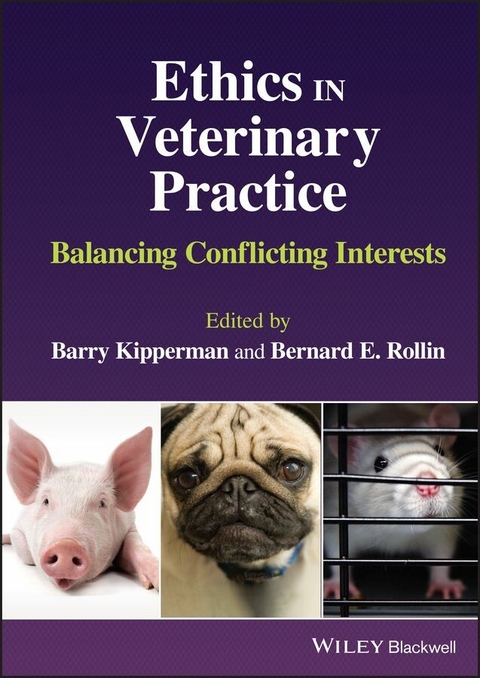
Ethics in Veterinary Practice (eBook)
John Wiley & Sons (Verlag)
978-1-119-79122-5 (ISBN)
An incisive examination of relevant and contemporary ethical issues facing veterinary practitioners, students, instructors, and animal researchers
In Ethics in Veterinary Practice: Balancing Conflicting Interests, a team of distinguished scholars delivers a foundational exploration of animal ethics and a guide to examining contemporary issues and dilemmas that arise regularly in veterinary practice. The book offers comprehensive, quickly accessible, and up-to-date information on veterinary ethics with content devoted to unique issues by practice type.
The authors offer a primary resource for veterinary ethics useful for veterinarians, faculty, instructors, senior undergraduates, and veterinary students that focuses on recognizing and addressing real-life ethical dilemmas and relevant philosophical discussions about the moral status of animals, animal rights, and interests.
Ethics in Veterinary Practice presents material on integrative medicine, animal pain, moral stress, and the future of veterinary ethics. Readers will also find:
- A thorough introduction to a theoretical basis for veterinary ethics, including discussions of animal welfare, ethical theories, and legal issues
- Comprehensive explorations of clinical veterinary ethics, including discussions of veterinary advocacy, ethical dilemmas, professionalism, economic issues, and medical errors
- Practical discussions of ethical concerns by practice type, including companion animals, equines, and animals used for food
- In-depth examination of emerging ethical concerns including animal use in veterinary education and animal maltreatment
Perfect for practicing veterinarians, veterinary students, and veterinary technicians and nurses, Ethics in Veterinary Practice: Balancing Conflicting Interests will also earn a place in the libraries of instructors teaching veterinary ethics, as well as biomedical and animal ethicists.
“As veterinary medicine becomes more technologically and socially complex, interest in ethics is growing. Ethics in Veterinary Practice provides a needed reference from the North American perspective, for anyone facing ethical dilemmas (i.e., all of us). Suitable for practitioners, students, and technicians, the book supplies factual background and practical guidance for navigation accompanied by a clear ethical analysis of common dilemmas in all aspects of veterinary medicine.”
Lisa Moses
Veterinary Specialist in Internal Medicine
Center for Bioethics
Harvard Medical School, USA
“Ethics in Veterinary Practice is a statement of both the influence of Bernie Rollin’s lifetime work and of the coming of age of veterinary ethics. From the moral status of animals to veterinary ethical dilemmas, from medical errors to professionalism, from economic issues to end-of-life decision making, Ethics in Veterinary Practice leaves no stone unturned. A must-read for students and professionals alike.”
Manuel Magalhães Sant'Ana
European Veterinary Specialist in Animal Welfare Science, Ethics and Law
University of Lisbon, Portugal
“This book makes a valuable contribution to the subject, hosting writing from a number of prominent scholars in the field. The book bravely tackles several contemporary issues including veterinary corporations, moral stress and medical errors as well as providing updated insights into the history of the profession and veterinary professionalism. Throughout, the complex and contested place of animals within our society is openly and thoughtfully explored from a veterinary perspective. “
Vanessa Ashall
European Veterinary Specialist in Animal Welfare Science, Ethics and Law
University of York, UK
Barry Kipperman is Instructor of Veterinary Ethics at the University of California at Davis, School of Veterinary Medicine, and Adjunct Associate Professor in the Department of Veterinary Medicine and Surgery, University of Missouri.
Bernard E. Rollin was a University Distinguished Professor and Professor of Philosophy, Animal Sciences, and Biomedical Sciences, as well as University Bioethicist at Colorado State University. He was the author of more than 20 books, including Animal Rights and Human Morality.
Ethics IN Veterinary Practice An incisive examination of relevant and contemporary ethical issues facing veterinary practitioners, students, instructors, and animal researchers In Ethics in Veterinary Practice: Balancing Conflicting Interests, a team of distinguished scholars delivers a foundational exploration of animal ethics and a guide to examining contemporary issues and dilemmas that arise regularly in veterinary practice. The book offers comprehensive, quickly accessible, and up-to-date information on veterinary ethics with content devoted to unique issues by practice type. The authors offer a primary resource for veterinary ethics useful for veterinarians, faculty, instructors, senior undergraduates, and veterinary students that focuses on recognizing and addressing real-life ethical dilemmas and relevant philosophical discussions about the moral status of animals, animal rights, and interests. Ethics in Veterinary Practice presents material on integrative medicine, animal pain, moral stress, and the future of veterinary ethics. Readers will also find: A thorough introduction to a theoretical basis for veterinary ethics, including discussions of animal welfare, ethical theories, and legal issues Comprehensive explorations of clinical veterinary ethics, including discussions of veterinary advocacy, ethical dilemmas, professionalism, economic issues, and medical errors Practical discussions of ethical concerns by practice type, including companion animals, equines, and animals used for food In-depth examination of emerging ethical concerns including animal use in veterinary education and animal maltreatment Perfect for practicing veterinarians, veterinary students, and veterinary technicians and nurses, Ethics in Veterinary Practice: Balancing Conflicting Interests will also earn a place in the libraries of instructors teaching veterinary ethics, as well as biomedical and animal ethicists. As veterinary medicine becomes more technologically and socially complex, interest in ethics is growing. Ethics in Veterinary Practice provides a needed reference from the North American perspective, for anyone facing ethical dilemmas (i.e., all of us). Suitable for practitioners, students, and technicians, the book supplies factual background and practical guidance for navigation accompanied by a clear ethical analysis of common dilemmas in all aspects of veterinary medicine. Lisa MosesVeterinary Specialist in Internal MedicineCenter for BioethicsHarvard Medical School, USA Ethics in Veterinary Practice is a statement of both the influence of Bernie Rollin s lifetime work and of the coming of age of veterinary ethics. From the moral status of animals to veterinary ethical dilemmas, from medical errors to professionalism, from economic issues to end-of-life decision making, Ethics in Veterinary Practice leaves no stone unturned. A must-read for students and professionals alike. Manuel Magalh es Sant'AnaEuropean Veterinary Specialist in Animal Welfare Science, Ethics and LawUniversity of Lisbon, Portugal This book makes a valuable contribution to the subject, hosting writing from a number of prominent scholars in the field. The book bravely tackles several contemporary issues including veterinary corporations, moral stress and medical errors as well as providing updated insights into the history of the profession and veterinary professionalism. Throughout, the complex and contested place of animals within our society is openly and thoughtfully explored from a veterinary perspective. Vanessa AshallEuropean Veterinary Specialist in Animal Welfare Science, Ethics and LawUniversity of York, UK
Barry Kipperman is Instructor of Veterinary Ethics at the University of California at Davis, School of Veterinary Medicine, and Adjunct Associate Professor in the Department of Veterinary Medicine and Surgery, University of Missouri. Bernard E. Rollin was a University Distinguished Professor and Professor of Philosophy, Animal Sciences, and Biomedical Sciences, as well as University Bioethicist at Colorado State University. He was the author of more than 20 books, including Animal Rights and Human Morality.
Ethics in Veterinary Practice: Balancing Conflicting Interests-B. Kipperman, B.E. Rollin, eds.
List of contributors
Foreword
In memoriam
Preface
Introduction
Acknowledgements
Index
Section 1-A Fundamental Basis for Veterinary Ethics
1- Why do Animals Matter? The Moral Status of Animals
Bernard E. Rollin
2- Animal Welfare: Science, Policy and the Role of Veterinarians
Joy A. Mench
3- Animal Ethics and the Evolution of the Veterinary Profession in the United States
Bernard Unti
4- Introduction to Veterinary Ethics
Barry Kipperman
Bernard E. Rollin
5- Veterinary Ethics and the Law
Carol Gray
David Favre
Section 2-Clinical Veterinary Ethics
6- Professionalism
Liz H. Mossop
7- Veterinary Advocacies and Ethical Dilemmas
Barry Kipperman
8- Economic Issues
Barry Kipperman
Gary Block
Brian Forsgren
9- Medical Errors
James Clark
Barry Kipperman
Section 3-Ethical Concerns by Practice Type
10- Companion Animals
Shelter medicine- Julie Dinnage
Outdoor cats, Overpopulation-Andrew Rowan
Neutering/gonadectomy, Conformational disorders, Convenience surgeries- Anne Quain
Behavioral medicine-Melissa Bain
Referrals-Barry Kipperman
Futile intervention -Christian Durnberger, Herwig Grimm
Obesity- Barry Kipperman
Access to care -Michael J. Blackwell
11- Laboratory Animals
Larry Carbone
12- Food Animals
Tim Blackwell
Shaw Perrin
Jennifer Walker
13- Equines
David W. Ramey
14- Animals in Zoos, Aquaria, and Free-Ranging Wildlife
Sathya Chinnadurai
Barbara De Mori
Jackie Gai
15- Exotic Pets
Michael Dutton
16- Integrative Medicine
Narda G. Robinson
17- Corporate Veterinary Medicine
Thomas Edling
Section 4-Emerging Ethical Concerns
18- Animal Use in Veterinary Education
Andrew Knight
Miriam A. Zemanova
19- Animal Pain
Beatriz Monteiro
Sheilah Robertson
20- Animal Maltreatment
Martha Smith-Blackmore
21-Death
James Yeates
22-Moral Stress
Carrie Jurney
Barry Kipperman
23-The Future of Veterinary Ethics
Herwig Grimm
Svenja Springer
1
Why Do Animals Matter? The Moral Status of Animals
Bernard E. Rollin
Philosophers and Moral Status
Ever since human beings began to think in a systematic, ordered fashion, they have been fascinated by moral questions. Is moral concern something owed by human beings only to human beings? Twenty-five hundred years of moral philosophy have tended to suggest that this is the case, not by systematic argument, but simply by taking it for granted. An entity has moral status “If … its interests morally matter … for the entity’s own sake” (Stanford Encyclopedia of Philosophy 2021). In other words, moral status relates to our duties, responsibilities, and obligations to others. Few thinkers have come to grips with the question of what makes a thing a moral object, and one wonders why. Surely the question of whether animals are direct objects of moral concern is a legitimate subject for inquiry. Yet, while examining the history of philosophy, there is very little discussion of the moral status of animals. What has prompted our ignoring of this question? Perhaps a cultural bias that sees animals as tools. Or, perhaps, a sense of guilt mixed with fear of where the argument may lead. For if it turns out that reason requires that other animals are as much within the scope of moral concern as are humans, we must view our entire history as well as all aspects of our daily lives from a new perspective.
Immanuel Kant (1724–1804) argued that only rational beings can count as moral agents and that the scope of moral concern therefore extends only to rational beings. He believed that only humans could entertain, understand, and formulate statements that are universal in scope, therefore only humans are rational. In contrast, animals were believed to be subject to stimulus and response reactions. Kant concluded that only rational beings are “ends in themselves”: that is, beings that are not to be used as means to achieve some immediate or long-term goal. Animals had only instrumental value: any worth they had related to their usefulness to humans. The position linking rationality, language, and moral status may briefly be outlined as follows:
- Only humans are rational.
- Only humans possess language.
- Only humans are objects of moral concern.
But if only rational and linguistic beings fall within the scope of moral concern, it is difficult to see how infants, children, the mentally disabled, the senile, or the comatose can be considered legitimate objects of moral concern. This shows that rationality and language do not represent a necessary condition for moral concern.
In a tradition most frequently associated with St. Thomas Aquinas (1225–1274) and Kant and incorporated into the legal systems of most civilized societies beginning in the late eighteenth century, cruelty to animals (see Chapter 20) was vigorously proscribed, though animals themselves were denied moral status. Most legal definitions of cruelty involve three criteria: (i) expert evidence of physical or mental suffering beyond a reasonable doubt; (ii) the suffering was unnecessary, unjustified, or illegitimate; and (iii) an intention to cause harm. Aquinas and Kant argued that allowing cruelty to animals would have a pernicious psychological effect upon humans; that is, if people are allowed to be cruel to animals, they will eventually abuse people, which is socially undesirable. Therefore, humans had only indirect duties to animals.
Why can we not broaden the anti-cruelty ethic to cover other animal treatment? It is because only a tiny percentage of animal suffering is the result of deliberate, malevolent acts. Cruelty would not cover animal suffering that results from industrial agriculture, safety testing of toxic substances on animals, and all forms of animal research. People who raise animals for food in an industrial setting, or who do biomedical research on animals, are not driven by desires to hurt these creatures. Rather, they believe they are doing social good, providing cheap and plentiful food, or medical advances, and they are in fact traditionally so perceived socially.
This left utilitarianism (see Chapter 4) as the source of the only clearly articulated basis for a robust animal ethic in the history of philosophy before the 20th century. Profound and intellectually bold utilitarian thinkers included Jeremy Bentham (1748–1832) and John Stuart Mill (1806–1873), who based candidacy for moral status on sentience, the ability to experience emotions and feel pleasure and pain. Bentham famously affirmed that: “The question is not, Can they reason? nor Can they talk? but, Can they suffer? Why should the law refuse its protection to any sensitive being? The time will come when humanity will extend its mantle over everything which breathes” (Bentham 1996). Since animals can feel pain and pleasure, according to Bentham, they belong within the scope of moral concern.
This approach was appropriated by Peter Singer (1946–) in his revolutionary book Animal Liberation (Singer 1975), the first contemporary attempt to ground full moral status for animals. Singer argues that species membership alone should not determine moral status, and is speciesism, a form of discrimination no different than racism or sexism (Singer 2009). Singer has argued, for utilitarian reasons, that the only way to ameliorate the suffering of farm animals raised in industrial animal factories is to stop eating meat and adopt a vegetarian, if not vegan, diet. A moment’s reflection reveals the implausibility of this suggestion. People will not give up meat even when counseled to do so by their physicians to improve their own health or even to save their own lives, so the chances that they will do so in the face of a philosophical argument are exceedingly small. In other words, not only must a successful animal ethic be logically consistent and persuasive, but it must also suggest real solutions that people can both advocate and adhere to.
The fundamental question for anyone attempting to extend all or part of our socio-ethical concerns to other creatures is this: are there any morally relevant differences between people and animals that compel us to withhold the full range of our moral machinery from animals? Answering this question occupied most of the thinkers who were trying to raise the moral status of animals. While most philosophers working on this question did not affirm that there is no moral difference between the lives of animals and the lives of humans, there was a consensus among them that the treatment of animals by humans needs to be weighed and measured by the same moral standards by which we judge the moral treatment of humans.
On the other hand, there are a considerable number of thinkers who have tried to deny a continuum of moral relevance across humans and animals and have presented arguments and criteria that support the concept of moral cleavage between the two. Many of these claims are theologically based. Most famous, perhaps, is the omnipresent Catholic view that humans have immortal souls and animals do not. Such claims include the ideas that humans are more powerful than animals, are superior to animals, are higher on the evolutionary scale than animals, have dominion over animals, are capable of reason and language while animals are not, even that humans feel pain while animals do not. These arguments draw a hard and fast line between humans, who have thoughts and feelings, and animals, who do not. The superior position of humans does not serve as adequate grounds for excluding animals from moral concern. One can argue that humans are obligated to behave morally toward other creatures precisely because of their superior power. Just as we expect fair and benevolent treatment at the hands of those capable of imposing their wills upon us, so ought we extend similar treatment to those vulnerable to us.
Of all the philosophical arguments to exclude animals from the moral arena, the most damaging are those going back to Rene Descartes (1596–1650) that deny thought, feeling, and emotion to animals. This view perpetrated the notion that animals were nothing more than machines, devoid of souls. This paradigm justified live vivisection of animals without anesthesia or pain management. It is common sense that we cannot have obligations to entities unless what we do to them, or allow to happen to them, matters to them. Therefore, we cannot have direct moral obligations to cars. If I destroy your friend’s car, I have not behaved in an immoral way toward the car but only toward its owner, to whom the condition of the car matters. For this reason, anyone advocating for higher moral status for animals cannot let claims about lack of sentience in animals go unchallenged and unrefuted.
In my experience, most people will acknowledge a continuum from animals through humans, as Charles Darwin (1809–1882) did. Most people will affirm that animals have thoughts, feelings, emotions, intentions, pain, sadness, joy, fear, and curiosity. Even more important to the inclusion of animals within the scope of moral concern is the point that most people share empathetic identification with animals, particularly regarding their pain and suffering. All forms of mattering to an animal are determined by what Aristotle referred to as its telos, or unique nature. Every living thing is constituted of a set of activities making it a living thing. How each living being actualizes these functions and fulfills these needs determines its telos. If we are to adopt telos as the basis for ethical obligations to animals, as our...
| Erscheint lt. Verlag | 8.7.2022 |
|---|---|
| Sprache | englisch |
| Themenwelt | Veterinärmedizin |
| Schlagworte | Animal ethics • animal interests • animal moral status • animal pain • Animal Welfare, Ethics & Law • economic limitations • Ethical Theories • Ethik • moral stress • practical ethics in veterinary medicine • Praxismanagement i. d. Veterinärmedizin • Tierschutz • Tierschutz, Ethik u. Recht • Veterinärmedizin • veterinary ethical dilemmas • veterinary ethical issues • Veterinary ethics • Veterinary Medicine • Veterinary Practice Management |
| ISBN-10 | 1-119-79122-7 / 1119791227 |
| ISBN-13 | 978-1-119-79122-5 / 9781119791225 |
| Informationen gemäß Produktsicherheitsverordnung (GPSR) | |
| Haben Sie eine Frage zum Produkt? |
 EPUB (Adobe DRM)
Kopierschutz: Adobe-DRM
Adobe-DRM ist ein Kopierschutz, der das eBook vor Mißbrauch schützen soll. Dabei wird das eBook bereits beim Download auf Ihre persönliche Adobe-ID autorisiert. Lesen können Sie das eBook dann nur auf den Geräten, welche ebenfalls auf Ihre Adobe-ID registriert sind.
Details zum Adobe-DRM
Dateiformat: EPUB (Electronic Publication)
EPUB ist ein offener Standard für eBooks und eignet sich besonders zur Darstellung von Belletristik und Sachbüchern. Der Fließtext wird dynamisch an die Display- und Schriftgröße angepasst. Auch für mobile Lesegeräte ist EPUB daher gut geeignet.
Systemvoraussetzungen:
PC/Mac: Mit einem PC oder Mac können Sie dieses eBook lesen. Sie benötigen eine
eReader: Dieses eBook kann mit (fast) allen eBook-Readern gelesen werden. Mit dem amazon-Kindle ist es aber nicht kompatibel.
Smartphone/Tablet: Egal ob Apple oder Android, dieses eBook können Sie lesen. Sie benötigen eine
Geräteliste und zusätzliche Hinweise
Buying eBooks from abroad
For tax law reasons we can sell eBooks just within Germany and Switzerland. Regrettably we cannot fulfill eBook-orders from other countries.
aus dem Bereich