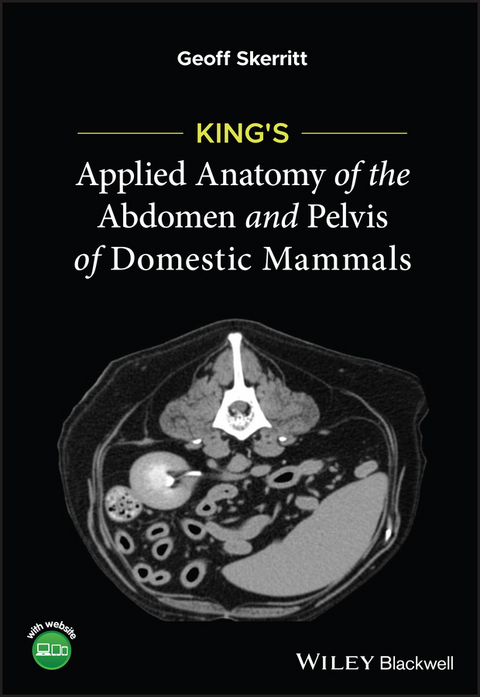
King's Applied Anatomy of the Abdomen and Pelvis of Domestic Mammals (eBook)
John Wiley & Sons (Verlag)
978-1-119-57459-0 (ISBN)
Discover a unique approach of combining descriptive anatomy with clinical information on the abdomen and pelvis of domestic mammals
King's Applied Anatomy of the Abdomen and Pelvis of the Domestic Mammals delivers a thorough and accessible exploration of the abdominal and pelvic anatomy of domestic animals in a clinically relevant style.
Designed as a refresher for veterinary students beginning to engage in clinical procedures, the book uses clinical illustration to teach the essential principles of how the abdomen and pelvis of domestic mammals are constructed. It covers core topics such as:
- Thorough introductions to the body wall, the mesenteries and ligaments of the abdomen and pelvis, and the gastrointestinal tract
- Explorations of the liver and the pancreas, the spleen and abdominal lymphatics, and the biology of digestion
- Practical discussions of the autonomic and somatic nerves of the abdomen and pelvis and the male and female reproductive organs
- Treatments of laparotomy and diagnostic imaging of the abdomen and pelvis
Perfect for veterinary students studying anatomy, King's Applied Anatomy of the Abdomen and Pelvis of the Domestic Mammals will also be useful to practicing veterinary practitioners, students of veterinary nursing, and people studying animal science and related disciplines.
Geoff Skerritt is a European Specialist in Veterinary Neurology, a Diplomate of the European College of Veterinary Neurology (ECVN), and former President of the ECVN. He was a co-founder of VetMRI, the first mobile veterinary MRI facility in Europe. He is the founder and former Director of ChesterGates Animal Referral Hospital, UK.
Discover a unique approach of combining descriptive anatomy with clinical information on the abdomen and pelvis of domestic mammals King s Applied Anatomy of the Abdomen and Pelvis of the Domestic Mammals delivers a thorough and accessible exploration of the abdominal and pelvic anatomy of domestic animals in a clinically relevant style. Designed as a refresher for veterinary students beginning to engage in clinical procedures, the book uses clinical illustration to teach the essential principles of how the abdomen and pelvis of domestic mammals are constructed. It covers core topics such as: Thorough introductions to the body wall, the mesenteries and ligaments of the abdomen and pelvis, and the gastrointestinal tract Explorations of the liver and the pancreas, the spleen and abdominal lymphatics, and the biology of digestion Practical discussions of the autonomic and somatic nerves of the abdomen and pelvis and the male and female reproductive organs Treatments of laparotomy and diagnostic imaging of the abdomen and pelvisPerfect for veterinary students studying anatomy, King s Applied Anatomy of the Abdomen and Pelvis of the Domestic Mammals will also be useful to practicing veterinary practitioners, students of veterinary nursing, and people studying animal science and related disciplines.
Geoff Skerritt is a European Specialist in Veterinary Neurology, a Diplomate of the European College of Veterinary Neurology (ECVN), and former President of the ECVN. He was a co-founder of VetMRI, the first mobile veterinary MRI facility in Europe. He is the founder and former Director of ChesterGates Animal Referral Hospital, UK.
Foreword
Preface
About the Author
About the Companion Website
Chapter 1 - The Boundaries of the Abdomen
Chapter 2 - Gastrointestinal Function
Chapter 3 - title missing
Chapter 4 - title missing
Chapter 5 - The Small Intestines
Chapter 6 - The Large Intestine
Chapter 7 - The Liver and Pancreas
Chapter 8 - title missing
Chapter 9 - title missing
Chapter 10 - Lymphatics and the Spleen
Chapter 11 - The Nerves of the Abdomen and Pelvis
Chapter 12 - title missing
Chapter 13 - The Ovaries and Ovarian Bursae
Chapter 14 - The Uterus, Uterine Tube, Vestibule and Vagina
Chapter 15 - The Mammalian Penis
Chapter 16 - The Testes
Chapter 17 - The Accessory Sex Glands
Chapter 18 - Diagnostic Imaging of the Abdomen
Appendix - Questionnaire
Bibliography
Index
1
The Boundaries of the Abdomen
1.1 Introduction
The abdomen is the major cavity of the body in the domestic animals and human beings. It contains the gastrointestinal tract, the liver, spleen, pancreas, kidneys and the ovaries together with most of the female reproductive tract. The abdomen is separated from the thorax cranially by the diaphragm and the caudal ribs; caudally it is continuous with the pelvic cavity.
Dorsally the abdomen is bounded by the vertebrae. Laterally and ventrally the boundaries of the abdomen comprise the abdominal wall, a soft tissue structure consisting of muscle, connective tissue and the layers of the skin. The abdominal wall is capable of stretching in the short term, as when the gastrointestinal tract is full of ingesta, and more gradually to accommodate the expanding uterus in pregnancy.
Apart from the important functions of containing and protecting the abdominal contents, the muscular components of the abdominal wall can aid in the expulsion of faeces, urine and foetuses. In addition, contraction of the abdominal muscles can assist in breathing, coughing and sneezing.
1.2 The Diaphragm (Figure 8.3)
The diaphragm is the musculotendinous structure that separates the thoracic and abdominal cavities. It is dome‐shaped with its apex pointing cranially. In the dog the diaphragm attaches to the sternum cranial to the xiphoid cartilage and to the medial surface of the 8th–13th ribs in the dog and cat. NB the horse has 18 pairs of ribs, ruminants 13, pigs 13–16. Dorsally the diaphragm attaches via the left and right crura to the third and fourth lumbar vertebrae. Dorsally the aorta, azygos vein and thoracic duct pass between the crura at the aortic hiatus. The oesophagus and the vagus nerves pass through the oesophageal hiatus located towards the centre of the diaphragm. The caval foramen (portal vena cava) is located on the right side of the central tendinous part of the diaphragm. Herniation of the diaphragm can occur as the result of trauma (see Section 1.7.4).
1.3 The Layers of the Abdominal Wall
Between the skin and the parietal peritoneum lie several layers of fascia and muscle. A proper appreciation of these layers, and the direction of their fibres, is important when making surgical incisions for entry to the abdominal cavity.
1.3.1 The skin
The skin, or common integument, varies in thickness between species and bodily location. The abdominal skin is very thick (4–5 mm) in the ox but is quite delicate and thin (1–3 mm) in the other domestic species. Hair grows from the skin in all of the species but is much less in the pig. In all species there is much less hair on the ventral abdomen than elsewhere. Most of the hair of the sheep has a specific structure and is termed wool. In all species except the pig a principal function of the hair/wool is to reduce heat loss; the pig relies on a large amount of subcutaneous fat for this function.
The domestic species vary in regard to the number and distribution of the mammary glands. The mare has only two mammary glands, and these are located either side of the midline on the ventral abdomen in a prepubic position. The cow usually has four mammary glands, collectively known as the udder; it is located mainly ventral to the caudal abdomen but with its caudal part ventral to the pelvis. The udder is suspended by strong elastic tissue extending essentially from the linea alba and the symphyseal tendon.
There are seven pairs of mammary glands in the sow, although only 8–10 are usually functional depending on litter size. In this species the mammary tissue extends in the body wall from the axilla to the level of the stifle.
The udder of small ruminants comprises two glands and is situated in the inguinal region. In the bitch there are usually five pairs of mammary glands; in the cat there are generally four pairs.
1.3.2 The subcutaneous fascia
Superficial fascia: In the pig this layer is adipose over most of its area and functions as an insulating layer promoting heat retention. However, in most other species this adipose tissue is not complete except in the inguinal region. In horses and cattle the cutaneous muscle is well developed in the superficial fascia layer and serves to twitch the skin to dislodge flies.
Deep fascia: In the horse and ox the deep fascia is developed as a thick sheet of fibroelastic tissue covering most of the external abdominal oblique muscle, the ribs and the tuber coxae. This is termed the yellow elastic tunic providing support for the abdominal contents and contributing to the suspensory apparatus of the udder in the cow.
1.3.3 The rectus abdominis muscle (Figures 1.1 and 1.2)
Figure 1.1 Lateral view of inguinal region of horse showing the rectus abdominis muscle. The peritoneum of the vaginal tunic is strongly reinforced by fusion with the internal spermatic fascia (derived from the transverse abdominal muscle).
Figure 1.2 Ventral view of the inguinal region of horse showing the rectus abdominis muscle. The left side of the diagram shows the relative positions of the superficial inguinal ring and the vaginal ring. On the right side of the diagram the vaginal tunic is shown wending its way from the deep inguinal ring, through the inguinal canal and out through the superficial inguinal ring.
Origin: The ventral surfaces of the sternal ribs and sternum.
Insertion: The cranial border of the pubis with the prepubic tendon. The prepubic tendon is the tendon of insertion of the two rectus abdominis muscles, although most of its fibres extend between the iliopubic eminences.
Structure: The left and right muscles are separated longitudinally by the linea alba, a band of fibrous tissue extending from the xiphoid cartilage to the prepubic tendon. A series of three to six transverse tendinous inscriptions cross each muscle belly, but the resulting muscle segments are not correlated with the nerve supply.
Species variations: In the ox there is wide separation of the medial borders of the rectus abdominis muscles. caudally. In the immature animal the linea alba is perforated by the umbilicus.
1.3.4 External abdominal oblique muscle (Figures 1.3–1.5)
Figure 1.3 Lateral view of the inguinal region of the horse left external oblique abdominal muscle.The spermatic sac is seen emerging from the left superficial inguinal ring.The spermatic sac contains the testicle and the spermatic cord (See Figure 15.4).For a definition of the spermatic sac see Section 16.4
Figure 1.4 Ventral view of inguinal region of the horse showing the left and right external abdominal oblique muscles. The arrows indicate the left and right femoral canals, providing exit for the femoral arteries and veins.
Figure 1.5 Lateral view of the abdomen of the ox showing the left external abdominal oblique muscle.
Origin: The lateral surfaces of the ribs caudal to the fourth rib and the lumbodorsal fascia.
Insertion: The linea alba and prepubic tendon.
Structure: Most of the muscle fibres run caudoventrally. At its origin it consists of muscle fibres but towards its insertion caudoventrally it becomes a tendinous aponeurosis. Towards its insertion in the prepubic tendon there is a slit in the aponeurosis; this is the superficial inguinal ring. The slit divides the tendon into an abdominal part cranially and a pelvic part caudally. The caudal edge of the pelvic part of the tendon is the inguinal ligament.
Species variations: The external abdominal oblique muscle of the dog and pig is mainly muscular almost to the dorsal edge of the rectus abdominis muscle. In ruminants there is no origin from the lumbodorsal fascia, but there is an insertion on the tuber coxae. In the ox the aponeurosis of this muscle is extensive. In the horse the external abdominal oblique muscle is very large and inserts onto the femoral fascia, linea alba, tuber coxae and the prepubic tendon.
1.3.5 Internal abdominal oblique muscle (Figures 1.6–1.8)
Figure 1.6 Lateral view of inguinal area of horse showing the internal abdominal oblique muscle. The left external abdominal oblique muscle has been removed although the position of the left superficial inguinal ring is shown. The mid‐section of the left cremaster muscle has been excised to expose the vaginal tunic.
Figure 1.7 Ventral view of inguinal region showing internal abdominal oblique muscle.
Figure 1.8 Lateral view of abdomen of ox showing left abdominal oblique muscle. The external abdominal oblique has been removed.
Origin: Tuber coxae and lumbodorsal fascia.
Insertion: Linea alba (except for the most caudal part), last rib and cartilages of the caudal ribs.
Structure: This is a sheet of muscle and tendon with the fibres running cranioventrally. It is muscular at its origin and becomes...
| Erscheint lt. Verlag | 9.2.2022 |
|---|---|
| Sprache | englisch |
| Themenwelt | Veterinärmedizin ► Kleintier |
| Schlagworte | canine anatomy • cat anatomy • clinical veterinary anatomy reference • Dog anatomy • domestic mammal anatomy • feline anatomy • Haustiere • Veterinäranatomie • Veterinäranatomie u. -physiologie • Veterinärmedizin • Veterinärmedizin f. Kleintiere • Veterinärmedizin / Innere Medizin • veterinary abdominal anatomy • Veterinary anatomy • Veterinary Anatomy & Physiology • veterinary anatomy reference • Veterinary Internal Medicine • Veterinary Medicine • Veterinary Medicine - Small Animal General • veterinary pelvic anatomy |
| ISBN-10 | 1-119-57459-5 / 1119574595 |
| ISBN-13 | 978-1-119-57459-0 / 9781119574590 |
| Informationen gemäß Produktsicherheitsverordnung (GPSR) | |
| Haben Sie eine Frage zum Produkt? |
 EPUB (Adobe DRM)
Kopierschutz: Adobe-DRM
Adobe-DRM ist ein Kopierschutz, der das eBook vor Mißbrauch schützen soll. Dabei wird das eBook bereits beim Download auf Ihre persönliche Adobe-ID autorisiert. Lesen können Sie das eBook dann nur auf den Geräten, welche ebenfalls auf Ihre Adobe-ID registriert sind.
Details zum Adobe-DRM
Dateiformat: EPUB (Electronic Publication)
EPUB ist ein offener Standard für eBooks und eignet sich besonders zur Darstellung von Belletristik und Sachbüchern. Der Fließtext wird dynamisch an die Display- und Schriftgröße angepasst. Auch für mobile Lesegeräte ist EPUB daher gut geeignet.
Systemvoraussetzungen:
PC/Mac: Mit einem PC oder Mac können Sie dieses eBook lesen. Sie benötigen eine
eReader: Dieses eBook kann mit (fast) allen eBook-Readern gelesen werden. Mit dem amazon-Kindle ist es aber nicht kompatibel.
Smartphone/Tablet: Egal ob Apple oder Android, dieses eBook können Sie lesen. Sie benötigen eine
Geräteliste und zusätzliche Hinweise
Buying eBooks from abroad
For tax law reasons we can sell eBooks just within Germany and Switzerland. Regrettably we cannot fulfill eBook-orders from other countries.
aus dem Bereich