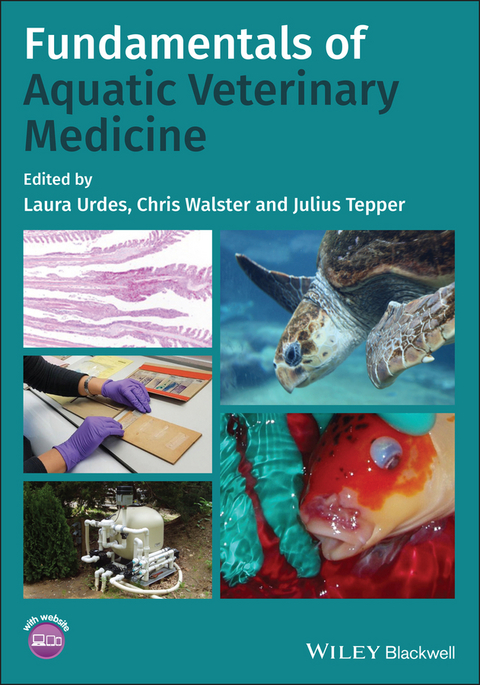
Fundamentals of Aquatic Veterinary Medicine (eBook)
561 Seiten
John Wiley & Sons (Verlag)
978-1-119-61272-8 (ISBN)
Covers the competencies necessary to assure the highest quality of aquatic veterinary services
Fundamentals of Aquatic Veterinary Medicine provides systematic, highly practical guidance on the treatment of aquatic mammals, amphibians, fish, and invertebrates in veterinary practice.
Mapping to each of the nine core areas of the WAVMA Certified Aquatic Veterinarian (CertAqV) Program, this comprehensive clinical reference covers taxonomy, anatomy and physiology of aquatic species, water quality and life support systems, diagnostics, treatment, and prevention of aquatic diseases, and more. Designed to help readers acquire and demonstrate the necessary knowledge, skills, and experience to be competent in aquatic veterinary medicine, this authoritative guide:
- Focuses on 'Day One' competencies outlined by the World Organization for Animal Health (OIE)
- Covers pathobiology and epidemiology of aquatic diseases, public health,zoonotic diseases, and seafood safety
- Provides up-to-date information on relevant legislation, regulations, and policies
Fundamentals of Aquatic Veterinary Medicine is a must-have reference and review guide for veterinary students and practitioners interested in practicing aquatic veterinary medicine, as well as for aquatic veterinarians looking to become WAVMA certified or wanting to acquire OIE 'Day One' competency.
About the Editors
Dr Laura Urdes is a Veterinarian and Assistant Professor, University of Agricultural Sciences and Veterinary Medicine, Bucharest, Romania.
Dr Chris Walster is a Qualified Veterinary Surgeon and Director of C & J Walster Limited, Stafford, UK.
Dr Julius Tepper is a Veterinarian at the Long Island Fish Hospital, Manorville, NY, USA.
About the Editors Dr Laura Urdes is a Veterinarian and Assistant Professor, University of Agricultural Sciences and Veterinary Medicine, Bucharest, Romania. Dr Chris Walster is a Qualified Veterinary Surgeon and Director of C & J Walster Limited, Stafford, UK. Dr Julius Tepper is a Veterinarian at the Long Island Fish Hospital, Manorville, NY, USA.
Preface
Acknowledgements
List of Contributors
About the Companion Website
Chapter 1 - Aquatic Environment and Life Support Systems
Sherry Kasper, Olanike K. Adeyemo, Trista Becker Welsh, David Scarfe, and Julius Tepper
Chapter 2 - Taxonomy, Anatomy and Physiology
Matt Longshaw, Wesley Baumgartner, Trista Becker Welsh, James E. Bogan, Jr., Erdem Danyer, Sherry Kasper, Nicole Marie Nemeth, Adolf Maas, and Acacia Alcivar-Warren
Chapter 3 - Husbandry and Industries
Trista Becker Welsh, Olanike K. Adeyemo, Erdem Danyer, and Nicholas Saint-Erne
Chapter 4 - Pathology and Epidemiology of Aquatic Diseases
Section 4.1. Pathology
Wesley Baumgartner, Farah Gonul Aydin, Kelly Bateman, Morag Clinton, Padraig Duignan, Mansour El-Matbouli, Maria Forzan, Leo Foyle, Soliman Hatem, Gregory Lewbart, Richmond Loh, Nicole Marie Nemeth, and Acacia Alcivar-Warren
Section 4.2 Epidemiology
Leo Foyle
Chapter 5 - Diagnostics and Treatment of Aquatic Animal Diseases
Richmond Loh, James E. Bogan, Jr., Mansour El-Matbouli, Soliman Hatem, Jack Kottwitz, Nicholas Saint-Erne, Mona Saleh, and Vasile Vulpe
Chapter 6 - Clinical Veterinary Experience and Client Communication
Richmond Loh, Laura Urdes, and Vasile Vulpe
Chapter 7 - Public Health, Zoonoses and Seafood Safety
Olanike K. Adeyemo and Leo Foyle
Chapter 8 - Legislation, Regulations and Policies
Myron Kebus and Chris Walster
Chapter 9 - Principles of Aquatic Animal Welfare
Laura Urdes and Chris Walster
Index
1
Aquatic Environment and Life Support Systems
Sherry Kasper, Olanike K. Adeyemo, Trista Becker, David Scarfe, and Julius Tepper
Learning Objectives
Students should demonstrate knowledge of the elements of life support systems and water found within these systems.
1.1 Introduction
For veterinarians to adequately evaluate the health or disease problems of aquatic animals, it is imperative that they understand the impact of, and assess the conditions in which the animal lives. Like terrestrial animals, the health of aquatic species is impacted by their environment. Suboptimal conditions can result in non‐infectious diseases or create situations favorable for opportunistic pathogens, which can lead to decreased growth, increased morbidity and clinical disease. It is therefore imperative to include an assessment of water quality and a history of any changes in the environment as part of a clinical evaluation of any health problem.
Fish health management is a term used in aquaculture to describe management practices designed to prevent fish disease. Once fish get sick it can be difficult to salvage them. Successful fish health management begins with prevention of disease rather than treatment, accomplished through, among other considerations, good water quality management. Without this foundation it is impossible to prevent outbreaks of opportunistic diseases. Fish are constantly bathed in potential pathogens, including bacteria, fungi, and parasites. Suboptimal water quality generally associated with stressful conditions allows potential pathogens to cause disease.
The biotic integrity of an ecological system is often reflected by the health of organisms that reside in that system. Proper management of the aquatic environment therefore offers optimum environmental conditions for the growth and better health of the cultivated fish. It also strengthens the defense mechanism of the body to fight against invading disease‐producing organisms. Eradicating any predatory or invasive fish species, disinfecting the pond, selecting quality and healthy seed for stocking, maintaining proper species ratios and stocking density, regulating water quality, as well as feeding and handling fish properly, are the various steps of these management measures.
With a very large number of cultured aquatic species, and hence different water systems in which they may live, the task of evaluating optimal conditions for every species may seem daunting. However, if considered on an ecosystem level for those that thrive naturally in freshwater, brackish or marine aquatic ecosystems, and evaluating these as life‐support systems for different taxa, the task is simplified. Furthermore, many biotic and abiotic physicochemical features of fresh, brackish or marine water bodies are similar, even for very different taxa.
This chapter provides general information about basic features of aquatic environments and life‐support systems important to the health of finfish, amphibians, mollusks, crustaceans and invertebrates that veterinarians might encounter. As aquatic mammals, birds and other homeothermic species are generally covered in veterinary curricula, they are not addressed here.
1.2 The Life‐Support System in Aquaculture and Ornamental Fish Care
Aquaculture is the farming of aquatic organisms including fish, mollusks, crustaceans and aquatic plants, with some sort of intervention in the rearing process to enhance production, such as regular stocking, feeding, and protection from predators. Farming also implies individual or corporate ownership of the stock being cultivated. Aquatic ecosystems provide the basis for aquatic production. The worldwide practice of aquaculture runs the gamut from low‐technology extensive methods to highly intensive systems. Although used for housing and maintaining ornamental fish, similar aquasystems are found in large public aquaria and private homes and are discussed in this chapter. The term ‘life‐support system’ is understood as a complete system that satisfies the physiological needs of an aquatic organism in question. Diagrams and photographs of examples of life‐support systems can be found in Chapter 3.
Managed ecosystems form the basis for aquaculture production, which has been widely offered as a means of complementing and ultimately supplementing traditional fisheries. Here, unlike fisheries, inputs, production processes and quality of output can be at least partially controlled, and ownership, care and environmental responsibility might be more easily established. By removing natural constraints to survival and productivity, and by husbandry and management, production need be limited only by availability of simple inputs such as land, water, seed (hatchling, spawn, fry or fingerling), fertilizers and feeds. The design of a life‐support system is dependent on the type of aquatic system in question, being either a flow‐through system or a closed system. In a flow‐through system, the main elements include a spigot or waterfall that is adjustable for the amount of water flow necessary, a drain that is usually positioned at the opposite end of the system, potential for increased aeration, and, possibly, temperature controls.
A closed system may be a pond, tank or aquarium. In a pond, the most important elements are circulation and aeration, and it may also include a filtration system. Tanks and aquaria usually require a filtration system, aeration, and often temperature control. The source of the water is important when deciding on the type of aquatic system and the type of life‐support system. A large well, river or lake is necessary for a flow‐through system because of the high volume of water that is needed to maintain proper water quality. If city water is being used in a system, it is important to have a reservoir to dechlorinate any new water entering the system. In recirculating systems, water circulation and purification is accomplished with the use of powered pumps and filtration systems. The type of equipment used will depend on the type of fish, number of fish and the expected growth rate of those fish.
In aquaculture, high‐intensity growth of fish leads to higher ammonia levels and waste production. The output of the pump should allow for a flow of the full volume of water in the system to pass through the filter every two to three hours. This is referred to as the “turnover time”. It is calculated by dividing the water volume in the system by the volume per time rating of the circulation, measured at the return (the volume/time is variously described in gallons/minute or hour as GPM, GPH or metric m3/hour). In tanks and ponds, flow rates are very variable, from less than five minutes in the smallest aquaria to more than 10 hours in larger ponds. Submersible pumps with low maintenance sealed impellors may be used in small ponds and aquaria, but larger aquasystems typically use external pumps. The filtration system should contain biological media with an appropriate surface area to allow for detoxification of ammonia based on the number of fish. On average, 1 m2 of active surface area can process 1 gram of ammonia every 24 hours (Wildgoose, 2001).
Monitoring of the system may be fully automated or may be performed by individuals. The benefits of automated monitoring equipment include the ability to set alarms for power outages, changes in dissolved oxygen and large changes in ammonia. Some systems are able to calculate flow rates and water usage, which is beneficial for production calculations. Monitoring should include ammonia, nitrite, nitrate, dissolved oxygen, temperature, total alkalinity and pH to assure proper water quality parameters.
1.2.1 Extensive Culture System
The extensive culture system is characterized by low to no inputs (food, fertilizer, etc.) and low stocking densities. Extensive aquaculture is practiced in lakes, reservoirs, lagoons, ponds and tanks.
1.2.1.1 Ponds
The most common production system in use is the earthen pond. Earthen ponds are extremely popular among fish growers due in part to ease of construction, low maintenance, relatively small area requirements and ability to grow a wide variety of species. Additionally, because earthen ponds mimic nature, they may produce fish of an overall healthier appearance than other techniques. A natural supply of food is often available in earthen ponds, which may lead to better fish health. Pond culture can vary, from all life stages naturally occurring in a single pond to elaborate systems with discrete ponds for holding broodstock, spawning, rearing, growing and catch‐out or harvest.
1.2.1.2 Tanks
Tanks essentially act as ponds but are generally constructed of concrete or fiberglass. Wood can also be used but must first be treated to prevent rotting. Concrete tanks have the advantage of being less expensive, easily constructed and formed into various shapes.
- Plastic, fiberglass or glass tanks are ordinary tanks which are either designed and constructed for rearing fish or used for storing water. They can be moved from one place to another.
- Wooden troughs are constructed with planks. They vary in size and depth. After construction, the tank is lined with nylon to prevent leakage. It can be moved from one place to other.
1.2.2 Semi‐Intensive Culture System
The semi‐intensive culture...
| Erscheint lt. Verlag | 18.11.2021 |
|---|---|
| Sprache | englisch |
| Themenwelt | Veterinärmedizin |
| Schlagworte | Aquaculture, Fisheries & Fish Science • Aquakultur • Aquakultur, Fischereiwesen u. Fischforschung • Fischkrankheit • Veterinärmedizin • Veterinärmedizin / Exoten • Veterinärmedizin / Fische • Veterinary Medicine • Veterinary Medicine - Exotic Pets • Veterinary Medicine - Fish |
| ISBN-10 | 1-119-61272-1 / 1119612721 |
| ISBN-13 | 978-1-119-61272-8 / 9781119612728 |
| Informationen gemäß Produktsicherheitsverordnung (GPSR) | |
| Haben Sie eine Frage zum Produkt? |
 EPUB (Adobe DRM)
Kopierschutz: Adobe-DRM
Adobe-DRM ist ein Kopierschutz, der das eBook vor Mißbrauch schützen soll. Dabei wird das eBook bereits beim Download auf Ihre persönliche Adobe-ID autorisiert. Lesen können Sie das eBook dann nur auf den Geräten, welche ebenfalls auf Ihre Adobe-ID registriert sind.
Details zum Adobe-DRM
Dateiformat: EPUB (Electronic Publication)
EPUB ist ein offener Standard für eBooks und eignet sich besonders zur Darstellung von Belletristik und Sachbüchern. Der Fließtext wird dynamisch an die Display- und Schriftgröße angepasst. Auch für mobile Lesegeräte ist EPUB daher gut geeignet.
Systemvoraussetzungen:
PC/Mac: Mit einem PC oder Mac können Sie dieses eBook lesen. Sie benötigen eine
eReader: Dieses eBook kann mit (fast) allen eBook-Readern gelesen werden. Mit dem amazon-Kindle ist es aber nicht kompatibel.
Smartphone/Tablet: Egal ob Apple oder Android, dieses eBook können Sie lesen. Sie benötigen eine
Geräteliste und zusätzliche Hinweise
Buying eBooks from abroad
For tax law reasons we can sell eBooks just within Germany and Switzerland. Regrettably we cannot fulfill eBook-orders from other countries.
aus dem Bereich