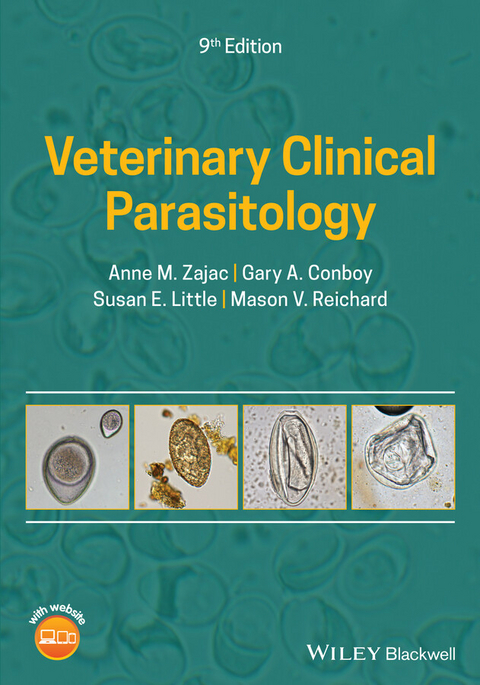
Veterinary Clinical Parasitology (eBook)
John Wiley & Sons (Verlag)
978-1-119-30079-3 (ISBN)
New edition of the?market-leading?benchtop reference on the diagnosis of internal and external parasites in animals, including expanded coverage of parasites of reptiles, birds,?and other exotic species?
Veterinary Clinical Parasitology, 9th?Edition,?allows for?a?quick and accurate reference to?internal and external parasites?found?in a wide variety of?domestic animals and?laboratory animal host species. Focusing on the tests and information most relevant to daily veterinary practice, this classic benchtop manual contains a wealth of high-quality images to assist readers?in?diagnosing?parasitic disease and identifying?and treating relevant parasites. Contributions by leading experts in veterinary pathobiology and parasitology?cover fecal examination for the diagnosis of parasitism, detection of parasites in the blood, diagnosis of arthropod parasites, and more.?
The latest edition contains fully revised?material?throughout, including new and expanded information on immunodiagnostic and molecular diagnostic tests, additional parasite-specific material on the benefits and limitations of different test modalities, and increased?coverage?of?reptiles, birds, and other exotic and laboratory animals.?New?sections include up-to-date information on anthelmintics,?antiprotozoals, and other antiparasitic drugs, and?challenging case studies?that provide insights on?situations where identification of parasites is especially difficult.?Published under the auspices of the American Association of Veterinary Parasitologists?(AAVP), this indispensable clinical manual:?
- Describes accurate?and?cost-effective techniques for diagnosing parasitic infections in animals?
- Presents clear and concise?information on the distribution, life cycle, and?significance?of each parasite?covered?
- Contains hundreds of color clinical images to enable rapid picture-matching and aid in diagnosis?
- Offers?a spiral-bound format that allows the book to lie flat on the benchtop, ideal for regular use in daily practice?
- Features revised content throughout,?including new?chapters and?images,?an improved format, an enhanced color scheme, and an updated companion website??
Veterinary Clinical Parasitology, 9th?Edition?is an essential?resource for practicing veterinarians, veterinary technicians, diagnosticians, researchers, and students in need of a timely and efficient reference on morphologic identification of parasites in different animal species.?
Anne M. Zajac, DVM, MS, PhD, DACVM-Parasit., is Professor in the Department of Biomedical Sciences and Pathobiology at the Virginia-Maryland College of Veterinary Medicine, Virginia Tech, Blacksburg, Virginia.
Gary A. Conboy, BSc, DVM, PhD, DACVM-Parasit., is Professor in the Department of Pathobiology and Microbiology at the Atlantic Veterinary College, University of Prince Edward Island, Charlottetown, Prince Edward Island, Canada.
Susan E. Little, DVM, PhD, DACVM-Parasit., is Regents Professor and the Krull-Ewing Professor in Veterinary Parasitology at the College of Veterinary Medicine, Oklahoma State University, Stillwater, Oklahoma, USA.
Mason V. Reichard, MS, PhD, is Professor of Veterinary Parasitology at the College of Veterinary Medicine, Oklahoma State University, Stillwater, Oklahoma, USA.
Anne M. Zajac, DVM, MS, PhD, DACVM-Parasit., is Professor in the Department of Biomedical Sciences and Pathobiology at the Virginia-Maryland College of Veterinary Medicine, Virginia Tech, Blacksburg, Virginia. Gary A. Conboy, BSc, DVM, PhD, DACVM-Parasit., is Professor in the Department of Pathobiology and Microbiology at the Atlantic Veterinary College, University of Prince Edward Island, Charlottetown, Prince Edward Island, Canada. Susan E. Little, DVM, PhD, DACVM-Parasit., is Regents Professor and the Krull-Ewing Professor in Veterinary Parasitology at the College of Veterinary Medicine, Oklahoma State University, Stillwater, Oklahoma, USA. Mason V. Reichard, MS, PhD, is Professor of Veterinary Parasitology at the College of Veterinary Medicine, Oklahoma State University, Stillwater, Oklahoma, USA.
Preface ix
Acknowledgments xi
Authors xv
About the Companion Website xvii
Chapter 1 Fecal Examination for the Diagnosis of Parasitism 1
Collection of Fecal Samples 1
Storage and Shipment of Fecal Samples 2
Fecal Exam Procedures 2
Fecal Flotation 3
Additional Procedures for Fecal Examination 12
Quality Control for Fecal Exam Procedures 15
Use of the Microscope 16
Microscope Calibration 16
Pseudoparasites and Spurious Parasites 19
Identification of Nematode Larvae Recovered with Fecal Flotation or Baermann Procedures 24
Techniques for Evaluation of Strongylid Nematodes in Grazing Animals 29
Fecal Culture 29
Identification of Ruminant and Camelid Third-Stage Larvae 30
Identification of Third-Stage Larvae of Equine Strongyles 35
Fecal Egg Count Reduction Test (FECRT) 36
Hoyer's Solution 39
Lactophenol 40
Parasites of Domestic Animals 41
Dogs and Cats 42
Ruminants and Camelids 96
Horses 126
Swine 140
Birds 154
Rodents and Rabbits 174
Reptiles 182
Chapter 2 Detection of Protozoan and Helminth Parasites in the Urinary, Reproductive, and Integumentary Systems and in the Eye 191
Techniques for Parasite Recovery 191
Parasites of the Urinary System 191
Parasites of the Reproductive Tract 192
Helminth Parasites of the Integumentary System 192
Parasite Detection in Urinary and Other Systems 193
Chapter 3 Detection of Parasites in the Blood 207
Immunologic and Molecular Detection of Blood Parasites 207
Microscopic Examination of Blood for Protozoan Parasites 207
Giemsa Stain 208
Microscopic Examination of Blood for Nematode Parasites 209
Tests for Canine Heartworm Microfilariae in Blood Samples 210
Blood Parasites of Dogs and Cats 213
Blood Parasites of Livestock and Horses 228
Blood Parasites of Birds 234
Chapter 4 Immunodiagnostic and Molecular Diagnostic Tests in Veterinary Parasitology 239
Immunodiagnostic Methods in Parasitology 239
Molecular Diagnostic Methods in Parasitology 243
Chapter 5 Diagnosis of Arthropod Parasites 247
Subclass Acari (Mites and Ticks) 247
Mite Identification 247
Tick Identification 278
Class Insecta 300
Lice (Order Phthiraptera) 300
Fleas (Order Siphonaptera) 314
Flies (Order Diptera) 322
Other Insects 342
Chapter 6 Parasites of Fish 347
Techniques for Recovery of Ectoparasites 347
Skin Biopsy (Mucus Smear) 348
Fin Biopsy (Fin Snip) 348
Gill Biopsy (Gill Snip) 348
Recovery of Endoparasites 349
Parasites of Fish 350
Chapter 7 Treatment of Veterinary Parasites 371
Introduction 371
Anthelmintics 371
Specific Anthelmintics 372
Ectoparasiticides 375
Protozoal Treatment 378
Non-Traditional Treatments 379
Chapter 8 Diagnostic Dilemmas 381
Diagnostic Dilemma 1 381
Diagnostic Dilemma 2 382
Diagnostic Dilemma 3 383
Diagnostic Dilemma 4 383
Diagnostic Dilemma 5 384
Diagnostic Dilemma 6 385
Diagnostic Dilemma 7 386
Bibliography 387
Index 391
"...the ninth edition of Veterinary Clinical Parasitology is a comprehensive and concise parasitology book with updated clinically relevant information....The updates to this edition make it well worth the price. This book will be a great microscope-side reference for any general veterinary practice." - JAVMA | SEP 15, 2021 | VOL 259 | NO. 6
CHAPTER 1
Fecal Examination for the Diagnosis of Parasitism
The fecal examination for diagnosis of parasitic infections is one of the most common laboratory procedures performed in veterinary practice. Relatively inexpensive and noninvasive, fecal examination can reveal the presence of parasites in several body systems. Parasites inhabiting the digestive system produce eggs, larvae, or cysts that leave the body of the host by way of the feces. Occasionally, even adult helminth parasites may be seen in feces, especially when the host has enteritis. Parasitic worm eggs or larvae from the respiratory system are usually coughed into the pharynx and swallowed, and they too appear in feces. Mange or scab mites may be licked or nibbled from the skin, thus accounting for their appearance in the feces. Many parasitic forms seen in feces have characteristic morphologic features that, when combined with knowledge of the host, are diagnostic for a particular species of parasite. On the other hand, certain parasites produce similar eggs or oocysts, and cannot be identified to the species level (e.g., many of the strongylid‐type eggs from livestock). Fecal examination may also reveal to a limited extent the status of digestion, as shown by the presence of undigested muscle, starch, or fat droplets.
COLLECTION OF FECAL SAMPLES
Fecal exams should be conducted on fresh fecal material. If fecal samples are submitted to the laboratory after being in the environment for hours or days, fragile protozoan trophozoites will have died and disappeared. The eggs of some nematodes can hatch within a few days in warm weather, and identification of nematode larvae is far more difficult than recognizing the familiar eggs of common species. Also, free‐living nematodes rapidly invade a fecal sample on the ground, and differentiation of hatched parasite larvae from these free‐living species can be time‐consuming and difficult.
Owners of small animals should be instructed to collect at least several grams of feces immediately after observing defecation. This will ensure the proper identification of the sample with the client’s pet (i.e., a sample from a stray animal will not be collected) and that feces rather than vomitus or other material is collected. The limited amount of feces recovered from the rectum on a thermometer or fecal loop should not be relied on for routine parasitologic examination, since many infections that produce only small numbers of eggs will be missed. Owners should be instructed to store fecal samples in the refrigerator if the sample will not be submitted for examination for more than an hour or two after collection.
Feces should be collected directly from the rectum of large animals. This is particularly important when identification of individual animals is needed. Rectal samples are also needed when the sample is to be examined for lungworm larvae or cultured for identification of third‐stage larvae, since contaminating free‐living nematodes and hatched first‐stage larvae of gastrointestinal nematodes may be confused with lungworm larvae. If rectal samples are unavailable, owners should be asked to collect feces immediately after observing defecation. The process of development and hatching of common strongylid eggs can be slowed by refrigeration. Development is also reduced when air is excluded from the sample by placing the collected feces in a plastic bag and evacuating or pressing out the air before sealing the bag.
STORAGE AND SHIPMENT OF FECAL SAMPLES
If collected feces cannot be examined within a few hours, the sample should be refrigerated until it can be tested. Feces should not be frozen, because freezing can distort parasite eggs. If a sample needs to be evaluated for the presence of protozoan trophozoites like Giardia and trichomonads, it should be examined within 30 minutes after collection. The trophozoite is the active, feeding form of the parasite and is not adapted to environmental survival; it dies soon after being passed in the feces.
Increasingly, veterinary practitioners in the United States are using reference laboratories for routine diagnostic tests for parasite infection. Specific laboratory instructions for age, storage and transportation of samples to commercial labs should be followed. In general, when fresh fecal material is submitted to another laboratory for examination, it should be packaged with cold packs. In some cases, preservation of samples may be preferred. Helminth eggs can be preserved with a volume of 5%–10% buffered formalin equal to that of the sample. Formalin fixation also inactivates many other infectious organisms that may be present. Special fixatives, such as polyvinyl alcohol (PVA), are required to preserve protozoan trophozoites and are not routinely used in veterinary practices.
Slides prepared from flotation tests do not travel well, even if the coverslip is ringed with nail polish, since hyperosmotic flotation solutions will usually make parasite eggs or larvae unrecognizable within hours of preparing the slide. However, slides from flotation tests can be preserved for several hours to several days by placing them in a refrigerator in a covered container containing moist paper towels to maintain high humidity. It is best to place applicator sticks under the slide to prevent it from becoming too wet.
FECAL EXAM PROCEDURES
Before performing specific tests on the fecal sample, its general appearance should be noted; consistency, color, and the presence of blood or mucus may all be indicative of specific parasitic infections. Hookworm disease in dogs, for example, commonly produces dark, tarry feces, whereas diarrheic feces caused by whipworms may contain excess mucus and frank blood. The presence of adult parasites or tapeworm segments should also be noted.
Fecal Flotation
The technique most commonly used in veterinary medicine for examination of feces is the fecal flotation test. This procedure concentrates parasite eggs and cysts while separating them from much of the sample debris. Fecal flotation is based on the principle that parasite material present in the feces is less dense than the fluid flotation medium and thus will float to the top of the container, where it can be collected for microscopic evaluation. Flotation tests are easy and inexpensive to perform, but in busy practices the choice of flotation solution and test procedure often does not receive much consideration, despite the substantial effect these choices can have on the sensitivity of flotation exams.
Choice and Preparation of Flotation Solutions
Many different substances can be used to make flotation solutions. The higher the specific gravity (SPG) of the flotation solution, the greater the variety of parasite eggs that will float. Additionally, studies have shown that fecal flotation tests recover only a portion of each type of parasite egg/cyst in a sample because of variation in individual eggs, binding to debris, and so on. As SPG increases the portion recovered increases, which is an important consideration when the number of eggs in the sample is low. However, as SPG increases, more debris will also float, and the risk of damage to eggs from the hyperosmotic solution also increases. These factors limit the range of useful flotation solutions to SPG ranging from approximately 1.18 to 1.3. Both salt and sugar flotation solutions are commonly used in veterinary parasitology and provide flotation for common parasites with lower specific gravities than the flotation solution (Table 1.1).
Salt solutions are widely used in flotation procedures. A common flotation solution used in the United States is a commercially available sodium nitrate solution (SPG 1.20). This solution will float common helminth eggs and protozoan cysts. The commercial solution is not a saturated solution of sodium nitrate (SPG 1.33). Slides prepared with any salt solution need to be examined relatively quickly after they are prepared because crystals form as slides dry and parasites may be damaged, making them more difficult to identify.
Zinc sulfate (ZnSO4) solution at a SPG of 1.18–1.2 is another salt flotation solution. It is preferred at SPG 1.18 for recovery of Giardia, but recovers a higher proportion of other parasites at SPG 1.2 and is probably used more frequently at this SPG. It is commercially available and when water is added to the purchased salt solution as directed, the resulting SPG is 1.2.
Table 1.1. Approximate specific gravity of some common helminth eggs
Sources: From 1David E., and Lindquist W. 1982. Determination of the specific gravity of certain helminth eggs using sucrose density gradient centrifugation. J. Parasitol. 68:916–919; 2Norris J., Steuer A. et al. 2018. Determination of the specific gravity of eggs of equine strongylids, Parascaris spp., and Anoplocephala perfoliata. Vet. Parasitol. 260:45–48.
| Species | Specific gravity |
|---|
| Ancylostoma caninum | 1.061 |
| Toxocara canis | 1.091 |
| Toxocara cati | 1.101 |
| Trichuris vulpis | 1.151 |
| Taenia sp. | 1.231 |
| Erscheint lt. Verlag | 21.4.2021 |
|---|---|
| Sprache | englisch |
| Themenwelt | Veterinärmedizin ► Klinische Fächer ► Parasitologie |
| Schlagworte | animal blood exam manual • animal fecal exam manual • animal parasite clinical exam • animal parasite images • animal parasiticides • Pflege i. d. Veterinärmedizin • Veterinärmedizin • Veterinärmedizin / Mikrobiologie,Parasitologie,Infektionen,Immunologie • Veterinary Medicine • Veterinary Microbiology, Parasitology,Infectious Diseases & Immunology • Veterinary Nursing & Animal Care • veterinary parasite detection • veterinary parasite diagnosis • Veterinary parasitology • veterinary parasitology reference |
| ISBN-10 | 1-119-30079-7 / 1119300797 |
| ISBN-13 | 978-1-119-30079-3 / 9781119300793 |
| Informationen gemäß Produktsicherheitsverordnung (GPSR) | |
| Haben Sie eine Frage zum Produkt? |
 EPUB (Adobe DRM)
Kopierschutz: Adobe-DRM
Adobe-DRM ist ein Kopierschutz, der das eBook vor Mißbrauch schützen soll. Dabei wird das eBook bereits beim Download auf Ihre persönliche Adobe-ID autorisiert. Lesen können Sie das eBook dann nur auf den Geräten, welche ebenfalls auf Ihre Adobe-ID registriert sind.
Details zum Adobe-DRM
Dateiformat: EPUB (Electronic Publication)
EPUB ist ein offener Standard für eBooks und eignet sich besonders zur Darstellung von Belletristik und Sachbüchern. Der Fließtext wird dynamisch an die Display- und Schriftgröße angepasst. Auch für mobile Lesegeräte ist EPUB daher gut geeignet.
Systemvoraussetzungen:
PC/Mac: Mit einem PC oder Mac können Sie dieses eBook lesen. Sie benötigen eine
eReader: Dieses eBook kann mit (fast) allen eBook-Readern gelesen werden. Mit dem amazon-Kindle ist es aber nicht kompatibel.
Smartphone/Tablet: Egal ob Apple oder Android, dieses eBook können Sie lesen. Sie benötigen eine
Geräteliste und zusätzliche Hinweise
Buying eBooks from abroad
For tax law reasons we can sell eBooks just within Germany and Switzerland. Regrettably we cannot fulfill eBook-orders from other countries.
aus dem Bereich