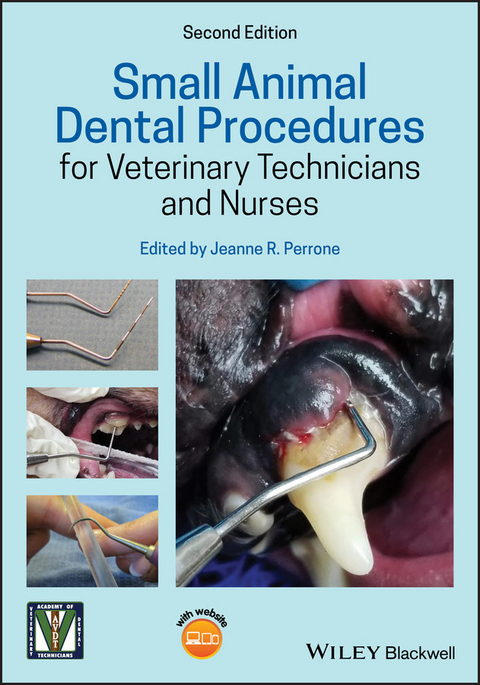
Small Animal Dental Procedures for Veterinary Technicians and Nurses (eBook)
John Wiley & Sons (Verlag)
978-1-119-45185-3 (ISBN)
The chapters contained within include in-depth coverage of all stages of small animal dental care, including:
• Anesthesia
• Radiology
• Dental cleaning
• Common diseases and treatment
• Equipment needs and maintenance
• Exotic dentistry
Small Animal Dental Procedures for Veterinary Technicians and Nurses includes access to a companion website that provides video clips, review questions, training exercises, forms, and editable glossaries. This book is an essential and invaluable resource for any veterinary technology student, veterinary technician or nurse regularly or occasionally engaged in small animal dental care.
The Editor
Jeanne R. Perrone, MS, CVT, VTS (Dentistry), is owner and facilitator of VT Dental Training, which provides consulting and dentistry skills training for veterinary staff, and serves as an online adjunct instructor for the Veterinary Technician program in dentistry at St. Petersburg College in St. Petersburg, FL, USA.
Small Animal Dental Procedures for Veterinary Technicians and Nurses, 2nd Edition brings together all aspects of canine, feline, and exotic animal dentistry for veterinary technicians and nurses. Offering complete coverage of all aspects of dental treatment for dogs, cats, and exotic pets, the book describes techniques for veterinary technicians providing dental care. The new edition includes brand new information on digital radiology, plus updates to current protocols and improved images throughout the book. The chapters contained within include in-depth coverage of all stages of small animal dental care, including: Anesthesia Radiology Dental cleaning Common diseases and treatment Equipment needs and maintenance Exotic dentistry Small Animal Dental Procedures for Veterinary Technicians and Nurses includes access to a companion website that provides video clips, review questions, training exercises, forms, and editable glossaries. This book is an essential and invaluable resource for any veterinary technology student, veterinary technician or nurse regularly or occasionally engaged in small animal dental care.
The Editor Jeanne R. Perrone, MS, CVT, VTS (Dentistry), is owner and facilitator of VT Dental Training, which provides consulting and dentistry skills training for veterinary staff, and serves as an online adjunct instructor for the Veterinary Technician program in dentistry at St. Petersburg College in St. Petersburg, FL, USA.
Although this book will also be useful for veterinarians, its best feature is that it was written to provide various task-related details that are specifically inclusive of veterinary technicians and nurses and emphasizes how they can use their skills at every step.... The flow, chapter and section headings, and overall organization of the text are top-notch and make the book easy to read. I highly recommend this textbook for any veterinary professional (including veterinary and veterinary technician students) who wants to enhance their knowledge regarding the standard of care in veterinary dentistry. JAVMA; MAR 15, 2021; VOL 258, NO. 6
1
The Basics
Gerianne Holzman, CVT, VTS (Dentistry)
Learning Objectives
- Identify all anatomical sites and systems of the head, skull, and teeth
- Explain the relationship between structures in the oral cavity
- State the eruption timetable for primary and adult teeth
- Describe the stages of tooth development
- State the dental formula for the pediatric and adult dog and cat
- List and define oral directional terminology
- Define and perform both the anatomic and Triadan numbering systems used to count and identify teeth in the pediatric and adult dog and cat
This comprehensive text on small animal dentistry meets the need for both novice and experienced veterinary technicians to advance their knowledge and explore new career paths. To learn advanced techniques, one needs to begin with the basics. This chapter discusses the anatomy of the skull and the teeth. With this knowledge, the veterinary technician learns the complex relationship between all structures surrounding the oral cavity. Dental disease, while generally thought of as a condition of the mouth, can also affect the nares, sinuses, and eyes.
Most mammals – including humans, dogs, and cats – have two sets of teeth in their lifetime: primary (or deciduous) and permanent (or secondary). Usually, the primary teeth exfoliate before the eruption of the permanent teeth. Malocclusions and dental disease can occur if this natural progression does not happen. (Two teeth should not occupy the same place at the same time.) Knowing the normal age of tooth eruption and the development of the tooth aids the veterinary technician in performing an oral exam.
In the mouth, the usual directional terminology of dorsal, ventral, medial, and lateral does not apply. The oral structures create a unique set of terms to determine location. Learning this specific terminology simplifies charting, surgical assisting, and explaining oral pathology.
Anatomy of the Skull1
Oral Cavity
The primary structures of the oral cavity consist of teeth, gingiva, tongue, soft palate, and hard palate. These vital organs of mastication and breathing can be involved with oral disease. Knowing what is normal helps in recognizing abnormalities.
Teeth2
Each species has a distinct dental formula. The dental formula is the number and types of teeth expected in a normal mouth. Dogs and cats have four types of teeth, each with separate purposes for eating and chewing. Domesticated animals, fed commercial diets, do not always use their teeth in the same manner as their wild ancestors. Incisors cut, pick up, and groom. Canines rip, tear, and hold. Premolars and molars grind food into a more digestible size (Figs. 1.1 and 1.2). Carnassials are the largest chewing teeth in the mouth. In both the dog and cat, they are the upper fourth premolar and the lower first molar.
Primary dental formula: canine (total 28)- Maxilla: incisors (6), canines (2), premolars (6), molars (0)
- Mandible: incisors (6), canines (2), premolars (6), molars (0)
Permanent dental formula: canine (total 42)
- Maxilla: incisors (6), canines (2), premolars (8), molars (4)
- Mandible: incisors (6), canines (2), premolars (8), molars (6)
Figure 1.1 Canine skull showing permanent dentition
(Illustration by Brenda Gregory).
Figure 1.2 Feline skull showing permanent dentition
(Illustration by Brenda Gregory).
Primary dental formula: feline (total 26)
- Maxilla: incisors (6), canines (2), premolars (6), molars (0)
- Mandible: incisors (6), canines (2), premolars (4) molars (0)
Permanent dental formula: feline (total 30)
- Maxilla: incisors (6), canines (2), premolars (6), molars (2)
- Mandible: incisors (6), canines (2), premolars (4), molars (2)
Dental formulae are often written as: canine (permanent): 2 × (I3/3, C1/1, P4/4, M2/3); and feline (permanent): 2 × (I3/3, C1/1, P3/2, M1/1). Anatomically, cats normally are missing their first upper premolars, first lower premolars, and second lower premolar teeth.
Gingiva3
The gingiva is the soft tissue surrounding and supporting the teeth. It also covers the alveolar bone supporting the teeth. Most often pink, the gingiva may be fully or partially pigmented. It should be glossy and smooth. Gingiva is modified epithelial and connective tissue. It divides into attached and unattached (or free) gingiva. Where the gingiva meets the rest of the oral mucosa of the lips is the mucogingival junction. Attached gingival tissue protects bone and tooth‐supporting structures from infection, trauma, and periodontal disease. The junction between the free gingiva and the tooth is the gingival sulcus. Normal depth of this space is 3 mm in dogs and 1 mm in cats. If the depth of the sulcus is greater than normal, it indicates the presence of connective tissue loss known as a periodontal pocket. Pockets are often associated with gingivitis, an early form of periodontal disease.
Tongue
The tongue has four primary functions: to taste food, to lap up liquids, to form food into a bolus, and to aid in swallowing. Canines have a relatively smooth and over long tongue. Panting provides an efficient method for dogs to lower their body temperature. Feline tongues are rough due to the presence of firm, upright papillae, which aid in grooming and cleaning. The tongue can be pink or pigmented. In certain dog breeds (e.g., chow chows), the tongue is near to black. In dogs, a median groove is present on the dorsal surface. Hairs may grow in this groove. While aesthetically displeasing, they rarely cause injury.
The dorsal surface of the tongue contains papillae, some of which are specialized into taste buds. Different tastes and combinations – sweet, sour, bitter, and salty – are sensed over all surfaces of the tongue, not just in specific sections.
Specialized muscles and nerves of the tongue provide animals with the ability to drink fluids. A cat’s tongue creates a “bowl” formation to allow it to scoop up water. In dogs, the tongue curls and twists water into the mouth. The tongue rolls food around the mouth forming a bolus or smooth round ball. With the aid of the tongue muscles, this bolus of food is then pushed to the back of the mouth and swallowed.
Hard and soft palate
The hard and soft palates comprise the “roof” of the oral cavity. The hard palate, created by the incisive, maxillary, and palatine bones, is covered by the soft tissue of the palatine rugae. The rugae, on each side of the palatine raphe (or midline), are symmetrical. Clefts or openings in the hard palate create direct access to the nasal cavity and sinuses. Surgical correction is appropriate for this genetic condition.
The incisive papilla located at the most rostral area of the hard palate is a raised round structure (Fig. 1.3). It aids in the senses of smell and taste and should not be confused with an oral mass. The soft palate is a continuation of the soft tissue overlying the hard palate. This movable fold of tissue connects the oral cavity to the pharynx. It is smooth and does not contain rugae.
Figure 1.3 Incisive papilla in a canine
(Courtesy of Jill Jecevicus).
Bones
The skull is composed of two sections: cranium and face. The cranium protects the brain and associated structures. The face comprises the bones of the oral, nasal, and ocular cavities. Bones provide the basic structure and support for blood vessels, muscles, tendons, all soft tissue structures, and teeth. Dogs and cats have three primary head shapes:
- Mesaticephalic or average (e.g., Labrador retriever [Fig. 1.4], German shepherd dog, domestic cat)
- Brachycephalic or short‐faced, resulting in crowded and rotated teeth (e.g., pug [Fig. 1.5], Persian cat, English bulldog)
- Dolichocephalic with a long narrow nose and face (e.g., Irish wolfhound, greyhound, Siamese cat [Fig. 1.6]).
Figure 1.4 Mesaticephalic head shape: Labrador retriever.
Figure 1.5 Brachycephalic head shape: pug.
Figure 1.6 Dolichocephalic head shape: Siamese
(Courtesy of Rebecca Johnson).
Skull4
The primary bones of the cranium are:
- Frontal
- Parietal
- Interparietal
- Temporal
- Ethmoid
- Occipital
- Sphenoid
The facial bones consist of:
- Lacrimal
- Temporal process (includes zygomatic arch)
- Nasal
- Maxilla
- Incisive
- Pterygoid
- Ventral nasal conchae
- Mandible
The primary bones of the oral cavity are the mandibles and maxilla and the incisive. They support the teeth, attach to muscles, and provide protection to vessels and nerves. Within the mandible, maxilla, and incisive bones, the alveolus surrounds the tooth root and connects to the periodontal ligament (Figs....
| Erscheint lt. Verlag | 11.8.2020 |
|---|---|
| Sprache | englisch |
| Themenwelt | Veterinärmedizin ► Kleintier |
| Schlagworte | canine dental care • canine dentistry • exotic animal dental care • feline dental care • feline dentistry • Pflege i. d. Veterinärmedizin • Small animal dental care • small animal dental procedure • Veterinärmedizin • Veterinärmedizin f. Kleintiere • Veterinärmedizin / Zahnheilkunde • veterinary dental care • Veterinary Dentistry • Veterinary Medicine • Veterinary Medicine - Small Animal General • veterinary nurse • Veterinary Nursing & Animal Care • Veterinary technician |
| ISBN-10 | 1-119-45185-X / 111945185X |
| ISBN-13 | 978-1-119-45185-3 / 9781119451853 |
| Informationen gemäß Produktsicherheitsverordnung (GPSR) | |
| Haben Sie eine Frage zum Produkt? |
 EPUB (Adobe DRM)
Kopierschutz: Adobe-DRM
Adobe-DRM ist ein Kopierschutz, der das eBook vor Mißbrauch schützen soll. Dabei wird das eBook bereits beim Download auf Ihre persönliche Adobe-ID autorisiert. Lesen können Sie das eBook dann nur auf den Geräten, welche ebenfalls auf Ihre Adobe-ID registriert sind.
Details zum Adobe-DRM
Dateiformat: EPUB (Electronic Publication)
EPUB ist ein offener Standard für eBooks und eignet sich besonders zur Darstellung von Belletristik und Sachbüchern. Der Fließtext wird dynamisch an die Display- und Schriftgröße angepasst. Auch für mobile Lesegeräte ist EPUB daher gut geeignet.
Systemvoraussetzungen:
PC/Mac: Mit einem PC oder Mac können Sie dieses eBook lesen. Sie benötigen eine
eReader: Dieses eBook kann mit (fast) allen eBook-Readern gelesen werden. Mit dem amazon-Kindle ist es aber nicht kompatibel.
Smartphone/Tablet: Egal ob Apple oder Android, dieses eBook können Sie lesen. Sie benötigen eine
Geräteliste und zusätzliche Hinweise
Buying eBooks from abroad
For tax law reasons we can sell eBooks just within Germany and Switzerland. Regrettably we cannot fulfill eBook-orders from other countries.
aus dem Bereich