


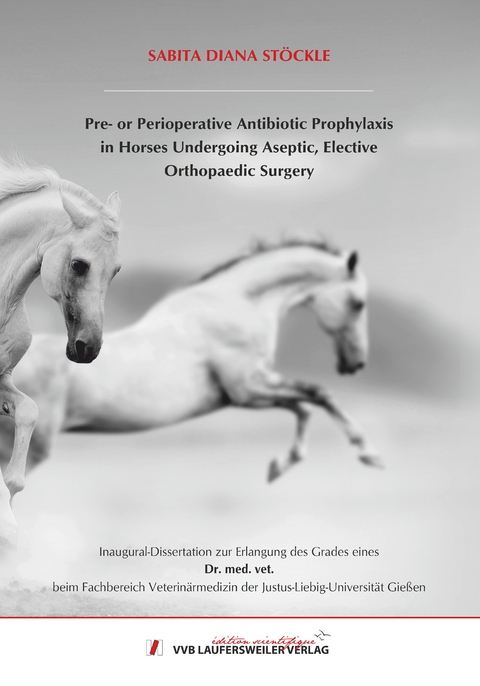
Pre- or Perioperative Antibiotic Prophylaxis in Horses Undergoing Aseptic, Elective Orthopaedic Surgery
Seiten
2019
VVB Laufersweiler Verlag
9783835967809 (ISBN)
VVB Laufersweiler Verlag
9783835967809 (ISBN)
- Keine Verlagsinformationen verfügbar
- Artikel merken
This dissertation comprises a retrospective analysis of patient files and a randomised, prospective clinical study of postoperative complications in equines after clean orthopaedic surgical procedures. The main aim of these studies was to evaluate possible differences between horses pre-treated with antibiotics and those not having received these drugs.
For the retrospective part, 652 out of the 684 case files were suitable for statistical analysis. Details were compiled on the patients, the surgical procedure, and the surgery-associated complications. Antibiotic-receiving patients (n=259) were statistically compared to controls (n=393) by employing the Fisher-Freeman-Halton test or an ANOVA. The main parameter was the development of postoperative complications. For the post hoc analysis, Fisher’s exact test and the Wilcoxon-Mann-Whitney-test were used. The overall complication rate in the retrospective study was 39.1%. An increased incisional swelling was observed most often (25.6%), followed by exudation (7.5%), fever (2.3%), dehiscence (1.8%), and seroma in five cases (0.8%). Septic arthritis was documented in 7/463 horses (1.5%) undergoing arthroscopies. There were no significant differences detected in the development of postoperative complications between the 97/259 (37.5%) antibiotic-receiving patients and in the 158/393 (40.2%) controls. The application of perioperative antibiotics was significantly influenced by the surgeon (p<0.0001), type of surgery (p=0.0007), and increased with the number of surgical lesions (p=0.03). Antibiotic-receiving patients were treated for 3-5 days after surgery and most of them received penicillin-based antibiotics. Patients with three or more interventions per session (n=30) received antibiotics significantly more often. In patients undergoing tendovaginoscopy/bursoscopy, fasciotomy, and neurectomy (n=98), antibiotic prophylaxis was initiated less frequently than in the other surgeries, e.g., combinations of surgeries, splint bone extraction, tenotomy, and arthroscopy (n=554).
In the prospective clinical study, 75 horses were assigned randomly to either the antibiotic-receiving (treated) or the control group. Treated horses received 10 mg/kg amoxicillin and 6.6 mg/kg gentamicin once directly before inducing general anaesthesia. These horses were intensely monitored for five days. Using a semiquantitative scoring system for swelling, skin temperature, exudation, and dehiscence, the surgical wounds were assessed on the days one, three, and five after surgery. In addition, the inflammatory parameters SAA, iron, and haptoglobin were determined on the day before, directly after, and on days one three and five after the surgery. Differences between the groups in score points, rectal body temperature, concentrations of inflammatory parameters, and patient characteristics were tested by the Fisher-Freeman-Halton test or the ANOVA/Wald test. For the post hoc analysis, Fisher’s exact test and the Wilcoxon-Mann-Whitney test were used.
Total score (p=0.002), the scores for swelling (p=0.002), and skin temperature (p=0.007) were significantly higher in the treated group than in controls. The post hoc analysis identified a significantly higher total score for the treated horses on day 1 (p=0.02), and 5 (p=0.01), which was mainly due to swelling with significantly higher scores on days 1 (p=0.02) and 5 (p=0.002), too. On day 1 (p=0.04) and 3 (p=0.03), the score points for skin temperature were significantly higher in the treated horses. Four horses in the control group and just one treated developed fever. There was no significant difference between the groups in SAA (p=0.18), serum iron (p=0.76), and haptoglobin (p=0.85) concentrations. Two horses (1 control, 1 treated drop-out), of which the treated one dropped out of the study because of postoperative additional gentamicin administration, developed a septic joint eight and nine days after surgery, respectively. Such severe complications in equine clean orthopaedic surgery are rare, whether having received perioperative antibiotics or not. In summary, the use of perioperative antibiotic prophylaxis in uncomplicated, elective orthopaedic surgical procedures in equines cannot be justified based on these data.
For the retrospective part, 652 out of the 684 case files were suitable for statistical analysis. Details were compiled on the patients, the surgical procedure, and the surgery-associated complications. Antibiotic-receiving patients (n=259) were statistically compared to controls (n=393) by employing the Fisher-Freeman-Halton test or an ANOVA. The main parameter was the development of postoperative complications. For the post hoc analysis, Fisher’s exact test and the Wilcoxon-Mann-Whitney-test were used. The overall complication rate in the retrospective study was 39.1%. An increased incisional swelling was observed most often (25.6%), followed by exudation (7.5%), fever (2.3%), dehiscence (1.8%), and seroma in five cases (0.8%). Septic arthritis was documented in 7/463 horses (1.5%) undergoing arthroscopies. There were no significant differences detected in the development of postoperative complications between the 97/259 (37.5%) antibiotic-receiving patients and in the 158/393 (40.2%) controls. The application of perioperative antibiotics was significantly influenced by the surgeon (p<0.0001), type of surgery (p=0.0007), and increased with the number of surgical lesions (p=0.03). Antibiotic-receiving patients were treated for 3-5 days after surgery and most of them received penicillin-based antibiotics. Patients with three or more interventions per session (n=30) received antibiotics significantly more often. In patients undergoing tendovaginoscopy/bursoscopy, fasciotomy, and neurectomy (n=98), antibiotic prophylaxis was initiated less frequently than in the other surgeries, e.g., combinations of surgeries, splint bone extraction, tenotomy, and arthroscopy (n=554).
In the prospective clinical study, 75 horses were assigned randomly to either the antibiotic-receiving (treated) or the control group. Treated horses received 10 mg/kg amoxicillin and 6.6 mg/kg gentamicin once directly before inducing general anaesthesia. These horses were intensely monitored for five days. Using a semiquantitative scoring system for swelling, skin temperature, exudation, and dehiscence, the surgical wounds were assessed on the days one, three, and five after surgery. In addition, the inflammatory parameters SAA, iron, and haptoglobin were determined on the day before, directly after, and on days one three and five after the surgery. Differences between the groups in score points, rectal body temperature, concentrations of inflammatory parameters, and patient characteristics were tested by the Fisher-Freeman-Halton test or the ANOVA/Wald test. For the post hoc analysis, Fisher’s exact test and the Wilcoxon-Mann-Whitney test were used.
Total score (p=0.002), the scores for swelling (p=0.002), and skin temperature (p=0.007) were significantly higher in the treated group than in controls. The post hoc analysis identified a significantly higher total score for the treated horses on day 1 (p=0.02), and 5 (p=0.01), which was mainly due to swelling with significantly higher scores on days 1 (p=0.02) and 5 (p=0.002), too. On day 1 (p=0.04) and 3 (p=0.03), the score points for skin temperature were significantly higher in the treated horses. Four horses in the control group and just one treated developed fever. There was no significant difference between the groups in SAA (p=0.18), serum iron (p=0.76), and haptoglobin (p=0.85) concentrations. Two horses (1 control, 1 treated drop-out), of which the treated one dropped out of the study because of postoperative additional gentamicin administration, developed a septic joint eight and nine days after surgery, respectively. Such severe complications in equine clean orthopaedic surgery are rare, whether having received perioperative antibiotics or not. In summary, the use of perioperative antibiotic prophylaxis in uncomplicated, elective orthopaedic surgical procedures in equines cannot be justified based on these data.
| Erscheinungsdatum | 27.04.2019 |
|---|---|
| Reihe/Serie | Edition Scientifique |
| Sprache | englisch |
| Maße | 146 x 210 mm |
| Gewicht | 192 g |
| Themenwelt | Veterinärmedizin |
| Schlagworte | Doktorarbeit • Uni • Wissenschaft |
| ISBN-13 | 9783835967809 / 9783835967809 |
| Zustand | Neuware |
| Informationen gemäß Produktsicherheitsverordnung (GPSR) | |
| Haben Sie eine Frage zum Produkt? |
Mehr entdecken
aus dem Bereich

aus dem Bereich
Ein Handbuch für Tiermedizinische Fachangestellte
Buch | Softcover (2025)
Lehmanns Media (Verlag)
CHF 23,70
Buch | Hardcover (2025)
Schlütersche (Verlag)
CHF 124,60
Buch | Hardcover (2025)
John Wiley & Sons Inc (Verlag)
CHF 319,95


