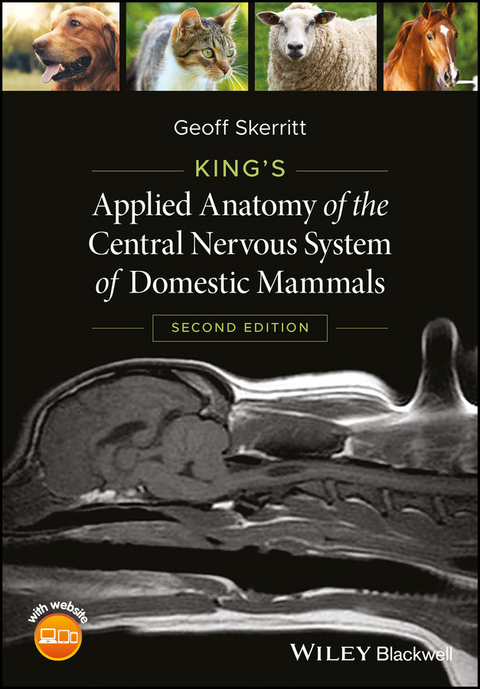
King's Applied Anatomy of the Central Nervous System of Domestic Mammals (eBook)
John Wiley & Sons (Verlag)
978-1-118-40110-1 (ISBN)
An update of a classic student text unlocking the mystery of veterinary neurology and neuroanatomy
King's Applied Anatomy of the Central Nervous System of Domestic Mammals, Second Edition is an ideal introduction for those with no prior knowledge of the central nervous system. Presented in a logical and accessible manner, readers can quickly comprehend the essential principles of how the central nervous system is constructed, the way it works and how to recognise damaged components. By blending descriptive anatomy with clinical neurology, the text offers a unique approach - explaining the structure and function of the central nervous system while highlighting the relevance to clinical practice.
Revised and updated to cover the latest clinical developments, this second edition includes additional content on electrodiagnostic methods, stem cell transplantation and advanced imaging. The book also comes with a companion website featuring self-assessment questions, label the diagram exercises, and downloadable figures to aid further learning.
An excellent introductory text for veterinary students, King's Applied Anatomy of the Central Nervous System of Domestic Mammals, Second Edition is also an invaluable reference for trainee veterinary neurology specialists as well as veterinary practitioners with a particular interest in neurology.
GEOFF SKERRITT is an RCVS and European Specialist in Veterinary Neurology, and a Diplomate and former President of the European College of Veterinary Neurology. In 1997 Geoff was one of the founders of VetMRI, the first mobile veterinary MRI facility in Europe. He is the founder and former Director of ChesterGates Animal Referral Hospital, a leading multi-discipline veterinary referral centre in the UK.
He began his career as a Lecturer in veterinary anatomy at the University of Liverpool, UK. Enthusiasm for neuroanatomy led to a developing interest in veterinary neurology and the establishment of neurology in the curriculum and clinics at the University of Liverpool School of Veterinary Science. Geoff is a popular speaker at meetings and congresses and has published widely in the subjects of veterinary neuroanatomy and neurology.
An update of a classic student text unlocking the mystery of veterinary neurology and neuroanatomy King's Applied Anatomy of the Central Nervous System of Domestic Mammals, Second Edition is an ideal introduction for those with no prior knowledge of the central nervous system. Presented in a logical and accessible manner, readers can quickly comprehend the essential principles of how the central nervous system is constructed, the way it works and how to recognise damaged components. By blending descriptive anatomy with clinical neurology, the text offers a unique approach explaining the structure and function of the central nervous system while highlighting the relevance to clinical practice. Revised and updated to cover the latest clinical developments, this second edition includes additional content on electrodiagnostic methods, stem cell transplantation and advanced imaging. The book also comes with a companion website featuring self-assessment questions, label the diagram exercises, and downloadable figures to aid further learning. An excellent introductory text for veterinary students, King's Applied Anatomy of the Central Nervous System of Domestic Mammals, Second Edition is also an invaluable reference for trainee veterinary neurology specialists as well as veterinary practitioners with a particular interest in neurology.
GEOFF SKERRITT is an RCVS and European Specialist in Veterinary Neurology, and a Diplomate and former President of the European College of Veterinary Neurology. In 1997 Geoff was one of the founders of VetMRI, the first mobile veterinary MRI facility in Europe. He is the founder and former Director of ChesterGates Animal Referral Hospital, a leading multi-discipline veterinary referral centre in the UK. He began his career as a Lecturer in veterinary anatomy at the University of Liverpool, UK. Enthusiasm for neuroanatomy led to a developing interest in veterinary neurology and the establishment of neurology in the curriculum and clinics at the University of Liverpool School of Veterinary Science. Geoff is a popular speaker at meetings and congresses and has published widely in the subjects of veterinary neuroanatomy and neurology.
Title Page 5
Copyright Page 6
Contents 9
Foreword to the Second Edition 19
Preface 21
Acknowledgement 23
About the Contributors 25
About the Companion Website 27
Chapter 1 Arterial Supply to the Central Nervous System 29
Arterial Supply to the Brain 29
1.1 Basic Pattern of the Main Arteries Supplying the Brain 29
1.2 Basic Pattern of Incoming Branches to the Cerebral Arterial Circle 29
1.3 Species Variations 30
1.3.1 Dog, Man and most Mammals 30
1.3.2 Sheep and Cat 33
1.3.3 Ox 33
1.3.4 Summary of Species Variations 33
1.4 Summary of the Significance of the Vertebral Artery as a Source of Blood to the Brain 33
1.5 Humane Slaughter 34
1.6 Rete Mirabile 35
Superficial Arteries of the Spinal Cord 36
1.7 Main Trunks 36
1.7.1 Dorsolateral Arteries 36
1.7.2 Ventral Spinal Artery 36
1.8 Anastomosing Arteries 36
1.9 Segmental Arteries to the Spinal Cord 38
1.9.1 Deep Arteries of the Neuraxis 38
1.10 General Principles Governing the Distribution of Arteries below the Surface of the Neuraxis 38
1.10.1 The Phylogenetic Age of the Region 38
1.11 The Deep Arteries of the Spinal Cord 38
1.11.1 Vertical Arteries 38
1.11.2 Radial Arteries 39
1.12 The Problem of Pulsation 39
1.13 Arterial Anastomoses of the Neuraxis 39
1.13.1 On the Surface of the Neuraxis 39
1.13.2 Below the Surface of the Neuraxis 39
1.13.3 Failure of the Blood Supply to the Neuraxis 39
Chapter 2 The Meninges and Cerebrospinal Fluid 41
Meninges 41
2.1 General Anatomy of the Cranial and Spinal Meninges 41
2.1.1 Dura Mater 41
2.1.2 Arachnoid 41
2.1.3 Pia Mater 41
2.2 Anatomy of the Meninges at the Roots of Spinal and Cranial Nerves 42
2.3 The Spaces around the Meninges 42
2.3.1 Epidural Space 43
2.3.2 Subdural Space 43
2.3.3 Subarachnoid Space 43
2.4 Relationship of Blood Vessels to the Meninges 44
2.5 The Filum Terminale 44
2.6 The Falx Cerebri and Membranous Tentorium Cerebelli 44
Cerebrospinal Fluid 44
2.7 Formation of Cerebrospinal Fluid 44
2.8 The Choroid Plexuses 44
2.9 Mechanism of Formation of Cerebrospinal Fluid 45
2.10 Circulation of Cerebrospinal Fluid 45
2.11 Drainage of Cerebrospinal Fluid 47
2.11.1 Venules of the Subarachnoid Space 47
2.11.2 Arachnoid Villi 47
2.11.3 Lymphatics of Cranial and Spinal Nerves 48
2.12 Functions of Cerebrospinal Fluid 48
2.12.1 Protection of the Neuraxis against Impact 49
2.13 Blood-brain Barrier 49
2.14 Collection of Cerebrospinal Fluid 50
2.14.1 The Atlanto-Occipital Site 50
2.14.2 The Lumbosacral Region 51
2.15 Clinical Conditions of the Cerebrospinal Fluid System 51
Chapter 3 Venous Drainage of the Spinal Cord and Brain 53
The Cranial System of Venous Sinuses 53
3.1 General Plan 53
3.1.1 Dorsal System of Sinuses 53
3.1.2 Ventral System of Sinuses 53
3.1.3 Connecting System of Sinuses 54
3.2 The Components of the Dorsal System of Sinuses 55
3.2.1 Dorsal Sagittal Sinus 55
3.2.2 Straight Sinus 55
3.2.3 Transverse Sinus 56
3.3 The Components of the Ventral System of Sinuses 56
3.3.1 Cavernous Sinus 56
3.3.2 Dorsal Petrosal and Ventral Petrosal Sinuses 56
3.4 Drainage of the Cranial Sinuses into the Systemic Circulation 56
3.4.1 The Veins of the Brain 56
The Spinal System of Venous Sinuses 57
3.5 General Plan 57
3.6 Connections to the Cranial System of Sinuses 57
3.7 Territory Drained by the Spinal System of Sinuses 57
3.8 Drainage of the Spinal Sinuses into the Systemic Circulation 57
Clinical Significance of the Venous Drainage of the Neuraxis 58
3.9 Spread of Infection in the Head 58
3.10 Paradoxical Embolism 58
3.11 Venous Obstruction 58
3.12 Angiography for Diagnosis 59
Chapter 4 The Applied Anatomy of the Vertebral Canal 61
The Anatomy of Epidural Anaesthesia and Lumbar Puncture 61
4.1 The Vertebrae 61
4.1.1 Caudal (Coccygeal) Vertebrae 61
4.1.2 Ligaments 61
4.2 Spinal Cord 61
4.2.1 Filum Terminale and Cauda Equina 61
4.2.2 The End of the Spinal Cord 63
4.3 Meninges 63
4.4 Lumbar Puncture 63
4.5 Epidural Anaesthesia in the Ox 63
4.5.1 Site 63
4.5.2 Objectives 63
4.5.3 Anatomical Hazards 64
4.5.4 Epidural Anaesthesia in other Species 64
4.6 Injuries to the Root of the Tail 64
The Anatomy of the Intervertebral Disc 64
4.7 The Components of the Disc 64
4.7.1 Anulus Fibrosus 64
4.7.2 Nucleus Pulposus 65
4.7.3 The Longitudinal Ligaments 66
4.7.4 Blood and Nerve Supply 66
4.8 Senile Changes 66
4.9 Disc Protrusion 66
4.9.1 General Principles 66
4.9.2 Regional Distribution in Domestic Animals 67
4.9.3 Regional Distribution in Man 69
4.10 Fibrocartilaginous Embolism 69
Malformation or Malarticulation of Vertebrae 69
4.11 The ‘Wobbler Syndrome’ in the Dog 69
4.12 The Wobbler Syndrome in the Horse 69
4.13 Atlanto-Axial Subluxation in Dogs 70
4.14 Anomalous Atlanto-Occipital Region in Arab Horses 70
4.15 Other Vertebral Abnormalities in Dogs 70
Chapter 5 The Neuron 71
The Anatomy of Neurons 71
5.1 General Structure 71
5.1.1 Relationships of the Dendrites and the Axon to the Cell Body 71
5.1.2 Branches of a Neuron 71
5.1.3 Synaptic End Bulbs 72
5.1.4 Size and Shape of the Neuron Cell Body 73
5.1.5 Cell Structure 73
5.1.6 Protein Synthesis 74
5.2 The Axon 74
5.2.1 The Axis Cylinder 74
5.2.2 Axonal Transport 76
5.2.3 The Myelin Sheath 77
5.2.4 Fibre Diameter and Conduction Velocity 78
5.3 Epineurium, Perineurium and Endoneurium 78
5.4 The Synapse 79
5.4.1 General Structure of the Synaptic End Bulb 80
5.4.2 The Presynaptic Membrane 80
5.4.3 The Synaptic Cleft 80
5.4.4 The Postsynaptic Membrane 80
5.4.5 Transmitter Substances 81
5.5 Phylogenetically Primitive and Advanced Neurons 82
5.5.1 Phylogenetically Primitive Neurons 82
5.5.2 Phylogenetically Advanced Neurons 82
5.5.3 Specific and Non-specific Pathways 82
5.6 Axonal Degeneration and Regeneration in Peripheral Nerves 83
5.7 Regeneration and Plasticity in the Neuraxis 86
5.8 Stem Cells and Olfactory Ensheathing Cells 86
5.9 The Reflex Arc 87
5.9.1 Basic Principles 87
5.10 Decussation: The Coiling Reflex 88
Chapter 6 The Nerve Impulse 91
Excitation and Inhibition 91
6.1 Ion Channels and Gating Mechanisms 91
6.2 The Membrane Potential 92
6.3 The Excitatory Postsynaptic Potential 92
6.3.1 Characteristics of the Excitatory Postsynaptic Potential 92
6.3.2 Ionic Basis of the Excitatory Postsynaptic Potential 94
6.3.3 Summation 94
6.3.4 Facilitation 94
6.4 The Inhibitory Postsynaptic Potential 95
6.4.1 Characteristics of the Inhibitory Postsynaptic Potential 95
6.4.2 Ionic Basis of the Inhibitory Postsynaptic Potential 95
6.4.3 Presynaptic Inhibition 95
6.4.4 Role of Inhibitory Neurons in the Neuraxis 95
6.4.5 Reciprocal Innervation 96
6.4.6 Disinhibition 96
6.5 The Receptor Potential 96
6.6 The End-plate Potential 97
6.7 Summary of Decremental Potentials 98
6.8 The Action Potential 99
6.8.1 Threshold 99
6.8.2 The Role of the Trigger Region 99
6.8.3 The Ionic Flux of the Action Potential 100
6.8.4 Recovery after an Action Potential 100
6.8.5 Refractory Periods 100
6.9 Concerning Water Closets 101
6.10 Transducer Mechanisms of Receptors 101
6.10.1 Neuroglia 103
6.11 Astrocytes 104
6.12 Oligodendrocytes 104
6.13 Microglia 105
Chapter 7 Nuclei of the Cranial Nerves 107
General Principles Governing the Architecture of the Nuclei of the Cranial Nerves 107
7.1 Shape and Position of the Central Canal 107
7.2 Fragmentation of the Basic Columns of Grey Matter 107
7.3 Development of an Additional Component Special Visceral Efferent
7.4 The Cranial Nerves of the Special Senses 110
7.5 Summary of the Architectural Principles of the Nuclei of the Cranial Nerves 110
Names, Topography and Functions of the Cranial Nerve Nuclei 110
7.6 Somatic Afferent Nucleus 110
7.7 Visceral Afferent Nucleus 113
7.8 Visceral Efferent Nuclei 113
7.9 Special Visceral Efferent Nuclei 114
7.10 Somatic Efferent Nuclei 114
Reflex Arcs of the Nuclei of the Cranial Nerves 115
Significance of the Nuclei of the Cranial Nerves in Clinical Neurology 116
Chapter 8 Medial Lemniscal System 117
Conscious Sensory Modalities, their Receptors and Pathways 117
8.1 Conscious Sensory Modalities 117
8.2 Peripheral Receptors of Touch, Pressure and Joint Proprioception 119
8.2.1 Free Nerve Endings 119
8.2.2 Neurite-Receptor Cell Complexes 119
8.2.3 Complex Laminated Receptors (Encapsulated Receptors) 120
8.3 Pathways of Touch, Pressure and Joint Proprioception 120
8.3.1 Neuron 1 120
8.3.2 Neuron 2 122
8.3.3 Neuron 3 122
Clinical Conditions Affecting the Medial Lemniscal System 122
8.4 Effects of Lesions in the Dorsal Funiculus 122
Pain Pathways 124
8.5 Peripheral Receptors of Pain 124
8.5.1 Superficial Pain 124
8.5.2 Deep Pain 124
8.6 Spinothalamic Tract of Man 125
8.6.1 Neuron 1 125
8.6.2 Neuron 2 125
8.6.3 Neuron 3 125
8.7 Spinothalamic Pathways in Domestic Mammals 128
8.8 Spinocervical Tract (Spinocervicothalamic Tract) 128
8.9 Species Variations in the Medial Lemniscal System 128
8.9.1 Cuneate and Gracile Fascicles 128
8.9.2 Spinothalamic Pathway 128
8.10 Somatotopic Localisation 129
8.11 Blending of Tracts in the Spinal Cord 129
8.12 Summary of the Medial Lemniscus System 129
Chapter 9 The Special Senses 131
Vision 131
9.1 Neuron 1 131
9.2 Neuron 2 131
9.3 Neuron 3 131
9.3.1 Pathways Coordinating Eyeball Movements 133
9.3.2 Pathways Constricting the Pupil 133
9.3.3 Pathways Controlling Turning of Head and Neck 133
9.3.4 Ascending Reticular Formation 133
9.3.5 Decussation of the Visual Pathways (see Sections 5.10 and 9.1 and Figure 9.3) 133
Hearing 134
9.4 Neuron 1 134
9.5 Neuron 2 134
9.6 Neuron 3 134
Balance 135
9.7 Neuron 1 135
9.8 Neuron 2 135
9.8.1 Connections of the Vestibular Nuclei 136
9.8.2 Vestibular Disease 139
Taste 140
9.9 Neuron 1 140
9.10 Neuron 2 140
9.11 Neuron 3 140
Olfaction Proper: The Sense of Smell 141
9.12 Neuron 1 141
9.13 Neuron 2 142
9.14 Neuron 3 142
9.14.1 The Rhinencephalon 142
9.14.2 Concept of the Limbic System 144
9.14.3 Thalamus and Geniculate Nuclei 144
Summary of the Conscious Sensory Systems 145
Chapter 10 Spinocerebellar Pathways and Ascending Reticular Formation 147
10.1 Spinocerebellar Pathways 147
10.2 Ascending Reticular Formation 147
Spinocerebellar Pathways 148
10.3 Hindlimbs 148
10.3.1 Dorsal Spinocerebellar Tract 148
10.3.2 Ventral Spinocerebellar Tract 148
10.4 Forelimbs 150
10.4.1 Spinocuneocerebellar Pathway 150
10.4.2 Cranial Spinocerebellar Tract 150
10.5 Projections of Spinocerebellar Pathways to the Cerebral Cortex 151
10.6 Functions of the Spinocerebellar Pathways 152
10.7 Species Variations 152
Ascending Reticular Formation 152
10.8 Organisation 152
10.8.1 Constituent Neurons 152
10.8.2 Input 152
10.8.3 In the Spinal Cord 152
10.8.4 In the Brain 155
10.8.5 Projection to the Cerebral Cortex 155
10.8.6 Site of Cell Location of Reticular Formation throughout the CNS 155
10.8.7 Phylogeny 155
Functions of the Ascending Reticular Formation 156
10.9 Arousal 156
10.10 Transmission of Deep Pain 156
10.10.1 Visceral Pain 159
10.10.2 Sleep 159
10.11 Summary of Spinocerebellar Pathways and Ascending Reticular Formation 160
Chapter 11 Somatic Motor Systems 163
Somatic Efferent Neurons 163
11.1 Motor Neurons in the Ventral Horn of the Spinal Cord 163
Muscle Spindles 165
11.2 Structure of the Muscle Spindle 165
11.3 The Mode of Operation of the Muscle Spindle 165
11.3.1 By Stretching of the Muscle as a Whole 165
11.3.2 By Stimulation of the Fusimotor Neuron 166
11.4 Role of Muscle Spindles in Posture and Movement 167
11.5 Golgi Tendon Organs 167
11.6 Muscle Tone 168
11.7 Motor Unit 169
11.8 Recruitment of Motor Units 169
11.9 Summary of Ways of Increasing the Force of Contraction of a Muscle 170
The Final Common Path 170
11.10 Algebraic Summation at the Final Common Path 170
11.11 Renshaw Cells 170
11.12 Lower Motor Neuron 170
11.13 Integration of the Two Sides of the Neuraxis 171
Chapter 12 Pyramidal System 173
Pyramidal Pathways 173
12.1 The Neuron Relay 173
12.1.1 Neuron 1 173
12.1.2 Neuron 2 176
12.1.3 Neuron 3 176
Feedback Pathways of the Pyramidal System 176
12.2 Feedback of the Pyramidal System 176
12.2.1 Corticopontocerebellar Path 176
12.2.2 Return Pathway from Cerebellum to Cerebral Cortex 177
Comparative Anatomy of the Pyramidal System 177
12.3 Species Variations in the Primary Motor Area of the Cerebral Cortex 177
12.4 Species Variations in the Pyramidal System 178
12.4.1 Primates and Carnivores 178
12.4.2 Ungulates 178
12.5 The Function of the Pyramidal System 178
Clinical Considerations 179
12.6 Effects of Lesions in the Pyramidal System 179
12.7 Validity of the Distinction between Pyramidal and Extrapyramidal Systems 180
Chapter 13 Extrapyramidal System 181
Motor Centres 181
13.1 Nine Command Centres 181
13.2 The Cerebral Cortex 181
13.3 Basal Nuclei and Corpus Striatum 182
13.4 Midbrain Reticular Formation 183
13.5 Red Nucleus 183
13.6 Mesencephalic Tectum 183
13.7 Pontine Motor Reticular Centres 184
13.8 Lateral Medullary Motor Reticular Centres 184
13.9 Medial Medullary Motor Reticular Centres 184
13.10 Vestibular Nuclei 184
Spinal Pathways 184
13.11 Pontine and Medullary Reticulospinal Tracts 184
13.12 Rubrospinal Tract 186
13.13 Vestibulospinal Tract 187
13.14 Tectospinal Tract 187
13.15 The Position in the Spinal Cord of the Tracts of the Extrapyramidal System 187
13.16 Summary of the Tracts of the Extrapyramidal System 187
Chapter 14 Extrapyramidal Feedback and Upper Motor Neuron Disorders 189
Feedback of the Extrapyramidal System 189
14.1 Neuronal Centres of the Feedback Circuits 189
14.1.1 Olivary Nucleus 189
14.1.2 Cerebellum 189
14.1.3 Thalamus 189
14.2 Feedback Circuits 189
14.2.1 Centres 1 and 2: The Cerebral Cortex and Globus Pallidus 191
14.2.2 Centres 3 and 4: The Midbrain Reticular Formation and Red Nucleus 191
14.2.3 Centres 5 and 9: The Tectum and Vestibular Nuclei 191
14.2.4 Centres 6, 7 and 8: The Pontine Motor Reticular Centres the Lateral Medullary Motor Reticular Centres and the Medial Medullary Motor Reticular Centres 191
14.2.5 Feedback between Basal Nuclei and Cerebral Cortex 192
14.3 Balance between Inhibitory and Facilitatory Centres 192
14.3.1 Facilitatory Components 192
14.3.2 Inhibitory Components 192
14.4 Clinical Signs of Lesions in Extrapyramidal Motor Centres in Man 193
14.4.1 General Principles 193
14.4.2 Lesions in the Basal Nuclei 193
14.4.3 Parkinson’s Disease 193
14.5 Clinical Signs of Lesions in the Basal Nuclei in Domestic Animals 194
14.6 Upper Motor Neuron Disorders 194
Chapter 15 Summary of the Somatic Motor Systems 197
The Motor Components of the Neuraxis 197
15.1 Pyramidal System 197
15.2 Extrapyramidal System 198
15.3 Distinction between Pyramidal and Extrapyramidal Systems 199
Clinical Signs of Motor System Injuries 199
15.4 Functions of the Pyramidal and Extrapyramidal Systems: Effects of Injury to the Motor Command Centres 199
15.5 Upper Motor Neuron 199
15.6 Lower Motor Neuron 200
15.7 Summary of Projections onto the Final Common Path 201
Chapter 16 The Cerebellum 203
Afferent Pathways to the Cerebellum 203
16.1 Ascending from the Spinal Cord 203
16.2 Feedback Input into the Cerebellar Cortex 203
16.2.1 From the Pyramidal System 203
16.2.2 From the Extrapyramidal System 204
Arterial Supply to the Brain 205
16.2.3 Summary of Decussation of the Feedback Circuits of the Cerebellum 206
Summary of Pathways in the Cerebellar Peduncles 206
16.3 Caudal Cerebellar Peduncle 207
16.4 Middle Cerebellar Peduncle 207
16.5 Rostral Cerebellar Peduncle 207
Rostral Cerebellar Peduncle 207
16.6 Vestibular Areas 207
16.7 Proprioceptive Areas 207
16.8 Feedback Areas 208
Functions of the Cerebellum 208
16.9 Co-ordination and Regulation of Movement 208
16.10 Control of Posture 209
16.11 Ipsilateral Function of the Cerebellum 209
16.12 Summary of Cerebellar Function 209
16.13 Functional Histology of the Cerebellum 210
16.13.1 Summary of Functional Cerebellar Histology 212
Clinical Conditions of the Cerebellum 212
16.14 The Three Cerebellar Syndromes 212
16.15 Cerebellar Disease in Domestic Mammals and Man 213
Chapter 17 Autonomic Components of the Central Nervous System 215
Neocortex and Hippocampus 215
17.1 Cortical Components 215
17.2 Hippocampus 216
Diencephalon 216
17.3 Hypothalamus 216
17.3.1 Components of the Hypothalamus 217
17.3.2 Autonomic Nuclei of the Hypothalamus 218
The Autonomic Functions of the Hypothalamus 218
17.4 Amygdaloid Body and Septal Nuclei 220
17.5 Habenular Nuclei 221
17.6 Hindbrain Autonomic Areas 221
The Autonomic Areas of the Hindbrain 221
17.6.1 Cardiovascular Centres 221
17.6.2 Respiratory Centres 222
17.6.3 Alimentary Centres 222
17.7 Autonomic Motor Pathways in the Spinal Cord 222
17.8 Ascending (Afferent) Visceral Pathways in the Spinal Cord and Brainstem 223
17.8.1 Visceral Pain Pathways 223
17.8.2 Visceral Afferent Pathways not Concerned with Pain 223
Clinical Disorders of the Autonomic System 223
17.9 Effects of Lesions in Autonomic Pathways 223
17.9.1 Lesions in the Hypothalamus 223
17.9.2 Lesions in the Pontine, Medullary and Spinal Reticular Formation 224
17.10 Summary of Descending Autonomic Pathways 225
Chapter 18 The Cerebral Cortex and Thalamus 227
Cerebral Cortex 227
18.1 Projection Areas and Association Areas 227
18.2 Instinct 228
18.3 Cerebral Cortex in Primitive Mammals 228
18.4 Cerebral Cortex in the Cat and Dog 228
18.5 Conditioned Reflexes 228
18.6 Cerebral Cortex in Man 229
18.7 Cognitive Association Area in Man 230
18.8 Cognitive Association Area in Carnivores 231
18.9 Interpretative Association Area in Man 232
18.10 Interpretative Association Area in Carnivores 232
18.11 Frontal Association Area in Man 232
18.12 Frontal Association Area in Carnivores 233
18.13 Corpus Callosum 233
Clinical Conditions of the Cerebral Cortex 233
18.14 Effects of Extensive Damage to the Cerebral Hemisphere in Domestic Mammals 233
18.15 Seizures 235
Histology of the Cerebral Cortex 236
18.16 Histology of the Cerebral Cortex 236
Thalamus 236
18.17 Ventral Group of Thalamic Nuclei 237
18.18 The Lateral Group 238
18.19 Central (or Intralaminar) Group 238
18.20 Dorsomedial Group 238
18.21 Summary of Incoming Afferent Paths to the Thalamus 238
18.22 Summary of the Projections from the Thalamus to the Cerebral Cortex 239
18.22.1 Specific Projections: 239
18.22.2 Diffuse Projections: 239
18.23 Summary of Functions of the Thalamus 239
18.24 Clinical Effects of Lesions of the Thalamus in Domestic Mammals 240
18.25 Clinical Effects of Lesions of the Thalamus in Man 240
Growth of the Human Brain 240
Chapter 19 Embryological and Comparative Neuroanatomy 243
The Embryological Development of the Central Nervous System 243
19.1 The Development of the Brain 243
19.2 The Development of the Spinal Cord 245
19.3 The Development of the Neural Crest 245
Evolution of the Vertebrate Forebrain 246
19.4 Primitive Vertebrates 246
19.5 Contemporary Amphibian 246
19.6 Contemporary Advanced Reptile 247
19.7 Mammal 248
19.8 Bird 249
19.9 Major Homologies in Mammals and Birds 250
Evolution of the Capacity to Differentiate Sensory Modalities 251
19.10 Lower Vertebrates, Including Amphibians 251
19.11 Advanced Reptiles and Birds 251
19.12 Mammals 251
Special Features of the Avian Brain 251
19.13 Size of the Brain 251
19.14 Poor Development of the Cerebral Cortex 251
19.15 External Striatum 252
19.16 Colliculi: The Optic Lobe 252
19.17 Olfactory Areas 252
19.18 Cerebellum 253
19.19 Spinocerebellar Pathways 254
19.20 Cuneate and Gracile Fascicles 254
19.21 Motor Spinal Pathways 255
Chapter 20 Clinical Neurology 257
20.1 Mental Status 257
20.2 Posture 258
20.3 Gait 258
20.4 Examination of the Cranial Nerves: Tests and Observations 260
20.4.1 Olfactory Nerve (Cranial Nerve I) 260
20.4.2 Optic Nerve (Cranial Nerve II) Tests 260
20.4.3 Oculomotor Nerve (Cranial Nerve III) 262
20.4.4 Trochlear Nerve (Cranial Nerve IV) 263
20.4.5 Trigeminal Nerve (Cranial Nerve V) 263
20.4.6 Abducens Nerve (Cranial Nerve VI) 266
20.4.7 Facial Nerve (Cranial Nerve VII) 266
20.4.8 Vestibulocochlear Nerve (Cranial Nerve VIII) 267
20.4.9 Glossopharyngeal Nerve (Cranial Nerve IX) 268
20.4.10 Vagus Nerve (Cranial Nerve X) 269
20.4.11 Accessory Nerve (Cranial Nerve XI) 270
20.4.12 Hypoglossal Nerve (Cranial Nerve XII) 271
Testing Postural and Locomotor Responses 271
20.5 Tonic Neck and Eye Responses 271
20.6 Proprioceptive Positioning Responses 271
20.7 Placing Responses 272
20.8 Extensor Postural Thrust 273
20.9 Hopping 273
20.10 Wheelbarrow Test 273
20.11 Hemiwalking 274
20.12 Righting 275
20.13 Blindfolding 275
20.14 Circling Test 275
20.15 Sway Test 275
Examination of Spinal Reflexes 275
20.16 Withdrawal (Flexor) Reflex 275
20.16.1 Forelimbs 276
20.16.2 Hindlimbs 277
20.17 Patellar Tendon Reflex 277
20.18 Triceps Tendon Reflex 278
20.19 Biceps Tendon Reflex 278
20.20 Cutaneous Trunci/Colli (Formerly Panniculus) Reflex 278
20.21 Perineal Reflex 279
20.22 Crossed Extensor Reflex 279
20.23 Babinski Reflex 279
Other Tests 280
20.24 Assessment of Muscle Tone 280
20.25 Testing Conscious Pain Responses 280
20.26 Detecting Discomfort 280
20.27 Testing the Sympathetic System 280
20.27.1 Neuroanatomy 280
20.28 Case Sheet 282
Chapter 21 Imaging Techniques for Study of the Central Nervous System 285
General Considerations 285
21.1 Species 285
21.2 Objectives of Imaging in Clinical Neurology 285
21.3 Computed Tomography and Magnetic Resonance Imaging 286
21.4 The Use of Contrast Agents in Imaging 288
Intracranial Structures 290
21.5 Positioning of the Head 290
21.6 Breed and Age Variation in Images of the Head 290
Vertebral Column 291
21.7 Positioning of the Patient 291
21.8 Imaging the Vertebral Column 292
21.8.1 Atlanto-Axial Subluxation 293
21.8.2 Cervical Spondylopathy 293
21.8.3 Syringomyelia (Figure 21.8) 293
21.8.4 Spina Bifida 293
21.8.5 Spondylosis 294
21.8.6 Discospondylitis 294
21.8.7 Lesions of Intervertebral Discs (Figure 4.5) 294
21.9 Contrast Radiography of the Vertebral Column 295
21.9.1 Myelography 295
21.9.2 Epidurography 296
Chapter 22 Topographical Anatomy of the Central Nervous System 297
Spinal Cord 297
22.1 Regions of the Spinal Cord 297
22.2 Segments of Spinal Cord and their Relationship to Vertebrae 298
22.3 General Organisation of Grey and White Matter 298
22.4 Dorsal, Lateral and Ventral Horns of Grey Matter 299
22.5 Laminae of Grey Matter 300
22.6 Funiculi of White Matter 300
22.7 Tracts of the White Matter 301
22.7.1 Dorsal Funiculus 301
22.7.2 Lateral Funiculus 301
22.7.3 Ventral Funiculus 302
Medulla Oblongata 302
22.8 Gross Structure 302
22.9 Cranial Nerves 302
22.10 Ventricular System 303
22.11 Internal Structure 305
22.11.1 Pyramids 305
22.11.2 Gracile and Cuneate Fascicles 305
22.11.3 Spinothalamic Tract 305
22.11.4 Spinal Tract of the Trigeminal Nerve 305
22.11.5 Dorsal and Ventral Spinocerebellar Tracts 306
22.11.6 Cochlear Nuclei 306
22.11.7 Vestibular Nuclei 306
22.11.8 Solitary Tract 307
22.11.9 Motor Nuclei of Cranial Nerves VI, VII, IX, X and XII 307
22.11.10 Spinotectal, Tectospinal and Rubrospinal Tracts 307
22.11.11 Reticular Formation 307
Pons 308
22.12 Gross Structure 308
22.13 Cranial Nerves 308
22.14 Ventricular System 309
22.15 Internal Structure 309
22.15.1 Corticospinal, Corticonuclear and Corticopontocerebellar Pathways 309
22.15.2 Ascending and Descending Tracts in the Tegmentum of the Pons 310
22.15.3 Motor and Sensory Trigeminal Nuclei 310
22.15.4 Reticular Formation 310
Midbrain 311
22.16 Gross Structure 311
22.17 Cranial Nerves 311
22.18 Ventricular System 312
22.19 Internal Structure 312
22.19.1 Tectum 312
22.19.2 Tegmentum of the Midbrain 313
22.19.3 Cerebral Crus 315
22.19.4 Substantia Nigra 315
Diencephalon 316
22.20 Gross Structure 316
22.20.1 Epithalamus 316
22.20.2 Thalamus 316
22.20.3 Metathalamus 316
22.20.4 Hypothalamus 316
22.20.5 Subthalamus 316
22.21 Cranial Nerves 317
22.22 Ventricular System 317
22.23 Internal Structure 318
22.23.1 Epithalamus 318
22.23.2 Thalamus 318
22.23.3 Metathalamus 319
22.23.4 Hypothalamus 320
22.23.5 Subthalamus 320
Cerebellum 321
22.24 Gross Structure 321
22.25 Internal Structure 321
22.25.1 Cerebellar Cortex 321
22.25.2 White Matter 321
22.25.3 Nuclei of the Cerebellum 321
22.26 Cerebellar Peduncles 322
Cerebral Hemispheres 323
22.27 Gross Structure 323
22.27.1 Lobes 324
22.27.2 Olfactory Components of the Rhinencephalon 324
22.28 Ventricular System 324
22.29 Internal Structure 325
22.29.1 White Matter 325
22.29.2 Grey Matter 326
Chapter 23 Electrodiagnostics 331
23.1 Introduction 331
23.2 Electromyography 331
23.3 Nerve Conduction Velocity 332
23.4 Electroencephalography 332
23.5 Evoked Potentials 333
23.5.1 Brainstem Auditory Evoked Potential 333
23.5.2 Visual Evoked Potential 334
23.6 Electroretinography 335
23.7 Intra-operative Monitoring of Spinal Cord Function 335
Chapter 24 Diagnostic Exercises 337
24.1 Introduction 337
24.2 Solutions to Diagnostic Exercises 345
Appendix 353
Further Reading 362
Index 374
EULA 396
| Erscheint lt. Verlag | 5.12.2017 |
|---|---|
| Sprache | englisch |
| Themenwelt | Veterinärmedizin ► Vorklinik ► Anatomie |
| Schlagworte | central nervous system of mammals • clinical neurology of mammals • descriptive neuroanatomy of mammals • details of veterinary neurology • function of central nervous system of animals • function of central nervous system of mammals • guide to veterinary neuroanatomy • guide to veterinary neurology • how the central nervous system of mammals works • information on veterinary neurology • introduction to veterinary neuroanatomy • King's Applied Anatomy of the Central Nervous System of Domestic Mammals<b> • </b>Geoff Skerritt</p> • <p>introduction to veterinary neurology • mammal central nervous system • reference to veterinary neuroanatomy • reference to veterinary neurology • revised work on veterinary neuroanatomy • revised work on veterinary neurology • structure of central nervous system of animals • structure of central nervous system of mammals • update on veterinary neurology • Veterinäranatomie u. -physiologie • Veterinärmedizin • Veterinärmedizin f. Kleintiere • Veterinärmedizin / Innere Medizin • Veterinary Anatomy & Physiology • Veterinary Internal Medicine • Veterinary Medicine • Veterinary Medicine - Small Animal General |
| ISBN-10 | 1-118-40110-7 / 1118401107 |
| ISBN-13 | 978-1-118-40110-1 / 9781118401101 |
| Informationen gemäß Produktsicherheitsverordnung (GPSR) | |
| Haben Sie eine Frage zum Produkt? |
 PDF (Adobe DRM)
Kopierschutz: Adobe-DRM
Adobe-DRM ist ein Kopierschutz, der das eBook vor Mißbrauch schützen soll. Dabei wird das eBook bereits beim Download auf Ihre persönliche Adobe-ID autorisiert. Lesen können Sie das eBook dann nur auf den Geräten, welche ebenfalls auf Ihre Adobe-ID registriert sind.
Details zum Adobe-DRM
Dateiformat: PDF (Portable Document Format)
Mit einem festen Seitenlayout eignet sich die PDF besonders für Fachbücher mit Spalten, Tabellen und Abbildungen. Eine PDF kann auf fast allen Geräten angezeigt werden, ist aber für kleine Displays (Smartphone, eReader) nur eingeschränkt geeignet.
Systemvoraussetzungen:
PC/Mac: Mit einem PC oder Mac können Sie dieses eBook lesen. Sie benötigen eine
eReader: Dieses eBook kann mit (fast) allen eBook-Readern gelesen werden. Mit dem amazon-Kindle ist es aber nicht kompatibel.
Smartphone/Tablet: Egal ob Apple oder Android, dieses eBook können Sie lesen. Sie benötigen eine
Geräteliste und zusätzliche Hinweise
Buying eBooks from abroad
For tax law reasons we can sell eBooks just within Germany and Switzerland. Regrettably we cannot fulfill eBook-orders from other countries.
aus dem Bereich