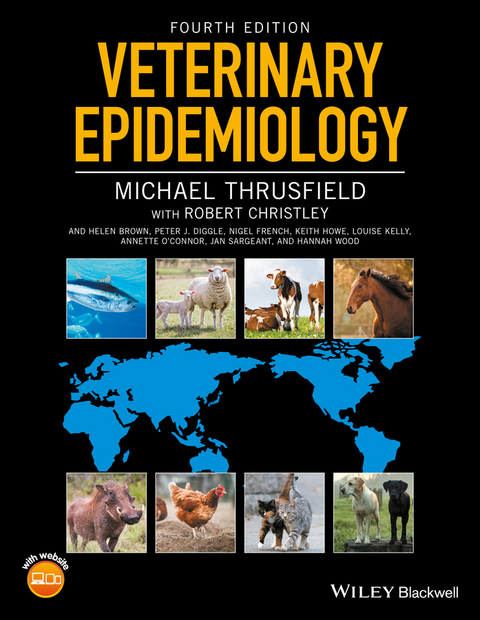
Veterinary Epidemiology (eBook)
John Wiley & Sons (Verlag)
978-1-118-28027-0 (ISBN)
A comprehensive introduction to the role of epidemiology in veterinary medicine
This fully revised and expanded edition of Veterinary Epidemiology introduces readers to the field of veterinary epidemiology. The new edition also adds new chapters on the design of observational studies, validity in epidemiological studies, systematic reviews, and statistical modelling, to deliver more advanced material.
This updated edition begins by offering an historical perspective on the development of veterinary medicine. It then addresses the full scope of epidemiology, with chapters covering causality, disease occurrence, determinants, disease patterns, disease ecology, and much more.
Veterinary Epidemiology, Fourth Edition:
? Features updates of all chapters to provide a current resource on the subject of veterinary epidemiology
? Presents new chapters essential to the continued advancement of the field
? Includes examples from companion animal, livestock, and avian medicine, as well as aquatic animal diseases
? Focuses on the principles and concepts of epidemiology, surveillance, and diagnostic-test validation and performance
? Includes access to a companion website providing multiple choice questions
Veterinary Epidemiology is an invaluable reference for veterinary general practitioners, government veterinarians, agricultural economists, and members of other disciplines interested in animal disease. It is also essential reading for epidemiology students at both the undergraduate and postgraduate levels.
MICHAEL THRUSFIELD is Professor of Veterinary Epidemiology at the Royal (Dick) School of Veterinary Studies in the University of Edinburgh in Edinburgh, UK.
ROBERT CHRISTLEY is Professor of Epidemiology and One Health at the Institute of Infection and Global Health and the Institute of Veterinary Science in the University of Liverpool in Liverpool, UK.
MICHAEL THRUSFIELD is Professor of Veterinary Epidemiology at the Royal (Dick) School of Veterinary Studies in the University of Edinburgh in Edinburgh, UK. ROBERT CHRISTLEY is Professor of Epidemiology and One Health at the Institute of Infection and Global Health and the Institute of Veterinary Science in the University of Liverpool in Liverpool, UK.
Contributors xviii
From the preface to the first edition xix
From the preface to the second edition xx
From the preface to the third edition xxi
Preface to the fourth edition xxii
About the companion website xxiv
1 The development of veterinary medicine 1
Michael Thrusfield
2 The scope of epidemiology 28
Michael Thrusfield
3 Causality 42
Michael Thrusfield
4 Describing disease occurrence 58
Michael Thrusfield
5 Determinants of disease 86
Michael Thrusfield
6 The transmission and maintenance of infection 115
Michael Thrusfield
7 The ecology of disease 138
Michael Thrusfield
8 Patterns of disease 168
Michael Thrusfield
9 Comparative epidemiology 189
Michael Thrusfield
10 The nature of data 201
Michael Thrusfield
11 Data collection and management 219
Michael Thrusfield
12 Presenting numerical data 251
Michael Thrusfield and Robert Christley
13 Surveys 270
Michael Thrusfield and Helen Brown
14 Demonstrating association 296
Michael Thrusfield
15 Observational studies 319
Michael Thrusfield
16 Design considerations for observational studies 339
Robert Christley and Nigel French
17 Clinical trials 361
Michael Thrusfield
18 Validity in epidemiological studies 383
Robert Christley and Nigel French
19 Systematic reviews 397
Annette O'Connor, Jan Sargeant and Hannah Wood
20 Diagnostic testing 421
Michael Thrusfield
21 Surveillance 457
Michael Thrusfield
22 Statistical modelling 492
Robert Christley and Peter J. Diggle
23 Mathematical modelling 520
Michael Thrusfield
24 Risk analysis 540
Michael Thrusfield and Louise Kelly
25 Economics and veterinary epidemiology 565
Keith Howe and Michael Thrusfield
26 Health schemes 586
Michael Thrusfield
27 The control and eradication of disease 604
Michael Thrusfield
Appendices 635
References 694
Index 841
1
The development of veterinary medicine
Veterinary epidemiology is concerned with disease in animal populations. Its evolution has spanned several centuries and has been central to the successful control of many animal diseases. This introductory chapter traces the development of veterinary medicine in general (including relevant aspects of human medicine), showing that it has been inseparably linked to that of veterinary epidemiology.
Although man’s association with animals began in prehistoric times, the development of scientific veterinary medicine is comparatively recent. A milestone in this growth was the establishment of the first permanent veterinary school at Lyons, France, in 1762. Early developments were governed largely by economic rather than humanitarian motives, associated with the importance of domestic stock as a source of food and as working animals; and there are still important economic reasons for concern about disease in animal populations. Later, with the advent of the industrial revolution and the invention of the internal combustion engine, the importance of draft animals declined in the more‐economically‐developed countries. Although dogs and cats have been companion animals for several thousand years, it is only relatively recently that they and other pets have increased in importance as components of human society.
Until the last half of the 20th century, the emphasis of veterinary medicine had been on the treatment of individual animals with clearly identifiable diseases or defects. Apart from routine immunization and prophylactic treatment of internal parasites, restricted attention had been given to herd health and comprehensive preventive medicine, which give proper consideration to both infectious and non‐infectious diseases.
Currently, the nature of traditional clinical practice is changing in the more‐economically‐developed countries. The stock owner is better educated, and, among livestock, the value of individual animals relative to veterinary fees has decreased. Therefore, contemporary large‐animal practitioners, if they are to meet modern requirements, must support herd health programmes designed to increase production by preventing disease, rather than just dispensing traditional treatment to clinically sick animals.
In the less‐economically‐developed countries, the infectious diseases still cause considerable loss of animal life and production. Traditional control techniques, based on identification of recognizable signs and pathological changes, cannot reduce the level of some diseases to an acceptable degree. Different techniques, based on the study of patterns of disease in groups of animals, are needed.
Similarly, contemporary companion‐animal practitioners, like their medical counterparts, are becoming increasingly involved with chronic and refractory diseases which can be understood better by an investigation of the diseases’ characteristics in populations.
This chapter outlines the changing techniques of veterinary medicine by tracing man’s attempts at controlling disease in animals, and introduces some current animal disease problems that can be solved by an epidemiological approach.
Historical perspective
Domestication of animals and early methods of healing
The importance of animal healers has been acknowledged since animals were initially domesticated, when they were already likely to have been chronically affected by various infections (McNeill, 1977). The dog, naturally a hunter, was probably the first animal to be domesticated over 14 000 years ago when it became the companion of early hunters, with evidence of close proximity to humans as early as 31 000 years ago (Germonpré et al., 2009); and differentiation from its ancestor, the wolf, was likely to have occurred at least 10 000 years ago, as hunter‐gatherer societies gradually evolved into sedentary agricultural populations (Vilà et al., 1997). Sheep and goats were domesticated by 9000 BC in the fertile Nile valley and were the basis of early pastoral cultures. A few of these societies have lasted (e.g., Pfeffer and Behera, 1997), but many were superseded by cattle cultures; in some, the pig increased in importance (Murray, 1968). An Egyptian cattle culture evolved from 4000 BC, and farming spread from the Near East into Europe (Figure 1.1). There is archaeological evidence of cattle shrines in Anatolia dating back to 6000 BC (Mellaart, 1967). This record illustrates that animals had religious, as well as economic, significance in early civilizations. The aurochs was central to the religion of the Sumerians, who migrated throughout Asia, North Africa and Europe in the third millennium BC taking their animals and beliefs with them. India is the largest cattle culture that remains. Cattle cultures also persist in north‐east Africa, the result of interaction between the Ancient Egyptians and early Nilotic tribes. Cattle still play important roles in these cultures: they are food, companionship, and status and religious symbols to the Suk (Beech, 1911) and Dinka (Lienhardt, 1961) of South Sudan.
Figure 1.1 A generalized map to show the spread of farming from the Near East to Europe in years BC.
(Adapted from Dyer, 1990.)
The first extensive colonization of the Eurasian steppe and semi‐arid areas occurred in the third millennium BC. The horse provided the key to successful exploitation of the area north of the Black Sea, the Caucasus, and the Taurus and Zagros mountains (Barraclough, 1984), and a Eurasian horse culture, associated with warrior tribes, emerged (Simpson, 1951). Some of these tribes overran the older cattle cultures. The horse is represented in Iranian, Greek and Celtic pantheons. It has become a symbol of veterinary medicine in the form of a centaur, one of which, Chiron, was considered to be the mythological founder of Greek medicine.
There have been several movements of animals with concomitant social and agricultural modifications since the early changes. The camel was introduced into Saharan Africa in the first century BC, and into the Sub‐Saharan region around AD 400 (Spencer and Thomas, 1978; Phillipson and Reynolds, 1996), the latter already having well established domestic cattle and goat populations (Cain, 1999; Tefera, 2004). The Spanish introduced cattle, sheep, pigs and goats to North America in the 16th century. Haired sheep were introduced to Africa by European slave traders. The Spanish brought turkeys to Europe from North America.
The early Egyptian healers combined religious and medical roles by being priest‐healers, often associated with temples. Their therapeutic techniques are recorded in the veterinary Papyrus of Kahun (c. 1900 BC). Literary records of similar age, describing veterinary activities, are extant from other parts of the world, such as Indian Sanskrit texts from the Vedic period (1800–1200 BC).
Changing concepts of the cause of disease
Concepts of the cause of disease have changed and evolved1. A method of treatment used by early Egyptians was incantation. This was partly ritual, but also reflected their belief in supernatural spirits as a possible cause of disease. Approaches to treatment and prevention are the direct result of theories of cause. There have been five main theories up to the middle of the last century2. One theory was often superseded by another, but traces of each still can be seen in different parts of the world.
Demons
Early man attributed disease to supernatural powers, the product of animism, which imbued all moving things with a spirit. In this ‘spirit‐world’, disease could be produced by witches3, superhuman entities and spirits of the dead (Valensin, 1972). Treatment therefore included: placation, for example by sacrifice; exorcism (forcible expulsion); evasion, for instance scattering millet seeds to avoid vampires (Summers, 1961); and transference, often to human and animal ‘scapegoats’4, probably the best known single example of which is the Gadarene swine (the Bible: Mark 5, i–xiii). The techniques included: ritual ceremonies; material objects that could be suspended (amulets and periapts), carried (talismans), hung in a building (fetishes and icons) or displayed in the community (totems); the use of special people such as witch doctors; and incantations5. The meaning of the Indian word ‘brahmin’ originally was ‘healer’ because the Brahmin were a class of healers. In the Neolithic period (4200–2100 BC), trepanation (the removal of a bone disc from the skull) may have been practised to release evil spirits from sick people (Buckland, 1882; Wakefield and Dellinger, 1939). The practice also is recorded in veterinary texts as early as the 16th century, but may be much older (Binois, 2015); and the Greek physician, Galen, practised trepanation on apes in the second century AD (Arnott et al., 2003).
During the 19th century, many European peasants still believed that diseases of cattle were caused by evil spirits, which could be kept at bay by fire (Frazer, 1890), and the African Nuer tribe occasionally still uses incantations during ritual sacrifice when cattle epidemics occur (Evans‐Pritchard, 1956)6. Moreover, sacrifice was practised in England as late as the 19th...
| Erscheint lt. Verlag | 19.2.2018 |
|---|---|
| Co-Autor | Robert Christley |
| Sprache | englisch |
| Themenwelt | Veterinärmedizin |
| Schlagworte | Animal diseases • animal health • Causality • determinants • Diagnostic Tests • disease occurrences • ecology disease • Epidemiological studies • Epidemiologie • Epidemiologie, Gesundheitswesen u. Statistik • epidemiology • <p>Veterinary epidemiology • Observational Studies • Patterns • preventative care</p> • statistical modeling • Surveillance • Systematic reviews • Veterinärmedizin • Veterinary Epidemiology, Public Health & Statistics • Veterinary Medicine |
| ISBN-10 | 1-118-28027-X / 111828027X |
| ISBN-13 | 978-1-118-28027-0 / 9781118280270 |
| Informationen gemäß Produktsicherheitsverordnung (GPSR) | |
| Haben Sie eine Frage zum Produkt? |
 EPUB (Adobe DRM)
Kopierschutz: Adobe-DRM
Adobe-DRM ist ein Kopierschutz, der das eBook vor Mißbrauch schützen soll. Dabei wird das eBook bereits beim Download auf Ihre persönliche Adobe-ID autorisiert. Lesen können Sie das eBook dann nur auf den Geräten, welche ebenfalls auf Ihre Adobe-ID registriert sind.
Details zum Adobe-DRM
Dateiformat: EPUB (Electronic Publication)
EPUB ist ein offener Standard für eBooks und eignet sich besonders zur Darstellung von Belletristik und Sachbüchern. Der Fließtext wird dynamisch an die Display- und Schriftgröße angepasst. Auch für mobile Lesegeräte ist EPUB daher gut geeignet.
Systemvoraussetzungen:
PC/Mac: Mit einem PC oder Mac können Sie dieses eBook lesen. Sie benötigen eine
eReader: Dieses eBook kann mit (fast) allen eBook-Readern gelesen werden. Mit dem amazon-Kindle ist es aber nicht kompatibel.
Smartphone/Tablet: Egal ob Apple oder Android, dieses eBook können Sie lesen. Sie benötigen eine
Geräteliste und zusätzliche Hinweise
Buying eBooks from abroad
For tax law reasons we can sell eBooks just within Germany and Switzerland. Regrettably we cannot fulfill eBook-orders from other countries.
aus dem Bereich