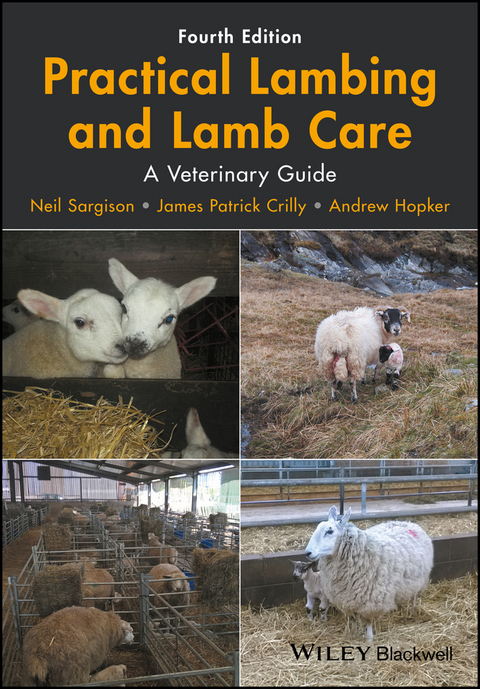
Practical Lambing and Lamb Care (eBook)
John Wiley & Sons (Verlag)
978-1-119-14067-2 (ISBN)
The Fourth Edition of Practical Lambing and Lamb Care offers a complete revision and update to this comprehensive and practical resource to all aspects of lambing and lamb care.
- Offers a thoroughly revised edition of this practical guide to all aspects of lambing and lamb care
- Presents an authoritative resource for anyone involved in the care of pregnant ewes and newborn lambs, especially sheep farmers and veterinarians ?
- Written by leading authors in the field
- Includes information on health problems, abortion, lambing management, obstetrics and much more
The authors
Neil Sargison, BA, VetMB, PhD, DSHP, DipECSRHM, FRCVS, is a Professor of Farm Animal Practice at the University of Edinburgh, Royal (Dick) School of Veterinary Studies, Roslin, Midlothian, Scotland; President of the European College of Small Ruminant Health Management.
James Patrick Crilly, MA, VetMB, CertAVP, DipECSRHM, MRCVS, is a Veterinary Surgeon at Larkmead Veterinary Group, UK.
Andrew Hopker, BVM&S, CertAVP, MRCVS, is a Lecturer and Clinician in the Farm Animal Practice at the Royal (Dick) School of Veterinary Studies, Scotland.
The Fourth Edition of Practical Lambing and Lamb Care offers a complete revision and update to this comprehensive and practical resource to all aspects of lambing and lamb care. Offers a thoroughly revised edition of this practical guide to all aspects of lambing and lamb care Presents an authoritative resource for anyone involved in the care of pregnant ewes and newborn lambs, especially sheep farmers and veterinarians Written by leading authors in the field Includes information on health problems, abortion, lambing management, obstetrics and much more
The authors Neil Sargison, BA, VetMB, PhD, DSHP, DipECSRHM, FRCVS, is a Professor of Farm Animal Practice at the University of Edinburgh, Royal (Dick) School of Veterinary Studies, Roslin, Midlothian, Scotland; President of the European College of Small Ruminant Health Management. James Patrick Crilly, MA, VetMB, CertAVP, DipECSRHM, MRCVS, is a Veterinary Surgeon at Larkmead Veterinary Group, UK. Andrew Hopker, BVM&S, CertAVP, MRCVS, is a Lecturer and Clinician in the Farm Animal Practice at the Royal (Dick) School of Veterinary Studies, Scotland.
Preface to the Fourth Edition vii
1 General Lambing Management 1
2 Specific Causes of Lamb and Kid Mortality 37
3 Husbandry and Health Planning to Prepare for Lambing or Kidding: Ensuring Pregnancy in Ewes and Does 61
4 Husbandry and Health Planning to Prepare for Lambing: Nutritional Management of Pregnant Ewes and Does 87
5 Husbandry and Health Planning to Prepare for Lambing: Health Management of Pregnant Ewes and Does 101
6 Identifying Unwell Ewes and Lambs, Does and Kids 129
7 Legislation 139
Index 155
1
General Lambing Management
It is should be emphasised that most sheep and goats give birth to their lambs and kids naturally and unassisted, as nature intended. When problems do arise, timely intervention is required to prevent losses. However, inappropriate intervention too soon can also cause harm to both ewe and lamb, can compromise animal welfare and may result in economic loss.
The normal hormonal processes involved in giving birth occur most effectively when the dam feels safe and is undisturbed. While good observation is essential, disturbance of the lambing ewes should be minimised and shepherds should move among the flock in a calm and quiet manner. The role of a good shepherd in the delivery of lambs at lambing time should be to provide the right amount of assistance at the right time, and no more. The keys to achieving this are good preparation and adequate supervision of lambing ewes to spot problems in a timely manner.
Most assisted deliveries can be undertaken satisfactorily, using a gentle hygienic technique to give a viable, humane and profitable outcome. The general principles and practice of delivering goat kids are the same as those for lambing ewes. In this chapter, specific reference to goats is only made where the important principles differ.
Preparation for Lambing
Around the world, the economics of small ruminant farming have necessitated a shift of focus away from the care of individual animals and towards whole flock or herd approaches. Careful preparation for lambing or kidding is now, therefore, of paramount importance to protect of the welfare of pregnant and lambing ewes or does, and their newborn lambs or kids. Lambing should be seen as the critical time when the benefits of general preparation, nutrition and animal health management throughout the year are realised.
Careful shepherding and the design and selection of the lambing environment – be it in lambing paddocks, or lambing sheds – is required to minimise disturbance of lambing ewes, thus enabling the establishment of a good ewe‐lamb bond and enhancing the survival of newborn lambs. Whenever possible, steep and exposed fields should be avoided. Lambing fields should not be too large and water sources not too far apart (Figure 1.1).
Figure 1.1 Lambing fields should ideally be small and flat with easy access to food and water.
When potentially less suitable lambing paddocks must be used, they should, if possible, be reserved for single‐bearing adult ewes. Buildings should be well ventilated and drained. Pens should be small enough to allow animals to be grouped according to their nutritional and animal health needs, and should be designed in a manner such that lambing and lambed ewes can be isolated and removed without undue disturbance of the whole group. Consideration should be given to the housed ewe space requirements of about 1.1 m2 per ewe, the need for constant access to forage, and concentrate feed trough space requirements of about 0.5 m per ewe (Figure 1.2). These requirements vary with breed and litter size.
Figure 1.2 Lambing sheds need to be carefully organised to ensure ease of observation, precision nutritional management and minimal disturbance of lambing ewes.
Sufficient individual pens should be available, based on a figure of about 10% for the flock. These should be large enough to allow the ewe and lamb to lie safely apart from each other, and need to be clean and well drained. All pens should be well lit and easily accessible. Food and water must be available at all times.
Despite long‐term planning, the need for careful skilled assistance for some lambing ewes is inevitable. A clear plan is required to avoid suffering in ewes which cannot be lambed. This should include guidelines about when and how to seek assistance and provision for the immediate humane destruction of distressed animals. Lambing equipment should be prepared in advance (see Table 1.1). Provision should be made for the management of those diseases which occur annually in most flocks around lambing, and there should also be clear guidelines about when to seek assistance, and to ensure prompt and humane destruction to prevent further suffering when treatment is unsuccessful or uneconomical. Preparation for lambing must also be aimed at prevention and management of disease in newborn lambs. Despite careful preventive management, the occurrence of disease in newborn lambs is inevitable, so provision should be made for the treatment of the common problems and specific diseases that occur in the flock.
Table 1.1 Equipment list for lambing sheep.
| Suitable antiseptic solution |
| Obstetric lubricant |
| Arm length disposable gloves |
| Lambing ropes, snares or other aids |
| Clean needles and syringes |
| Antibiotics for treatment of mastitis or metritis |
| Injectable anti‐inflammatory drugs |
| Plastic retainers or harnesses, local anaesthetic, clean obstetric tape and needles for the management of vaginal prolapse |
| Calcium borogluconate injection for the treatment of hypocalcaemia |
| Propylene glycol, or other concentrated energy supplements for the treatment of pregnancy toxaemia |
| Strong iodine tincture for navels and a dip cup or spray to apply |
| Stomach tubes, colostrum, a warming box, glucose injection, syringes and needles for the treatment of starvation and hypothermia |
| Kettle for hot water |
| Rehydration drench or formula for lambs |
| Clips or small syringes and needles for subconjunctival injections to correct entropion |
| Oral antibiotics for watery mouth prevention if needed |
| Injectable antibiotics for the treatment of neonatal bacteraemias if needed |
| Elastrator rubber rings for lambs if needed |
| Marker paint |
| Spare hurdles for making addition pens |
| Disinfectant for pens and floors |
| Sufficient clean buckets for food and water |
Normal Lambing
The normal ewe gestation period is 143–147 days. Impending lambing (parturition) is signalled by udder development, accumulation of colostrum, slackening of the sacro‐iliac ligaments between the tail head and the vulva and visible dropping of the abdominal contents, giving an appearance of hollowness of the sub‐lumbar spaces on both sides of the ewe. The birth process is described as having three consecutive stages.
First stage labour is represented by cervical dilation, which takes 2–6 hours, being fastest in ewes bearing multiple lambs (multiparous ewes). Behavioural changes are often the first sign of impending lambing. The ewe will frequently separate herself from the flock or not come forward for feeding. If she does come to the trough, she may leave early. Sheep may paw at the ground and then sniff the area, while frequently lying down and then standing (Figure 1.3).
Figure 1.3 Ewes in first stage labour initially separate themselves from the main group in a preferred lambing site before abdominal contractions begin.
Ewes lambing outdoors often separate themselves from the flock at this stage, so it is important that corners, ditches, bushes and other such areas are checked regularly. Abdominal contractions (straining) will start, initially lasting 15–30 seconds and occurring at about 15 minute intervals. Straining becomes more frequent, until it is happening every two to three minutes, and a string of mucus may be seen at the vulva. The appearance of the water bag at the vulva indicates that the ewe is ready to give birth, although the bag may burst and go unnoticed. This process usually occurs faster in older animals which have previously given birth, and tends to be slower in ewe lambs and gimmers. Disturbance of the sheep during this process may also delay progress.
Second stage labour is represented by the passage of the lamb through the birth canal, and typically takes about one hour. The breaking of the water bag (rupture of allanto‐chorion) is indicated by a rush of fluid, following which part of the placenta (the amnion) and foetus are presented into the birth canal. Powerful reflex and voluntary contractions of abdominal muscles will occur every couple of minutes. Parts of the lamb may be seen protruding from the vulva (Figure 1.4).
Figure 1.4 The appearance of the placenta and foetus in the birth canal indicates second stage labour.
Once the lamb has appeared at the vulva it is normally delivered soon afterwards (Figure 1.5). Again, disturbance of the ewe may delay this process.
Figure 1.5 Normal unassisted delivery of a lamb in anterior presentation.
Once the lamb is born, the ewe should immediately lick and clean the lamb. This process is important for stimulating the lamb and establishing the bond between mother and young, as well as drying the lamb....
| Erscheint lt. Verlag | 24.1.2018 |
|---|---|
| Sprache | englisch |
| Themenwelt | Veterinärmedizin ► Großtier |
| Schlagworte | Agriculture • animal agriculture • Animal Breeding & Genetics • ensuring safe pregnancy in ewes and does • goat kidding management • guide to lambing management • health management of pregnant ewes and does • how to manage lambs • Husbandry and health planning to prepare for lambing • Husbandry and health planning to prepare for lambing: nutritional management of pregnant ewes and does • Husbandry and health planning to prepare for lambing or kidding • Identifying unwell ewes and lambs • Lamm • Landwirtschaft • Legislation concerning lambing management</p> • <p>Introduction to lambing management • obstetrical procedures and health management of newborn lambs or kids • practical information on lamb care • principles of lamb management • resource to lamb management • Schafe • Schafzucht • Specific causes of lamb and kid mortality • Tierhaltung • Tierzucht • Tierzucht u. Genetik • Veterinärmedizin • Veterinärmedizin f. Nutztiere • Veterinary Medicine • Veterinary Medicine - Farm Animals |
| ISBN-10 | 1-119-14067-6 / 1119140676 |
| ISBN-13 | 978-1-119-14067-2 / 9781119140672 |
| Informationen gemäß Produktsicherheitsverordnung (GPSR) | |
| Haben Sie eine Frage zum Produkt? |
 EPUB (Adobe DRM)
Kopierschutz: Adobe-DRM
Adobe-DRM ist ein Kopierschutz, der das eBook vor Mißbrauch schützen soll. Dabei wird das eBook bereits beim Download auf Ihre persönliche Adobe-ID autorisiert. Lesen können Sie das eBook dann nur auf den Geräten, welche ebenfalls auf Ihre Adobe-ID registriert sind.
Details zum Adobe-DRM
Dateiformat: EPUB (Electronic Publication)
EPUB ist ein offener Standard für eBooks und eignet sich besonders zur Darstellung von Belletristik und Sachbüchern. Der Fließtext wird dynamisch an die Display- und Schriftgröße angepasst. Auch für mobile Lesegeräte ist EPUB daher gut geeignet.
Systemvoraussetzungen:
PC/Mac: Mit einem PC oder Mac können Sie dieses eBook lesen. Sie benötigen eine
eReader: Dieses eBook kann mit (fast) allen eBook-Readern gelesen werden. Mit dem amazon-Kindle ist es aber nicht kompatibel.
Smartphone/Tablet: Egal ob Apple oder Android, dieses eBook können Sie lesen. Sie benötigen eine
Geräteliste und zusätzliche Hinweise
Buying eBooks from abroad
For tax law reasons we can sell eBooks just within Germany and Switzerland. Regrettably we cannot fulfill eBook-orders from other countries.
aus dem Bereich