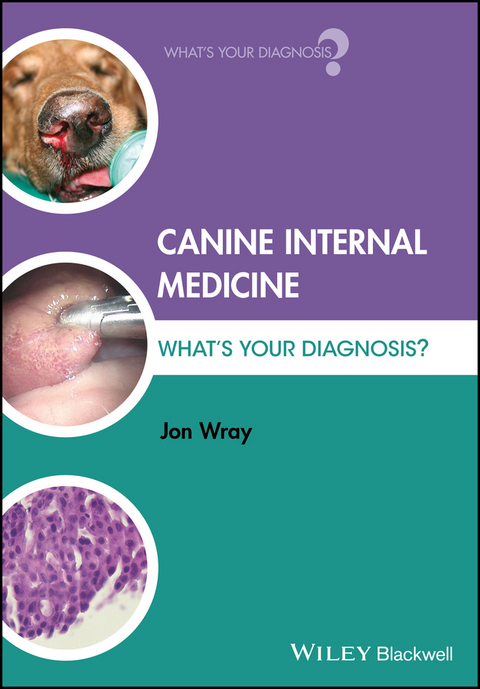
Canine Internal Medicine (eBook)
John Wiley & Sons (Verlag)
978-1-118-91816-6 (ISBN)
About the author:
Jon Wray is a Specialist in Small Animal Internal Medicine and Head of Cardiology at Dick White Referrals, one of the busiest small animal multidisciplinary referral hospitals in the UK. He is an RCVS Recognised Specialist in Small Animal Medicine, Honorary Associate Professor of Small Animal Internal Medicine at the University of Nottingham, and was previously Chief Examiner for the RCVS Diploma and Certificate in Small Animal Medicine.
A unique, case-based guide to diagnosing and treating a wide range of conditions encountered in canine internal medicine Canine Internal Medicine: What's Your Diagnosis? is an ideal guide to how internal medicine cases are handled in the clinical setting. This text is part of an exciting series, which combines problem-based learning, case studies, and questions and answers. Designed for veterinarians in practice and students, the series presents material in a format designed to enhance critical thinking and understanding. Adopting a case-based approach, chapters are built around body systems and are directed by questions to test the reader's ability to interpret clinical history, illustrative images and diagnostic results in order to provide differential diagnoses, diagnostic plans and treatment options. Common pitfalls in diagnosis and management are discussed, and you will benefit from the experience of the author as a busy and experienced clinician. An innovative and interesting way to increase knowledge and skills in canine internal medicine, Canine Internal Medicine: What's Your Diagnosis? is an indispensable resource for veterinary students, veterinarians in small animal practice, and those studying for post-graduate qualification in small animal medicine.
About the author: Jon Wray is a Specialist in Small Animal Internal Medicine and Head of Cardiology at Dick White Referrals, one of the busiest small animal multidisciplinary referral hospitals in the UK. He is an RCVS Recognised Specialist in Small Animal Medicine, Honorary Associate Professor of Small Animal Internal Medicine at the University of Nottingham, and was previously Chief Examiner for the RCVS Diploma and Certificate in Small Animal Medicine.
Acknowledgements vii
Dedication ix
How to Use This Book xi
Introduction xiii
Section A Endocrinology 1
Case 1 presenting with polyuria/polydipsia 3
Case 2 presenting with seizures 17
Case 3 presenting with lethargy and weight loss 27
Case 4 presenting with alopecia and polyuria/polydipsia 39
Case 5 presenting with weight gain, lethargy and coat abnormalities 53
Section B Haematology and Immunology 61
Case 6 presenting with lethargy and pigmenturia 63
Case 7 presenting with lethargy and vomiting 75
Case 8 presenting with lethargy and lameness 85
Case 9 presenting with lethargy and lameness also 99
Section C Hepatobiliary Disease 105
Case 10 presenting with abdominal pain 107
Case 11 presenting with mentation abnormalities 117
Case 12 presenting with jaundice 131
Section D Gastroenterology 153
Case 13 presenting with diarrhoea, ascites and seizures 155
Case 14 presenting with inappetence and vomiting 167
Case 15 presenting with diarrhoea and weight loss 181
Case 16 presenting with regurgitation 195
Section E Respiratory 205
Case 17 presenting with cough and tachypnoea 207
Case 18 presenting with episodes of dyspnoea 217
Case 19 presenting with tachypnoea 225
Section F Ear, Nose and Throat 237
Case 20 presenting with exercise intolerance 239
Case 21 presenting with epistaxis 247
Section G Cardiovascular 259
Case 22 presenting with lethargy and ascites 261
Case 23 presenting with lethargy and heart murmur 275
Section H Urology and Nephrology 287
Case 24 presenting with azotaemia on pre-anaesthetic blood sample 289
Case 25 presenting with dysuria 303
Case 26 presenting with haematuria 311
Section I Reproductive/Genital Tract 325
Case 27 presenting with blood from the penis 327
Section J Oncology 339
Case 28 presenting with pelvic limb swelling 341
Case 29 presenting with weight loss and tachypnoea 349
Case 30 presenting with lymphadenomegaly 361
Section K Neurology 379
Case 31 presenting with ocular changes and regurgitation 381
Case 32 presenting with stiffness and dysphagia 389
Section L Infectious diseases 395
Case 33 presenting with lethargy and polyuria 397
Case 34 presenting with lethargy, vomiting and jaundice 413
Appendix 1: Index of Tables and Figures, Pearls and Clinical Skills Generated 421
Appendix 2: Diagnosis by Case 435
Appendix 3: Conversion Table of SI to Common Units 437
Index 439
Introduction
Approach to medical problem-solving and laboratory interpretation
All medical problem solving succeeds or fails on the history and the physical examination. Without performing these properly, all diagnostic attempts are doomed to being based more on luck than judgment. These skills tend to, in my humble opinion, be ignored/marginalised/undervalued by many veterinary surgeons who are keen to explore more technologically ‘glamorous' avenues of diagnosis. This is a mistake. Honing the skills of asking the right questions, in the right way and interpreting the findings of this and a thorough, skillful and objective physical examination are the sine qua non of Internal Medicine diagnosis.
The problem list
The initial approach to medical diagnosis starts with the problem list. In this context a medical ‘problem' may be a clinical sign exhibited by the animal or concern expressed by their owner, a physical examination abnormality or the result of a diagnostic test that differs from the expected normal. Great care must be taken to define the nature of the problem, especially where different problems may appear, or at least be described, similarly. An example of this would be the need to distinguish regurgitation (which is often due to oesophageal disease) versus vomiting (which is usually associated with pathology distal to the oesophagus). Careful ‘open' (that is not leading) questioning and unbiased interpretation of responses during the initial history taking is an important skill to cultivate. A good thorough clinical history should often allow a judicious clinician to both define what the problem is and often where the problem is. This latter is especially important in refining the diagnostic approach to the likely area of interest, especially where diagnostic imaging is to be performed. For example, performing thoracic radiographs alone to look for a cause of dyspnoea in an older Labrador with laryngeal paralysis is not only going to lead to misdiagnosis but belies a lack of recognition of the site of disease because of poor observational/physical examination skills.
By defining a problem list that is complete, the clinician can avoid potential errors of omission and ‘anchoring bias' (see below) that may prevent accurate diagnosis. By using this problem list to develop a set of relevant differential diagnoses for each problem, areas of potential commonality may be reviewed and can help marshal the differential diagnosis more rapidly into an order of likelihood than might otherwise be the case. The law of parsimony (Occam's razor) is usefully employed (see Case 3 for a further explanation) to focus on the simplest hypothesis/that which involves the fewest assumptions first.
Although a problem list should be complete, there is sense in considering both those problems that are the most serious/impactful on the patient and also those that have a limited or well-defined differential diagnosis and affording these greater emphasis when it comes to construction of a differential diagnosis list. For instance, in an animal whose clinical signs (problems) include vomiting, lethargy, jaundice and inappetence, the problems of vomiting and jaundice have more easily defined and limited differential diagnoses than those of lethargy and inappetence, which are common to so many clinical illnesses that the differential diagnosis of them would be huge (and meticulous consideration and exclusion of all of them would result in an unnecessarily lengthy, broad-based and potentially medically overintrusive diagnostic course). Thus whilst it is encouraged to maintain an open mind in producing a problem list that is genuinely reflective of all problems identified, equally clinicians are encouraged to perform some initial ‘sorting' of these into problems that may rationally be afforded greater emphasis (‘pivotal' problems) or be a more effective ‘substrate' for medical problem-solving, versus those that, whilst not dismissed, are of a more general/broad nature.
The differential diagnosis
Differential diagnoses can be problematic in many ways, not least because there is variation in how these can be considered. One can consider a ‘mechanistic' differential diagnostic approach such as may be appropriate for considering icterus/jaundice (to divide it into pre-hepatic, hepatic and post-hepatic causes) or polyuria/polydipsia, but this may not be suitable for many other types of clinical problem. There are various useful mnemonics, such as VITAMIN-D or DAMNIT-V to help the clinician consider broad aetiologies of differential diagnosis and thus to avoid errors of omission. Whilst these have their place, it is important to recognise that these, and commonly lists of differential diagnoses reproduced in reference textbooks, fail to take into account the prevalence of diseases and geographical and practice-type variability. These have a profound effect on pre-test probability (see below) and, by-and-large, it is sensible to start with a relatively broad differential diagnostic list and then to ‘marshal' these into some sort of order of likelihood based on factors such as known prevalence and geography, as well as considering those problems whose differential diagnoses are limited as offering the greatest possibility of successful medical problem solving. This book is written in the United Kingdom and in particular there are many infectious diseases that are not endemic to our shores, so readers in other countries are encouraged to elevate diseases native to their own countries to their appropriate position based on prevalence. Where I have used mnemonics I have used the DAMNIT-V system, not because it is particularly better than any other, but because that is what I was taught and am most familiar with. The DAMNIT-V mnemonic describes broad aetiological subdivisions as:
| D | Degenerative |
| A | Anomalous, Anatomical |
| M | Metabolic |
| N | Neoplastic, Nutritional |
| I | Infectious (including parasitic), Inflammatory, Immune-mediated |
| T | Traumatic, Toxic |
| V | Vascular |
One notable absence from both DAMNIT-V and VITAMIN-D classifications is genetic disorders, though these may variably fall under one of the categories such as ‘Metabolic' or be considered an ‘Anomaly'.
The usefulness of such mnemonics is that they help reduce the fallacies of omission and ‘anchoring' bias that may beset clinical problem solving. The primary disadvantage of them is that they may appear to afford equal emphasis to all possibilities whereas the thoughtful clinician will construct a list that takes into account not only possibility but also likelihood.
Sources of diagnostic error, recognition of diagnostic styles, bias
and cognitive error and heuristics
It should go without saying that the success of any treatment relies on applying it to patients in which an accurate diagnosis has been made first of all. It behoves clinicians to recognise those potential causes of diagnostic error, which may then limit the effectiveness of any future treatment strategy if it is thus consequently misapplied to the wrong diagnosis. Sources of diagnostic error may include:
- So-called ‘no fault error', for example where willful misleading of a veterinary surgeon by an owner occurs or where a new variation of disease occurs.
- ‘System error', where organisational, technical problems or production of spurious results hampers diagnosis.
- ‘Cognitive error', which is due to flawed clinical reasoning.
The clinical approach to diagnostic reasoning has been previously described in terms of ‘Intuitive' reasoning (sometimes called ‘System 1 thinking') and ‘Analytical' reasoning (sometimes called ‘System 2 thinking'). Clinicians who employ purely Intuitive reasoning rely heavily on experience, prior case exposure, intuition, pattern recognition, heuristics (mental shortcuts that make intuitive diagnostic sense) and long-term memory. Those who employ Analytical thinking rely on systematic problem solving, analysis, reasoning and hypothesis or data-driven consciously controlled decision making. The former approach risks errors of omission and fallaciously limited consideration based on potentially very limited prior case exposure; the latter may risk clinicians overthinking problems, missing the obvious/commonsensical approach and may lead to overly laborious, expensive, medically intrusive and ‘throwing the kitchen sink at it' approaches to medical diagnosis. Of course, in reality these two different styles of diagnostic reasoning are seldom practiced one to the exclusion of the other and most clinicians will employ a range of approaches that often use a combination of these styles. By considering those aspects of medical problem solving that are best served by one or other of these approaches and by critically appraising those features that may lead to errors of diagnostic judgment (cognitive errors), thoughtful clinicians can guard against making mistakes that may hamper accurate diagnosis.
Cognitive error (flawed clinical reasoning) has many...
| Erscheint lt. Verlag | 5.10.2017 |
|---|---|
| Reihe/Serie | What's Your Diagnosis? |
| What's Your Diagnosis? | What's Your Diagnosis? |
| Sprache | englisch |
| Themenwelt | Veterinärmedizin |
| Schlagworte | canine differential diagnosis • canine ear, nose, and throat medicine • canine endocrinology • canine gastroenterology • canine genetic disorders • canine hematology • canine hepatobiliary disorders diagnosis • canine internal medicine • canine medical emergencies • canine nephrology • canine neurology • canine oncology • canine otorhinolaryngology • canine pharmacology • canine reproductive medicine • canine respiratory diseases • canine urology • cns disorders in dogs • diagnosing canine cardiovascular diseases • diagnosing canine genetic disorders • diagnosing canine neurological disorders • diagnosing diseases in dogs • diagnosing pain in dogs • diagnosing respiratory disorders in dogs • <p>veterinary medicine • small animal internal medicine • small animal medicine • small animal pharmacology • small animal treatment planning for dogs</p> • Veterinärmedizin • Veterinärmedizin f. Kleintiere • Veterinärmedizin / Hunde u. Katzen • Veterinärmedizin / Innere Medizin • Veterinary Internal Medicine • veterinary medical emergencies • Veterinary Medicine • Veterinary Medicine - Dogs & Cats • Veterinary Medicine - Small Animal General • veterinary medicine text • Veterinary Pharmacology |
| ISBN-10 | 1-118-91816-9 / 1118918169 |
| ISBN-13 | 978-1-118-91816-6 / 9781118918166 |
| Informationen gemäß Produktsicherheitsverordnung (GPSR) | |
| Haben Sie eine Frage zum Produkt? |
 EPUB (Adobe DRM)
Kopierschutz: Adobe-DRM
Adobe-DRM ist ein Kopierschutz, der das eBook vor Mißbrauch schützen soll. Dabei wird das eBook bereits beim Download auf Ihre persönliche Adobe-ID autorisiert. Lesen können Sie das eBook dann nur auf den Geräten, welche ebenfalls auf Ihre Adobe-ID registriert sind.
Details zum Adobe-DRM
Dateiformat: EPUB (Electronic Publication)
EPUB ist ein offener Standard für eBooks und eignet sich besonders zur Darstellung von Belletristik und Sachbüchern. Der Fließtext wird dynamisch an die Display- und Schriftgröße angepasst. Auch für mobile Lesegeräte ist EPUB daher gut geeignet.
Systemvoraussetzungen:
PC/Mac: Mit einem PC oder Mac können Sie dieses eBook lesen. Sie benötigen eine
eReader: Dieses eBook kann mit (fast) allen eBook-Readern gelesen werden. Mit dem amazon-Kindle ist es aber nicht kompatibel.
Smartphone/Tablet: Egal ob Apple oder Android, dieses eBook können Sie lesen. Sie benötigen eine
Geräteliste und zusätzliche Hinweise
Buying eBooks from abroad
For tax law reasons we can sell eBooks just within Germany and Switzerland. Regrettably we cannot fulfill eBook-orders from other countries.
aus dem Bereich