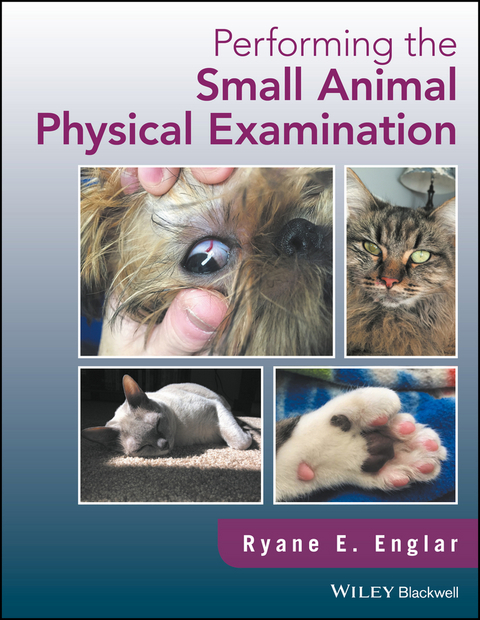
Performing the Small Animal Physical Examination (eBook)
John Wiley & Sons (Verlag)
978-1-119-29532-7 (ISBN)

Performing the Small Animal Physical Examination offers an easy-to-follow guide to successfully executing a thorough physical exam in cats and dogs, with nearly 1,000 clinical photographs depicting step-by-step details.
- Provides comprehensive, practical information on the physical examination in small animal patients
- Presents nearly 1,000 color photographs with step-by-step details of the procedures and principles
- Offers advice on preparing the examination room, useful tips, and concrete guidance for examining each body system
- Outlines a systematic, in-depth approach to the initial examination in dogs and cats
- Supports new and experienced veterinarians and veterinary technicians alike in performing a thorough basic exam
The author
Ryane E. Englar, DVM, DABVP (Canine and Feline Practice), is Assistant Professor of Small Animal Primary Care at Midwestern University College of Veterinary Medicine in Glendale, Arizona, USA.
Performing the Small Animal Physical Examination offers an easy-to-follow guide to successfully executing a thorough physical exam in cats and dogs, with nearly 1,000 clinical photographs depicting step-by-step details. Provides comprehensive, practical information on the physical examination in small animal patients Presents nearly 1,000 color photographs with step-by-step details of the procedures and principles Offers advice on preparing the examination room, useful tips, and concrete guidance for examining each body system Outlines a systematic, in-depth approach to the initial examination in dogs and cats Supports new and experienced veterinarians and veterinary technicians alike in performing a thorough basic exam
The author Ryane E. Englar, DVM, DABVP (Canine and Feline Practice), is Assistant Professor of Small Animal Primary Care at Midwestern University College of Veterinary Medicine in Glendale, Arizona, USA.
Performing the Small Animal Physical Examination 3
Contents 7
About the Author 15
Preface 16
Acknowledgments 17
Part One Performing the Feline Physical Examination 19
1 Setting the Stage: Feline-Friendly Practice 21
1.1 Challenges Faced in Feline Practice 21
1.2 The Emergence of Feline-Friendly Practice 22
1.3 Key Principles of Feline-Friendly Practice 22
1.4 The Role of Sound 26
1.5 The Role of Tactile Stimulation 26
1.6 The Role of Scent 26
1.7 The Role of Advance Preparation 27
1.8 Examination Room Etiquette: Accessing the Cat 28
1.9 Recognizing Body Language 30
1.10 Feline-Friendly Handling 34
1.11 Other Feline Handling Tools 38
2 Assessing the Big Picture: the Body, the Coat, and the Skin of the Cat 42
2.1 Forms of Identification 42
2.2 Body Condition Scoring 43
2.3 Assessing Hydration 47
2.4 Inspecting the Coat: First Impressions 48
2.5 Identifying Coat Colors and Coat Patterns 50
2.6 Assessing Coat Quality 52
2.7 Inspecting the Skin 58
3 Examining the Head of the Cat 70
3.1 Skull Shape and Facial Symmetry 70
3.2 The Eyes and Accessory Visual Structures 70
3.2.1 A Systematic Approach to the Eye Examination 70
3.2.2 Evaluating the Adnexa of the Eye 71
3.2.3 Evaluating the Globe 76
3.2.4 Evaluating the Sclera 78
3.2.5 Evaluating the Cornea 79
3.2.6 Evaluating the Iris 79
3.2.7 Evaluating the Pupils 80
3.2.8 Assessing Ocular Reflexes 80
3.2.9 Assessing the Anterior Chamber 82
3.2.10 Assessing the Lens 83
3.2.11 Introduction to Fundoscopy 84
3.2.12 Fundoscopy and Direct Ophthalmoscopy 85
3.2.13 Fundoscopy and Indirect Ophthalmoscopy 85
3.3 The Ears 86
3.4 The Nose 90
3.5 The Extra-Oral Examination 91
3.6 The Intra-Oral Examination 93
3.6.1 Assessing Mucous Membrane Color 93
3.6.2 Assessing Capillary Refill Time 94
3.6.3 Examining the Mucosa 94
3.6.4 Examining the Gingiva 96
3.6.5 Assessing the Dentition 96
3.6.6 Assessing the Occlusion 97
3.6.7 Assessing for Calculus 99
3.6.8 Opening the Mouth 99
3.6.9 Examining the Tongue 100
3.6.10 Assessing for Periodontal Disease 100
3.6.11 Feline-Specific Dentistry 102
4 Examining the Endocrine and Lymphatic Systems of the Cat 108
4.1 Evaluating the Thyroid Gland 108
4.1.1 The Pathophysiology of Hyperthyroidism 108
4.1.2 The Etiology of Hyperthyroidism 109
4.1.3 The Art of Palpating an Enlarged Thyroid Gland 109
4.2 Assessing the Lymphatic System 111
4.2.1 Examining the Submandibular Lymph Nodes 111
4.2.2 Examining the Superficial Cervical or Pre-Scapular Lymph Nodes 111
4.2.3 Examining the Popliteal Lymph Nodes 112
4.2.4 Feeling for Lymph Nodes That Should Not Be Present 112
5 Examining the Cardiovascular and Respiratory Systems of the Cat 116
5.1 The Cardiac Patient 116
5.2 Assessing the Cardiovascular System Prior to Auscultation 117
5.2.1 Attitude 117
5.2.2 Respiratory Rate 117
5.2.3 Respiratory Effort 117
5.2.4 Respiratory Route 117
5.2.5 Mucous Membrane Color 117
5.2.6 Capillary Refill Time (CRT) 117
5.2.7 Jugular Pulse 117
5.2.8 Palpating the Ventral Neck 118
5.2.9 Palpating the Limbs for Warmth and Assessing the Extremities for Color 118
5.2.10 Assessing Femoral Pulses 118
5.3 Cardiothoracic Auscultation 119
5.3.1 Recalling the Cardiac Cycle 119
5.3.2 Normal Heart Sounds 119
5.3.3 Abnormal Heart Sounds: Murmurs 119
5.3.4 Other Heart Sounds 120
5.3.5 Ausculting the Heart 120
5.3.6 Understanding How the Stethoscope Is Built to Facilitate Auscultation 123
5.4 The Respiratory Patient 123
5.4.1 The Upper Airway Patient 123
5.4.2 The Lower Airway Patient 123
5.4.3 The Patient with Thoracic Cavity Disease 125
5.5 Assessing the Respiratory System Prior to Auscultation 128
5.5.1 The Nose 130
5.5.2 The Larynx and the Trachea 131
5.5.3 Thoracic Compliance 131
5.5.4 Thoracic Percussion 131
5.6 Understanding Normal Airway Sounds 132
5.7 Ausculting the Airway 132
5.8 Understanding Adventitious Airway Sounds 133
5.9 Using Airway Sounds to Corroborate Percussive Findings 134
5.10 Purring as an Obstruction to Auscultation 134
6 Examining the Abdominal Cavity of the Cat 138
6.1 Overview of the Digestive Tract as It Pertains to Presenting Complaints 138
6.2 The Esophagus 140
6.3 Visual Inspection of the Abdomen 140
6.4 Superficial Palpation of the Abdomen 140
6.5 Deep Palpation of the Abdomen 142
6.5.1 The Liver 144
6.5.2 The Stomach 145
6.5.3 The Spleen 145
6.5.4 The Pancreas 145
6.5.5 The Small Intestine 146
6.5.6 Mesenteric Lymph Nodes 147
6.5.7 The Large Intestine 147
6.5.8 The Rectal Examination 148
6.6 The Upper Urinary Tract 150
6.7 The Lower Urinary Tract 152
6.8 The Male Reproductive Tract 153
6.9 The Female Reproductive Tract 155
6.10 Being Presented with a Female of Unknown Sexual Status 156
6.11 Neonates 156
7 Examining the Musculoskeletal System of the Cat 163
7.1 Muscle Condition Score (MCS) 163
7.2 The Skeleton as a Whole 164
7.2.1 Key Components of the Axial Skeleton to Appreciate on Physical Examination 166
7.2.2 Key Components of the Appendicular Skeleton to Appreciate on Physical Examination 168
7.2.3 Additional Components of the Skeleton to Appreciate on Physical Examination 171
7.3 The Appendicular Skeleton: The Forelimb 171
7.4 The Appendicular Skeleton: The Hind Limb 178
8 Evaluating the Nervous System of the Cat 192
8.1 Assessing Behavior and Mental Status 192
8.2 Assessing Posture 194
8.3 Assessing Coordination and Gait 195
8.4 Assessing Postural Reactions 196
8.5 Assessing for Other Abnormal Movements 198
8.6 Evaluating the Spinal Reflexes 199
8.7 Assessing the Cranial Nerves 201
8.7.1 Reviewing the Ocular Reflexes Associated with the Cranial Nerves 201
8.7.2 Reviewing the Cranial Nerves Associated with Ocular Movement 203
8.7.3 Reviewing the Cranial Nerves Associated with Tactile Sensation 203
8.7.4 Reviewing the Cranial Nerves Associated with Muscle Movement Other Than Ocular 204
8.7.5 Reviewing the Cranial Nerves Associated with Digestion 204
8.7.6 Reviewing the Cranial Nerves Associated with Maintaining Posture 204
8.8 Assessing Nociception 204
Part Two Performing the Canine Physical Examination 209
9 Setting the Stage: Canine-Friendly Practice and Low-Stress Handling 211
9.1 Challenges Faced in Canine Practice 211
9.2 The Concept of Low-Stress Handling 212
9.3 White Coat Syndrome 214
9.4 The Role of Scent 216
9.5 The Role of Advance Preparation 217
9.6 Examination Room Etiquette: Setting the Tone for Initial Veterinary Interactions with the Dog 217
9.7 Recognizing Body Language 217
9.8 Creative Approaches to Challenging Interactions with Canine Patients 223
9.9 Other Canine Handling Tools 224
10 Assessing the Big Picture: the Body, the Coat, and the Skin of the Dog 231
10.1 Forms of Identification 231
10.2 Body Condition Scoring 232
10.3 Assessing Hydration 239
10.4 Breed Designation 240
10.5 Inspecting the Coat: First Impressions 241
10.6 Identifying Coat Colors and Coat Patterns 243
10.7 Assessing Coat Quality 251
10.8 Inspecting the Skin 255
10.9 Primary Skin Lesions 258
10.10 Secondary Skin Lesions 263
10.11 Miscellaneous Skin Lesions 264
10.12 Hyperkeratosis 267
10.13 Skin Folds 268
10.14 Nails and Paw Pads 269
10.15 Skin Incisions 270
10.16 Mammary Glands 273
11 Examining the Head of the Dog 279
11.1 Skull Shape: Function Versus Cosmesis 279
11.2 Facial symmetry 283
11.3 The Eyes and Accessory Visual Structures 283
11.3.1 A Systematic Approach to the Eye Examination 283
11.3.2 Evaluating the Adnexa of the Eye 283
11.3.3 Evaluating the Globe 292
11.3.4 Evaluating the Sclera 293
11.3.5 Evaluating the Cornea 295
11.3.6 Evaluating the Iris 296
11.3.7 Evaluating the Pupils 298
11.3.8 Assessing Ocular Reflexes 299
11.3.9 Assessing the Anterior Chamber 299
11.3.10 Assessing the Lens 300
11.3.11 Introduction to Fundoscopy 300
11.3.12 Fundoscopy and Direct Ophthalmoscopy 301
11.3.13 Fundoscopy and Indirect Ophthalmoscopy 301
11.4 The Ears 302
11.5 The Nose 307
11.6 The Extra-Oral Examination 309
11.7 The Intra-Oral Examination 313
11.7.1 Assessing Mucous Membrane Color 313
11.7.2 Assessing Capillary Refill Time 314
11.7.3 Examining the Mucosa 314
11.7.4 Examining the Gingiva 314
11.7.5 Assessing the Dentition 315
11.7.6 Assessing the Occlusion 319
11.7.7 Assessing for Calculus 320
11.7.8 Miscellaneous Acquired Tooth-Related Defects 321
11.7.9 Opening the Mouth 322
11.7.10 Examining the Tongue 323
11.7.11 Assessing for Periodontal Disease 324
12 Examining the Endocrine and Lymphatic Systems of the Dog 330
12.1 Thyroid Gland Neoplasia in the Dog 330
12.2 The Typical Presentation of Thyroid Gland Neoplasia in the Dog 331
12.3 The Pathophysiology of Hypothyroidism 331
12.4 The Typical Presentation of a Hypothyroid Dog 332
12.5 The Atypical Presentation of a Hypothyroid Dog 333
12.6 Assessing the Lymphatic System 333
12.7 Examining the Submandibular Lymph Nodes 334
12.8 Examining the Superficial Cervical or Pre-Scapular Lymph Nodes 334
12.9 Examining the Popliteal Lymph Nodes 334
12.10 Feeling for Lymph Nodes That Should Not Be Present 335
13 Examining the Cardiovascular and Respiratory Systems of the Dog 338
13.1 Congenital Heart Disease in the Dog 338
13.2 Acquired Heart Disease in the Dog 339
13.3 Assessing the Cardiovascular System Prior to Auscultation 340
13.3.1 Attitude 340
13.3.2 Respiratory Rate 341
13.3.3 Respiratory Effort 341
13.3.4 Respiratory Route 341
13.3.5 Mucous Membrane Color 341
13.3.6 Capillary Refill Time (CRT) 341
13.3.7 Jugular Pulse 342
13.3.8 Assessing Femoral Pulses 342
13.4 Cardiothoracic Auscultation 343
13.4.1 Normal Heart Sounds 343
13.4.2 Abnormal Heart Sounds 344
13.4.3 Other Heart Sounds 344
13.4.4 Ausculting the Heart 344
13.4.5 Understanding How the Stethoscope Is Built to Facilitate Auscultation 344
13.4.6 Understanding the Limitations of Cardiothoracic Auscultation 344
13.5 The Respiratory Patient 348
13.5.1 The Upper Airway Patient 348
13.5.2 The Patient with Laryngeal Disease 350
13.5.3 The Lower Airway Patient 350
13.5.4 The Patient with Thoracic Cavity Disease 351
13.6 Assessing the Respiratory System Prior to Auscultation 352
13.6.1 The Nose 352
13.6.2 The Larynx and the Trachea 352
13.6.3 Thoracic Compliance 353
13.6.4 Thoracic Percussion 353
13.7 Understanding Normal Airway Sounds 353
13.8 Ausculting the Airway 353
13.9 Understanding Adventitious Airway Sounds 354
13.10 Panting as an Obstruction to Auscultation 355
14 Examining the Abdominal Cavity of the Dog 360
14.1 Overview of the Digestive Tract 360
14.2 The Esophagus 360
14.3 Visual Inspection of the Abdomen 361
14.4 Auscultion and Superficial Palpation of the Abdomen 362
14.4.1 Auscultation of the Abdomen 362
14.4.2 Superficial Palpation of the Abdomen 362
14.5 Deep Palpation of the Abdomen 364
14.5.1 The Liver 366
14.5.2 The Stomach 366
14.5.3 The Spleen 368
14.5.4 The Pancreas 369
14.5.5 The Small Intestine 370
14.5.6 The Mesenteric Lymph Nodes 372
14.5.7 The Large Intestine 372
14.5.8 The Anal Sacs 372
14.5.9 The Rectal Examination 373
14.6 The Upper Urinary Tract 375
14.7 The Lower Urinary Tract 376
14.8 The Male Reproductive Tract 379
14.9 The Female Reproductive Tract 382
14.10 Being Presented with a Female of Unknown Sexual Status 385
14.11 Neonates 386
15 Examining the Musculoskeletal System of the Dog 398
15.1 Muscle Condition Score (MCS) 398
15.2 The Skeleton as a Whole 400
15.2.1 Key Components of the Axial Skeleton to Appreciate on Physical Examination 400
15.2.2 Key Components of the Appendicular Skeleton to Appreciate on Physical Examination 401
15.2.3 Additional Components of the Skeleton to Appreciate on Physical Examination 404
15.3 The Appendicular Skeleton: The Forelimb 404
15.4 The Appendicular Skeleton: The Hind Limb 410
16 Evaluating the Nervous System of the Dog 430
16.1 Assessing Behavior and Mental Status 430
16.2 Assessing Posture 431
16.3 Assessing Coordination and Gait 433
16.4 Assessing Postural Reactions 433
16.5 Assessing for Other Abnormal Movements 436
16.6 Evaluating the Spinal Reflexes 437
16.7 Assessing the Cranial Nerves 439
16.7.1 Reviewing the Ocular Reflexes Associated with the Cranial Nerves 439
16.7.2 Reviewing the Cranial Nerves Associated with Ocular Movement 440
16.7.3 Reviewing the Cranial Nerves Associated with Tactile Sensation 440
16.7.4 Reviewing the Cranial Nerves Associated with Muscle Movement Other than Ocular 441
16.7.5 Reviewing the Cranial Nerves Associated with Digestion 441
16.7.6 Reviewing the Cranial Nerves Associated with Maintaining Posture 441
16.8 Assessing Nociception 441
Index 450
EULA 459
?Performing the Small Animal Physical Examination provides a very detailed overview of how to complete a comprehensive physical examination in dogs and cats?.Although the text contains many medical terms, it is easy to read and follow. The best part of this book is the vast amount of color photographs it contains that complement and reinforce information provided in the text and provide comparisons of normal versus abnormal?.This book will be an excellent resource for veterinary and veterinary technician students and new graduates. It will also be appropriate for experienced large animal veterinarians who are transitioning into small animal medicine and desire information on current low-stress examination techniques for dogs and cats.? JAVMA, January 2018
| Erscheint lt. Verlag | 24.7.2017 |
|---|---|
| Sprache | englisch |
| Themenwelt | Veterinärmedizin ► Kleintier |
| Schlagworte | Abdomen • body condition scoring • canine • Cardiovascular • Cat • Diagnosis • diagnostic examination • Dog • feline • Head • Health • Kleintier • <p>Physical examination • lymphatic • Musculoskeletal • neck • Nervous • pet</p> • physical assessment • Physical exam • Preventative Care • Respiratory • small animal • therapy • Urogenital • Veterinärmedizin • Veterinärmedizin / Hunde u. Katzen • Veterinärmedizin / Innere Medizin • Veterinary Internal Medicine • Veterinary Medicine • Veterinary Medicine - Dogs & Cats • Wellness |
| ISBN-10 | 1-119-29532-7 / 1119295327 |
| ISBN-13 | 978-1-119-29532-7 / 9781119295327 |
| Informationen gemäß Produktsicherheitsverordnung (GPSR) | |
| Haben Sie eine Frage zum Produkt? |
 PDF (Adobe DRM)
Kopierschutz: Adobe-DRM
Adobe-DRM ist ein Kopierschutz, der das eBook vor Mißbrauch schützen soll. Dabei wird das eBook bereits beim Download auf Ihre persönliche Adobe-ID autorisiert. Lesen können Sie das eBook dann nur auf den Geräten, welche ebenfalls auf Ihre Adobe-ID registriert sind.
Details zum Adobe-DRM
Dateiformat: PDF (Portable Document Format)
Mit einem festen Seitenlayout eignet sich die PDF besonders für Fachbücher mit Spalten, Tabellen und Abbildungen. Eine PDF kann auf fast allen Geräten angezeigt werden, ist aber für kleine Displays (Smartphone, eReader) nur eingeschränkt geeignet.
Systemvoraussetzungen:
PC/Mac: Mit einem PC oder Mac können Sie dieses eBook lesen. Sie benötigen eine
eReader: Dieses eBook kann mit (fast) allen eBook-Readern gelesen werden. Mit dem amazon-Kindle ist es aber nicht kompatibel.
Smartphone/Tablet: Egal ob Apple oder Android, dieses eBook können Sie lesen. Sie benötigen eine
Geräteliste und zusätzliche Hinweise
Buying eBooks from abroad
For tax law reasons we can sell eBooks just within Germany and Switzerland. Regrettably we cannot fulfill eBook-orders from other countries.
aus dem Bereich