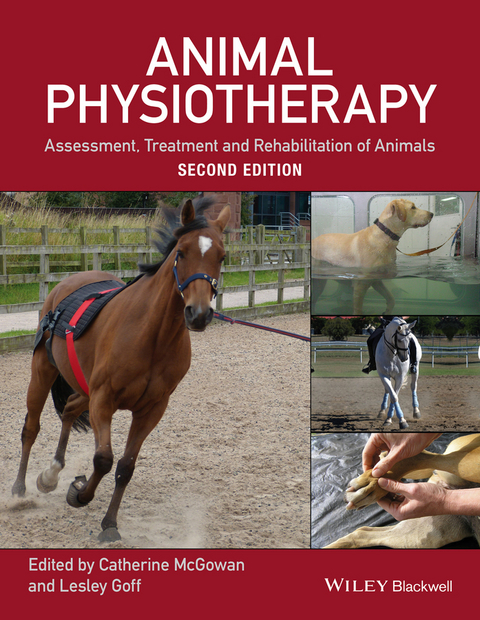
Animal Physiotherapy (eBook)
John Wiley & Sons (Verlag)
978-1-118-85231-6 (ISBN)
- Seven new chapters provide greatly expanded coverage of practical treatment and rehabilitation
- Includes reviews of different physiotherapy techniques, drawing on both human and animal literature
- Discusses approaches in small animal medicine as well as for elite equine athletes
- Provides applied evidence-based clinical reasoning model, with case examples
- Now in full colour with many more illustrations
Professor Catherine McGowan BVSc DipVetClinStud MACVSc PhD DEIM DipECEIM FHEA MRCVS
Catherineis a veterinarian and Director of Professional Studies at the University of Liverpool. She has a keen interest in equine performance, having completed her PhD in Equine Exercise Physiology. She has formerly lectured at the Royal Veterinary College, UK, the University of Queensland, and the University of Helsinki.Cathy holds the RCVS and European Diplomas in Equine Internal Medicine and is an RCVS Specialist in Equine Internal Medicine.
Dr Lesley Goff PhD MSc(AnimPhysio) MAPpSc(ExSpSc)GDip(Manip) BAppSc(Physio)
Lesley is one of the world's leading Animal Physiotherapists, currently balancing an animal physiotherapy practice in Queensland, Australia, with presenting at vet/physiotherapy conferences in Australia and internationally. She has been involved in teaching on the Animal Physiotherapy Masters degree at University of Queensland and is Honorary Lecturer in University of Liverpool for the Veterinary Physiotherapy Masters degree. Lesley is the consultant Animal Physiotherapist at the Veterinary Medical Centre at the University of Queensland.A thoroughly updated edition of this essential reference guide for physiotherapists and physical therapists, looking to apply the proven benefits of physiotherapy to the treatment of companion and performance animals. Seven new chapters provide greatly expanded coverage of practical treatment and rehabilitation Includes reviews of different physiotherapy techniques, drawing on both human and animal literature Discusses approaches in small animal medicine as well as for elite equine athletes Provides applied evidence-based clinical reasoning model, with case examples Now in full colour with many more illustrations
Professor Catherine McGowan BVSc DipVetClinStud MACVSc PhD DEIM DipECEIM FHEA MRCVS Catherineis a veterinarian and Director of Professional Studies at the University of Liverpool. She has a keen interest in equine performance, having completed her PhD in Equine Exercise Physiology. She has formerly lectured at the Royal Veterinary College, UK, the University of Queensland, and the University of Helsinki. Cathy holds the RCVS and European Diplomas in Equine Internal Medicine and is an RCVS Specialist in Equine Internal Medicine. Dr Lesley Goff PhD MSc(AnimPhysio) MAPpSc(ExSpSc)GDip(Manip) BAppSc(Physio) Lesley is one of the world's leading Animal Physiotherapists, currently balancing an animal physiotherapy practice in Queensland, Australia, with presenting at vet/physiotherapy conferences in Australia and internationally. She has been involved in teaching on the Animal Physiotherapy Masters degree at University of Queensland and is Honorary Lecturer in University of Liverpool for the Veterinary Physiotherapy Masters degree. Lesley is the consultant Animal Physiotherapist at the Veterinary Medical Centre at the University of Queensland.
Contributors iv
1 Introduction 1
Catherine M. McGowan
2 Applied animal behaviour: assessment, pain and aggression 3
Daniel Mills and Fiona Williams
3 Applied animal nutrition 15
Rosalind Carslake and Teresa Hollands
4 Applied canine biomechanics 39
Caroline Adrian
5 Applied Equine Biomechanics 55
Lesley Goff
6 Comparative exercise physiology 73
Catherine M. McGowan and Brian Hampson
7 Equine lameness 92
Chris Whitton
8 Canine lameness 112
Lance Wilson and Bruce Smith
9 Small animal neurological and muscular conditions 127
Philip A. Moses and Rita Gonc¸alves
10 Equine neurological and muscular conditions 150
Harry Carslake
11 Physiotherapy assessment for animals 171
Lesley Goff
12 Manual therapy 198
Lesley Goff
13 Electrophysical agents in animal physiotherapy 212
Tim Watson and Katie Lawrence
14 Aquatic therapy 225
Michelle Monk
15 Acupuncture and trigger points 238
Brooke Marsh
16 Small animal treatment and rehabilitation for cardiorespiratory conditions 247
Helen Nicholson
17 Small animal treatment and rehabilitation for neurological conditions 260
Heli Hyyti¨ainen
18 Canine treatment and rehabilitation for orthopaedic conditions 272
Laurie Edge-Hughes
19 Assessment and treatment techniques of the equine head, neck and thoracic limb 302
Emma Dainty
20 Assessment and treatment techniques of the equine thoracolumbar spine, pelvis and pelvic limb 313
Emma Dainty
21 Equine sports medicine and performance management 329
Lesley Goff
22 Outcome measures in animal physiotherapy 347
Anna Bergh
Index 364
"this edition is a well-rounded and practical guide on animal physiotherapy that will be a valuable resource for all practitioners, particularly those with an interest in comparative training and conditioning of animal athletes." (Journal of the American Veterinary Medical Association 2016)
CHAPTER 2
Applied animal behaviour: assessment, pain and aggression1
Daniel Mills1 and Fiona Williams2
1University of Lincoln, Lincoln, UK
2Dogs at Donyatt Canine Hydrotherapy, Ilminster, Somerset, UK
Summary
It is important for the animal physiotherapist to understand animal behaviour both in terms of the assessment of signs of pain and the safe and appropriate delivery of physiotherapeutic interventions. Here we discuss the importance of considering both genetic and environmental factors when assessing animal behaviour in general as well as factors influencing the identification and assessment of pain more specifically. The mechanisms underlying pain and pain management are also considered with reference to their relationship with behaviour. Finally, we discuss aggression in terms of potential triggers and its management whilst administering treatments.
2.1 Introduction
Understanding animal behaviour is important for animal physiotherapists to ensure safe handling of animals that may be in pain and therefore aggressive, and to facilitate a more complete and accurate assessment of the animal's pain. Often, we only know that an animal is in need of physiotherapeutic intervention because of its behaviour. The behaviour may be overt, such as a non-weight-bearing lameness, or more subtle, such as a decline in activity or in the vigour of the activity. In either case, the challenge may be to distinguish pain from a pain-free loss of physical function or mobility.
In horses, pain may manifest as training problems or poor performance. If we wish to address the cause of this behaviour (rather than simply contain the problem), then we need to be aware of the full range of potential factors that interact with and influence behaviour. This involves at least some appreciation of many diverse branches of zoology as well as various branches of psychology, veterinary medicine, animal management and nutrition. This might seem a bit daunting, and is why it is often most effective to work as part of a multidisciplinary team, with everyone respecting each other's expertise.
Since there are two elements to the expression of pain, that is, a sensory-discriminative component (i.e. processing of the nature of the aversive stimulus and its bodily location) and an affective-motivational component of pain (i.e. the emotional and behavioural response to pain or its anticipation) (Craig 2006), it is important to recognise their differing behavioural expression. The former will largely relate to local changes such as lameness and local sensitivity to interference, whereas the latter will be expressed in more general behavioural changes such as increased aggressivity and avoidance.
Therefore, the animal physiotherapist should be aware that some animals might need behavioural therapy in order to treat the affective-motivational aspects of pain before the sensory-discriminative component of pain can be effectively addressed. Although animal physiotherapists are not expected to be behaviour specialists and should not be tempted to practise beyond their own knowledge base and skill, a solid grounding and appreciation of the subject are essential to avoid putting themselves and others at risk of harm and to avoid threatening the well-being of their animals. Animal physiotherapists who have moved into the field from the human discipline may have a substantial awareness of the psychological effects of chronic pain, but it is important to understand the biological and cognitive differences that exist between humans and non-human animals and not assume that what applies to one species necessarily applies to another. Anthropomorphism (ascribing human characteristics to animals) may lead to superficial and/or inaccurate assessments with consequently inappropriate treatment. It is therefore important to always be thorough and assess all of the available information objectively in the light of the biology of the species being considered.
In this chapter, we begin with an initial guide to the principles that underpin the assessment of animal behaviour. Behaviour, like physiology, is a mechanism and expression of an animal's attempt to adapt to or cope with its environment. To survive and be successful within an evolutionary context, animals must be as efficient as possible, since those able to adapt most appropriately will outcompete those less efficient. Accordingly, the behaviour of a given individual should be viewed as an attempt by the animal to behave most appropriately in the current circumstances given previous experience.
There are three major considerations to the evaluation of an animal's behaviour: the nature of the individual concerned; its previous experience; and its current circumstance. Consideration of all three is fundamental to a complete understanding of why an animal is behaving in a particular way. After discussing these three considerations, we move on to discuss the concepts of pain, pain assessment, pain management and aggression within a context that is relevant to the animal physiotherapist.
2.1.1 Assessment of animal behaviour
As previously mentioned, there are three major principles that should be included in one's thought process when trying to evaluate an animal's behaviour.
- The nature of the individual is influenced genetically at many levels.
- Previous experience has both general and specific effects on behaviour.
- The current circumstance of the individual refers to both its general motivational state and the internal and external factors which cause this state to dominate the animal's behaviour.
Genetic influence
Genetic effects lay the foundation for both species-typical behaviour but also individual differences within a given species. Species-typical behaviour refers to those activities that define a dog as a dog and a horse as a horse. One species is a predator-scavenger and the other a prey species. In order to reduce the risk of predation, natural selection is likely to have favoured a greater capacity to mask, where possible, the signs of pain, injury and disease in horses compared with dogs. In other words, by the time a horse appears overtly sick or lame, its welfare is often already seriously compromised. Similarly, during treatment and rehabilitation, a horse might be expected to stop showing these signs before it has fully recovered, increasing the risk of relapse if the animal is returned to an inappropriate level of work too rapidly or too abruptly. The animal physiotherapist plays an essential role in ensuring that this does not happen and that the build-up to full fitness is appropriately managed.
It is also essential to be aware of the normal behaviours of the species in order to appreciate if something is genuinely disease related; for example, an inexperienced owner might mistakenly think that their cat is in pain because she is intermittently meowing with great intensity and rolling around on the floor, when in fact this is normal behaviour for a female cat in oestrus. It is not possible to go into detail here about species-typical behaviour patterns of companion animals, so the reader is referred to the many texts available on the different species and breeds, which should be essential reading according to the species being treated by the individual concerned.
There is also a large genetic contribution to the enormous variation that occurs within a species, for example between breeds and within a breed itself. So, although some generalisations about breeds may be easy to argue, such as selection favouring greater stoicism in breeds which are used to fight live game (e.g. terriers), it is important to appreciate that the variation within a breed may be greater than the variation that exists between breeds, i.e. it should not be assumed that because an individual is of a certain breed that it will necessarily be more or less stoical than an individual from another breed. Expressions of individual variation arise as a result of the interaction of different genetic and environmental factors throughout life; this serves to shape the temperament of the individual (Scott & Fuller 1965) and the way it perceives the world around it, including the personal significance of events (Weisenberg 1977). So whilst it is important to appreciate breed characteristics, they should not be rigid points of reference, especially when it comes to an individual's response to pain.
Suffering is a subjective experience and must always be respected when observed, and not dismissed as unworthy of consideration because the cause seems minor to the observer. This is perhaps one of the main challenges faced by those trying to devise generic guides to the recognition of pain in animals. Therefore, it is not surprising that in many cases the owner is the best assessor, since they recognise what is normal for that individual, and how it behaved before any change arose (Wiseman et al. 2001). Owners see a far wider range of behaviour in their animals than will be observed during a consultation by the physiotherapist; for example, an animal may display greater signs of pain in the evening or first thing in the morning and this can only be monitored at home.
It is therefore important that records of behaviour relevant to the individual are kept and that each subject acts as its own point of reference when trying to evaluate response to treatment.
This kind of record keeping is essential for the physiotherapist to be able to...
| Erscheint lt. Verlag | 21.3.2016 |
|---|---|
| Sprache | englisch |
| Themenwelt | Medizin / Pharmazie |
| Veterinärmedizin ► Allgemein ► Alternative Heilverfahren | |
| Schlagworte | animal acupuncture • animal behavior • animal behaviour • animal muscular conditions • Animal nutrition • animal physiotherapy assessment • applied animal nutrition • Applied Canine Biomechanics • aquatic therapy for animals • canine lameness • canine orthopaedic conditions • Canine Rehabilitation • Complementary Veterinary Medicine • equine lameness • equine muscular condition • Equine neurological conditions • Exercise Physiology • <p>Animal physiotherapy • physical therapy • Tierphysiotherapie • Veterinärmedizin • Veterinärmedizin / ergänzende Heilmethoden • Veterinärmedizin f. Pferde • Veterinärmedizin / Hunde u. Katzen • Veterinärmedizin • Veterinärmedizin / ergänzende Heilmethoden • Veterinärmedizin f. Pferde • Veterinärmedizin / Hunde u. Katzen • Veterinary Medicine • Veterinary Medicine - Dogs & Cats • Veterinary Medicine - Equine • veterinary physiotherapy</p> |
| ISBN-10 | 1-118-85231-1 / 1118852311 |
| ISBN-13 | 978-1-118-85231-6 / 9781118852316 |
| Informationen gemäß Produktsicherheitsverordnung (GPSR) | |
| Haben Sie eine Frage zum Produkt? |
 EPUB (Adobe DRM)
Kopierschutz: Adobe-DRM
Adobe-DRM ist ein Kopierschutz, der das eBook vor Mißbrauch schützen soll. Dabei wird das eBook bereits beim Download auf Ihre persönliche Adobe-ID autorisiert. Lesen können Sie das eBook dann nur auf den Geräten, welche ebenfalls auf Ihre Adobe-ID registriert sind.
Details zum Adobe-DRM
Dateiformat: EPUB (Electronic Publication)
EPUB ist ein offener Standard für eBooks und eignet sich besonders zur Darstellung von Belletristik und Sachbüchern. Der Fließtext wird dynamisch an die Display- und Schriftgröße angepasst. Auch für mobile Lesegeräte ist EPUB daher gut geeignet.
Systemvoraussetzungen:
PC/Mac: Mit einem PC oder Mac können Sie dieses eBook lesen. Sie benötigen eine
eReader: Dieses eBook kann mit (fast) allen eBook-Readern gelesen werden. Mit dem amazon-Kindle ist es aber nicht kompatibel.
Smartphone/Tablet: Egal ob Apple oder Android, dieses eBook können Sie lesen. Sie benötigen eine
Geräteliste und zusätzliche Hinweise
Buying eBooks from abroad
For tax law reasons we can sell eBooks just within Germany and Switzerland. Regrettably we cannot fulfill eBook-orders from other countries.
aus dem Bereich