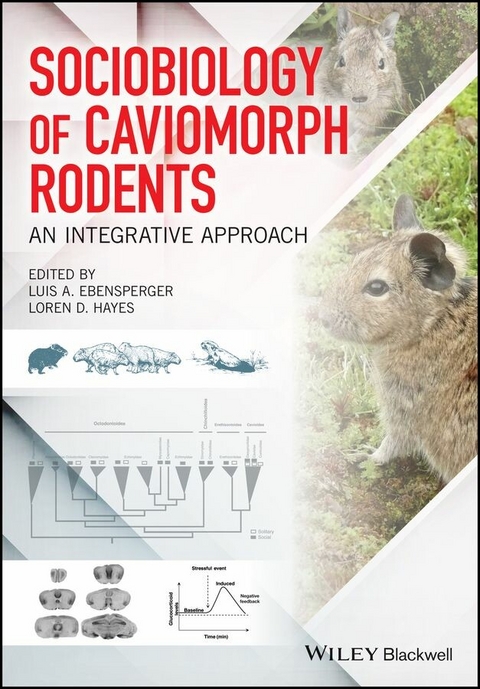
Sociobiology of Caviomorph Rodents (eBook)
John Wiley & Sons (Verlag)
978-1-118-84652-0 (ISBN)

Fully integrative approach to the socibiology of caviomorph rodents
- Brings together research on social systems with that on epigenetic, neurendocrine and developmental mechanisms of social behavior
- Describes the social systems of many previously understudied caviomorph species, identifying the fitness costs and benefits of social living in current day populations as well as quantified evolutionary patterns or trends
- Highlights potential parallels and differences with other animal models
Fully integrative approach to the socibiology of caviomorph rodents Brings together research on social systems with that on epigenetic, neurendocrine and developmental mechanisms of social behavior Describes the social systems of many previously understudied caviomorph species, identifying the fitness costs and benefits of social living in current day populations as well as quantified evolutionary patterns or trends Highlights potential parallels and differences with other animal models
Luis A. Ebensperger, P. Universidad Católica de Chile, Chile Luis Ebensperger has developed a research career to examine causes (ecological, evolutionary) and consequences of rodent social living. He has successfullycombined field observational, demographical, and lab approaches to address why animals congregate, how they cooperate, and what are the fitness effectsof group-living and cooperation. His recent work has addressed the neuroendocrine and immune responses of social mammals and the links between these mechanisms and direct fitness. He has been able to acquire evidence not only from several caviomorph rodent models, but also from other animal models, including ungulates. In addition to publishing research papers in high impact journals, he has produced papers aimed to summarize andprovide an integrative view to current social behavior theory. Loren D. Hayes, Department of Biological and Environmental Sciences, University of Tennessee at Chattanooga, USA Loren Hayes' research program examines the ecological and neural drivers of social systems, costs and benefits of communal care, and fitness consequences of group-living. Hayes has successfully combined field and laboratory work to determine the mechanisms of maternal investment and neuroendocrine sources of direct fitness variation in social voles and degus, respectively. His NSF-funded program includes collaborations in Chile, the U.S., and Taiwan and has generated 30 peer-reviewed papers, including two synthetic reviews on an integrated theory for sociality. Additionally, he co-organized a workshop on vertebrate sociality in Chile, participated in a National Evolutionary Synthesis Center working group on integrative animal sociality, and co-coordinated a Journal of Mammalogy Special Feature on caviomorph social systems.
Acknowledgments ix
Notes on contributors xi
Introduction xv
1 The caviomorph rodents: distribution and ecological diversification 1
Ricardo A. Ojeda, Agustina A. Ojeda and Agustina Novillo
2 Diversity of social behavior in caviomorph rodents 28
Christine R. Maher and Joseph R. Burger
3 Comparative neurobiology and genetics of mammalian social behavior 59
Annaliese Beery, Yasmin Kamal, Raúl Sobrero and Loren D. Hayes
4 Developmental underpinnings of social behavior 91
Valentina Colonnello, Ruth C. Newberry and Jaak Panksepp
5 Dispersal in caviomorph rodents 119
Eileen A. Lacey
6 Mechanisms of social communication in caviomorph rodents 147
Gabriel Francescoli, Selene Nogueira and Cristian Schleich
7 Causes and evolution of group-living 173
Luis A. Ebensperger and Loren D. Hayes
8 Rodent sociality: a comparison between caviomorphs and other rodent model systems 201
Nancy G. Solomon and Brian Keane
9 Cooperation in caviomorphs 228
Rodrigo A. Vásquez
10 Caviomorphs as models for the evolution of mating systems in mammals 253
Emilio A. Herrera
11 Parent-offspring and sibling-sibling interactions in caviomorph rodents: a search for elusive patterns 273
Zuleyma Tang-Martínez and Elizabeth R. Congdon
12 Fitness consequences of social systems 306
Loren D. Hayes and Luis A. Ebensperger
13 An integrative view of caviomorph social behavior 326
Luis A. Ebensperger and Loren D. Hayes
Glossary 356
Index 371
Introduction
Luis A. Ebensperger1 & Loren D. Hayes2
1Departamento de Ecología, Facultad de Ciencias Biológicas, Pontificia Universidad Católica de Chile, Santiago, Chile
2Department of Biology, Geology, and Environmental Sciences, University of Tennessee at Chattanooga, Chattanooga, TN, USA
I.1 Social behavior of caviomorph rodents and book aims
Social behavior involves the actions directed toward, or in response to conspecifics and the fitness consequences for all individuals involved (Wersinger 2009; Székely et al. 2011). Given that social interactions are diverse in nature and extent, social behavior is similarly diverse. Thus, social behavior encompasses a variety of agonistic (including aggressive) behaviors that result in the establishment of dominance hierarchies and territoriality, but also a similarly diverse array of affiliative interactions. Affiliative interactions takes place in different contexts, including courtship and other sexual interactions that result in mating systems, parent–offspring interactions that result in parental care patterns, or the relatively permanent association of adult conspecifics that result in sociality (or group-living) and different forms of cooperation.
In the late 1990s and early 2000s, some researchers began to argue that generalizations about rodent social behavior were premature due to the lack of information coming from the caviomorph or New World hystricognath rodents, a socially diverse group of South American rodents (Ebensperger 1998; Tang-Martínez 2003). We propose that a greater focus on caviomorph rodents as subject models of social behavior would contribute greatly to collaborative and integrative research on this area. Caviomorph rodents exhibit a diverse range of social behaviors and life history attributes, and are found in a wide range of habitats. Caviomorphs span from solitary living (Adler 2011) to highly social (Herrera et al. 2011), and live in kin-biased (Lacey & Wieczorek 2004) or non-kin biased (Quirici et al. 2011) groups. Some species provide communal care to offspring (Ebensperger et al. 2007) while others attempt to avoid contact with non-descendant offspring held in communal crèches (Taber & Mcdonald 1992; Campos et al. 2001). Mating systems are equally diverse, with some species exhibiting monogamy and territoriality, while others exhibit polygyny, or promiscuity (Adrian & Sachser 2011). In terms of life history, caviomorph rodents exhibit a mixture of “fast” and “slow” traits; many have long gestation periods and produce small litters of precocial offspring, yet reach sexual maturity at a young age and exhibit low survival (Kraus et al. 2005). High mortality rates effectively make some species semelparous (Ebensperger et al. 2013). Finally, caviomorph rodents are ecologically diverse, occurring in habitats such as high and low altitude shrublands, tropical and temperate forests, and coastal areas. Habitats range from arboreal to semiaquatic to subterranean. Numerous species have wide geographical ranges, increasing the potential for social and life history flexibility.
Historically, the caviomorph rodents have offered diverse opportunities to studies focused primarily on functional or evolutionary explanations of social behavior. However, caviomorphs are also emerging as good model organisms for integrative research (Colonnello et al. 2011; Ardiles et al. 2013). Researchers have started to make in-roads into the neural mechanisms underlying social variation (e.g. Seidel et al. 2011; Uekita & Okanoya 2011), facilitating comparative analyses that cast mechanism in an evolutionary context (Beery et al. 2008). In some species, we are beginning to understand the neuroendocrine (Ebensperger et al. 2011, 2013) and immunological (Ebensperger et al. 2015) responses to social, reproductive, and environmental conditions. Molecular tools are available for some species, setting the stage for work on sociogenomics and mechanisms underlying reproductive success. Thus, we believe that the time is right to move caviomorph sociobiology into an integrative framework (Hayes et al. 2011). We hope that this book encourages researchers to continue the momentum, increasing the level of international interest in these curious organisms.
The main aim of this book is to provide a comprehensive understanding of caviomorph rodent social systems, focusing on advances and future work in the major themes mentioned above. For each topic addressed in this book we asked contributors to provide relevant information on caviomorph rodents, establish potential parallels (or differences) with other animal models, and place this information into a hypothesis-driven and integrative framework. To the best of our ability, we integrated these individual or topic-based efforts to provide an overall conceptual framework for future studies of social behavior. However, before we introduce these wonderfully diverse and interesting organisms, we first discuss how research approaches to social behavior are evolving. We use this framework to highlight how caviomorph animal models may enrich and contribute to speed up our knowledge on animal social behavior.
I.2 Research approaches to social behavior
Niko Tinbergen's (1963) seminal paper was pivotal to widening the scope of animal behavior research and encompassing proximate causation (i.e. genetic, neurological, and hormonal mechanisms), developmental effects, function, and evolution or historical underpinnings of social behavior. Since then, relatively separate lines of research have addressed all four types of questions. In this sense, behavioral ecologists have made great progress to determine the ecological causes and fitness consequences of several aspects of social behavior, including mating systems (Shuster & Wade 2003), parental care (Clutton-Brock 1991; Royle et al. 2012), sociality (Krause & Ruxton 2002), and cooperation (Dugatkin 1997). On the other hand, behavioral geneticists, neurobiologists and endocrinologists have produced information about how genes, gene expression mechanisms, and neuroendocrinological pathways predispose or prone individuals to exhibit different forms of social behavior (e.g. Becker et al. 2002; Anholt & Mackay 2010).
Historically, the ecological-evolutionary work pursued by behavioral ecologists and mechanistic work pursued by geneticists, neurobiologists, and physiologists have followed relatively independent trajectories. Likely, long-term research goals that characterized each field were a major contributor to this end. For example, a large amount of research on the mechanistic underpinnings of social behavior has been based on a few laboratory animal models kept under unnatural conditions and aimed at extrapolations on human-oriented social and sexual behaviors as well as related pathologies (Anholt & Mackay 2010). In contrast, behavioral ecologists have relied on an array of wild animal models and their natural environments, but generally have been less sensitive to the importance of proximate causes (e.g. Krebs & Davies 1993; Davies et al. 2012). As a result, functional and evolutionary implications of behavior from laboratory animal models are complicated, and a lack of detailed genotypic or neuroendocrinological knowledge of wild animal models limits their use to mechanistic studies.
A major push to integrate social behavior research from widely diverse disciplines should be credited to Wilson (1976), who coined the term “sociobiology” to embrace the approach called to examine the biological basis of social behavior. Although Wilson did not develop these issues with great detail in the individual chapters of his seminal book (Sociobiology: The New Synthesis, 1976), it was apparent that the aims of sociobiology included genetics, development, and physiological bases of social behavior. Subsequently, behavioral ecologists have highlighted the relevance of mechanisms to fully understand current function and the evolution of social and other behaviors. Thus, mechanisms were placed in a context of constraints and function, with explicit fitness and evolutionary consequences (e.g. Real 1994; Dukas 1998). On the other hand, mechanistically oriented scholars increasingly have shown an explicit interest in placing mechanisms into ecologically and evolutionary relevant settings. This trend is evident from recent reviews and textbooks addressing how genetic, neurological, or endocrinological substrates of social behavior have diverged or converged to explain current within and between species differences in social behavior (e.g. Adkins-Regan 2005; Donaldson & Young 2008; Robinson et al. 2008; Zupanc 2010; O'Connell & Hofmann 2011; Choleris et al. 2013). As a result, we see a growing trend in Behavioral Ecology and other historically separate disciplines to converge into integrative approaches to explain and predict variation in social behavior (Monaghan 2014). However, what is meant precisely by integrative research?
Tinbergen (1963) suggested that a deep understanding of animal behavior would be achieved through research addressing different, yet complementary perspectives. In practice, this view was a powerful framework to stimulate “multidisciplinarity” (sensu Tress et al. 2004), meaning that disciplines such as behavioral genetics, endocrinology, and behavioral ecology have been focused on similar behavioral traits or phenomena, yet in parallel, keeping multiple disciplinary objectives (Blumstein et al. 2010; Bateson...
| Erscheint lt. Verlag | 24.2.2016 |
|---|---|
| Sprache | englisch |
| Themenwelt | Naturwissenschaften ► Biologie ► Zoologie |
| Technik | |
| Veterinärmedizin | |
| Schlagworte | Ãkologie u. Biologie der Organismen • Animal Science & Zoology • Biowissenschaften • Communal rearing • communication complexity • Early developmental effects • Ecology & Organismal Biology • Fitness Effects • Life Sciences • mating systems • Neuroendocrine mechanisms • Ökologie u. Biologie der Organismen • Parental Care • Parent-offspring conflict • Sociality • social variation • Zoologie |
| ISBN-10 | 1-118-84652-4 / 1118846524 |
| ISBN-13 | 978-1-118-84652-0 / 9781118846520 |
| Informationen gemäß Produktsicherheitsverordnung (GPSR) | |
| Haben Sie eine Frage zum Produkt? |
 EPUB (Adobe DRM)
Kopierschutz: Adobe-DRM
Adobe-DRM ist ein Kopierschutz, der das eBook vor Mißbrauch schützen soll. Dabei wird das eBook bereits beim Download auf Ihre persönliche Adobe-ID autorisiert. Lesen können Sie das eBook dann nur auf den Geräten, welche ebenfalls auf Ihre Adobe-ID registriert sind.
Details zum Adobe-DRM
Dateiformat: EPUB (Electronic Publication)
EPUB ist ein offener Standard für eBooks und eignet sich besonders zur Darstellung von Belletristik und Sachbüchern. Der Fließtext wird dynamisch an die Display- und Schriftgröße angepasst. Auch für mobile Lesegeräte ist EPUB daher gut geeignet.
Systemvoraussetzungen:
PC/Mac: Mit einem PC oder Mac können Sie dieses eBook lesen. Sie benötigen eine
eReader: Dieses eBook kann mit (fast) allen eBook-Readern gelesen werden. Mit dem amazon-Kindle ist es aber nicht kompatibel.
Smartphone/Tablet: Egal ob Apple oder Android, dieses eBook können Sie lesen. Sie benötigen eine
Geräteliste und zusätzliche Hinweise
Buying eBooks from abroad
For tax law reasons we can sell eBooks just within Germany and Switzerland. Regrettably we cannot fulfill eBook-orders from other countries.
aus dem Bereich