Fundamentals of Canine Neuroanatomy and Neurophysiology (eBook)
John Wiley & Sons (Verlag)
978-1-118-77175-4 (ISBN)
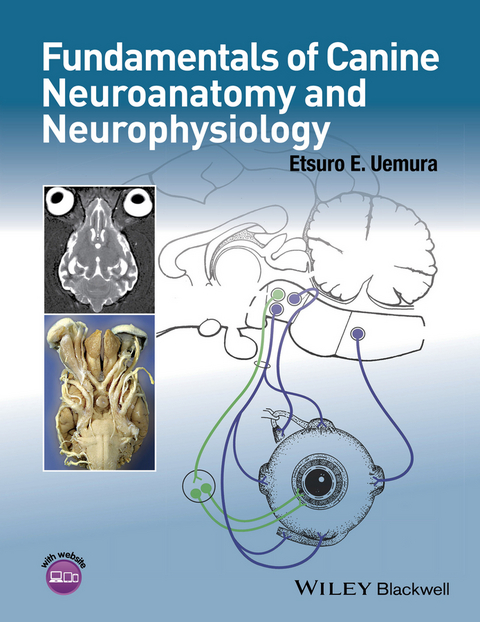
Fundamentals of Canine Neuroanatomy and Neurophysiology introduces the fundamentals of veterinary neuroanatomy and neurophysiology, demonstrating structure and function as it relates to clinical applications with a highly visual approach.
- Offers a straightforward yet comprehensive introduction to structure and function of the nervous system
- Demonstrates the relevance of the basic principles to the clinical setting
- Illustrates concepts using line drawings, photographs, micrographs, and MRIs
- Includes access to a companion website with review questions and answers and the figures from the book at www.wiley.com/go/uemura/neuroanatomy
Etsuro E. Uemura, DVM, MS, PhD, is a Professor in the Department of Biomedical Sciences at the College of Veterinary Medicine, Iowa State University, Ames, Iowa, USA.
Etsuro E. Uemura, DVM, MS, PhD, is a Professor in the Department of Biomedical Sciences at the College of Veterinary Medicine, Iowa State University, Ames, Iowa, USA.
Preface vi
Abbreviations vii
About the Companion Website viii
1 Developmental Anatomy 1
2 Structure and Function of Neurons and Neuroglia 11
3 Anatomy of the Canine Brain 38
4 Meninges and Ventricular System 85
5 Spinal Cord 99
6 Spinal Reflexes 120
7 Somatosensory System 128
8 Viscerosensory System 156
9 Brain Stem 167
10 Midbrain 178
11 Pons 189
12 Medulla Oblongata 201
13 Reticular Formation 237
14 Thalamus 246
15 Cerebrum 252
16 Motor System 257
17 Cerebellum 288
18 Vestibular System 307
19 Auditory System 329
20 Visual System 347
21 Hypothalamus 372
22 Autonomic Nervous System 383
Self-Evaluation Answers 410
Index 416
"This excellent and scientifically detailed book is a much-needed introduction for first year veterinarians." (Doody's, 8 January 2015)
"The book is reasonably priced and will be a good addition to the libraries of both general practitioners and veterinary students. I definitely recommend this book for students or clinicians who desire more knowledge of the anatomy and pathophysiology of the canine nervous system." (Journal of the American Veterinary Medical Association 15 June 2016)
1
Developmental Anatomy
The brain and spinal cord are organized through a series of developmental events. They start as a thickened neural plate and then transform into a simple tubular structure, the neural tube. The cranial end of the tubular structure enlarges to become the brain, whereas the remaining neural tube develops into the spinal cord. As precursor cells of the neural tube proliferate and differentiate into neurons and neuroglia, they migrate to appropriate target locations. This process of proliferation, differentiation, and migration is crucial for further developmental events, including outgrowth of axons and formation of synapses. Any interference with such developmental processes risks congenital malformations, perinatal mortality, and postnatal morbidity.
Formation of the neural tube
- What embryonic germ layer becomes the nervous tissue?
- Explain how the neural ectoderm forms the neural tube.
The development of the nervous system, like all other organ systems, starts at fertilization. An oocyte swept from the ovary is transported in the uterine tube to be fertilized. A fertilized ovum undergoes repeated cell division (also called cleavage). The first cleavage of the ovum results in two blastomeres, and successive cell divisions of blastomeres produce a spherical ball of cells. The blastomeres start to rearrange and a fluid-filled cavity, the blastocele, is formed. The wall of the blastocyst is only a single cell in thickness, except the area where a cluster of cells, the inner cell mass, appears. The inner cell mass is destined to be concerned primarily with the formation of the embryonic body. Within the inner cell mass a cavity starts to develop, separating the amnion from the embryo-formative cells, the embryonic disc. The embryonic disc gives rise to the three germ layers (endoderm, mesoderm, ectoderm) that form all the tissue and organs of the embryo.
The dorsomedial area of the ectoderm differentiates to become the neural ectoderm (Fig. 1.1). As the embryo develops, the neural ectoderm separates from the remaining ectoderm. Initially, the neural ectoderm is a flat area made of a single cell layer. There are three developmental stages (neural plate, neural fold, and neural tube) that form a tubular primordium of the central nervous system (CNS) (Fig. 1.2). The neural ectoderm thickens to become the neural plate, which folds into a neural groove. As the neural fold continues to become thicker, the groove becomes narrower and the dorsal edges of the fold fuse and the neural fold becomes the neural tube. The rostral end of the neural tube becomes the brain and the remaining neural tube develops into the spinal cord.
Fig. 1.1 The neural plate develops from the neural ectoderm that occupies the central portion of the ectoderm.
Fig. 1.2 Development of the neural tube and neural crest from the ectoderm. (A) Transverse section of the embryonic disc. The neural plate is the thickened area of the ectoderm. (B) Invagination of the neural plate to form the neural fold. The neural crest appears at the dorsolateral edge of the neural fold. (C) Fusion of the dorsal edges of the neural fold forms the neural tube. (D) The neural crest gives rise to small aggregates of cells that start to migrate ventrally to become ganglia.
Neural plate
The neural ectoderm thickens to form a neural plate (Figs 1.1 and 1.2A). The first step in the formation of the brain and spinal cord is its transformation from a thickened neural plate into a tubular mass of cells.
Neural fold
The neural groove appears as a result of differential growth of the neural plate along the longitudinal axis of the embryo (Fig. 1.2B). The groove deepens and the elevated lateral margins of the neural plate form the neural fold. The neural folds, as they become more elevated, grow toward each other. The neural fold at the rostral end (also referred to as the cephalic end because the rostral neural fold develops into the brain) is much greater in size than it is further caudally. This results in the differentiation of the rostral neural fold into the brain and the remaining caudal portion into the spinal cord. At about the time the neural groove deepens, a cluster of cells appears and forms the neural crest at the area where the neural fold borders on the ectoderm. The neural crest detaches from the ectoderm to become ganglia of the cranial and spinal nerves. A cluster of cells associated with the cephalic end differentiates into the ganglia of the cranial nerves. Those cells associated with the remaining neural fold differentiate into the dorsal root ganglia and ganglia of the autonomic nervous system (ANS).
Neural tube
The neural tube results from fusion of the dorsal edges of the neural fold (Fig. 1.2C and D). Prior to the closure of the neural groove, the neural plate is continuous laterally with the ectoderm. When the two neural folds fuse with each other, the ectoderm also fuses to overlie the newly formed neural tube. The closure of the neural groove begins in the middle of the embryo and proceeds toward the two ends. However, progression of closure is more rapid towards the cephalic end than towards the caudal end (Fig. 1.3). As a result, three stages of neural development (i.e., the neural plate, fold, and tube) coexist simultaneously in different regions of the embryo. The cephalic end of the neural tube starts to enlarge and differentiate to become the brain. The rest of the neural tube remains relatively unchanged and becomes the spinal cord. The ectoderm separated from the neural ectoderm forms the epidermis.
Fig. 1.3 Dorsal view of the embryo, showing transformation of the neural groove into a neural tube. Three developmental stages (neural plate, neural fold, and neural tube) of the nervous system coexist in different areas of the embryo. This is because closure of the neural groove starts at the middle of the embryo and proceeds toward the cephalic and caudal ends. The developing cerebrum becomes obvious even before the closure of the cephalic neural groove.
Three primary brain regions and their subdivisions
- What are the three vesicles stage and subsequent five vesicles stage of the developing brain?
- What structures differentiate from each of the five vesicles of the developing brain?
- Name the ventricular spaces associated with each of the five vesicles of the developing brain.
- What developing vesicle gives rise to the eye and neurohypophysis?
- Where are the choroid plexuses located?
The nervous system starts as a relatively straight neural tube. As the embryo develops, the neural tube at the cephalic end expands more rapidly. Subsequently, the cephalic end develops into three primary regions: the forebrain (also known as the prosencephalon), midbrain, and hindbrain (also known as the rhombencephalon) (Fig. 1.4A). The central neural space runs the length of the neural tube, and it remains open in spite of the development of the neural tube into the brain and spinal cord. However, the shape and size of the space change greatly, reflecting the regional modification of the neural tube during development (Figs 1.5, 1.6, and 1.7).
Fig. 1.4 Dorsal view of the developing brain from the three vesicles stage to the five vesicles stage. (A) Three enlargements appear at the cephalic end of the neural tube: the forebrain, midbrain, and hindbrain. (B) The forebrain develops into the telencephalon and diencephalon. The hindbrain further differentiates into the metencephalon and myelencephalon. L: lateral ventricle; III: third ventricle; CA: cerebral aqueduct; IV: fourth ventricle.
Fig. 1.5 The brain and spinal cord each start as a relatively straight neural tube. The cranial portion of the neural tube is dramatically modified by unequal growth and the appearance of flexures. This results in the formation of three enlargements: the forebrain, midbrain, and hindbrain. The shape and size of the neural tube vary greatly, reflecting the regional modification of the neural tube during the development.
Fig. 1.6 Midsagittal section of the developing brain. 10 mm pig embryo. The forebrain is beginning its division into telencephalon and diencephalon. The spinal cord is not visible as it is not cut exactly at the midsagittal plane.
Fig. 1.7 Midsagittal section of the developing brain. 15 mm pig embryo. The ventricles occupy a large portion of the brain. L: lateral ventricle; III: third ventricle; IV: fourth ventricle.
Forebrain
The forebrain (or prosencephalon) gives rise to two lateral evaginations: the telencephalon (Gr. telos end, enkephalos brain) (Fig. 1.4). These two evaginations at the end of the neural tube become the cerebral hemispheres. The junction between the two hemispheres is a narrow interhemispheric fissure (L. fissura groove) (Fig. 1.4B). Each hemisphere has a vault, called the future cerebral cortex, and a floor, called the future basal nuclei (Fig. 1.8B). The telencephalon is initially smooth in contour. However, convolution becomes apparent later in development. The neural space in each hemisphere...
| Erscheint lt. Verlag | 29.7.2015 |
|---|---|
| Sprache | englisch |
| Themenwelt | Medizin / Pharmazie |
| Veterinärmedizin ► Vorklinik | |
| Veterinärmedizin ► Kleintier | |
| Schlagworte | <p>Neuroanatomy, neurophysiology, neurobiology, neuroscience, structure, function, neural, neurologic, neurology, neural pathway, brain, reflexes, clinical, veterinary, canine, dog</p> • Neuroanatomie • Neurophysiologie • Veterinäranatomie • Veterinäranatomie u. -physiologie • Veterinärmedizin • Veterinärmedizin / Hunde u. Katzen • Veterinärmedizin / Innere Medizin • Veterinäranatomie • Veterinäranatomie u. -physiologie • Veterinärmedizin • Veterinärmedizin / Hunde u. Katzen • Veterinärmedizin / Innere Medizin • Veterinary Anatomy & Physiology • Veterinary Internal Medicine • Veterinary Medicine • Veterinary Medicine - Dogs & Cats |
| ISBN-10 | 1-118-77175-3 / 1118771753 |
| ISBN-13 | 978-1-118-77175-4 / 9781118771754 |
| Informationen gemäß Produktsicherheitsverordnung (GPSR) | |
| Haben Sie eine Frage zum Produkt? |
 EPUB (Adobe DRM)
Kopierschutz: Adobe-DRM
Adobe-DRM ist ein Kopierschutz, der das eBook vor Mißbrauch schützen soll. Dabei wird das eBook bereits beim Download auf Ihre persönliche Adobe-ID autorisiert. Lesen können Sie das eBook dann nur auf den Geräten, welche ebenfalls auf Ihre Adobe-ID registriert sind.
Details zum Adobe-DRM
Dateiformat: EPUB (Electronic Publication)
EPUB ist ein offener Standard für eBooks und eignet sich besonders zur Darstellung von Belletristik und Sachbüchern. Der Fließtext wird dynamisch an die Display- und Schriftgröße angepasst. Auch für mobile Lesegeräte ist EPUB daher gut geeignet.
Systemvoraussetzungen:
PC/Mac: Mit einem PC oder Mac können Sie dieses eBook lesen. Sie benötigen eine
eReader: Dieses eBook kann mit (fast) allen eBook-Readern gelesen werden. Mit dem amazon-Kindle ist es aber nicht kompatibel.
Smartphone/Tablet: Egal ob Apple oder Android, dieses eBook können Sie lesen. Sie benötigen eine
Geräteliste und zusätzliche Hinweise
Buying eBooks from abroad
For tax law reasons we can sell eBooks just within Germany and Switzerland. Regrettably we cannot fulfill eBook-orders from other countries.
aus dem Bereich