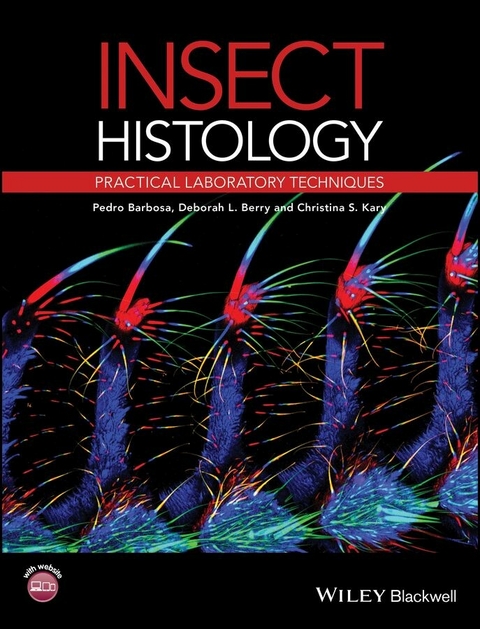
Insect Histology (eBook)
John Wiley & Sons (Verlag)
978-1-118-87500-1 (ISBN)
Insect Histology is designed as a resource for student and professional researchers, in academia and industry, who require basic information on the procedures that are essential for the histological display of the tissues of insects and related organisms.
This title is a much needed update of Barbosa's self-published Manual of Basic Techniques in Insect Histology. It is a laboratory manual of 'traditional' and 'modern' insect histology techniques, completely revised using cutting-edge methodology carried out today and includes new immunohistochemical techniques not previously looked at. Insect Histology is designed as a resource for student and professional researchers, in academia and industry, who require basic information on the procedures that are essential for the histological display of the tissues of insects and related organisms.
Dr Pedro Barbosa is a Professor Emeritus at the Department of Entomology of the University of Maryland, College Park. He has been a professor at Rutgers University, the University of Massachusetts at Amherst and at the University of Maryland. Although his research focused on the ecology of insects and insect-plant interactions, he also has an interest in insect histology. Since his retirement in 2010 he has written several books on insects. Dr Deborah Berry is Co-Director for the Histopathology and Tissue Shared Resource at the Lombardi Comprehensive Cancer Center, Georgetown University, which provides research pathology support for translational cancer research. She has over 20 years' experience in histology with a specialty in the histology of the fruit fly Drosophila melanogaster. Dr Christina Kary is a scientific editor with the journal Genes & Development at Cold Spring Harbor Laboratory Press, New York. Before becoming an editor, she earned a PhD with Dr Eric Baehrecke at the University of Maryland and was a Jane Coffin Childs post-doctoral fellow with Dr Susan Mango at Harvard University.
Preface ix
Acknowledgements xi
Introduction xiii
About the companion website xiv
1 Problems of sclerotized chitin: Softening insect cuticle 1
1.1 Introduction 1
1.2 General Methods 3
1.3 Preparations of insect eggs 14
1.4 Double Embedding Techniques 16
References 19
2 Fixation 21
2.1 Introduction 21
2.2 Aldehyde based fixatives 21
2.3 Protein denaturing 30
2.4 Picric acid based 33
2.5 Mercuric chloride based 37
2.6 SEM/TEM 40
2.7 Other 46
References 51
3 Dehydrating, clearing, and embedding 54
3.1 Dehydration 54
3.2 Clearing 60
3.3 Embedding General 65
3.4 Embedding - Ester Wax 73
3.5 Embedding - Methacrylate 74
References 77
4 Staining 79
4.1 Single-contrast staining - Carmines 81
4.2 Single contrast staining - Nuclear Stains 83
4.3 Single contrast staining - General Stains 86
4.4 Single contrast staining - Golgi 89
4.5 Single contrast staining - Eggs 89
4.6 Single contrast staining - Silver Stains 90
4.7 Polychrome staining techniques - General 92
4.8 Polychrome staining - Brain/Nerve 102
4.9 Polychrome staining - blood 103
4.10 Single contrast procedures for chitinous material 105
4.11 Polychrome staining procedures for chitinous material 106
4.12 Polychrome staining for chitinous material - KOH 110
4.13 Polychrome staining for chitinous material - Differential staining of Individual Organs 111
4.14 Staining of specific tissues 113
4.15 Two dye combinations 114
References 117
5 Immunohistochemical techniques 119
5.1 Introduction 119
5.2 General immunostaining techniques 127
5.3 Immunolabeling of samples for Transmission Electron Microscopy (TEM) 135
5.4 Proliferation assays 140
5.5 Methods to detect specific proteins 142
References 144
6 Use of genetic markers in insect histology 146
6.1 Introduction 146
6.2 Inducible genetic markers 149
6.3 Mosaic gene expression 156
6.4 Fluorescent markers for live imaging and kinetic microscopy 165
References 169
7 Fluorescence 171
7.1 Introduction 171
References 192
8 Mounting 194
8.1 Introduction 194
References 206
9 Preparation of whole mounts 208
9.1 Introduction 208
References 229
10 Preparation of whole mounts for staining 231
10.1 Introduction 231
10.2 Detection of NAPDHd 237
10.3 SEM 238
10.4 In situ hybridization 240
References 244
11 Preparation of genitalia, mouthparts and other body parts 246
References 256
12 Preparation of chromosomes 258
References 288
13 Preparation of other specific insect organs and tissues 290
13.1 Introduction 290
References 323
Appendix Dissecting fluids and saline solutions 325
Index 333
"A very useful book to have in your library." (British Journal of Entomology & Natural History, 1 March 2015)
Chapter 1
Problems of sclerotized chitin: Softening insect cuticle
1.1 Introduction
The softening and processing of heavily sclerotized specimens for subsequent histological preparations is one of the major problems in insect histology. Many approaches to the solution of this problem have been suggested. Attempts to soften and otherwise alter sections with sclerotized chitin have been incorporated at every procedural level of histological methods. Suggestions have been made for changes in fixation, clearing, mounting, and embedding. Others have also attempted prefixation, postfixation, premounting, presectioning, and so on, as additional steps geared towards improving the quality of sections.
Aside from the more detailed procedures and specific compounds that are recommended in the following pages there are other simple general methods recommended. These techniques represent basic procedures that have been used independently or in conjunction with other methods. One of the most widely used procedures is the treatment of insect specimens with sodium or potassium hydroxide. These chemicals soften sclerotized portions of specimens and dissolve the soft internal tissues. They are generally used either cold or warm at a 10% concentration. These substances are also frequently used in the preparation of insect specimens for taxonomic study.
The use of hypochlorite of soda is another alternate for softening chitin. It is suggested for the preparation of all stages, that is, larvae, pupae, and adults. The insect is usually placed in boiling hypochlorite of soda (about 25% in distilled water). It is usually left in the solution for about 24 hours or more. A third, widely used approach is the use of tenerals or newly moulted specimens. In this way, the specimens are used before the cuticle has hardened.
The elimination of certain chemical agents which tend to harden insect tissues can also be helpful. Occasionally, it is best merely to avoid long exposures to hardening compounds. For example, to avoid excess hardening, short exposures or avoidance of the higher concentrations of ethanol will aid in preventing its hardening effects. The use of n-butyl or t-butyl alcohol as a substitute dehydrating agent may avoid the hardening of tissues. Similarly, prolonged exposure to certain chemicals or fixatives containing chemicals such as acidified dichromate, mercuric chloride or chromic acid is not recommended. Prolonged heating may also cause unwanted brittleness. The choice of clearing agent may also be a key factor in brittleness of tissue preparations. Thus, the use of clearing agents other than xylene or similar compounds will result in improved preparations. Finally, excessively high temperatures and prolonged periods of infiltration in wax may be another source of troublesome tissue hardening.
Fig. 1.1 Beetles have a hardened cuticle. (Source: © Michal Grabowski.http://commons.wikimedia.org/wiki/File:Xylena_exsoleta.jpg#filehistory/CC BY-SA 3.0.)
Fig. 1.2 Components of the cuticle. Procuticle – polysaccaride chitin and cross-linked proteins involved in sclerotization.
Fig. 1.3 The most sclerotized parts of beetles. (Source: Ellis 2000. Reproduced with permission of Elsevier.)
Another widely used procedure involves the puncturing of insect specimens before placing them in a fixative. This allows complete penetration of the fixing agent. Care must always be taken not to damage particular areas of interest on the specimen. The following procedure was suggested as an alternative to the puncturing of specimens.
1.1.1 Gottlieb's technic [1]
Application:
Recommended for the histological preparation of insect larvae, pupae, and adults.
Formula:
- Solution A: Relaxing fluid
- Drosophila Ringer's with magnesium sulphate (4%) added.
- Solution B: Chrome alum fixative
Chrome Alum 3 pt Formaldehyde (40%) 30 pt Proprionic Acid 2 pt Distilled Water 238 pt Dimethyl Sulfoxide 25 pt
Procedure:
- Rinse specimen in Ringer's solution and place in warmed solution A for 2 to 5 min.
- Transfer to warmed solution B in a covered dish (on hot plate) for no more than 5 min.
- Keep specimen in dish and remove from hot plate for 10 to 15 min.
- Rinse in distilled water and dehydrate.
- Dehydration must be slow and gentle.
- Three methods of dehydration are recommended:
- Dioxane.
- Graded ethanol series with a benzene clearing agent.
- Graded tertiary butyl alcohol series.
- In graded ethanol series a slow transfer to benzene is required before infiltration by using trichloropropane.
- In the dioxane procedure, the following steps are necessary:
- Several changes of 50% dioxane for one day.
- Several changes of 100% dioxane for 2 to 3 days.
- Infiltration is as follows:
- Transfer to solutions of increasing paraffin concentrations for 24 to 36 hr.
- Transfer to two baths of pure paraffin for 12 hr each.
Note:
- Graded alcohols series consist of the following: 10–70% (in 10% steps), to 85% (in 5% steps), to 100% (in 2.5% steps).
- A complete schedule of dehydration solutions and a timetable is available on Table 1 of Gottlieb (1966).
- Either t-butyl alcohol or dioxane is recommended to avoid excess hardening.
1.2 General Methods
The following are general methods, fixatives, and softening agents recommended for the softening of histological preparations with extensive sclerotized chitin.
1.2.1 Cox's technic [2]
Application:
Recommended for small insects and insect parts, e.g., beetle elytra.
Formula:
- Solution A:
- Potassium Hydroxide (10%)
- Solution B:
- Acetic Acid (33%)
Procedure:
- Fix insect specimen.
- Transfer to solution A for 24 hr.
- Wash in water for 6 hr.
- Transfer to solution B for 24 hr.
- Wash in water for 6 to 8 hr.
- Dehydrate, embed, and mount.
Fig. 1.4 Components of the cuticle – SEM images of the dry gula (a plate which in most insects supports the basal part of the labium). (a,c,d) Surface of the gula. (b) Cross fracture of the gula cuticle showing the epicuticle (epi), exocuticle (exo) and endocuticle (endo). Fibers of the outer part of the exocuticle are oriented perpendicular to the surface but are parallel in the deeper layers of the exocuticle and in the endocuticle. Pores (pr), dried organic substances (se) and cracks (cr) can be seen on the cuticle surface. Rectangles c and d, indicate parts of the sample magnified in c and d, respectively. (Source: Barbakadze et al. 2006. Reproduced with permission of the authors.)
1.2.2 Eltringham's method II [2]
Formula:
- Solution A:
- Sodium Hypochlorite (6%)
- Solution B: Fixative
Water 250 pt Picric Acid 2.6 pt Nitric Acid 10 pt
Procedure:
- Fix insect specimen.
- Wash in running water for 4 hr.
- Transfer to solution A for 60°C for 36 hr.
- Wash in water for 4 hr.
- Transfer to solution B at 60°C for 6 days.
- Boil in alcohol (70%) for 1 min.
- Let stand in alcohol (70%) for 1 min.
- Dehydrate, clear in cedar-oil and mount.
1.2.3 Verdcourt's nitric-ethanol [3]
Application:
Recommended for the softening elytra of Coleoptera.
Formula:
- Solution A:
Ethyl Alcohol 3 pt Nitric Acid (concentrated) 1 pt
1.2.4 Schultze's [3]
Application:
Recommended for the softening elytra of Coleoptera.
Formula:
| Nitric Acid (concentrated) | 2 pt |
| Potassium Chlorate | 1 pt |
Note:
- When warmed, this substance softens in a few minutes, but is harsh and must be watched.
1.2.5 Modified Schultze's [3]
Application:
Recommended for the softening elytra of Coleoptera.
Formula:
| Nitric Acid (concentrated) | 2 pt |
| Potassium Chlorate | 1 pt |
Note:
- Softening occurs within 5 to 6 days, however, after about 12 days specimens become deformed.
- Wash well in water after use.
1.2.6 Verdcourt's technic [3]
Application:
- Recommended for the softening and histological preparation of hard chitinous insect tissues.
- Recommended as particularly useful for softening and preparating slides of the elytra of coleopterans.
Procedure:
- Place in softening agent (see Verdcourt's Nitric-ethanol, Schultze's...
| Erscheint lt. Verlag | 3.10.2014 |
|---|---|
| Sprache | englisch |
| Themenwelt | Naturwissenschaften ► Biologie ► Zoologie |
| Technik | |
| Veterinärmedizin | |
| Schlagworte | Animal Science & Zoology • Biowissenschaften • Entomologie • Entomology • Histologie • Immunohistochemical • Insect histology • insect morphology • Life Sciences • Pedro Barbosa • structural biology • Strukturbiologie • Systematics • Zoologie |
| ISBN-10 | 1-118-87500-1 / 1118875001 |
| ISBN-13 | 978-1-118-87500-1 / 9781118875001 |
| Informationen gemäß Produktsicherheitsverordnung (GPSR) | |
| Haben Sie eine Frage zum Produkt? |
 EPUB (Adobe DRM)
Kopierschutz: Adobe-DRM
Adobe-DRM ist ein Kopierschutz, der das eBook vor Mißbrauch schützen soll. Dabei wird das eBook bereits beim Download auf Ihre persönliche Adobe-ID autorisiert. Lesen können Sie das eBook dann nur auf den Geräten, welche ebenfalls auf Ihre Adobe-ID registriert sind.
Details zum Adobe-DRM
Dateiformat: EPUB (Electronic Publication)
EPUB ist ein offener Standard für eBooks und eignet sich besonders zur Darstellung von Belletristik und Sachbüchern. Der Fließtext wird dynamisch an die Display- und Schriftgröße angepasst. Auch für mobile Lesegeräte ist EPUB daher gut geeignet.
Systemvoraussetzungen:
PC/Mac: Mit einem PC oder Mac können Sie dieses eBook lesen. Sie benötigen eine
eReader: Dieses eBook kann mit (fast) allen eBook-Readern gelesen werden. Mit dem amazon-Kindle ist es aber nicht kompatibel.
Smartphone/Tablet: Egal ob Apple oder Android, dieses eBook können Sie lesen. Sie benötigen eine
Geräteliste und zusätzliche Hinweise
Buying eBooks from abroad
For tax law reasons we can sell eBooks just within Germany and Switzerland. Regrettably we cannot fulfill eBook-orders from other countries.
aus dem Bereich