Handbook of Canine and Feline Emergency Protocols (eBook)
320 Seiten
Wiley-Blackwell (Verlag)
9781118558966 (ISBN)
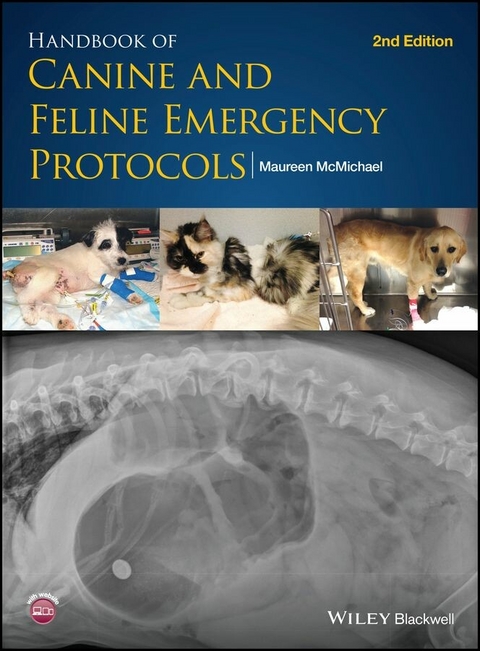
Handbook of Canine and Feline Emergency Protocols, Second Edition offers practical step-by-step guidance to managing emergency cases in small animal practice. Presenting more than 165 complete protocols for triaging, stabilizing, and managing emergent patients, the book is designed for fast access in an emergency situation, with tabs to make it easy to flip to the relevant section. An ideal resource for veterinary practitioners seeking a quick reference for dog and cat emergencies, this Second Edition provides enhanced imaging information to increase the book's diagnostic usefulness and full updates throughout.
Logically organized alphabetically by category of emergency, the book includes useful chapters on procedures, shock, toxicology, and trauma in addition to a procedures chapter. Video clips, additional images, review questions, formula calculations, and quick reference guides are available on a companion website. Handbook of Canine and Feline Emergency Protocols, Second Edition provides a user-friendly daily reference for any small animal practitioner.
The Editor
Maureen McMichael, DVM, DACVECC, is Associate Professor in the Department of Veterinary Clinical Medicine and Section Chief of the Small Animal Emergency and Critical Care Section at the University of Illinois College of Veterinary Medicine in Urbana, Illinois, USA.
The Editor Maureen McMichael, DVM, DACVECC, is Associate Professor in the Department of Veterinary Clinical Medicine and Section Chief of the Small Animal Emergency and Critical Care Section at the University of Illinois College of Veterinary Medicine in Urbana, Illinois, USA.
List of Contributors ix
Acknowledgments xi
Introduction xiii
Abbreviations xv
1 Acute Abdomen 1
Maureen McMichael
2 Allergic Reactions 9
Maureen McMichael
3 Cardiac Emergencies 13
Jennifer M. Herring
4 Endocrine Emergencies 35
Mauria O'Brien
5 Gastrointestinal Emergencies 45
Jennifer M. Herring
6 Hematologic Emergencies 64
Christopher G. Byers
7 Hepatic Emergencies 76
Mauria O'Brien
8 Infectious Disease 87
Maureen McMichael
9 Neoplasia 102
Mauria O'Brien
10 Neurologic Emergencies 106
Jennifer M. Herring
11 Ophthalmologic Emergencies 116
Mauria O'Brien
12 Pediatric and Neonatal Emergencies 122
Maureen McMichael
13 Procedures and Protocols 131
Christopher G. Byers and Maureen McMichael
14 Pulmonary/Respiratory Emergencies 168
Jennifer M. Herring
15 Renal and Urinary Emergencies 189
Mauria O'Brien
16 Reproductive Emergencies 196
Mauria O'Brien
17 Shock and Sepsis 208
Christopher G. Byers
18 Toxicology 219
Maureen McMichael
19 Trauma/Environmental Emergencies 249
Christopher G. Byers
Index 279
"This handbook presents a great deal of practical and valuable information in a clear and concise format and will be beneficial for both emergency clinicians and general practitioners who are looking for a quick reference for use in crisis situations. It is reasonably priced, and although it is not intended to be an exhaustive reference, readers will not be disappointed as long as they recognize its intended scope." (Journal of the American Veterinary Medical Association, 15 June 2015)
"The second updated edition of Handbook of Canine and Feline Emergency Protocols provides a step-by-step key to managing animal emergencies in small practices, and packs in over 165 complete protocols for triage, as well as stabilizing and handling patients. It's arranged by category of emergency, it provides step-by-step procedures, and it offers clear guidelines and the latest information on imaging, diagnosis, and treatment. Add a lay-flat binding format designed for use with a patient and color illustrations and bibliographic references and you have an important handbook no vet practice should be without." (Midwest Book Review, 1 December 2014)
"I would recommend this book to practices that are looking for a list of protocols for emergency treatment. It is not a comprehensive text on treating emergencies (and does not purport to be). For practices that are busy and work well with their nursing teams, I could see this text being very well used to achieve appropriate patient care with a minimum of fuss."(Australian Veterinary Journal , 27 August 2015)
Chapter 1
Acute Abdomen
Maureen McMichael
ACUTE ABDOMEN DIFFERENTIAL DIAGNOSES
Gastrointestinal
- Gastric dilatation +/− volvulus
- Gastritis/enteritis/ulceration
- Gastric/intestinal obstruction
- Hemorrhagic gastroenteritis
- Intestinal/mesenteric volvulus
- Intussusception
- Obstipation
Hepatic
- Bile duct obstruction/rupture
- Gallbladder rupture
- Hepatic abscess
- Hepatic neoplasia
- Hepatitis/cholangiohepatitis
- Hepatic lipidosis
Intervertebral Disc Disease
Occasionally dogs with back pain present with clinical signs that mimic abdominal pain
Pancreatitis
Peritonitis
Prostate
- Prostatic abscess
- Prostatitis
Renal
- Acute renal failure
- Pyelonephritis
- Renal calculi
- Ureteral obstruction
Reproductive
- Dystocia
- Metritis/pyometra
- Orchitis/epididymitis
- Uterine/testicular torsion
Splenic
- Rupture/neoplasia
- Torsion
Toxin
- Arsenic
- Lead
- Zinc
Urinary
- Bladder rupture
- Urethral obstruction/rupture
HEMOABDOMEN
History
If chronic, (neoplasia) often has a history of lethargy with intermittent periods of improvement. Occasionally PU/PD, distended abdomen, and vomiting. If acute, (neoplasia, trauma, and coagulopathy) can present in shock.
Clinical Signs
Pale mucous membranes, tachycardia, may have systolic heart murmur (anemia), bounding or weak pulses, and palpable abdominal fluid wave. May be tachypneic, weak, depressed. Sudden loss of volume is not often reflected in HCT/TS. A normal HCT with slightly low TS is often encountered on presentation with the HCT dropping as fluid administration and redistribution of body fluid occurs.
Diagnostics
- Minimally: MDB, abdominocentesis (PCV, cytology, fluid analysis).
- 1st Tier: PT or ACT or coagulation panel, CBC + retic count.
- 2nd Tier: Blood type and crossmatch, chem panel, CXR (metastasis check), AUS.
Treatment
- Oxygen supplementation.
- IV catheter (largest catheter possible for rapid replacement).
- Administer isotonic crystalloid bolus:
- Dogs: 20 ml/kg (up to 90 ml/kg) and then reassess perfusion.
- Cats: 10 ml/kg (up to 45 ml/kg) and then reassess perfusion.
- Synthetic colloids (HES):
- Dogs: 5 ml/kg bolus over 15–20 min and reassess perfusion. Give up to 20 ml/kg total.
- Cats: 2–5 ml/kg bolus over 20–30 min and reassess perfusion. Do not bolus colloids rapidly in cats.
Blood:
With clinical anemia (i.e., lethargy, tachycardia, and tachypnea) and normal albumin level, administer crossmatched pRBCs at 6–12 ml/kg over 1–4 h. With clinical anemia and hypoalbuminemia, administer crossmatched fresh whole blood at 10–20 ml/kg over 1–4 h or pRBCs and FFP.
Coagulopathy:
If prolonged PT this may be anticoagulant rodenticide. Although this rarely presents as hemoabdomen (more commonly presents as retroperitoneal bleed or hemothorax), it is most likely in young dogs with significantly prolonged PT. If ACT or aPTT is prolonged and the pet has signs of inflammatory disease, consider DIC. Plasma administration may be helpful to replace coagulation factors.
Monitoring:
End points of fluid/blood/colloid resuscitation are normalizing of HR, pulse quality, mentation, lactate, HCT/TS, CVP, and urine output.
Prognosis
Prognosis depends on the underlying disease. Prognosis is good for trauma that responds to fluid resuscitation (surgery may not be needed). May need surgical correction of lacerated vessel if not stabilized by transfusion/fluid therapy. Prognosis is guarded to poor for ruptured splenic or liver masses due to hemangiosarcoma. Prognosis guarded for ruptured adrenal masses presenting as hemoabdomen. Approximately 75% of dogs with nontraumatic hemoabdomen on presentation have neoplasia.
SPLENIC TORSION
History
Acute: Shocky, painful abdomen, and enlarged spleen. Chronic: Lethargy, anorexia, enlarged spleen, and possibly painful abdomen. Large breeds and Great Danes predisposed.
Clinical Signs
Tachycardia, weak pulses, pale or icteric mucous membranes, painful abdomen, enlarged spleen, and cardiac arrhythmias.
Diagnostics
- Minimally: MDB, AXR.
- 1st Tier: CBC with retic count, platelet count, ACT or coag panel, chem panel, lactate. May see anemia with fragmented RBCs, hemoglobinemia, hemoglobinuria, elevated liver enzymes, elevated bilirubin.
- 2nd Tier: CXR, AUS. Abdominal ultrasound may reveal enlarged splenic vessels (Figs 1.1 and 1.2).
Fig. 1.1. Partial splenic torsion. Ultrasound image of a 4-year-old Great Dane with evidence of a hypoechoic and roughly triangular region (outlined by arrowheads) in the distal tail of the spleen consistent with a partial splenic torsion
(courtesy Dr. Robert O'Brien, DVM, DACVS).
Fig. 1.2. Splenic torsion. Ultrasound image from a 6-year-old Great Dane with a splenic torsion. Note the “lacey” appearance to the spleen with Doppler evidence (green dashed lines) of decreased flow
(courtesy Dr. Robert O'Brien, DVM, DACVS).
Treatment
- Administer isotonic crystalloid bolus:
- Dogs: 20 ml/kg (up to 90 ml/kg) and then reassess perfusion.
- Cats: 10 ml/kg (up to 45 ml/kg) and then reassess perfusion.
- Synthetic colloids (HES):
- Dogs: 5 ml/kg bolus over 15–20 min and reassess perfusion. Give up to 20 ml/kg total.
- Cats: 2–5 ml/kg bolus over 20–30 min and reassess perfusion. Do not bolus colloids rapidly in cats.
Blood products:
With clinical anemia (i.e., lethargy, tachycardia, and tachypnea) and normal albumin level, administer crossmatched pRBCs at 6–12 ml/kg over 1–4 h. With clinical anemia and hypoalbuminemia, administer crossmatched fresh whole blood at 10–20 ml/kg over 1–4 h or pRBCs and FFP.
Analgesia:
Multimodal analgesia is ideal and should include a pure μ-opioid agonist along with additional analgesics. Options include fentanyl at 2–6 µg/kg/h or morphine at 0.12–0.36 mg/kg/h or hydromorphone at 0.024–0.072 mg/kg/h along with lidocaine at 25–50 µg/kg/min (dogs) +/or ketamine at 2–5 µg/kg/min. Other options include methadone at 0.25–0.75 mg/kg IV/IM/SC q4 h (dogs) or methadone at 0.05–0.5 mg/kg IV/IM/SC q4 h (cats) or Gabapentin at 5–10 mg/kg PO q8–12 h.
- Surgery should be performed as soon as the patient is resuscitated.
Monitoring
End points for fluid and blood product resuscitation include normalization of HR, lactate, mentation, and urine output. These are temporary as surgery is the only corrective measure.
Prognosis
Good if surgery is corrective and there is no predisposing underlying cause (i.e., neoplasia).
PERITONITIS
History
May have history of previous surgery, penetrating wound, pregnancy, previous cystocentesis, pyometra, or no prior history (perforated intestinal neoplasia).
Clinical Signs
Pale or muddy mucous membranes, tachycardia (except cats, see bradycardia), weak or bounding pulses, painful abdomen (cats may not have abdominal pain with peritonitis), fever, or hypothermia (cats—hypothermia).
Diagnostics
- Minimally: MDB, AXR (check for loss of detail, free gas), abdominocentesis (intracellular bacteria are hallmark of septic peritonitis, and also can check lactate, blood glucose, creatinine, bilirubin, and lipase on the fluid in addition to cytology and culture). Abdominal effusion glucose <50 mg/dl and/or an effusion to venous lactate of >4.6 mmol/l are highly indicative of bacterial peritonitis. It is best to do radiographs before abdominal tap, as the latter can introduce free gas into the abdomen and confuse radiographic interpretation.
- 1st Tier: lactate (may be increased with hypoperfusion), CBC (look for left shift, toxic changes in leukocytes), chem panel (may see hypoglycemia).
- 2nd Tier: ACT/coagulation panel, CXR, AUS (Figs 1.3 and 1.4).
Fig. 1.3. Peritonitis. Ultrasound image of a 5-year-old Coonhound with peritonitis secondary to a uroabdomen. Note the abdominal free fluid (arrowhead) and severe corrugation of the intestinal loop (arrow)
(courtesy Dr. Robert O'Brien, DVM, DACVS).
Fig. 1.4. GI Septic peritonitis with free gas. Lateral radiograph from a 6-year-old Labrador Retriever with septic peritonitis. Note the multiple small gas bubbles in the ventral aspect of the abdomen (arrows). Loss of serosal detail is also present. Some loops of bowel in the mid-ventral abdomen are gas distended (arrowheads)
(courtesy Dr. Robert O'Brien, DVM,...
| Erscheint lt. Verlag | 7.8.2014 |
|---|---|
| Sprache | englisch |
| Themenwelt | Medizin / Pharmazie |
| Veterinärmedizin ► Kleintier | |
| Schlagworte | Hundekrankheit • Katzenkrankheit • Veterinärmedizin • Veterinärmedizin / Hunde u. Katzen • Veterinärmedizin / Notfallmedizin • Veterinärmedizin • Veterinärmedizin / Hunde u. Katzen • Veterinärmedizin / Notfallmedizin • Veterinary Emergency & Critical Care • Veterinary Medicine • Veterinary Medicine - Dogs & Cats |
| ISBN-13 | 9781118558966 / 9781118558966 |
| Informationen gemäß Produktsicherheitsverordnung (GPSR) | |
| Haben Sie eine Frage zum Produkt? |
 EPUB (Adobe DRM)
Kopierschutz: Adobe-DRM
Adobe-DRM ist ein Kopierschutz, der das eBook vor Mißbrauch schützen soll. Dabei wird das eBook bereits beim Download auf Ihre persönliche Adobe-ID autorisiert. Lesen können Sie das eBook dann nur auf den Geräten, welche ebenfalls auf Ihre Adobe-ID registriert sind.
Details zum Adobe-DRM
Dateiformat: EPUB (Electronic Publication)
EPUB ist ein offener Standard für eBooks und eignet sich besonders zur Darstellung von Belletristik und Sachbüchern. Der Fließtext wird dynamisch an die Display- und Schriftgröße angepasst. Auch für mobile Lesegeräte ist EPUB daher gut geeignet.
Systemvoraussetzungen:
PC/Mac: Mit einem PC oder Mac können Sie dieses eBook lesen. Sie benötigen eine
eReader: Dieses eBook kann mit (fast) allen eBook-Readern gelesen werden. Mit dem amazon-Kindle ist es aber nicht kompatibel.
Smartphone/Tablet: Egal ob Apple oder Android, dieses eBook können Sie lesen. Sie benötigen eine
Geräteliste und zusätzliche Hinweise
Buying eBooks from abroad
For tax law reasons we can sell eBooks just within Germany and Switzerland. Regrettably we cannot fulfill eBook-orders from other countries.
aus dem Bereich