


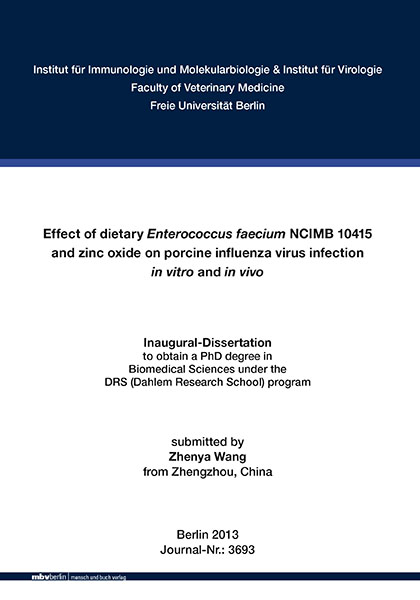
Effect of dietary Enterococcus faecium NCIMB 10415 and zinc oxide on porcine influenza virus infection in vitro and in vivo
Seiten
2014
Mensch & Buch (Verlag)
978-3-86387-465-0 (ISBN)
Mensch & Buch (Verlag)
978-3-86387-465-0 (ISBN)
- Keine Verlagsinformationen verfügbar
- Artikel merken
Porcine respiratory tract epithelial cells express sialic acid receptors utilized by both avian and mammalian influenza viruses. Pigs are, therefore, considered “mixing vessels” [15] for new human-avian influenza A virus reassortants with the potential to cause significant respiratory disease or even pandemics in humans [11,53]. Thus, the control of SIV is of concern for the economics of swine production as well as for animal and public health. Since there is no causative treatment for SIV, and no sterile immunity is achieved with current vaccines, a positive effect on prevention and/or course of clinical disease achieved through nutritional supplementation would be highly useful.
Probiotics have been recently shown to mediate antiviral effects against certain viruses in vitro and in vivo [75,95,168,169] and the effect of various strains of probiotics on the course of virus infections in pigs is being studied intensively. However, while some descriptive information on the effect of probiotics on model viruses such as vesicular stomatitis virus (VSV), transmissible gastroenteritis virus (TGEV) and rotaviruses [75,95,168,169] are available, no such data are yet available for swine influenza viruses which are most important in view of their exquisite zoonotic capacity. It is commonly believed that mammalian influenza viruses are restricted to the respiratory tissue and thus may hardly be affected by probiotics acting in the intestine. However, a recent report on the pathogenesis of seasonal influenza virus H1N1 in ferrets shows that this virus is also present in the intestine [17]. Furthermore it is world acknowledged that avian influenza virus infections frequently initiate in the intestine of the avian host [3]. Therefore it appears justified to include influenza viruses in studies on the probiotic inhibition of virus multiplication both in vitro and in vivo.
Zn was utilized frequently in attempts to treat various virus infections or aid in their prophylaxis. Some results suggest that Zn can directly interact with viral structural components, thereby influencing virus replication. It is also widely accepted that Zn affects immune responses at the cellular level as well as at the level of the recipient organism [108]. Interestingly, in cell culture studies, high Zn concentrations and the addition of compounds that stimulate cellular import of Zn were found to inhibit the replication of various RNA viruses, including influenza virus [133].
In the present study we explored whether E. faecium affects the replication of swine influenza virus H1N1 and H3N2 in a macrophage (3D4/21) and epithelial cell line (MDBK). More importantly, we also explored systemic effects of E. faecium and high level Zn oxide feeding on SIV vaccination and infection in pigs.
Probiotics have been recently shown to mediate antiviral effects against certain viruses in vitro and in vivo [75,95,168,169] and the effect of various strains of probiotics on the course of virus infections in pigs is being studied intensively. However, while some descriptive information on the effect of probiotics on model viruses such as vesicular stomatitis virus (VSV), transmissible gastroenteritis virus (TGEV) and rotaviruses [75,95,168,169] are available, no such data are yet available for swine influenza viruses which are most important in view of their exquisite zoonotic capacity. It is commonly believed that mammalian influenza viruses are restricted to the respiratory tissue and thus may hardly be affected by probiotics acting in the intestine. However, a recent report on the pathogenesis of seasonal influenza virus H1N1 in ferrets shows that this virus is also present in the intestine [17]. Furthermore it is world acknowledged that avian influenza virus infections frequently initiate in the intestine of the avian host [3]. Therefore it appears justified to include influenza viruses in studies on the probiotic inhibition of virus multiplication both in vitro and in vivo.
Zn was utilized frequently in attempts to treat various virus infections or aid in their prophylaxis. Some results suggest that Zn can directly interact with viral structural components, thereby influencing virus replication. It is also widely accepted that Zn affects immune responses at the cellular level as well as at the level of the recipient organism [108]. Interestingly, in cell culture studies, high Zn concentrations and the addition of compounds that stimulate cellular import of Zn were found to inhibit the replication of various RNA viruses, including influenza virus [133].
In the present study we explored whether E. faecium affects the replication of swine influenza virus H1N1 and H3N2 in a macrophage (3D4/21) and epithelial cell line (MDBK). More importantly, we also explored systemic effects of E. faecium and high level Zn oxide feeding on SIV vaccination and infection in pigs.
| Sprache | deutsch |
|---|---|
| Einbandart | gebunden |
| Themenwelt | Veterinärmedizin |
| ISBN-10 | 3-86387-465-X / 386387465X |
| ISBN-13 | 978-3-86387-465-0 / 9783863874650 |
| Zustand | Neuware |
| Informationen gemäß Produktsicherheitsverordnung (GPSR) | |
| Haben Sie eine Frage zum Produkt? |
Mehr entdecken
aus dem Bereich

aus dem Bereich
Ein Handbuch für Tiermedizinische Fachangestellte
Buch | Softcover (2025)
Lehmanns Media (Verlag)
CHF 23,70
Buch | Hardcover (2025)
Schlütersche (Verlag)
CHF 124,60
Buch | Hardcover (2025)
John Wiley & Sons Inc (Verlag)
CHF 319,95


