Wish you could interpret cytological specimens in practice rather than paying a lab to do it for you? Want to provide your clients with a faster service?
Manual of Diagnostic Cytology of the Dog and Cat is the ideal quick reference for the busy veterinarian in first opinion practice. It describes techniques for obtaining good quality cytological diagnostic specimens, and guides you through the interpretation of cytological findings.
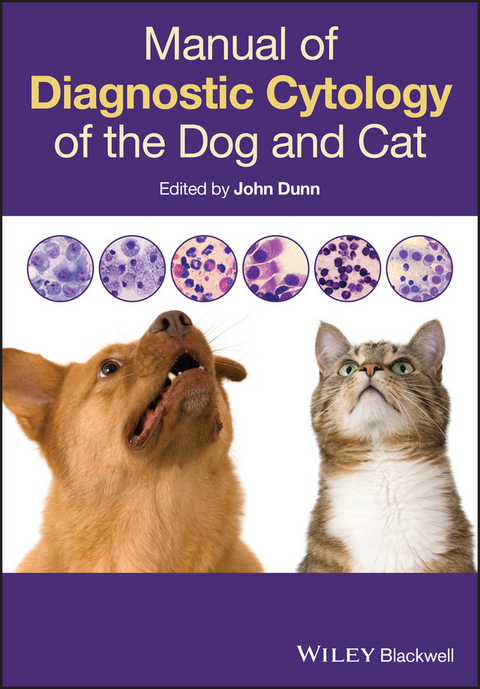
Created to be used alongside the microscope, hundreds of high quality colour photos will help you to identify normal cell types and abnormal cytology, including both non-neoplastic and neoplastic lesions. It describes in a clear and concise manner the most common lesions and related disorders encountered in a practice setting. The concise format means that you can quickly find exactly what you're looking for.
Covering indications for cytological investigation, collection techniques and the evaluation and interpretation of findings, this concise manual will be your go-to resource.
ABOUT THE EDITOR
John Dunn, BVM&S, MVetSci, MA, DSAM, DipECVIM, DipECVCP, FRCPath, MRCVS
John is a Senior Clinical Pathologist at Axiom Veterinary Laboratories Ltd, UK, having previously spent 15 years as a lecturer in Small Animal Medicine and Clinical Pathology at the University of Cambridge Veterinary School. He is a Diplomate of both the European College of Veterinary Internal Medicine (Companion Animals) and the European College of Veterinary Clinical Pathology, and is a Fellow of the Royal College of Pathologists.
Wish you could interpret cytological specimens in practice rather than paying a lab to do it for you? Want to provide your clients with a faster service? Manual of Diagnostic Cytology of the Dog and Cat is the ideal quick reference for the busy veterinarian in first opinion practice. It describes techniques for obtaining good quality cytological diagnostic specimens, and guides you through the interpretation of cytological findings. Created to be used alongside the microscope, hundreds of high quality colour photos will help you to identify normal cell types and abnormal cytology, including both non-neoplastic and neoplastic lesions. It describes in a clear and concise manner the most common lesions and related disorders encountered in a practice setting. The concise format means that you can quickly find exactly what you re looking for. Covering indications for cytological investigation, collection techniques and the evaluation and interpretation of findings, this concise manual will be your go-to resource.
ABOUT THE EDITOR John Dunn, BVM&S, MVetSci, MA, DSAM, DipECVIM, DipECVCP, FRCPath, MRCVS John is a Senior Clinical Pathologist at Axiom Veterinary Laboratories Ltd, UK, having previously spent 15 years as a lecturer in Small Animal Medicine and Clinical Pathology at the University of Cambridge Veterinary School. He is a Diplomate of both the European College of Veterinary Internal Medicine (Companion Animals) and the European College of Veterinary Clinical Pathology, and is a Fellow of the Royal College of Pathologists.
Contributors vii
Preface xi
Editor's Note xii
1 Cytological Collection Techniques and Sample Preparation 1
Natali Bauer
2 General Principles of Cytological Interpretation 17
Kathleen Tennant
3 Cytology of the Lymphoid Tissues 33
Erik Teske
4 Cytology of Cutaneous and Subcutaneous Lesions 57
John Dunn
5 Cytology of the Respiratory Tract 75
John Dunn
6 Biochemical and Cytological Evaluation of Body Cavity Effusions 89
Niki Skeldon and Emma Dewhurst
7 Cytology of Synovial Fluid 111
Kate Sherry
8 Biochemical and Cytological Examination of Cerebrospinal Fluid 127
Kate English and Holger Volk
9 Cytology of the Eye and Adnexal Structures 139
Roger Powell and David Gould
10 Cytology of the Urinary Tract 161
Joy Archer
11 Cytology of the Liver, Exocrine Pancreas and Gastrointestinal Tract 175
Marta Costa and Kostas Papasouliotis
12 Cytological Examination of the Endocrine Glands 195
Walter Bertazzolo
13 Cytology of the Male and Female Genital Tracts 213
Gary C.W. England and Kristen R. Friedrichs
14 Cytology of Mammary Gland Lesions 231
Reinhard Mischke
15 Cytology of Selected Infectious Organisms 247
Harold Tvedten
Further Reading 263
Index 267
"This book will serve as an excellent resource for small
animal veterinarians who are seeking a reference with useful
information on the acquisition and interpretation of cytologic
samples." (Journal of the American Veterinary
Medical Association, 15 September 2014)
"This is a nice book that will provide valuable
information for veterinarians obtaining samples and performing
in-house cytology." (Doody's, 5 September
2014)
"If you are keen to develop your skills in diagnostic
cytology, I would definitely consider buying this
book." (European Journal of Companion Animal
Practice, 1 July 2014)
1
Cytological Collection Techniques and Sample Preparation
Natali Bauer
Department of Clinical Sciences, Faculty of Veterinary Medicine, Clinical Pathophysiology and Clinical Pathology, Justus-Liebig University Giessen, Giessen, Germany
Acquisition of a fine-needle aspirate for cytological examination is a fast and easy, minimally invasive technique which can be performed in every practice or clinic. The advantages are that generally no anaesthesia or sedation is required and the risk of haemorrhage is minimal while the technique provides an excellent evaluation of single cell morphology. In contrast to histology, however, it has to be kept in mind that the tissue architecture is not preserved and cannot be evaluated. Histopathological examination of biopsy specimens allows the assessment of growth patterns and the margins of the lesion can be visualised if necessary, but surgical biopsy is associated with a higher risk of haemorrhage and anaesthesia (local or general) is necessary.
Adequate techniques of sample preparation and staining are mandatory for the optimal interpretation of cytological specimens. Moreover, correct interpretation of any cytological specimen requires correct microscopic examination and recognition of common artefacts. This chapter describes the practical approach to optimal sampling, routine staining techniques and the systematic microscopic evaluation and detection of common artefacts.
Sampling techniques
Fine-needle aspiration
Fine-needle aspiration cytology is a useful technique for the investigation of soft tissue masses (cutaneous lesions, lymph nodes, intra-thoracic or intra-abdominal masses) and effusions from body cavities. The technique can be easily performed in a practice setting. The following basic equipment is required:
- Glass slides with a frosted end which can be easily labelled.
- 5 ml syringe (if required also a 2 ml or 10 ml syringe; a 10 ml syringe might be advantageous for aspirating very firm masses),
- 20–22 G needles.
- A pencil for labelling the slides with the date and localisation of the lesion as well as the patient´s name. Note: Labels written with a ballpoint pen or marker may be washed away with alcohol-based stains (e.g. Diff-Quik, Wright’s, May–Grünwald–Giemsa).
Figure 1.1 Fine-needle aspiration using a needle and syringe.
For organs such as the liver or spleen, longer needles are usually required especially in large dogs. Here, a spinal needle with a stylet is recommended to avoid contamination by tissues adjacent to the mass or organ (with softer tissues smaller needles and syringes can be used).
Fine-needle aspirates can be taken with an ‘aspiration technique’ or a ‘non-aspiration technique’. The non-aspiration technique is preferred for sampling of all masses or organs which are highly vascular (e.g. spleen, liver) in order to minimise blood contamination. Overall, the sampling procedure should take no longer than 5–10 s, and several smears should be prepared.
- Aspiration technique:
- The mass or organ (e.g. a peripheral lymph node) is immobilised with one hand and the needle is inserted with the other (Figure 1.1). Wherever possible, fine-needle aspiration of abdominal organs or masses is best performed under ultrasound guidance.
- The skin is disinfected as for venipuncture.
- The needle with attached syringe is inserted into the lesion.
- The plunger is withdrawn, and while maintaining negative pressure, the needle can be redirected to aspirate different regions of the mass or organ.
- The needle with attached syringe is removed after releasing the plunger.
- The syringe is filled with approximately 3–5 ml air and reattached to the needle to expel the aspirate gently on the glass slide.
- Note: To facilitate pulling the plunger, commercial aspiration guns may be useful when aspirating masses or organs which are difficult to immobilise since the vacuum can be easily maintained with one hand (Figure 1.2).
- Non-aspiration technique: Two methods of this technique can be used for sampling.
- ‘Needle-alone technique’: The needle without the syringe attached is inserted into the lesion after disinfection of the skin (Figure 1.3). The needle is then rapidly moved back and forth in the tissue approximately ten times before it is withdrawn. A syringe already filled with 3–5 ml air ensures a rapid expulsion of the aspirated material onto the slide.
- Alternatively, the needle is inserted with a syringe already filled with 2–3 ml of air attached (Figure 1.4). The needle and syringe are then rapidly moved back and forth in the tissue before the needle with syringe attached is removed. The aspirated material is then ejected onto the slide, and smears are prepared immediately.
Figure 1.2 Fine-needle aspiration using an aspiration gun, e.g. ‘Zyto-Gun®’ (Scil animal care company GmbH, Viernheim, Germany).
Figure 1.3 The non-aspiration technique using a ‘needle-alone technique’ is useful for obtaining samples from small lesions such as pustules or bullae.
Figure 1.4 The non-aspiration technique with the syringe attached to the needle is used here to sample the spleen of a dog with ascites and icterus under ultrasonographic control. Note the syringe is prefilled with air and is held between the thumb and forefinger.
Cytological smears can be prepared using the blood smear (Figure 1.5) or squash preparation technique (Figure 1.6).
Impression smears/imprints
Imprints can be made from wet surfaces (e.g. biopsies, ulcerated or exudative skin lesions) as well as from dry skin lesions using Sellotape (Figure 1.7 and Figure 1.8). It may be necessary to blot away excessive blood or tissue fluids from the surface of a biopsy specimen with a clean, dry swab or paper towel before making the imprint onto a clean glass slide. The disadvantages of impression smears are that they only collect cells from the surface of the lesion and therefore may not be representative of underlying pathology, fewer cells are collected and bacterial contamination is more likely.
Scrapings
Scrapings may be useful for sampling extremely firm lesions which are less likely to exfoliate cells with the aspiration technique. After the lesion is cleaned and dried, a large scalpel blade (held at a 90° angle) is moved several times over the surface of the lesion in the direction of the person taking the sample. The scraped material is then transferred to a slide and is distributed evenly with the scalpel blade, or a second slide may be used to prepare a squash preparation using the technique described previously.
Figure 1.5 Preparation of the smear using a blood smear technique. (A) The aspirated material is deposited onto the glass slide by ejecting 3–5 ml air through the syringe and needle. (B) A second slide held at a 45° angle (for highly viscous fluids such as joint fluid, smaller angles of approximately 25° are recommended) is brought towards until it makes contact with the aspirated material. (C/D) The material is distributed along the width of the spreader slide which is then pushed forwards smoothly and rapidly.
Figure 1.6 The squash preparation technique. (A) The fine-needle aspirate is placed on the glass slide by ejecting 3–5 ml air through the syringe and needle. (B) A second slide is gently placed on top of the first one. Capillary forces result in the slides adhering to each other. (C) The top slide is gently drawn over the bottom slide on which the aspirate has been deposited. (D) The top (spreader) slide is removed once it reaches the end of the bottom slide which can then be submitted for cytological examination.
Figure 1.7 Impression smear of a liver biopsy. (A) Prior to preparing the impression smear, blood contamination is minimised by pressing the biopsy gently on a filter paper. (B and C) The imprint smear is prepared by touching the slide with the surface of the biopsy in several areas.
Figure 1.8 Sellotape imprint. (A) A strip of Sellotape is pressed several times onto the skin lesion. This technique is ideal to show micro-organisms (bacteria, yeasts) on the skin surface. For assessment of cells, however, other techniques such as evaluation of Romanowsky-stained skin scrapings are preferred. Parasites such as lice or Cheyletiella mites can also be detected with an unstained Sellotape preparation. (B) For preparation of a Romanowsky-stained Sellotape imprint, the piece of Sellotape is firstly put on the slide like an upturned ‘u’ (sticky side down), and the imprint can then be stained without fixation. After staining (and also for preparation of an unstained Sellotape imprint), the strip of Sellotape is put flat on the slide and can be then evaluated microscopically.
Swab smears
Swab smears are especially useful for preparing smears from fistulous tracts, the vagina or the ear canal (Figure 1.9). They are less useful for tumour diagnosis (the disadvantages are similar to those described for impression smears).
Figure 1.9 Collection of an ear swab for cytological investigation. (A) The cerumen or discharge is collected with a cotton bud. (B) The material is then rolled out onto a slide. (C)...
| Erscheint lt. Verlag | 6.1.2014 |
|---|---|
| Sprache | englisch |
| Themenwelt | Medizin / Pharmazie |
| Veterinärmedizin ► Kleintier | |
| Schlagworte | Busy • Cat • Clients • cytological • Cytologie • cytology • describes techniques • Diagnostic • Dog • FASTER • First • Good • Hundekrankheit • Ideal • Interpret • Interpretation • Katzenkrankheit • lab • Manual • Practice • quality • Quick • Reference • Specimens • Veterinärmedizin • Veterinärmedizin / Hunde u. Katzen • Veterinärmedizin / klinische Pathologie u. Labormedizin • veterinarian • Veterinärmedizin • Veterinärmedizin / Hunde u. Katzen • Veterinärmedizin / klinische Pathologie u. Labormedizin • Veterinary Clinical Pathology & Laboratory Medicine • Veterinary Medicine • Veterinary Medicine - Dogs & Cats • wish |
| ISBN-13 | 9781118783108 / 9781118783108 |
| Informationen gemäß Produktsicherheitsverordnung (GPSR) | |
| Haben Sie eine Frage zum Produkt? |
 EPUB (Adobe DRM)
Kopierschutz: Adobe-DRM
Adobe-DRM ist ein Kopierschutz, der das eBook vor Mißbrauch schützen soll. Dabei wird das eBook bereits beim Download auf Ihre persönliche Adobe-ID autorisiert. Lesen können Sie das eBook dann nur auf den Geräten, welche ebenfalls auf Ihre Adobe-ID registriert sind.
Details zum Adobe-DRM
Dateiformat: EPUB (Electronic Publication)
EPUB ist ein offener Standard für eBooks und eignet sich besonders zur Darstellung von Belletristik und Sachbüchern. Der Fließtext wird dynamisch an die Display- und Schriftgröße angepasst. Auch für mobile Lesegeräte ist EPUB daher gut geeignet.
Systemvoraussetzungen:
PC/Mac: Mit einem PC oder Mac können Sie dieses eBook lesen. Sie benötigen eine
eReader: Dieses eBook kann mit (fast) allen eBook-Readern gelesen werden. Mit dem amazon-Kindle ist es aber nicht kompatibel.
Smartphone/Tablet: Egal ob Apple oder Android, dieses eBook können Sie lesen. Sie benötigen eine
Geräteliste und zusätzliche Hinweise
Buying eBooks from abroad
For tax law reasons we can sell eBooks just within Germany and Switzerland. Regrettably we cannot fulfill eBook-orders from other countries.
aus dem Bereich