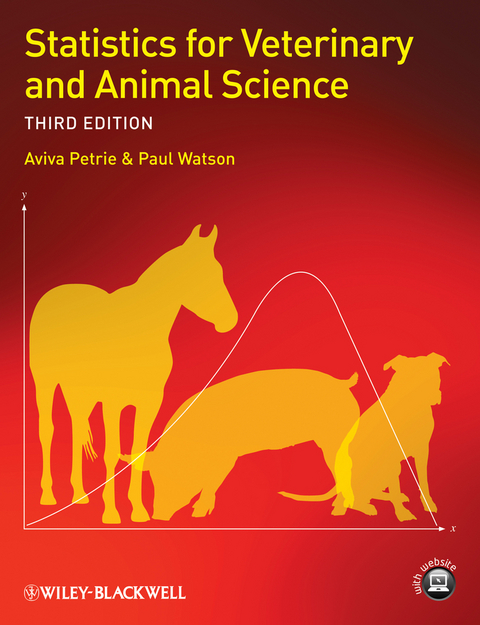
Statistics for Veterinary and Animal Science (eBook)
John Wiley & Sons (Verlag)
978-1-118-56741-8 (ISBN)
Banish your fears of statistical analysis using this clearly written and highly successful textbook. Statistics for Veterinary and Animal Science Third Edition is an introductory text which assumes no previous knowledge of statistics. It starts with very basic methodology and builds on it to encompass some of the more advanced techniques that are currently used. This book will enable you to handle numerical data and critically appraise the veterinary and animal science literature. Written in a non-mathematical way, the emphasis is on understanding the underlying concepts and correctly interpreting computer output, and not on working through mathematical formulae.
Key features:
- Flow charts are provided to enable you to choose the correct statistical analyses in different situations
- Numerous real worked examples are included to help you master the procedures
- Two statistical packages, SPSS and Stata, are used to analyse data to familiarise you with typical computer output
- The data sets from the examples in the book are available as electronic files to download from the book's companion website in ASCII, Excel, SPSS, Stata and R Workspace formats, allowing you to practice using your own software and fully get to grips with the techniques
- A clear indication is provided of the more advanced or obscure topics so that, if desired, you can skip them without loss of continuity.
New to this edition:
- New chapter on reporting guidelines relevant to veterinary medicine as a ready reference for those wanting to follow best practice in planning and writing up research
- New chapter on critical appraisal of randomized controlled trials and observational studies in the published literature: a template is provided which is used to critically appraise two papers
- New chapter introducing specialist topics: ethical issues of animal investigations, spatial statistics, veterinary surveillance, and statistics in molecular and quantitative genetics
- Expanded glossaries of notation and terms
- Additional exercises and further explanations added throughout to make the book more comprehensive.
Carrying out statistical procedures and interpreting the results is an integral part of veterinary and animal science. This is the only book on statistics that is specifically written for veterinary science and animal science students, researchers and practitioners.
Aviva Petrie, Head of Biostatistics Unit and Senior Lecturer, UCL Eastman Dental Institute, London; Honorary Lecturer in Medical Statistics, Medical Statistics Unit, London School of Hygiene and Tropical Medicine, UK. She is also author of a number of other books, including Medical Statistics at a Glance.
Paul Watson is a distinguished and well respected scientist in the field of Reproductive Biology, and is Emeritus Professor at the Royal Veterinary College, UK.
Banish your fears of statistical analysis using this clearly written and highly successful textbook. Statistics for Veterinary and Animal Science Third Edition is an introductory text which assumes no previous knowledge of statistics. It starts with very basic methodology and builds on it to encompass some of the more advanced techniques that are currently used. This book will enable you to handle numerical data and critically appraise the veterinary and animal science literature. Written in a non-mathematical way, the emphasis is on understanding the underlying concepts and correctly interpreting computer output, and not on working through mathematical formulae. Key features: Flow charts are provided to enable you to choose the correct statistical analyses in different situations Numerous real worked examples are included to help you master the procedures Two statistical packages, SPSS and Stata, are used to analyse data to familiarise you with typical computer output The data sets from the examples in the book are available as electronic files to download from the book s companion website in ASCII, Excel, SPSS, Stata and R Workspace formats, allowing you to practice using your own software and fully get to grips with the techniques A clear indication is provided of the more advanced or obscure topics so that, if desired, you can skip them without loss of continuity. New to this edition: New chapter on reporting guidelines relevant to veterinary medicine as a ready reference for those wanting to follow best practice in planning and writing up research New chapter on critical appraisal of randomized controlled trials and observational studies in the published literature: a template is provided which is used to critically appraise two papers New chapter introducing specialist topics: ethical issues of animal investigations, spatial statistics, veterinary surveillance, and statistics in molecular and quantitative genetics Expanded glossaries of notation and terms Additional exercises and further explanations added throughout to make the book more comprehensive. Carrying out statistical procedures and interpreting the results is an integral part of veterinary and animal science. This is the only book on statistics that is specifically written for veterinary science and animal science students, researchers and practitioners.
Aviva Petrie, Head of Biostatistics Unit and Senior Lecturer, UCL Eastman Dental Institute, London; Honorary Lecturer in Medical Statistics, Medical Statistics Unit, London School of Hygiene and Tropical Medicine, UK. She is also author of a number of other books, including Medical Statistics at a Glance. Paul Watson is a distinguished and well respected scientist in the field of Reproductive Biology, and is Emeritus Professor at the Royal Veterinary College, UK.
Cover 1
Title page 5
Copyright page 6
Contents 7
Preface to third edition 11
Preface to second edition 13
Preface to first edition 15
About the companion website 17
1: The whys and wherefores of statistics 19
1.1 Learning objectives 19
1.2 Aims of the book 19
1.2.1 What will you get from this book? 19
1.2.2 What are learning objectives? 20
1.2.3 Should you use a computer statistics package? 20
1.2.4 Will you be able to decide when and how to use a particular procedure? 20
1.2.5 Use of the glossaries of notation and terms 20
1.3 What is statistics? 20
1.4 Statistics in veterinary and animal science 21
1.5 Evidence-based veterinary medicine 22
1.6 Types of variable 22
1.7 Variations in measurements 23
1.7.1 Biological variation 24
1.7.2 Technical errors 24
1.8 Terms relating to measurement quality 25
1.9 Populations and samples 27
1.9.1 Types of population 27
1.9.2 Random sampling and random allocation 27
1.10 Types of statistical procedures 28
1.11 Conclusion 28
Exercises 28
2: Descriptive statistics 30
2.1 Learning objectives 30
2.2 Summarizing data 30
2.3 Empirical frequency distributions 30
2.3.1 What is a frequency distribution? 30
2.3.2 Relative frequency distributions 31
2.3.3 Cumulative relative frequency distributions 32
2.4 Tables 32
2.5 Diagrams 33
2.5.1 Categorical (qualitative) data 33
2.5.2 Numerical (quantitative) data 34
2.6 Numerical measures 37
2.6.1 Measures of location (averages) 38
2.6.2 Measures of dispersion (spread) 41
2.7 Reference interval 42
Exercises 43
3: Probability and probability distributions 46
3.1 Learning objectives 46
3.2 Probability 46
3.2.1 Relevance of probability to statistics 46
3.2.2 Definitions of probability 47
3.2.3 Properties of a probability 47
3.2.4 Rules of probability 48
3.3 Probability distributions 48
3.3.1 Introduction 48
3.3.2 Avoiding the theory! 49
3.4 Discrete probability distributions 49
3.4.1 Definition 49
3.4.2 Binomial distribution 50
3.4.3 Poisson distribution 51
3.5 Continuous probability distributions 51
3.5.1 Relationship between discrete and continuous probability distributions 51
3.5.2 Calculating probabilities from the probability density function 53
3.5.3 Normal (or Gaussian) distribution 53
3.5.4 Other continuous probability distributions 58
3.6 Relationships between distributions 60
3.6.1 Normal approximations of the Binomial and Poisson distributions 60
3.6.2 Mathematical interrelationships 61
Exercises 61
4: Sampling and sampling distributions 64
4.1 Learning objectives 64
4.2 Distinction between the sample and the population 64
4.3 Statistical inference 64
4.3.1 Introduction 64
4.3.2 Estimation of population parameters by sample statistics 65
4.3.3 Notation for population parameters and sample statistics 65
4.3.4 Sampling error 65
4.4 Sampling distribution of the mean 66
4.4.1 Sampling error in relation to the sample mean 66
4.4.2 Concept of the distribution of the sample means 66
4.4.3 Properties of the sampling distribution of the mean 66
4.4.4 Estimation of the standard error using sample data 67
4.4.5 Distinction between the standard deviation and the standard error of the mean 68
4.5 Confidence interval for a mean 68
4.5.1 Understanding confidence intervals 68
4.5.2 Calculating the confidence interval for the mean 69
4.6 Sampling distribution of the proportion 70
4.6.1 Concept of the distribution of sample proportions 70
4.6.2 Properties of the sampling distribution of the proportion 70
4.7 Confidence interval for a proportion 71
4.8 Bootstrapping and jackknifing 71
Exercises 72
5: Experimental design and clinical trials 73
5.1 Learning objectives 73
5.2 Types of study 73
5.2.1 Distinction between observational and experimental studies 74
5.2.2 Distinction between cross-sectional and longitudinal studies 74
5.2.3 Distinction between cohort and case–control observational studies 75
5.3 Introducing clinical trials 77
5.4 Importance of design in the clinical trial 78
5.5 Control group 79
5.5.1 Why do we need a control? 79
5.5.2 Positive or negative control? 79
5.5.3 Historical controls 79
5.6 Assignment of animals to the treatment groups 80
5.6.1 Need for random assignment 80
5.6.2 Methods of randomization 81
5.7 Avoidance of bias in the assessment procedure 83
5.8 Increasing the precision of the estimates 84
5.8.1 Introduction 84
5.8.2 Replication 84
5.8.3 Concept of blocks 84
5.8.4 ‘Between’ and ‘within’ comparisons 85
5.8.5 Use of specific animals 86
5.9 Further considerations 86
5.9.1 Confounding and interactions 86
5.9.2 Protocol 87
5.9.3 Outliers 88
5.9.4 Missing data 89
5.9.5 Analysis by intention-to-treat 90
5.9.6 Pilot studies 90
5.9.7 Cross-over trials 91
Exercises 91
6: An introduction to hypothesis testing 93
6.1 Learning objectives 93
6.2 Introduction 93
6.3 Basic concepts of hypothesis testing 93
6.3.1 The null hypothesis, H0 94
6.3.2 Getting a feel for the data 95
6.3.3 The test statistic and the P-value 95
6.3.4 Making a decision using the P-value 95
6.3.5 Deriving the P-value 96
6.3.6 Degrees of freedom of the test statistic 96
6.3.7 Quoting a confidence interval 97
6.3.8 Summary of the hypothesis test procedure 97
6.4 Type I and Type II errors 97
6.4.1 Making the wrong decision in a hypothesis test 97
6.4.2 Probability of making a wrong decision 98
6.5 Distinction between statistical and biological significance 98
6.6 Confidence interval approach to hypothesis testing 99
6.7 Collecting our thoughts on confidence intervals 100
6.8 Equivalence and non-inferiority studies 100
6.8.1 Approach 100
6.8.2 Example 101
Exercises 101
7: Hypothesis tests 1 – the t-test: comparing one or two means 103
7.1 Learning objectives 103
7.2 Requirements for hypothesis tests for comparing means 103
7.2.1 Nature of the data 103
7.2.2 Implications of sample size 104
7.2.3 Study designs 104
7.3 One-sample t-test 105
7.3.1 Introduction 105
7.3.2 Assumption 105
7.3.3 Approach 105
7.3.4 Example 106
7.4 Two-sample t-test 107
7.4.1 Introduction 107
7.4.2 Assumptions 107
7.4.3 Approach: equal variances 107
7.4.4 Example 108
7.4.5 Modified t-test: unequal variances 109
7.5 Paired t-test 110
7.5.1 Introduction 110
7.5.2 Assumption 111
7.5.3 Approach 111
7.5.4 Example 112
Exercises 114
8: Hypothesis tests 2 – the F-test: comparing two variances or more than two means 118
8.1 Learning objectives 118
8.2 Introduction 118
8.3 The F-test for the equality of two variances 118
8.3.1 Rationale 118
8.3.2 Assumptions 119
8.3.3 Approach 119
8.3.4 Example 120
8.4 Levene’s test for the equality of two or more variances 120
8.5 Analysis of variance (ANOVA) for the equality of means 120
8.5.1 Rationale 120
8.5.2 The ANOVA table 121
8.5.3 Particular forms of ANOVA 121
8.6 One-way analysis of variance 123
8.6.1 Assumptions 123
8.6.2 Approach 123
8.6.3 Multiple comparisons 124
8.6.4 Example 124
Exercises 127
9: Hypothesis tests 3 – the Chi-squared test: comparing proportions 130
9.1 Learning objectives 130
9.2 Introduction 130
9.3 Testing a hypothesis about a single proportion 130
9.3.1 Approach 130
9.3.2 Example 131
9.4 Comparing two proportions: independent groups 131
9.4.1 Introduction 131
9.4.2 The 2 × 2 contingency table (the fourfold table) 132
9.4.3 Comparing two proportions in a 2 × 2 table using the Chi-squared test 132
9.5 Testing associations in an r × c contingency table 135
9.5.1 Introduction 135
9.5.2 Assumptions 136
9.5.3 General approach 136
9.5.4 Example 136
9.5.5 Particular circumstances 137
9.6 Comparing two proportions: paired observations 138
9.6.1 Introduction 138
9.6.2 Assumptions 138
9.6.3 Approach 139
9.6.4 Example 139
9.7 Chi-squared goodness- of-fit test 140
9.7.1 Introduction 140
9.7.2 Assumptions 140
9.7.3 Approach 141
9.7.4 Example 141
Exercises 141
10: Linear correlation and regression 144
10.1 Learning objectives 144
10.2 Introducing linear correlation and regression 144
10.2.1 Types of variable 144
10.2.2 Aims of linear correlation and regression 144
10.2.3 Scatter diagram 145
10.3 Linear correlation 145
10.3.1 Correlation coefficient 145
10.3.2 Testing a hypothesis that the correlation coefficient is zero 147
10.3.3 Misuse of the correlation coefficient 150
10.4 Simple (univariable) linear regression 150
10.4.1 Equation of the regression line 150
10.4.2 Example 152
10.4.3 Regression diagnostics 154
10.4.4 Residual variance and the ANOVA table 157
10.4.5 Assessing goodness-of-fit 157
10.4.6 Investigating the slope 157
10.4.7 Predicting y from a given x 159
10.5 Regression to the mean 160
Exercises 160
11: Further regression analyses 164
11.1 Learning objectives 164
11.2 Introduction 164
11.3 Multiple (multivariable) linear regression 165
11.3.1 Multiple linear regression equation 165
11.3.2 Appropriateness of the model 168
11.3.3 Understanding the computer output in a multiple regression analysis 169
11.3.4 Choosing the explanatory variables to include in the model 170
11.3.5 Example 171
11.4 Multiple logistic regression: a binary response variable 172
11.4.1 Rationale 172
11.4.2 Interpreting the coefficients 173
11.4.3 Maximum likelihood estimation 174
11.4.4 Example 174
11.4.5 Checking the logistic regression model 175
11.4.6 Applications of logistic regression 176
11.5 Poisson regression 177
11.5.1 Rationale 177
11.5.2 Generalized linear models 177
11.5.3 Example of Poisson regression 178
11.6 Regression methods for clustered data 179
11.6.1 What are clustered data? 179
11.6.2 Example 180
Exercises 181
12: Non-parametric statistical methods 183
12.1 Learning objectives 183
12.2 Parametric and non-parametric tests 183
12.2.1 Difference between parametric and non-parametric tests 183
12.2.2 What if assumptions of the parametric test are not satisfied? 184
12.2.3 Advantages and disadvantages of using non-parametric tests 184
12.3 Sign test 185
12.3.1 Introduction 185
12.3.2 Rationale 185
12.3.3 Assumptions 186
12.3.4 Approach 186
12.3.5 Example 186
12.4 Wilcoxon signed rank test 187
12.4.1 Assumptions 187
12.4.2 Approach 187
12.4.3 Example 188
12.4.4 Choosing between the sign test and the Wilcoxon signed rank test 189
12.5 Wilcoxon rank sum test 189
12.5.1 Introduction 189
12.5.2 Assumptions 189
12.5.3 Approach 189
12.5.4 Example 190
12.6 Non-parametric analyses of variance 191
12.6.1 Introduction 191
12.6.2 Kruskal–Wallis one-way ANOVA 191
12.6.3 Friedman two-way ANOVA 192
12.7 Spearman’s rank correlation coefficient 193
12.7.1 Introduction 193
12.7.2 Calculation 193
12.7.3 Interpretation 194
12.7.4 Hypothesis testing and calculation of confidence intervals 194
12.7.5 Example 194
Exercises 196
13: Further aspects of design and analysis 199
13.1 Learning objectives 199
13.2 Transformations 199
13.2.1 Normalizing data 199
13.2.2 Linearizing a relationship 200
13.2.3 Stabilizing the variance 200
13.3 Sample size 202
13.3.1 Importance of sample size 202
13.3.2 Methods for determining the optimal sample size 202
13.3.3 Nomogram 203
13.3.4 Adjustments 206
13.3.5 Internal pilot study 207
13.4 Sequential and interim analysis 207
13.5 Meta-analysis 208
13.5.1 Introduction 208
13.5.2 The process 209
13.5.3 Example 211
13.6 Methods of sampling 212
13.6.1 Introduction 212
13.6.2 Technical terms in sampling 212
13.6.3 More common sampling designs 212
13.6.4 Sampling from wildlife populations 214
Exercises 216
14: Additional techniques 218
14.1 Learning objectives 218
14.2 Diagnostic tests 218
14.2.1 Introduction 218
14.2.2 Characteristics of the test: sensitivity and specificity 219
14.2.3 Using the ROC to assess a diagnostic test and to determine the optimal cut-off 220
14.2.4 Using logistic regression to determine the optimal cut-off 221
14.2.5 Estimating the sensitivity and specificity with no gold standard 221
14.2.6 Using logistic regression to estimate the sensitivity and specificity 221
14.2.7 Usefulness of the test: positive and negative predictive values 222
14.2.8 Estimating the PPV and NPV with no gold standard: the likelihood ratio 222
14.2.9 Using logistic regression to estimate the PPV and NPV 224
14.2.10 Using two (or more) diagnostic tests 224
14.2.11 Example 225
14.3 Bayesian analysis 226
14.3.1 The process 226
14.3.2 Choice of prior 227
14.3.3 Comparing the Bayesian and frequentist philosophies 227
14.3.4 Applications 228
14.4 Measuring agreement 229
14.4.1 Introduction 229
14.4.2 Repeatability and reproducibility of numerical measurements 230
14.5 Measurements at successive points in time 236
14.5.1 Time series 236
14.5.2 Analysis of repeated measurements 237
14.6 Survival analysis 239
14.6.1 Introduction 239
14.6.2 Approaches 240
14.6.3 Example 243
14.7 Multivariate analysis 244
Exercises 245
15: Some specialized issues and procedures 248
15.1 Learning objectives 248
15.2 Introduction 248
15.3 Ethical and legal issues 248
15.3.1 Ethics and animal ‘rights’ 248
15.3.2 The three Rs 249
15.3.3 Legislation controlling animal investigation 250
15.3.4 Principles of animal welfare and ethics committees 251
15.4 Spatial statistics and geospatial information systems 251
15.4.1 What is spatial statistics? 251
15.4.2 Displaying the data 252
15.4.3 Examples of spatial statistics in veterinary and animal science 252
15.4.4 What are the hazards of using these methods? 253
15.4.5 Some useful references 254
15.4.6 Example 254
15.5 Veterinary surveillance 255
15.5.1 What is veterinary surveillance? 255
15.5.2 Why is veterinary surveillance conducted? 255
15.5.3 How is veterinary surveillance conducted? 256
15.5.4 How are veterinary surveillance data analysed? 257
15.5.5 Uses of veterinary surveillance in the UK 257
15.5.6 Further reading in veterinary surveillance 258
15.6 Molecular and quantitative genetics 258
15.6.1 Molecular genetics 258
15.6.2 Quantitative genetics 259
Exercises 260
16: Evidence-based veterinary medicine 261
16.1 Learning objectives 261
16.2 Introduction 261
16.3 What is evidence-based veterinary medicine? 262
16.4 Why has evidence-based veterinary medicine developed? 262
16.5 What is involved in practising evidence-based veterinary medicine? 263
16.5.1 Phrasing the question 263
16.5.2 Obtaining the information 264
16.5.3 Evaluating the information: the role of statistics 265
16.5.4 Applying the results and making a clinical judgement 267
16.5.5 Reviewing the process 267
16.6 Integrating evidence-based veterinary medicine into clinical practice 267
16.7 Example 267
Exercises 268
17: Reporting guidelines 270
17.1 Learning objectives 270
17.2 Introduction to reporting guidelines (EQUATOR network) 270
17.2.1 Introduction 270
17.2.2 EQUATOR Network 271
17.3 REFLECT statement (livestock and food safety RCTs) 272
17.3.1 CONSORT and its history 272
17.3.2 REFLECT statement 273
17.4 ARRIVE guidelines (research using laboratory animals) 273
17.4.1 Background 273
17.4.2 ARRIVE guidelines 273
17.5 STROBE statement (observational studies) 273
17.6 STARD statement (diagnostic accuracy) 274
17.7 PRISMA statement (systematic reviews and meta-analysis) 274
18: Critical appraisal of reported studies 287
18.1 Learning objectives 287
18.2 Introduction 287
18.3 A template for critical appraisal of published research involving animals 288
18.4 Paper 1 291
18.5 Critical appraisal of paper 1 302
18.6 Paper 2 306
18.7 Critical appraisal of paper 2 315
18.8 General conclusion 320
Solutions to exercises 321
Chapter 1 321
Chapter 2 322
Chapter 3 323
Chapter 4 324
Chapter 5 324
Chapter 6 325
Chapter 7 326
Chapter 8 328
Chapter 9 329
Chapter 10 331
Chapter 11 333
Chapter 12 334
Chapter 13 336
Chapter 14 337
Chapter 15 339
Chapter 16 339
Appendices 341
Appendix A: Statistical tables 341
Acknowledgements 341
Table A.1 The Standard Normal distribution (two-tailed P-values from values of z, the SND) 342
Table A.2 The Standard Normal distribution (values of z, the SND, from P-values) 344
Table A.3 The t-distribution 344
Table A.4 The Chi-squared (?2) distribution 346
Table A.5 The F-distribution 347
Table A.6 Pearson’s correlation coefficient (r) 350
Table A.7 Spearman’s rank correlation coefficient (rs) 351
Table A.8 The sign test 352
Table A.9 The Wilcoxon signed rank test 353
Table A.10 The Wilcoxon rank sum test 354
Table A.11 The table of random numbers 356
Appendix B: Tables of confidence intervals 357
Appendix C: Glossary of notation 359
Mathematical symbols and transformations 359
Common notation 360
Abbreviations 361
Appendix D: Glossary of terms 363
Appendix E: Flowcharts for selection of appropriate tests 386
References 389
Index 397
Supplemental Images 411
"This book succeeds in this and represents an appropriate
text for anyone wishing to understand or produce veterinary and
animal science research." (Veterinary Record, 14
December 2013)
"Any who carry out or interpret statistical results in a
veterinary practice will find this a powerful read, packed with
ideas presented in a non-mathematical method clear of jargon but
pertinent to any daily practice." (Midwest
Book Review, 1 September 2013)
"This book offers a good introduction to the most
important tests used in veterinary statistics. It provides readers
with relevant information on appropriate tests, computer programs,
and use of the data. All the data is current and a website provides
updated information." (Doody's, 6
September 2013)
"It also seems likely that the third edition of the book
will be positively received and meet with approval from those
looking for an introduction to statistics for students taking
degree programs in veterinary medicine and animal sciences.
Although written primarily with students and practitioners of
veterinary medicine in mind, Statistics for Veterinary and Animal
Science also has much to offer students and researchers within
other branches of the biological sciences."
(Aquaculture International, 22 July 2013)
| Erscheint lt. Verlag | 21.2.2013 |
|---|---|
| Sprache | englisch |
| Themenwelt | Medizin / Pharmazie |
| Veterinärmedizin | |
| Schlagworte | Analysis • animal • BASIC • Book • Computer • Concepts • emphasis • Epidemiologie, Gesundheitswesen u. Statistik • Fears • Formulae • introductory • Knowledge • Mathematical • nonmathematical • Numerical data • previous • Science • starts • Statistical • Statistics • Statistik • techniques • Third • Veterinärmedizin • Veterinärmedizin • Veterinary • Veterinary Epidemiology, Public Health & Statistics • Veterinary Medicine • Way |
| ISBN-10 | 1-118-56741-2 / 1118567412 |
| ISBN-13 | 978-1-118-56741-8 / 9781118567418 |
| Informationen gemäß Produktsicherheitsverordnung (GPSR) | |
| Haben Sie eine Frage zum Produkt? |
 PDF (Adobe DRM)
Kopierschutz: Adobe-DRM
Adobe-DRM ist ein Kopierschutz, der das eBook vor Mißbrauch schützen soll. Dabei wird das eBook bereits beim Download auf Ihre persönliche Adobe-ID autorisiert. Lesen können Sie das eBook dann nur auf den Geräten, welche ebenfalls auf Ihre Adobe-ID registriert sind.
Details zum Adobe-DRM
Dateiformat: PDF (Portable Document Format)
Mit einem festen Seitenlayout eignet sich die PDF besonders für Fachbücher mit Spalten, Tabellen und Abbildungen. Eine PDF kann auf fast allen Geräten angezeigt werden, ist aber für kleine Displays (Smartphone, eReader) nur eingeschränkt geeignet.
Systemvoraussetzungen:
PC/Mac: Mit einem PC oder Mac können Sie dieses eBook lesen. Sie benötigen eine
eReader: Dieses eBook kann mit (fast) allen eBook-Readern gelesen werden. Mit dem amazon-Kindle ist es aber nicht kompatibel.
Smartphone/Tablet: Egal ob Apple oder Android, dieses eBook können Sie lesen. Sie benötigen eine
Geräteliste und zusätzliche Hinweise
Buying eBooks from abroad
For tax law reasons we can sell eBooks just within Germany and Switzerland. Regrettably we cannot fulfill eBook-orders from other countries.
aus dem Bereich