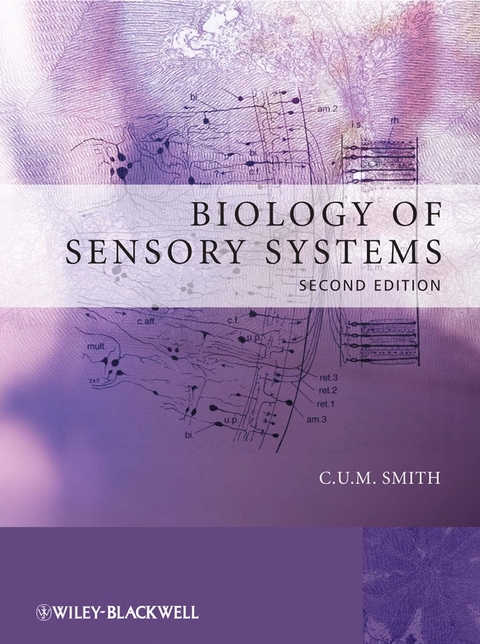
Biology of Sensory Systems (eBook)
John Wiley & Sons (Verlag)
9780470694381 (ISBN)
Biology of Sensory Systems has thus been completely revised and takes a molecular, evolutionary and comparative approach, providing an overview of sensory systems in vertebrates, invertebrates and prokaryotes, with a strong focus on human senses.
Written by a renowned author with extensive teaching experience, the book covers, in six parts, the general features of sensory systems, the mechanosenses, the chemosenses, the senses which detect electromagnetic radiation, other sensory systems including pain, thermosensitivity and some of the minority senses and, finally, provides an outline and discussion of philosophical implications.
New in this edition:
- Greater emphasis on molecular biology and intracellular mechanisms
- New chapter on genomics and sensory systems
- Sections on TRP channels, synaptic transmission, evolution of nervous systems, arachnid mechanosensitive sensilla and photoreceptors, electroreception in the Monotremata, language and the FOXP2 gene, mirror neurons and the molecular biology of pain
-
Updated passages on human olfaction and gustation.
Over four hundred illustrations, boxes containing supplementary material and self-assessment questions and a full bibliography at the end of each part make Biology of Sensory Systems essential reading for undergraduate students of biology, zoology, animal physiology, neuroscience, anatomy and physiological psychology. The book is also suitable for postgraduate students in more specialised courses such as vision sciences, optometry, neurophysiology, neuropathology, developmental biology.
Praise from the reviews of the first edition:
'An excellent advanced undergraduate/postgraduate textbook.' ASLIB BOOK GUIDE
'The emphasis on comparative biology and evolution is one of the distinguishing features of this self-contained book. .... this is an informative and thought-provoking text...' TIMES HIGHER EDUCATIONAL SUPPLEMENT
Dr. Christopher Upham Murray Smith. Honorary Visiting Fellow, Vision Sciences, Aston University, Birmingham, UK.
Since publication of the first edition, huge developments have taken place in sensory biology research and new insights have been provided in particular by molecular biology. These show the similarities in the molecular architecture and in the physiology of sensory cells across species and across sensory modality and often indicate a common ancestry dating back over half a billion years. Biology of Sensory Systems has thus been completely revised and takes a molecular, evolutionary and comparative approach, providing an overview of sensory systems in vertebrates, invertebrates and prokaryotes, with a strong focus on human senses. Written by a renowned author with extensive teaching experience, the book covers, in six parts, the general features of sensory systems, the mechanosenses, the chemosenses, the senses which detect electromagnetic radiation, other sensory systems including pain, thermosensitivity and some of the minority senses and, finally, provides an outline and discussion of philosophical implications. New in this edition: Greater emphasis on molecular biology and intracellular mechanisms New chapter on genomics and sensory systems Sections on TRP channels, synaptic transmission, evolution of nervous systems, arachnid mechanosensitive sensilla and photoreceptors, electroreception in the Monotremata, language and the FOXP2 gene, mirror neurons and the molecular biology of pain Updated passages on human olfaction and gustation. Over four hundred illustrations, boxes containing supplementary material and self-assessment questions and a full bibliography at the end of each part make Biology of Sensory Systems essential reading for undergraduate students of biology, zoology, animal physiology, neuroscience, anatomy and physiological psychology. The book is also suitable for postgraduate students in more specialised courses such as vision sciences, optometry, neurophysiology, neuropathology, developmental biology. Praise from the reviews of the first edition: "e;An excellent advanced undergraduate/postgraduate textbook."e; ASLIB BOOK GUIDE "e;The emphasis on comparative biology and evolution is one of the distinguishing features of this self-contained book. .... this is an informative and thought-provoking text..."e; TIMES HIGHER EDUCATIONAL SUPPLEMENT
Dr. Christopher Upham Murray Smith. Honorary Visiting Fellow, Vision Sciences, Aston University, Birmingham, UK.
BiologyofSensorySystems 3
CONTENTS 7
Preface to Second Edition 13
Preface to First Edition 15
PART I:PRELIMINARIES 17
Chapter 1 Elements 19
1.1 Allosteric Effectors 20
1.2 Membranes 21
1.2.1 Lipids 21
1.2.2 Proteins 22
1.2.3 Mobility of Proteins 24
1.3 Membrane Signalling Systems 24
1.3.1 Receptor Molecules 25
1.3.2 G-proteins 26
1.3.3 Effectors and Second Messengers 28
1.4 Channels and Gates 30
1.4.1 TRPChannels 30
1.4.2 Ligand-Gated Ion Channels (LGICs) 32
1.4.3 Voltage-Gated Ion Channels (VGICs) 32
1.5 Concluding Remarks 34
Chapter 2 Membranes, Action Potentials, Synapses 35
2.1 The Measurement of Resting Potentials 36
2.2 The Ionic Bases of Resting Potentials 37
2.3 Electrotonic Potentials and Cable Conduction 39
2.4 Receptor and Generator Potentials 40
2.5 Sensory Adaptation 41
2.6 Action Potentials 42
2.7 Synapses and Synaptic Transmission 44
2.8 Concluding Remarks 46
Chapter 3 General Features of Sensory Systems 47
3.1 Classification of the Senses 49
3.2 Modality 50
3.3 Intensity 50
3.4 Adaptation 52
3.5 Receptive Fields 52
3.6 Maps of Sensory Surfaces 53
3.7 Hierarchical and Parallel Design 54
3.8 Feature Extraction and Trigger Stimuli 54
3.9 Concluding Remarks 55
Box 3.1 Hermann von Helmholtz 48
Chapter 4 Classification and Phylogeny 57
4.1 Systematics 57
4.2 Classification into Six Kingdoms 58
4.3 Unicellularity 58
4.4 Multicellularity 58
4.5 Protostomes and Deuterostomes 59
4.6 Classification of the Metazoa 60
4.7 Evolution of Nervous Systems 65
4.7.1 Cnidaria 66
4.7.2 Platyhelminthes 66
4.7.3 Nematoda 66
4.7.4 Annelida 67
4.7.5 Arthropoda 68
4.7.6 Mollusca 69
4.7.7 Echinodermata 71
4.7.8 Chordata 71
4.8 Concluding Remarks 71
Chapter 5 Genes, Genomics and Neurosensory Systems 73
5.1 Introduction 73
5.2 Comparative Genomics 76
5.3 Genomes and Neurosensory Systems 78
5.4 Concluding Remarks 80
Box 5.1 Nomenclature of Genes and Proteins 75
Part I:Self Assessment 81
Part I:Notes, References and Bibliography 85
PART II:MECHANOSENSITIVITY 89
Chapter 6 Mechanosensitivity of Cell Membranes 91
6.1 Mechanosensitive Channels in E.coli 92
6.2 Detection of Osmotic Swelling by Hypothalamic Cells in Mammals 96
6.3 Concluding Remarks 99
Chapter 7 Kinaesthesia 101
7.1 Kinaesthetic Mechanisms in Arthropods 101
7.1.1 Stretch Receptors in Crustacean Muscle 102
7.1.2 Insect Sensilla 103
7.1.3 Maintenance of Equilibrium in Flight 106
7.2 Kinaesthetic Mechanisms in Mammals 107
7.2.1 Intrafusal Spindle Endings 107
7.2.2 Golgi Tendon Organs 110
7.2.3 Joint Receptors 112
7.3 Concluding Remarks 113
Chapter 8 Touch 115
8.1 Mechanoreception in Caenorhabditis Elegans 115
8.2 Spiders 119
8.2.1 TactileHairs 119
8.2.2 Trichobothria 119
8.2.3 Slit Sensilla and Lyriform Organs 120
8.3 Insects 122
8.3.1 Acoustic Sensilla and Tympanic Organs 125
8.4 Tactile Receptors in Mammalian Skin 128
8.4.1 Fast Adapting Receptors 128
8.4.2 Slow Adapting Receptors 130
8.5 Cerebral Analysis of Touch 130
8.6 Plasticity of the Somaesthetic Cortex 134
8.7 Concluding Remarks 136
Chapter 9 Equilibrium and Hearing: The Uses of Hair Cells 139
9.1 Anatomy and Physiology of Hair Cells 139
9.2 Lateral Line Canals 144
9.3 Evolution of the Vertebrate Ear 145
9.3.1 Equilibrium 145
9.3.2 Phonoreception 148
9.3.3 Bat Sonar 161
9.4 Concluding Remarks 161
Box 9.1 Biophysics of Outer Hair Cells 157
Box 9.2 Genetics and Deafness 159
Chapter 10 Cerebra lAnalysis 163
10.1 The Mammalian Vestibular Pathway and Reflexes 164
10.2 The Mammalian Auditory Pathway 166
10.2.1 Cochlear Fibres 167
10.2.2 Cochlear Nucleus 168
10.2.3 Superior Olivary Nuclei 169
10.2.4 Inferior Colliculus 169
10.2.5 Medial Geniculate Nucleus 169
10.3 The Avian Auditory Pathway and the Mapping of Auditory Space by the Barn Owl 169
10.4 The Mammalian Auditory Cortex 173
10.5 The Bat Auditory System and Echolocation 174
10.6 The Human Auditory Cortex and Language 178
10.7 Lateralization and the Neuroanatomy of Language 183
10.8 Language and the FOXP2 Gene 185
10.9 Callosectomy and After 186
10.10 Concluding Remarks 188
Box10.1 Broca and Wernicke 182
Part II:Self Assessment 189
Part II:Notes, References and Bibliography 195
PART III:CHEMOSENSITIVITY 203
Chapter 11 Chemosensitivity in Prokaryocytes 205
11.1 Chemosentivity in E.coli 205
11.1.1 Molecular Genetics 208
11.2 Concluding Remarks 210
Chapter 12 Mammalian Chemo- Enteroreceptors 211
12.1 Location of Mammalian Chemoreceptors for PaO2 and PaCO2 212
12.2 Structure 213
12.3 Physiology 213
12.4 Biochemistry 216
12.5 Concluding Remarks 217
Chapter 13 Gustation 219
13.1 Gustation in Insects 220
13.1.1 Tachinid Flies 220
13.1.2 Drosophila 222
13.2 Gustation in Mammals 224
13.2.1 Taste Buds 224
13.2.2 Central Projections 232
13.2.3 Labelled Lines or Population Profile? 233
13.3 Concluding Remarks 233
Chapter 14 Olfaction 235
14.1 Insect Olfactory Systems 236
14.1.1 Hygroreceptors 236
14.1.2 Olfactory Sensilla 237
14.1.3 Central Processing in Drosophila Antennal Lobes 240
14.2 Mammalian Olfactory Systems 241
14.2.1 Olfactory Epithelium of the Nasal Cavity 241
14.2.2 Olfactory Neurosensory Cells 242
14.2.3 Molecular Biology 243
14.2.4 Central Processing 246
14.3 The Vertebrate Vomeronasal Organ (VNO) and Pheromones 248
14.4 Concluding Remarks 251
Part III:Self Assessment 253
Part III:Notes, References and Bibliography 256
PART IV:PHOTOSENSITIVITY 261
Box I4.1 Bacteriorhodopsin 265
Chapter 15 Invertebrate Vision 269
15.1 Designs of Invertebrate Eyes 269
15.1.1 Evolution of the Vesicular Eye 273
15.1.2 Evolution of the Compound Eye 274
15.1.3 Scanning Eyes 277
15.2 Examples of Invertebrate Eyes 278
15.2.1 Eyespots of the Protista 280
15.2.2 The Pinhole Eye of Nautilus Pompilius 282
15.2.3 The Mirror Eye of Pecten, the Scallop 283
15.2.4 The Vesicular Eye of Octopus 283
15.2.5 Lateral Eyes of Limulus, the King or Horseshoe ‘Crab ’ 287
15.2.6 The Advanced Ocellar Eyes of Jumping Spiders (Salticidae) 291
15.2.7 The Advanced Compound Eyes of Flies (Diptera) 293
15.3 Concluding Remarks 295
Box 15.1 The Evolution of Opsins 270
Box 15.2 Early Genetics of Eyes 279
Chapter 16 The Human Eye 297
16.1 Anatomy 298
16.1.1 Eyeball 298
16.1.2 Adnexa 299
16.2 Embryology 303
16.3 Detailed Anatomy and Physiology 309
16.3.1 Cornea 309
16.3.2 Sclera 313
16.3.3 Lens 313
16.3.4 UvealTract 319
16.3.5 Iris 328
16.3.6 Vitreous Humour 329
16.4 Movements of the Eyeball 329
16.5 Concluding Remarks 330
Box 16.1 Genetics of Cataract 318
Chapter 17 The Retina 331
17.1 Retinal Pigment Epithelium (RPE) 332
17.2 Retina 333
17.2.1 Photoreceptor Cells 335
17.2.2 Horizontal Cells 353
17.2.3 Bipolar Cells 353
17.2.4 M ¨uller Cells 356
17.2.5 Interplexiform Cells 357
17.2.6 Amacrine Cells 357
17.2.7 Ganglion Cells 357
17.2.8 Wiring Diagrams 361
17.2.9 Colour 364
17.3 Concluding Remarks 366
Box 17.1 Retinitis Pigmentosa 346
Box 17.2 Macular Degeneration 358
Chapter 18 Visual Pathways and Cortices 369
18.1 Visual Pathways into the Brain 370
18.1.1 The Retino-Tectal Pathway 370
18.1.2 The Retino-Geniculo-Striate (RGS) Pathway 371
18.2 Primary Visual Cortex 374
18.2.1 Structure 374
18.2.2 Functioning 376
18.2.3 Plasticity 385
18.3 Extrastriate Cortices 388
18.4 Face Recognition 388
18.5 Prosopagnosia 392
18.6 Concluding Remarks 394
Box 18.1 The Reality of Cortical Columns 383
Box 18.2 Blindsight 390
Chapter 19 Other Vertebrate Visual Systems 395
19.1 Visual Pigments 396
19.2 Photoreceptors 396
19.3 Tapeta 399
19.4 Retinae 401
19.4.1 Deep Sea Fish 401
19.4.2 Frog 401
19.4.3 Areae Centrales of Mammals and Birds 402
19.5 Dioptric Apparatus 404
19.6 Median Eyes 407
19.7 Visual Pathways 409
19.8 Visual Centres in the Brain 410
19.8.1 Amphibia 410
19.8.2 Reptiles 410
19.8.3 Birds 411
19.9 Concluding Remarks 412
Part IV:Self Assessment 413
Part IV:Notes, References and Bibliography 419
PART V:OTHER SENSES 429
Chapter 20 Thermosensitivity 431
20.1 Molecular Biology 432
20.1.1 Caenorhabditis Elegans 432
20.1.2 Dorsal Root Ganglia (DRG) 432
20.1.3 Mouse Thermosensory Neurons 433
20.2 Poikilotherms 433
20.3 Homeotherms 434
20.3.1 Thermoreceptors in The Skin 435
20.3.2 Deep Thermoreceptors 435
20.3.3 Hypothalamic Thermoreceptors 436
20.4 Concluding Remarks 437
Chapter 21 Minority Senses 439
21.1 Infrared Radiation 440
21.2 Polarized Light 441
21.3 Electric Fields 444
21.3.1 Fish 444
21.3.2 Monotremata 448
21.4 Magnetic Fields 450
21.5 Concluding Remarks 452
Chapter 22 Pain 453
22.1 The Biological Significance of Pain 454
22.2 Neurophysiology of Pain 456
22.2.1 Nociceptor Fibres 456
22.2.2 Nociceptor Ion Channels 459
22.2.3 Molecular Biology 460
22.2.4 Central Pathways 462
22.3 Neuropharmacology of Pain Pathways 465
22.4 Referred Pain 466
22.5 Gate Theory 467
22.6 Concluding Remarks 468
Part V:Self Assessment 471
Part V:Notes, References and Bibliography 474
PART VI:CODA 479
Chapter 23 Summing Up 481
23.1 Molecular Themes 482
23.2 Cellular Themes 484
23.3 Sense Organs 485
23.4 Central Analysers 486
23.5 Homeostasis 488
23.6 Different Sensory Worlds 489
23.7 From Abiotic to Biotic: Communication 490
23.8 From Biotic to Social Communication:Mirror Neurons 491
23.9 Concluding Remarks 493
Chapter 24 Philosophical Postscript 495
24.1 Descartes 495
24.2 Qualia 496
24.3 Tabula Rasa? 497
24.4 Epigenetic Epistemology 498
24.5 Evolutionary Epistemology 501
24.6 Beyond Descartes 503
24.7 Concluding Remarks 506
Box 24.1 Sensory Substitution 500
Part VI:Self Assessment 507
Part VI:Notes, References and Bibliography 509
Appendix:Some Techniques 513
Acronyms and Abbreviations 517
Glossary 521
Index 527
| Erscheint lt. Verlag | 20.11.2008 |
|---|---|
| Sprache | englisch |
| Themenwelt | Medizin / Pharmazie ► Medizinische Fachgebiete ► Neurologie |
| Naturwissenschaften ► Biologie ► Humanbiologie | |
| Naturwissenschaften ► Biologie ► Zoologie | |
| Veterinärmedizin | |
| Schlagworte | across • Animal physiology • Architecture • Biowissenschaften • Cell & Molecular Biology • Cells • Developments • First • huge • human senses • Insights • Life Sciences • Medical Science • Medizin • molecular • Neurologie • Neurology • Neuroscience • Neurowissenschaften • New • Overview • particular • Physiology • Place • Publication • sensory • similarities • Systems • Vertebrates • Zell- u. Molekularbiologie • Zoologie / Physiologie |
| ISBN-13 | 9780470694381 / 9780470694381 |
| Informationen gemäß Produktsicherheitsverordnung (GPSR) | |
| Haben Sie eine Frage zum Produkt? |
 PDF (Adobe DRM)
Kopierschutz: Adobe-DRM
Adobe-DRM ist ein Kopierschutz, der das eBook vor Mißbrauch schützen soll. Dabei wird das eBook bereits beim Download auf Ihre persönliche Adobe-ID autorisiert. Lesen können Sie das eBook dann nur auf den Geräten, welche ebenfalls auf Ihre Adobe-ID registriert sind.
Details zum Adobe-DRM
Dateiformat: PDF (Portable Document Format)
Mit einem festen Seitenlayout eignet sich die PDF besonders für Fachbücher mit Spalten, Tabellen und Abbildungen. Eine PDF kann auf fast allen Geräten angezeigt werden, ist aber für kleine Displays (Smartphone, eReader) nur eingeschränkt geeignet.
Systemvoraussetzungen:
PC/Mac: Mit einem PC oder Mac können Sie dieses eBook lesen. Sie benötigen eine
eReader: Dieses eBook kann mit (fast) allen eBook-Readern gelesen werden. Mit dem amazon-Kindle ist es aber nicht kompatibel.
Smartphone/Tablet: Egal ob Apple oder Android, dieses eBook können Sie lesen. Sie benötigen eine
Geräteliste und zusätzliche Hinweise
Buying eBooks from abroad
For tax law reasons we can sell eBooks just within Germany and Switzerland. Regrettably we cannot fulfill eBook-orders from other countries.
aus dem Bereich