


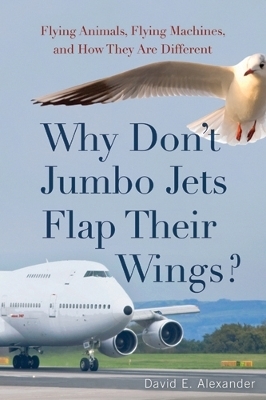
Why Don't Jumbo Jets Flap Their Wings?
Flying Animals, Flying Machines, and How They Are Different
Seiten
2009
Rutgers University Press (Verlag)
978-0-8135-4479-3 (ISBN)
Rutgers University Press (Verlag)
978-0-8135-4479-3 (ISBN)
- Titel ist leider vergriffen;
keine Neuauflage - Artikel merken
Explains how nature and human engineers each arrived at powered flight. This book traces the slow and deliberate evolutionary process of animal flight - in birds, bats, and insects - over millions of years and compares it to the directed efforts of human beings to create the aircraft over the course of a single century.
What do a bumble bee and a 747 jet have in common? It’s not a trick question. The fact is they have quite a lot in common. They both have wings. They both fly. And they’re both ideally suited to it. They just do it differently.
Why Don’t Jumbo Jets Flap Their Wings? offers a fascinating explanation of how nature and human engineers each arrived at powered flight. What emerges is a highly readable account of two very different approaches to solving the same fundamental problems of moving through the air, including lift, thrust, turning, and landing. The book traces the slow and deliberate evolutionary process of animal flight-in birds, bats, and insects-over millions of years and compares it to the directed efforts of human beings to create the aircraft over the course of a single century.
Among the many questions the book answers:
Why are wings necessary for flight?
How do different wings fly differently?
When did flight evolve in animals?
What vision, knowledge, and technology was needed before humans could learn to fly?
Why are animals and aircrafts perfectly suited to the kind of flying they do?
David E. Alexander first describes the basic properties of wings before launching into the diverse challenges of flight and the concepts of flight aerodynamics and control to present an integrated view that shows both why birds have historically had little influence on aeronautical engineering and exciting new areas of technology where engineers are successfully borrowing ideas from animals.
What do a bumble bee and a 747 jet have in common? It’s not a trick question. The fact is they have quite a lot in common. They both have wings. They both fly. And they’re both ideally suited to it. They just do it differently.
Why Don’t Jumbo Jets Flap Their Wings? offers a fascinating explanation of how nature and human engineers each arrived at powered flight. What emerges is a highly readable account of two very different approaches to solving the same fundamental problems of moving through the air, including lift, thrust, turning, and landing. The book traces the slow and deliberate evolutionary process of animal flight-in birds, bats, and insects-over millions of years and compares it to the directed efforts of human beings to create the aircraft over the course of a single century.
Among the many questions the book answers:
Why are wings necessary for flight?
How do different wings fly differently?
When did flight evolve in animals?
What vision, knowledge, and technology was needed before humans could learn to fly?
Why are animals and aircrafts perfectly suited to the kind of flying they do?
David E. Alexander first describes the basic properties of wings before launching into the diverse challenges of flight and the concepts of flight aerodynamics and control to present an integrated view that shows both why birds have historically had little influence on aeronautical engineering and exciting new areas of technology where engineers are successfully borrowing ideas from animals.
DAVID E. ALEXANDER is an assistant professor of entomology in the ecology and evolutionary biology department at the University of Kansas. He is the author of Nature's Flyers: Birds, Insects, and the Biomechanics of Flight.
List of Illustrations
Preface
Acknowledgments
Flying Animals and Flying Machines:Birds of a Feather?
Hey Buddy, Need a Lift?
Power: The Primary Push
To Turn or Not To Turn
A Tail of Two Tails
Flight Instruments
Dispensing with Power: Soaring
Straight Up: Vertical Take-Offs and Hovering
Stoop of the Falcon: Predation and Aerial Combat
Biology Meets Technology Head-On: Ornithopters and Human-Powered Flight
Epilogue: So Why Don't Jumbo Jets Flap Their Wings?
Notes
Glossary
Bibliography
Index
| Erscheint lt. Verlag | 30.6.2009 |
|---|---|
| Zusatzinfo | 32 illustrations |
| Verlagsort | New Brunswick NJ |
| Sprache | englisch |
| Maße | 152 x 229 mm |
| Gewicht | 626 g |
| Themenwelt | Naturwissenschaften ► Biologie ► Evolution |
| Technik ► Fahrzeugbau / Schiffbau | |
| Technik ► Luft- / Raumfahrttechnik | |
| ISBN-10 | 0-8135-4479-3 / 0813544793 |
| ISBN-13 | 978-0-8135-4479-3 / 9780813544793 |
| Zustand | Neuware |
| Informationen gemäß Produktsicherheitsverordnung (GPSR) | |
| Haben Sie eine Frage zum Produkt? |
Mehr entdecken
aus dem Bereich



aus dem Bereich


