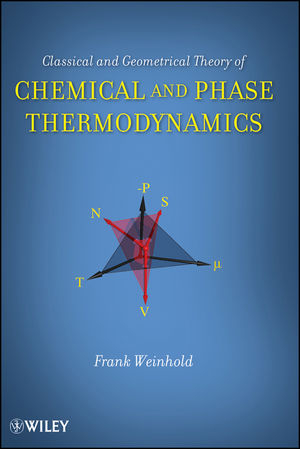
Classical and Geometrical Theory of Chemical and Phase Thermodynamics
Wiley-Interscience (Verlag)
978-0-470-40236-8 (ISBN)
Simplified, innovative alternative to standard calculus-based thermodynamics
This textbook proves how equilibrium thermodynamics, a traditionally difficult subject, can be accurately expressed using basic high school geometry concepts. Specifically, the text deals with classical equilibrium thermodynamics and its modern reformulation in metric geometric terms. The author emphasizes applications to chemical and phase equilibria in complex chemical systems, statistical mechanical origins, and extensions to near-equilibrium transport properties.
The text is divided into three parts:
Part One: Inductive Foundations of Classical Thermodynamics
Part Two: Gibbsian Thermodynamics of Chemical and Phase Equilibria
Part Three: Metric Geometry of Equilibrium Thermodynamics
In addition to a rigorous introduction to the principles of chemical and phase thermodynamics, this text takes a novel, innovative approach, reformulating and extending these principles in the framework of Euclidean and Riemannian geometry. The resulting "thermodynamic geometry" provides a powerful alternative to the traditional calculus-based formulation of equilibrium thermodynamics. Students will find that this approach simplifies many mathematical derivations and clarifies thermodynamic logic. Moreover, this approach suggests novel extensions to equilibrium and nonequilibrium systems of arbitrary chemical and phase complexity.
This text also provides a general introduction to vector- and matrix-algebraic methods that are highly effective for thermodynamics as well as applications in quantum mechanics and other advanced topics in physical chemistry.
With its unique simplified approach to thermodynamics coupled with its discussions of the historical and conceptual development of the field, this text is ideal for both undergraduate and graduate students in physical chemistry, chemical engineering, thermal physics, and materials sciences.
Frank Weinhold received his PhD from Harvard and held postdoctoral and teaching appointments at Oxford, Berkeley, and Stanford before moving to the University of Wisconsin-Madison in 1976, where he served as Professor of Chemistry and a member of the Theoretical Chemistry Institute until achieving emeritus status in 2007. He is the author of more than 170 technical publications and software packages, including the Natural Bond Orbital (NBO) analysis program, widely incorp-orated in modern ab initio quantum chemistry packages. In addition to the metric geo-metric theory of equilibrium thermodynamics, Dr. Weinhold's research examines upper and lower bounds for quantum-mechanical properties, complex-coordinate rotation methods for autoionizing resonances, and quantum cluster equilibrium descriptions of water and other H-bonded fluids.
PREFACE. PART I INDUCTIVE FOUNDATIONS OF CLASSICAL THERMODYNAMICS.
1. Mathematical Preliminaries: Functions and Differentials.
1.1 Physical Conception of Mathematical Functions and Differentials.
1.2 Four Useful Identities.
1.3 Exact and Inexact Differentials.
1.4 Taylor Series.
2. Thermodynamic Description of Simple Fluids.
2.1 The Logic of Thermodynamics.
2.2 Mechanical and Thermal Properties of Gases: Equations of State.
2.3 Thermometry and the Temperature Concept.
2.4 Real and Ideal Gases.
2.5 Condensation and the Gas–Liquid Critical Point.
2.6 Van der Waals Model of Condensation and Critical Behavior.
2.7 The Principle of Corresponding States.
2.8 Newtonian Dynamics in the Absence of Frictional Forces.
2.9 Mechanical Energy and the Conservation Principle.
2.10 Fundamental Definitions: System, Property, Macroscopic, State.
2.11 The Nature of the Equilibrium Limit.
3. General Energy Concept and the First Law.
3.1 Historical Background of the First Law.
3.2 Reversible and Irreversible Work.
3.3 General Forms of Work.
3.4 Characterization and Measurement of Heat.
3.5 General Statements of the First Law.
3.6 Thermochemical Consequences of the First Law.
4. Engine Efficiency, Entropy, and the Second Law.
4.1 Introduction: Heat Flow, Spontaneity, and Irreversibility.
4.2 Heat Engines: Conversion of Heat to Work.
4.3 Carnot’s Analysis of Optimal Heat-Engine Efficiency.
4.4 Theoretical Limits on Perpetual Motion: Kelvin’s and Clausius’ Principles.
4.5 Kelvin’s Temperature Scale.
4.6 Carnot’s Theorem and the Entropy of Clausius.
4.7 Clausius’ Formulation of the Second Law.
4.8 Summary of the Inductive Basis of Thermodynamics.
PART II GIBBSIAN THERMODYNAMICS OF CHEMICAL AND PHASE EQUILIBRIA.
5. Analytical Criteria for Thermodynamic Equilibrium.
5.1 The Gibbs Perspective.
5.2 Analytical Formulation of the Gibbs Criterion for a System in Equilibrium.
5.3 Alternative Expressions of the Gibbs Criterion.
5.4 Duality of Fundamental Equations: Entropy Maximization versus Energy Minimization.
5.5 Other Thermodynamic Potentials: Gibbs and Helmholtz Free Energy.
5.6 Maxwell Relations.
5.7 Gibbs Free Energy Changes in Laboratory Conditions.
5.8 Post-Gibbsian Developments.
6. Thermodynamics of Homogeneous Chemical Mixtures.
6.1 Chemical Potential in Multicomponent Systems.
6.2 Partial Molar Quantities.
6.3 The Gibbs–Duhem Equation.
6.4 Physical Nature of Chemical Potential in Ideal and Real Gas Mixtures.
7. Thermodynamics of Phase Equilibria.
7.1 The Gibbs Phase Rule.
7.2 Single-Component Systems.
7.3 Binary Fluid Systems.
7.4 Binary Solid–Liquid Equilibria.
7.5 Ternary and Higher Systems.
8. Thermodynamics of Chemical Reaction Equilibria.
8.1 Analytical Formulation of Chemical Reactions in Terms of the Advancement Coordinate.
8.2 Criterion of Chemical Equilibrium: The Equilibrium Constant.
8.3 General Free Energy Changes: de Donder’s Affinity.
8.4 Standard Free Energy of Formation.
8.5 Temperature and Pressure Dependence of the Equilibrium Constant.
8.6 Le Chatelier’s Principle.
8.7 Thermodynamics of Electrochemical Cells.
8.8 Ion Activities in Electrolyte Solutions.
8.9 Concluding Synopsis of Gibbs’ Theory.
PART III METRIC GEOMETRY OF EQUILIBRIUM THERMODYNAMICS.
9. Introduction to Vector Geometry and Metric Spaces.
9.1 Vector and Matrix Algebra.
9.2 Dirac Notation.
9.3 Metric Spaces.
10. Metric Geometry of Thermodynamic Responses.
10.1 The Space of Thermodynamic Response Vectors.
10.2 The Metric of Thermodynamic Response Space.
10.3 Linear Dependence, Dimensionality, and Gibbs–Duhem Equations.
11. Geometrical Representation of Equilibrium Thermodynamics.
11.1 Thermodynamic Vectors and Geometry.
11.2 Conjugate Variables and Conjugate Vectors.
11.3 Metric of a Homogeneous Fluid.
11.4 General Transformation Theory in Thermodynamic Metric Space.
11.5 Saturation Properties Along the Vapor-Pressure Curve.
11.6 Self-Conjugate and Normal Response Modes.
11.7 Geometrical Characterization of Common Fluids.
11.8 Stability Conditions and the “Third Law” for Homogeneous Phases.
11.9 The Critical Instability Limit.
11.10 Critical Divergence and Exponents.
11.11 Phase Heterogeneity and Criticality.
12. Geometrical Evaluation of Thermodynamic Derivatives.
12.1 Thermodynamic Vectors and Derivatives.
12.2 General Solution for Two Degrees of Freedom and Relationship to Jacobian Methods.
12.3 General Partial Derivatives in Higher-Dimensional Systems.
12.4 Phase-Boundary Derivatives in Multicomponent Systems.
12.5 Stationary Points of Phase Diagrams: Gibbs–Konowalow Laws.
12.6 Higher-Order Derivatives and State Changes.
13. Further Aspects of Thermodynamic Geometry.
13.1 Reversible Changes of State: Riemannian Geometry.
13.2 Near-Equilibrium Irreversible Thermodynamics: Diffusional Geometry.
13.3 Quantum Statistical Thermodynamic Origins of Chemical and Phase Thermodynamics.
Appendix: Units and Conversion Factors.
AUTHOR INDEX.
SUBJECT INDEX.
| Sprache | englisch |
|---|---|
| Maße | 184 x 260 mm |
| Gewicht | 1007 g |
| Themenwelt | Naturwissenschaften ► Chemie ► Physikalische Chemie |
| Technik ► Maschinenbau | |
| ISBN-10 | 0-470-40236-9 / 0470402369 |
| ISBN-13 | 978-0-470-40236-8 / 9780470402368 |
| Zustand | Neuware |
| Informationen gemäß Produktsicherheitsverordnung (GPSR) | |
| Haben Sie eine Frage zum Produkt? |
aus dem Bereich