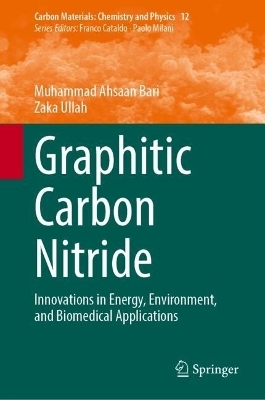
Graphitic Carbon Nitride
Springer International Publishing (Verlag)
978-3-032-18430-6 (ISBN)
- Noch nicht erschienen (ca. April 2026)
- Versandkostenfrei
- Auch auf Rechnung
- Artikel merken
This book provides a comprehensive overview of the synthesis, properties, and multifunctional applications of g-C N , with a strong emphasis on its role in solving critical global challenges. As the world faces escalating challenges related to energy scarcity and environmental pollution, the demand for sustainable solutions has never been greater. Over the past four decades, global energy consumption has risen by an average of 2.2% per year, and by 2050, it is projected to increase by an additional 30%. Currently, fossil fuels such as coal, crude oil, and natural gas account for nearly 90% of the world s energy supply, underscoring the urgent need for renewable and eco-friendly alternatives.
Among the most promising solutions is solar energy, an abundant, renewable, and sustainable resource. Photocatalysis, which harnesses solar energy for chemical transformations, has emerged as a key technology for addressing environmental and energy-related challenges. Central to this process are photocatalysts, materials that drive essential reactions such as water splitting, pollutant degradation, and CO2 reduction.
In recent years, graphitic carbon nitride (g-C N ) has garnered significant attention as a metal-free semiconductor with remarkable photocatalytic properties. Its ease of synthesis, chemical stability, and tunable electronic structure make it highly effective in a wide range of applications, including energy conversion, environmental remediation, and biomedical technologies. Beyond photocatalysis, g-C N has shown promise in supercapacitors, batteries, electrocatalysis, and emerging biomedical applications such as biosensors, bioimaging, drug delivery, and antimicrobial treatments.
Covering photocatalysis, electrochemical energy storage, solar cells, and biomedical advancements, this book offers researchers, engineers, and industry professionals an in-depth understanding of the latest developments and future directions in this rapidly evolving field.
With its interdisciplinary approach and practical focus, this book serves as a valuable resource for scientists working on materials science, nanotechnology, renewable energy, and environmental sustainability. By exploring both fundamental principles and cutting-edge applications, it aims to inspire new research pathways and innovative solutions for a cleaner and more sustainable future.
Muhammad Ahsaan Bari obtained a bachelor's degree in physics from Bahauddin Zakariya University, Multan, and a master's degree in material physics from Government College University (GCU), Lahore, Pakistan. He commenced his research activities at the Solar Cell Applications Research Laboratory, Department of Physics, GCU Lahore. He later served as a Visiting Lecturer at the Department of Physics, University of Education, Multan Campus, Pakistan.
He is currently pursuing a Ph.D. in materials engineering at the NanoBioMedical Center, Adam Mickiewicz University in Poznan, Poland. His current research focuses on the synthesis, characterization, and structure study of two-dimensional materials for multipurpose usage.
In addition to publishing several research articles in international journals, Ahsaan has co-authored two international books published by IOP Publishing. His interdisciplinary background and active contributions to the field position him well to contribute to the advancement of materials research for energy and environmental applications
Dr. Zaka Ullah earned his Ph.D. from the University of Chinese Academy of Sciences, China, and is currently working as an Assistant Professor of Physics at the University of Education, Pakistan. He has authored around 90 research articles in high-impact international journals, including Advanced Energy Materials, Energy Storage Materials, Advanced Functional Materials, Nano Energy, Chemical Engineering Journal, Small, and Journal of Materials Chemistry A.
Dr. Ullah holds one Chinese patent and has received a research grant from the Higher Education Commission (HEC) of Pakistan. He is an editorial board member of several journals, including Frontiers in Materials, and has reviewed over 1,000 manuscripts for more than 100 SCI-indexed journals. In recognition of his peer-review contributions, he received the Publons/Web of Science Top Peer Reviewer Award in 2019.
He has been a complimentary member of the American Chemical Society (ACS) during 2019 2020 and 2022 2023. He is also a life member of the Pakistan Institute of Physics.
Introduction.- Photocatalytic Applications.- Electrochemical and Photoelectrochemical Application.- Biomedical Applications.- Solar Cell Applications.- Future Prospective.
| Erscheint lt. Verlag | 3.4.2026 |
|---|---|
| Reihe/Serie | Carbon Materials: Chemistry and Physics |
| Zusatzinfo | Approx. 220 p. |
| Verlagsort | Cham |
| Sprache | englisch |
| Maße | 155 x 235 mm |
| Themenwelt | Naturwissenschaften ► Physik / Astronomie ► Atom- / Kern- / Molekularphysik |
| Technik ► Elektrotechnik / Energietechnik | |
| Schlagworte | Advanced Semiconductor Photocatalysts • Biomedical Applications of Nanomaterials • Carbon-Based Photocatalytic Materials • Electrochemical Energy Storage Materials • Graphitic Carbon Nitride Applications • Next-Generation Solar Cell Materials • Photocatalysis for Energy Conversion • Photodynamic Therapy with Nanomaterials • Sustainable Environmental Remediation Technologies |
| ISBN-10 | 3-032-18430-4 / 3032184304 |
| ISBN-13 | 978-3-032-18430-6 / 9783032184306 |
| Zustand | Neuware |
| Informationen gemäß Produktsicherheitsverordnung (GPSR) | |
| Haben Sie eine Frage zum Produkt? |
aus dem Bereich