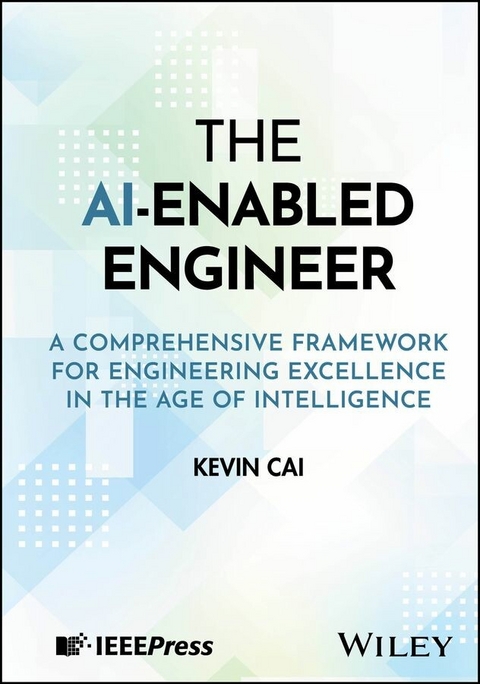
The AI-Enabled Engineer (eBook)
336 Seiten
Wiley-IEEE Press (Verlag)
978-1-394-37578-3 (ISBN)
A detailed guide to the evolution of engineering in the face of intelligent systems, including artificial intelligence
In The AI-Enabled Engineer: A Comprehensive Framework for Engineering Excellence in the Age of Intelligence, senior systems engineer Kevin Cai delivers an expert discussion of the evolution of modern engineering. From computer applications and the expansion of the internet to data digitalization and the emergence of contemporary artificial intelligence, the author offers practical insights into foundational concepts and promising technological trends that could define the discipline in the coming years.
The author balances coverage of hardware, software, and AI technologies, providing an up-to-date guide to assist young engineers as they navigate complex engineering challenges. He emphasizes the broader societal and technological implications of new developments in intelligent systems, exploring the social responsibilities of practicing engineers.
The book also provides:
- Expert guidance for developing and implementing complex methodological frameworks
- An insightful linking of foundational theoretical engineering principles with real-world applications
- Practical discussions of likely future developments in technology and engineering practice
- Original treatments of engineering's evolving role in societal innovation
Perfect for engineering students in graduate and doctoral programs, The AI-Enabled Engineer will also benefit systems engineers working in the technology and communications industries, hardware and software integration specialists, and professionals involved with AI and emerging technologies.
Kevin Cai, PhD, serves as Technical Leader in the Unified Computing Systems Division at Cisco Systems. Throughout his three-decade career, he has held senior engineering positions at leading technology companies, including Nortel Networks, Sun Microsystems, Juniper Networks, Rambus, and Cisco, with roles ranging from High-Speed Signal Advisor to Senior Principal Engineer. He has pioneered breakthrough methodologies for high-speed signal transmission across diverse platforms-from indoor environments and wireless networks to IC packages, optical fiber, PCBs, and integrated systems. Dr. Cai has authored numerous technical publications and secured multiple patents, specializing in numerical and analytical solutions, as well as comprehensive validation processes for complex engineering challenges.
1
Introduction
Engineering as a profession was formalized during the Industrial Revolution; however, people have engineered technological solutions long before then. Ancient achievements in engineering, like the Great Pyramids and Roman aqueducts, emerged from practical experience, with builders developing techniques scientists later codified into principles like energy conservation. The relationship between engineering and science evolved as each pushed the other forward—the light bulb opened new avenues for optics research, while scientific discoveries enabled new engineering applications. Now, as artificial intelligence (AI) reshapes computer science, we face the challenge of defining new engineering principles for systems that increasingly shape society.
Engineering has progressed through distinct technological epochs, each developing its own principles and methodologies: pre-Industrial Revolution engineering (ancient times–1760) employed empirical methods and iterative refinement across diverse civilizations, the First Industrial Revolution (1760–1840) introduced mechanical principles and systematic design approaches with steam power, and the Second Industrial Revolution (1870–1914) developed electrical theory and mass production techniques. The Digital Revolution (1950s–1990s) created circuit design principles and binary logic systems, transforming analog systems to digital.
The Information Era (1980s–2020s) followed, where data became a fundamental economic resource. As Brynjolfsson's research demonstrates (Brynjolfsson and McAfee, 2016), this era witnessed rapid developments in internet connectivity and digital systems that transformed how society processes information. It introduced new methodologies, including network architecture approaches, client-server design patterns, and distributed system techniques. Today, emerging developments in AI suggest we're entering what might be called an “Age of Intelligence”—a term still being defined—characterized by autonomous decision-making, neural network implementation, and human–AI interaction, while fundamental engineering principles remain constant (Figure 1.1).
Each era developed specialized approaches. Industrial Age disciplines established foundational engineering methodologies: civil engineering used structural analysis principles to develop infrastructure, mechanical engineering applied thermodynamic laws to control motion, chemical engineering developed process models to scale up chemical reactions, and electrical engineering created circuit theory to transmit information and power. The Digital Revolution spawned hardware engineering, with digital logic design and electronic system principles, and software engineering, a dramatic departure from traditional practice.
Software engineering represents the most dramatic departure from traditional practice. Unlike physical systems governed by natural laws, software deals with logical constructs and abstract systems. This shift introduced principles like abstraction layers and modularity, alongside development methodologies that could adapt quickly to changing requirements.
Figure 1.1 Evolution of engineering through major technological epochs, showing key innovations from ancient engineering through the Industrial Revolutions and Digital Revolution to the Information Era (1980s–2020s) and the emerging Age of Intelligence (2020s–future).
The integration of hardware and software created embedded systems—dedicated computers within larger mechanical systems—and complex integrated devices like smartphones and electric vehicles with numerous embedded components working as unified products. This integration demanded new approaches like hardware–software co-design to ensure optimal performance across traditionally separate domains.
As Kurzweil's analysis of accelerating technological development demonstrates (Kurzweil, 2024), rapid advances in AI and related technologies have challenged traditional engineering education with its historically distinct disciplinary boundaries. This has necessitated new methodologies for hybrid systems that span multiple domains, while academic institutions adapt their curricula to prepare engineers for these interdisciplinary realities.
In the Age of Intelligence, AI transforms both engineering practice and society. Engineers now create systems that learn, adapt, and make autonomous decisions—from machine learning components to robotics that sense and respond to environments. These systems with varying levels of autonomy profoundly impact how we live, work, and interact.
In the context of emerging technologies available in the Information Era and Age of Intelligence, how to condense engineering principles, methods, and approaches and innovate them to cope with ever-evolving technical paradigms represents an immediate demand from both experienced engineers and recent graduates.
This adaptation requires a fundamental shift in engineering education—from narrow expertise to broader systems thinking. Today's engineers must:
- Bridge disciplines by understanding the interplay between hardware, software, and data.
- Embrace agile methodologies for continuously evolving technologies.
- Develop system-level problem-solving across technical domains.
The future belongs to engineers who adapt to new paradigms rather than merely mastering specific technologies. As technologies become obsolete together, engineering education must cultivate the mindset to learn, adapt, and apply core principles to whatever comes next—transforming engineers from specialists into perpetual students who constantly redefine solutions for tomorrow's challenges.
1.1 Intent of This Book
While previous works like Kossiakoff's Systems Engineering Principles and Practice (Kossiakoff et al., 2020) focus on large military and space systems, this book addresses engineering principles for consumer products in what we term the “Age of Intelligence.” We present a unified framework for hardware–software convergence in AI-enabled consumer systems such as smartphones, electric vehicles, and probably humanoid robots. The concept of the Age of Intelligence and its relationship with other technological eras will be defined and explored in detail later in this chapter.
The aim of our work is twofold:
- To present a unified picture of the convergence between hardware and software engineering practices for consumer-level products enhanced by artificially intelligent tools
- To provide young engineering professionals entering the workforce with conceptual frameworks and practical guidance for navigating the rapidly evolving technological landscape of the Age of Intelligence
Modern engineering education must evolve to integrate core principles with AI capabilities. This framework serves both students and practicing engineers working in increasingly interdisciplinary fields. Our title—The AI-Enabled Engineer: A Comprehensive Framework for Engineering Excellence in the Age of Intelligence—reflects our focus on AI as a tool, conceptual guidance beyond procedural tasks, performance optimization, and adaptation to an era where AI transforms information processing.
Our title represents our vision:
- “AI-Enabled” brings focus to artificial intelligence as an important tool.
- “Comprehensive Framework” emphasizes principles, methods, approaches, and applications to serve as conceptual guidance, not just procedural tasks.
- “Engineering Excellence” signifies our drive to raise the performance of engineers to their highest levels.
- “Age of Intelligence” situates the work within an era where AI permeates how information is agglomerated, processed, and utilized.
Unlike traditional technical manuals, we provide flexible structural frameworks rather than prescribed solutions. To establish this approach, we must clarify the fundamental building blocks of engineering practice: principles, methods, and approaches. These three interconnected elements form the foundation of engineering excellence in the Age of Intelligence and serve as the structural pillars for our framework. This prepares engineers for continuous technological disruption, particularly in AI-enabled systems where development outpaces publication cycles.
1.1.1 Engineering Principles, Methods, and Approaches
Contemporary engineering applies fundamental principles to develop methods that define approaches. While methods and approaches have rapidly evolved from traditional disciplines through the Information Era (Brynjolfsson and McAfee, 2016) into the Age of Intelligence, fundamental principles remain constant. Engineering excellence requires understanding how these elements interact in complex, intelligent systems.
- Principles form the “why” of engineering—fundamental truths that remain consistent across time and applications. As shown in Figure 1.2, these include first principles, which cannot be broken down further, and derived principles like conservative thinking and optimization that emerge from these foundations. These principles guide engineering decisions at every level.
Figure 1.2 Relationships between engineering principles, methods, and approaches, showing their hierarchical structure and...
| Erscheint lt. Verlag | 30.12.2025 |
|---|---|
| Sprache | englisch |
| Themenwelt | Technik |
| ISBN-10 | 1-394-37578-6 / 1394375786 |
| ISBN-13 | 978-1-394-37578-3 / 9781394375783 |
| Informationen gemäß Produktsicherheitsverordnung (GPSR) | |
| Haben Sie eine Frage zum Produkt? |
 EPUB (Adobe DRM)
Größe: 28,9 MB
Kopierschutz: Adobe-DRM
Adobe-DRM ist ein Kopierschutz, der das eBook vor Mißbrauch schützen soll. Dabei wird das eBook bereits beim Download auf Ihre persönliche Adobe-ID autorisiert. Lesen können Sie das eBook dann nur auf den Geräten, welche ebenfalls auf Ihre Adobe-ID registriert sind.
Details zum Adobe-DRM
Dateiformat: EPUB (Electronic Publication)
EPUB ist ein offener Standard für eBooks und eignet sich besonders zur Darstellung von Belletristik und Sachbüchern. Der Fließtext wird dynamisch an die Display- und Schriftgröße angepasst. Auch für mobile Lesegeräte ist EPUB daher gut geeignet.
Systemvoraussetzungen:
PC/Mac: Mit einem PC oder Mac können Sie dieses eBook lesen. Sie benötigen eine
eReader: Dieses eBook kann mit (fast) allen eBook-Readern gelesen werden. Mit dem amazon-Kindle ist es aber nicht kompatibel.
Smartphone/Tablet: Egal ob Apple oder Android, dieses eBook können Sie lesen. Sie benötigen eine
Geräteliste und zusätzliche Hinweise
Buying eBooks from abroad
For tax law reasons we can sell eBooks just within Germany and Switzerland. Regrettably we cannot fulfill eBook-orders from other countries.
aus dem Bereich