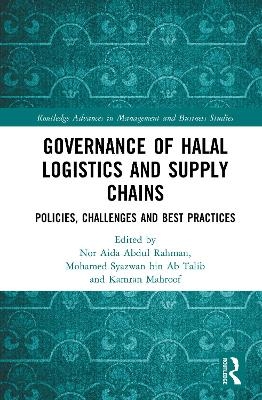
Governance of Halal Logistics and Supply Chains
Routledge (Verlag)
978-1-041-12039-1 (ISBN)
- Noch nicht erschienen (ca. April 2026)
- Versandkostenfrei
- Auch auf Rechnung
- Artikel merken
The book begins with an analysis of halal policy frameworks, governance structures, and the role of public-private partnerships shape effective policies. Offering insights into the harmonization of global standards and certifications for halal compliance, it then addresses the key challenges faced in the implementation of halal logistics and supply chains, including fraud, traceability issues, consumer trust, and policy fragmentation. The book then delves into the implications of digital transformation, sustainability, and ethical practices, providing perspectives from diverse markets such as Asia, Brazil, Korea and Spain. The book also discusses strategies for advancing halal logistics, including branding through transparency and traceability and leveraging technology for the future of halal supply chains. Concluding with actionable recommendations, the book provides a roadmap for stakeholders to overcome challenges and capitalize on opportunities in the global halal market.
An essential resource for higher education institutions in Muslim countries, as well as researchers of halal logistics and supply chain management.
Nor Aida Abdul Rahman, PhD, is Professor at Universiti Kuala Lumpur, Malaysian Institute of Aviation Technology in Subang, Selangor, Malaysia. She is also a coordinator at Technology Transfer Office, Center for Research and Innovation, Universiti Kuala Lumpur. Her work has been featured in prestigious journals such as Industrial Marketing Management, Journal of Islamic Marketing, Journal of Humanitarian Logistics and Supply Chain Management, and Journal of Quality and Reliability Management, among others. Kamran Mahroof, PhD is an Associate Professor of Supply Chain Analytics and Programme Leader for the MSc in the Applied Artificial Intelligence and Data Analytics programme, at the University of Bradford, UK, School of Management. His extensive industry experience has shaped his research interests in the areas of Supply Chain Management, Circular Economy, Artificial Intelligence (AI) and the Societal Impact of Emerging Technologies. Mohamed Syazwan Ab Talib is an Assistant Professor of Logistics Management at the UBD School of Business and Economics, Universiti Brunei Darussalam. His research and teaching focus primarily on logistics and supply chain management, emphasising halal principles, sustainable distribution, and halal certification.
List of Contributors
PART I: Halal Policy Development and Contemporary Issue
Preface
1. Halal Supply Chain Governance Pyramid for ESG Integration
2. Governance and Policy Framework for Indonesia’s Halal Supply Chain Management
3. Bridging Faith, State, and Market: A Public–Private Partnership Model for Halal Policy-Making
4. Harmonizing Global Standards for Halal Materials, Products, and Laboratory Certification
PART II: Key Challenges in Halal Logistics and Supply Chain Management Implementation
5. Fraud, Traceability, and Consumer Trust: Contemporary Challenges in Halal Logistics
6. Sustainable Halal Logistics: Fraud, Traceability, and Consumer Trust in the ESG
7. Sustainability and Ethical Practices in Halal Supply Chain Management: A System Dynamics Approach
8. Digital Transformation in Halal Supply Chains: Opportunities and Risks
9. An In-depth Analysis of the Korean Halal Logistics Paradox: A Strategic Examination from Regulatory, Market, and Ecosystem Perspectives
10. Critical Factors for Effective Halal Supply Chain Management and Their Impact on Sustainability: Future Research Directions on Governance
11. Sustainability vs. Compliance: Overcoming the Dual Challenges in Halal Retailing
PART III: BEST PRACTICES
12. Embedding ESG Principles in Halal Logistics: A Sustainable Path Forward
13. Branding Halal Logistics: Creating Value Through Transparency and Traceability
14. Unlocking the Potential of Halal Markets: A Brazilian Perspective on Halal Supply Chains
15. The Next Frontier: Key Technology Pillars for the Future of Halal Supply Chains in Europe
Conclusions and Ways Forward
| Erscheint lt. Verlag | 30.4.2026 |
|---|---|
| Reihe/Serie | Routledge Advances in Management and Business Studies |
| Zusatzinfo | 20 Tables, black and white; 7 Line drawings, black and white; 12 Halftones, black and white; 19 Illustrations, black and white |
| Verlagsort | London |
| Sprache | englisch |
| Maße | 156 x 234 mm |
| Themenwelt | Technik |
| Wirtschaft ► Betriebswirtschaft / Management ► Logistik / Produktion | |
| Wirtschaft ► Betriebswirtschaft / Management ► Unternehmensführung / Management | |
| ISBN-10 | 1-041-12039-7 / 1041120397 |
| ISBN-13 | 978-1-041-12039-1 / 9781041120391 |
| Zustand | Neuware |
| Informationen gemäß Produktsicherheitsverordnung (GPSR) | |
| Haben Sie eine Frage zum Produkt? |
aus dem Bereich