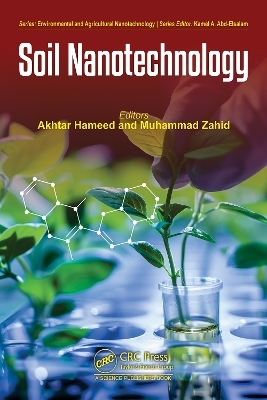
Soil Nanotechnology
CRC Press (Verlag)
978-1-032-87829-4 (ISBN)
- Noch nicht erschienen (ca. Mai 2026)
- Versandkostenfrei
- Auch auf Rechnung
- Artikel merken
Dr. Akhtar Hameed is currently serving as an Assistant Professor at the Institute of Plant Protection, MNS University of Agriculture Multan (MNSUAM), Pakistan. He is an accomplished plant pathologist with a strong academic background and extensive research contributions in the field of plant disease management. Dr. Hameed earned his Ph.D. in Plant Pathology from the Department of Plant Pathology, University of Agriculture Faisalabad (UAF), Pakistan, during the period of 2016 to 2020. After successfully completing his doctoral studies, he joined MNSUAM as an Assistant Professor in 2021, where he has been actively engaged in research, teaching, and mentorship. His primary research interests lie in the molecular characterization of plant pathogens, plant-microbe interaction, quorum sensing and quorum quenching, as well as the management of plant diseases through innovative approaches such as biopesticides, nanoparticles, and quantum dots. Over the years, Dr. Hameed has made significant contributions to the field, authoring 12 internationally recognized book chapters and publishing more than 72 peer-reviewed journal articles, which collectively hold an impressive cumulative impact factor of over 150. His research has not only been recognized nationally but has also gained international acknowledgment, solidifying his reputation as a leading expert in plant pathology. He has successfully supervised six MPhil research students, providing them with the necessary guidance to contribute meaningfully to the field. He has also served as a visiting researcher at the DNA Zoo Lab, University of Western Australia. Dr. Hameed has been a key participant in various research projects funded by both national and international agencies. These include prestigious organizations such as Grand Challenges Canada, the United States-Pakistan Center for Advanced Studies in collaboration with Dr. Douglas Cook, the Feed the Future Innovation Lab at the University of California, Davis (UC Davis), and the Higher Education Commission (HEC) of Pakistan. His work in these projects has primarily focused on the development of novel bio-based solutions for the sustainable management of plant diseases. Furthermore, his research also extends to studying the impact of climate change on plant diseases, CRISPR/Cas9-based genome editing for disease resistance, and microbial applications for improving soil health. Recognizing the importance of biosafety and risk management in scientific research, Dr. Hameed has obtained an internationally recognized certification in “Biorisk Management”from the International Federation of Biosafety Associations (IFBA), Canada. His expertise and contributions to the scientific community are further highlighted by his active involvement as a peer reviewer for several high-impact journals published by leading academic publishers. Additionally, he holds the prestigious position of Editor-in-Chief at the Journal of Agriculture and Biology. Dr. Hameed’s scholarly contributions extend beyond research papers and journal editorial roles; he is also an active participant in global scientific discussions. As a multilingual academic, he has presented his research findings at numerous international conferences and has undergone specialized training programs in China, Australia, Turkey and Saudi Arabia. He is an esteemed member of several professional organizations, including the American Phytopathological Society (APS), the American Society for Microbiology (ASM), the Pakistan Phytopathological Society (PPS), and the Pakistan Biological Safety Association (PBSA). Dr. Muhammad Zahid is currently serving as a Professor at the Department of Chemistry, University of Agriculture Faisalabad (UAF) Pakistan. He completed his PhD during 2007–2011 in Chemistry from the Institute of Physical and Theoretical Chemistry, Graz University of Technology, Austria. He joined UAF Pakistan in 2011 as an Assistant Professor after completing his PhD degree. His research interests include the synthesis of advanced nanomaterials such as graphene, graphene oxide, graphitic carbon nitride, carbon quantum dots, semiconductor nanoparticles, nanocomposites, etc., and their applications in environmental remediation, sensors, energy materials, etc. Dr. Zahid has published 04 books, 30 book chapters (05 National and 25 International) and more than 170 peer-reviewed journal articles (with a cumulative impact factor of more than 700), having above 5500 citations and h-index > 43 (SCOPUS). He has supervised 07 PhD, and more than 120 MPhil/MS research students. He has won several research projects, from national and international funding agencies for developing new materials for various applications in environment, energy, sensors, etc. He also secured a position in Stanford - Elsevier’s Top 2% Scientist (published in the years 2022, 2023, 2024 and 2025). He is involved as a reviewer for several peer-reviewed journals of high repute published by leading publishers. He served as a Guest-Editor for “Carbon-based Materials: Powering the Future of Energy and Environmental Progress” Frontiers in Chemistry.
Preface to the Series. Preface. Introduction to Soil Nanotechnology: Principles and Applications. Impacts of Nanomaterials on Soil Health and Productivity. Nanotechnology for Soil Remediation and Pollution Control. Nanomaterials for Soil Fertility Enhancement. Nanosensors for Soil Monitoring and Assessment. Impact of Nanoparticles on the Biogeochemistry of the Soil. Nanoparticles and Plant-Soil Interactions. Nanotechnology for Sustainable Soil Management Practices. Engineered Nanomaterials and their Impact on Soil Health. Nanomaterials for Contaminant Detection and Remediation in Soil. Geographic Information System, Remote Sensing and Nanotechnology for Site-Specific and Efficient Nutrient Management. Nano-Biochar: Applications and Implications for Soil Health. Nanomaterial-Based Soil Amendments for Improved Crop Production. Nanotechnology for Soil Erosion Control and Land Rehabilitation. Effect of Nanoparticles on Soil Microbes. Soil-Nanoparticle Interactions: Fate and Transportation, and Ecological Implications. Nanotechnology for Soil Carbon Sequestration and Climate Change Mitigation. Regulatory and Environmental Considerations of Soil Nanotechnology. Future Perspectives and Challenges in Soil Nanotechnology Research. Index. Editors' Biography.
| Erscheint lt. Verlag | 15.5.2026 |
|---|---|
| Reihe/Serie | Environmental and Agricultural Nanotechnology |
| Zusatzinfo | 32 Tables, black and white; 24 Line drawings, black and white; 8 Halftones, color; 19 Halftones, black and white; 8 Illustrations, color; 43 Illustrations, black and white |
| Verlagsort | London |
| Sprache | englisch |
| Maße | 178 x 254 mm |
| Themenwelt | Naturwissenschaften ► Geowissenschaften ► Geologie |
| Technik | |
| Weitere Fachgebiete ► Land- / Forstwirtschaft / Fischerei | |
| ISBN-10 | 1-032-87829-0 / 1032878290 |
| ISBN-13 | 978-1-032-87829-4 / 9781032878294 |
| Zustand | Neuware |
| Informationen gemäß Produktsicherheitsverordnung (GPSR) | |
| Haben Sie eine Frage zum Produkt? |
aus dem Bereich