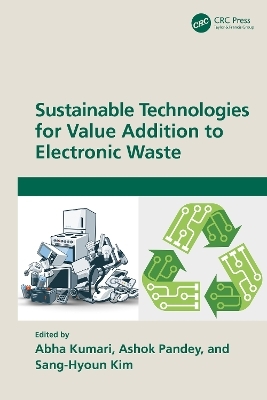
Sustainable Technologies for Value Addition to Electronic Waste
CRC Press (Verlag)
978-1-041-06604-0 (ISBN)
- Noch nicht erschienen (ca. Juli 2026)
- Versandkostenfrei
- Auch auf Rechnung
- Artikel merken
This book presents a sustainable, effective, and cost-effective solution for the valorization of e-waste for the recovery of expensive, valuable, strategic, heavy, and base metals and rare earth elements. The first section covers the sustainable technologies for the valorization of e-waste to metals, materials, and alloys followed by section covering sustainable technologies for the valorization of e-waste to plastic and biofuels.
Explores sustainable techniques for recovery of metals, material, and plastic from e-waste.
Describes sustainable (green) technologies for e-waste management
Covers the recovery and separation of metals, materials and plastic
Discusses life cycle assessment, E-waste management policy and circular economy
Includes e-plastic management and conversion of e-plastic to fuel and material
This book is aimed at graduate students and researchers in environmental engineering and waste management.
Abha Kumari Abha Kumari is currently working as an Associate Professor at the Centre for Biotechnology and Biochemical Engineering, Amity Institute of Biotechnology, Amity University, Noida, India. She has earlier served as an Associate Professor in the Department of Biotechnology at Delhi Technological University, Delhi, India, Visiting Researcher at the Tohoku Institute of Technology, Sendai, Japan, DBT Postdoctoral Fellow at National Chemical Laboratory, Pune, and Postdoctoral Fellow at Lakehead University, Ontario, Canada. She was awarded a Pool Officer fellowship from the Council of Scientific Industrial Research, India. Dr. Abha earned her Ph.D. and M.Sc. (Engg.) from the Indian Institute of Science (IISc), Bangalore, India. Her research interest is in the field of Biochemical engineering and biotechnology with a specialization in waste-to-value, municipal solid waste-to-biogas and carotenoid production, bio-enzyme from waste, waste treatment and management, metals recovery from electronic waste. She has more than 20 years of research and teaching experience in bioprocess technology, biochemical engineering, downstream processing, enzyme technology, and principles of chemical engineering. She is the author and editor of one book. She has published research articles in peer-reviewed international journals and authored numerous book chapters. She has worked as a Principal Investigator on two government-funded projects and as a Co-investigator on one government-funded project. She is a life member of the Indian Institute of Metals (IIM), India and the Indian Science Congress Association Ashok Pandey Professor Ashok Pandey is currently Distinguished Scientist at the Centre for Innovation and Translational Research, CSIR-Indian Institute of Toxicology Research, Lucknow, India. His major research and technological development interests are industrial & environmental biotechnology and energy biosciences, focusing on biomass to biofuels & chemicals, waste to wealth & energy, etc. He has 16 patents, 120 books, >1000 papers and book chapters, etc with h index of 141 and >85,000 citations (Goggle scholar). Professor Pandey is the recipient of many national and international awards and honours, which include Fellow of five international and four national academies such as the World Academy of Sciences; Indian National Science Academy, National Academy of Sciences, etc; Distinguished Fellow, the Biotech Research Society, India; India, Academician of European Academy of Sciences and Arts, etc. He recently won India Research Excellence Citation Award-2023 from Clarivate Analytics, USA and has been named as Rank #1 in India in Biology by Research.Com during 2022 and 2023, and in Biotechnology by Stanford University, USA in its reports from 2020 to 2023. Sang-Hyoun Kim Sang-Hyoun Kim is a full professor at the Department of Civil and Environmental Engineering , Yonsei University and the Yonsei Lee Youn Jae Fellow (Top 10 faculty in Yonsei University). He received his Ph.D. in Civil and Environmental Engineering at Korea Advanced Institute of Science and Technology (KAIST), where he also got his master and bachelor degrees in Civil Engineering and Chemistry, respectively. Before coming to Yonsei University, he served as a faculty at Daegu University (2010 to 2018), and a senior researcher at Korea Institute of Industrial Technology (2009 to 2010). His research interests lie in water-energy-resources nexus. Specifically, his research focuses on anaerobic digestion of wastewater and solid waste, biohydrogen production from renewable resources, energy saving in wastewater treatment, and bioprocess based on real-time monitoring and machine learning. He is the vice president of the Korean Society of Waste Management, and the central council of the International Bioprocessing Association. His Scopus H-index and FWCI are 60 and 2.12, respectively, as of March 16, 2024.
1. Valorization of Electronic Waste 2. Recovery of Platinum Group Metals from E-waste 3. Recovery of precious metals from e-waste 4. Recovery of Strategic Metals from Electronic Waste 5. Recovery of Semiconductor Metals from E-waste 6. Recovery of base metals from e-waste 7. Recovery of Toxic Metals and Heavy Metals from E-Waste 8. Recovery of alkali metals from e-waste 9. Recovery of refractory metals and materials from e-waste 10. Recovery of rare earth elements from e-waste 11. Conversion e-plastic to composite materials 12. Recovery of plastic value from e-waste 13. Conversion of plastic e-waste to biofuels 14. E-Waste Recycling: Impact on Circular Economy 15. Application of artificial intelligence tools in e-waste management 16. E-waste management policy worldwide
| Erscheint lt. Verlag | 17.7.2026 |
|---|---|
| Zusatzinfo | 37 Tables, black and white; 39 Line drawings, black and white; 8 Halftones, black and white; 47 Illustrations, black and white |
| Verlagsort | London |
| Sprache | englisch |
| Maße | 156 x 234 mm |
| Themenwelt | Naturwissenschaften ► Biologie ► Ökologie / Naturschutz |
| Technik ► Elektrotechnik / Energietechnik | |
| ISBN-10 | 1-041-06604-X / 104106604X |
| ISBN-13 | 978-1-041-06604-0 / 9781041066040 |
| Zustand | Neuware |
| Informationen gemäß Produktsicherheitsverordnung (GPSR) | |
| Haben Sie eine Frage zum Produkt? |
aus dem Bereich