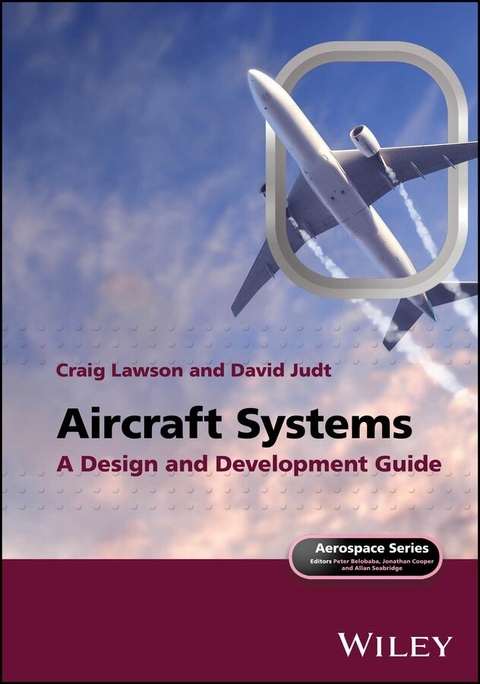
Aircraft Systems (eBook)
240 Seiten
Wiley (Verlag)
978-1-119-11319-5 (ISBN)
In-depth reference on fixed wing aircraft electrical and mechanical systems, covering electronics, hydraulics, and other essential components
Aircraft Systems delivers comprehensive material on the design and development of fixed wing aircraft electrical and mechanical systems, providing broad coverage of aircraft systems including electronics, hydraulics, pneumatics, flight control actuation, and landing gear. The book features many practical examples of existing commercial and military aircraft. Academic design studies and methods are presented, along with information on technical and mathematical methods of design. The book also features design guides for each system, including equations where appropriate to size sub-systems and major components, and discusses environmental concerns.
Topics discussed in Aircraft Systems include:
- Aircraft systems design philosophy and safety, covering systems design approaches, safety assessments, requirement captures, and component reliability
- Secondary power sources including main engines, auxiliary and ground power units, batteries, ram air turbines, and fuel cells
- Hydraulic system components, covering hydraulic fluids, pumps, and piping, reservoirs, filters, accumulators, and relief valves
- Aircraft icing and rain protection, covering ice protection systems such as electro-impulse de-icing and chemical ice protection systems
Aircraft Systems is an essential resource for undergraduate and postgraduate students studying the design of fixed wing aircraft systems. The book is also valuable to professionals in aerospace engineering due to its broad view of aircraft systems development and integration.
Craig Lawson, PhD, is Professor of Aircraft Design at Cranfield University, UK. He is a Chartered Engineer, Fellow of the Royal Aeronautical Society, and Fellow of the UK Higher Education Academy. He is an expert in aircraft design focusing on assessment of the impact of novel systems on aircraft design, performance, and assembly. He manages industry and government funded research projects, supervises doctoral candidates, and teaches aircraft conceptual, preliminary, and detailed design to postgraduate students.
David Judt is the Head of Airworthiness at Aircraft Completion Engineering, France. He is a Member of the Royal Aeronautical Society and Fellow of the UK Higher Education Academy. Educated at Glasgow University and Cranfield University, he was Senior Lecturer and Course Director for the Aerospace Vehicle Design MSc. program, teaching and researching in the airframe systems field. He now leads the certification and continued airworthiness activities for cabin modifications and oxygen system products.
2
Airframe Systems Design Process
2.1 Introduction
2.1.1 Systems Design Approach
There are many approaches to systems design, and an experienced design engineer will develop and refine their own approach over time. In this section, a common generic approach to systems design is presented. While the details of a design task will vary greatly depending on the situation, the following universal stages can usefully be considered for airframe systems design:
- Decide what the system must do.
- Consider what it might have to do in the future.
- Design a system to meet stages 1 and 2 and regulatory requirements.
- Refine the system to make it:
- Safe
- Low cost
- Low mass
- Reliable
- Easy to maintain
- Easy to understand
- Simplify whenever possible, as simplicity is likely to be beneficial in helping to satisfy stage 4.
While stage 1 may seem obvious, great care should be taken in defining the scope and boundaries of what the system has to do. It is also important not to be too heavily influenced by previous designs. While studying existing systems may provide extremely valuable information, it is important to return to first principles to address the problem of what is required for the particular application being designed.
Stage 2 involves consideration of what happens when an aircraft enters service. Whether it is a military or a civil aircraft, this usually involves the aircraft class’s life being extended by enhancement. This can be achieved relatively inexpensively by making limited systems changes, provided that this provision has been considered at the initial design stage.
Stage 3 is the start of the practical design work. As well as considering the broad objectives set out in stages 1 and 2, the relevant airworthiness regulations must be consulted to define their implications for the system. Although regulations do not overly influence the permissible design of systems, they do often imply particular types of systems. In many ways, airworthiness requirements reflect a summation of current safe practice and thus reflect past and present certified designs. This naturally leads to a review of existing aircraft.
Stage 4 explicitly mentions reliability and also brings in safety. A distinction between reliability and safety is useful: Reliability requires few failures, whereas safety requires few catastrophic failures. Redundancy in systems usually improves the latter, but often at the expense of the former.
In the past, the design of airframe systems has, unfortunately, been treated as something of an afterthought. However, with the increasing sophistication of aircraft over time, for modern and future aircraft, this is no longer the case. Due to the increased complexity of the systems themselves, and the greater integration between airframe, engines and systems, airframe systems design is now considered at an early stage in the aircraft design process.
The cost implications associated with systems should also be considered. On small and medium‐sized transport aircraft, the cost of the systems typically represents more than one third of the total initial cost of the aircraft. Furthermore, systems incur costs throughout the life of the aircraft due to increased fuel consumption (due to their weight, power requirements, and perhaps direct drag increases), maintenance requirements, and their less‐than‐100% reliability (causing delays and spares requirements).
These costs should all be considered during the systems design process to compare the overall effectiveness of one design against another.
2.1.2 Safety Assessment Philosophy
The safety assessment of aircraft systems can be divided into several stages, as follows:
- What can go wrong?
- What effect will this have? (stages 1 and 2 may be combined by asking: What happens if ….?)
- How often will this occur?
- Is this acceptable?
- If not, what changes should be made?
When considering stage 1, it is important to keep in mind Murphy’s Law1: ‘Anything that can go wrong, will go wrong.’ The systems engineer generally appreciates this and designs to prevent failures that are likely to cause a hazard at the aircraft level. An important part of the process of enabling this to be achieved is identifying all of the failure modes, their link to aircraft hazards and their criticality classification.
Accidents in modern aviation are commonly the result of failures in one system affecting another. Therefore, it is important for the systems designer to consider how a malfunction in their system will affect the operation of another system, which requires close coordination across the traditional systems boundaries. Model‐based systems engineering philosophies can aid this process where requirements, functional failures and aircraft‐level hazards can be traced across multiple systems.
2.1.3 Aircraft Systems Design Methods
Industry standards provide the designer with useful guidance, regardless of the particular system being designed and the type of aircraft to which it will be applied. The type becomes important to establish the aircraft’s certification basis, whose requirements must be rigorously followed. Such documents are consulted at the very beginning of the design process. Design guidance documents relevant to specific systems are mentioned in subsequent chapters. Here is a list of documents relevant to the design process and aircraft systems in general:
- SAE ARP 4754 [1]
- SAE ARP 4761 [2]
- EASA CS‐25.1309 and EASA AMC25.1309 (FAA AC 25.1309‐1A) [3]
- ATA‐100 (still widely used, but superseded by ATA iSpec 2200) [4, 5]
- RTCA DO‐178C [6]
- RTCA DO‐254 [7]
Figure 2.1, which has been simplified from ARP 4754, provides an overview of the interrelationships between the design standard documents listed earlier.
2.1.4 SAE ARP4754
This document, titled ‘Guidelines for Development of Civil Aircraft and Systems’, outlines a set of design processes for aircraft systems, employing a top‐down approach beginning with aircraft‐level functions. It provides guidance in developing design practices and in methods for showing compliance with safety regulations. Details to enable the design of particular aircraft systems are not covered in the document.
Figure 2.1 Relationships between guideline documents for aircraft and systems development
Figure 2.2 Simplified relationships between design phases and safety analysis
2.1.5 SAE ARP4761
This document, titled ‘Guidelines and Methods for Conducting the Safety Assessment Process on Civil Airborne Systems and Equipment’, outlines a set of tools and techniques to enable showing compliance with EASA/FAR 25.1309. Aircraft‐level safety assessment is covered and techniques outlined including Functional Hazard Assessment (FHA), Preliminary Systems Safety Assessment (PSSA), and Systems Safety Assessment (SSA) (Figure 2.2).
2.2 Requirements Capture
The early design‐stage activity of establishing and recording the requirements for the system in question is probably the most important step in the process. This includes what has informally been referred to previously in this chapter as ‘deciding what the system has to do’. It is therefore conducted in a structured and rigorous manner, resulting in a set of requirements that are interpretable, traceable back to the aircraft’s needs and verifiable by the eventual matured design. This activity is not a discrete step, since new requirements will emerge as specific design architectures are developed, components selected and integration choices with the airframe made.
Requirements are often developed from the concept of operation provided by the aircraft’s end‐user. Here the most top‐level design drivers are mission performance, operational economics and safety. In addition, the original equipment manufacturer (OEM) will need to consider its own economic drivers in relationship to the aircraft’s development. Such higher‐level drivers will eventually translate to the system drivers and requirements. These can again be roughly categorised by performance, cost, safety and function.
The earliest system architectures are functional and show how a set of provided functions in combination satisfy the top level required functions for the system as a whole. Hence, identifying these functional requirements of the system is key to establish a first solution architecture.
Requirements information, as shown in Table 2.1, is traditionally captured in text‐based formats under version control guidelines. More recent approaches use software tools, either stand‐alone for requirements capture or as part of a product lifecycle management (PLM) software framework. Such environments bring the benefit of identifying stakeholders in multi‐disciplinary projects, tracing requirements to design solutions and showing compliance via linked test or analysis results. Efforts to standardise such model‐based representation of requirements were led by Object Management Group (OMG’s) Unified Modelling Language (UML)...
| Erscheint lt. Verlag | 19.12.2025 |
|---|---|
| Sprache | englisch |
| Themenwelt | Technik ► Maschinenbau |
| ISBN-10 | 1-119-11319-9 / 1119113199 |
| ISBN-13 | 978-1-119-11319-5 / 9781119113195 |
| Informationen gemäß Produktsicherheitsverordnung (GPSR) | |
| Haben Sie eine Frage zum Produkt? |
 EPUB (Adobe DRM)
Größe: 14,5 MB
Kopierschutz: Adobe-DRM
Adobe-DRM ist ein Kopierschutz, der das eBook vor Mißbrauch schützen soll. Dabei wird das eBook bereits beim Download auf Ihre persönliche Adobe-ID autorisiert. Lesen können Sie das eBook dann nur auf den Geräten, welche ebenfalls auf Ihre Adobe-ID registriert sind.
Details zum Adobe-DRM
Dateiformat: EPUB (Electronic Publication)
EPUB ist ein offener Standard für eBooks und eignet sich besonders zur Darstellung von Belletristik und Sachbüchern. Der Fließtext wird dynamisch an die Display- und Schriftgröße angepasst. Auch für mobile Lesegeräte ist EPUB daher gut geeignet.
Systemvoraussetzungen:
PC/Mac: Mit einem PC oder Mac können Sie dieses eBook lesen. Sie benötigen eine
eReader: Dieses eBook kann mit (fast) allen eBook-Readern gelesen werden. Mit dem amazon-Kindle ist es aber nicht kompatibel.
Smartphone/Tablet: Egal ob Apple oder Android, dieses eBook können Sie lesen. Sie benötigen eine
Geräteliste und zusätzliche Hinweise
Buying eBooks from abroad
For tax law reasons we can sell eBooks just within Germany and Switzerland. Regrettably we cannot fulfill eBook-orders from other countries.
aus dem Bereich