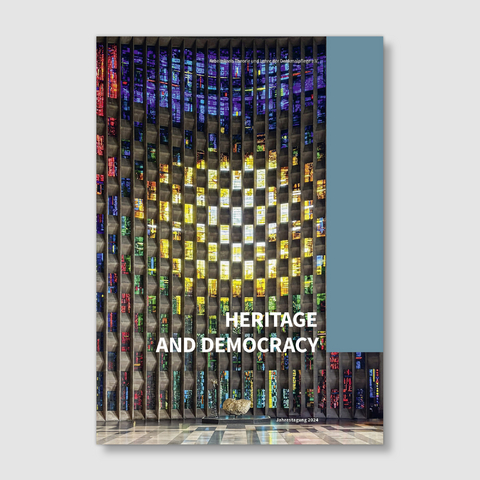
Heritage and Democracy
Mitzkat, Jörg (Verlag)
978-3-95954-188-6 (ISBN)
Sabine Coady Schäbitz and Svenja Hönig
The 2024 annual conference of the Association for Theory and Higher Education of Heritage Conservation (AKTLD) took place from the 3rd to the 6th of October in Coventry. Invited by the Department of the Built Environment at Coventry University, the conference explored the relationship between Heritage and Democracy.
This publication brings together a collection of the different contributions to the topic by analysing heritage under the categories of the public good, civil society, politics and polity. The conference examined heritage processes which operate in conjunction with the notion of democracy and how cultural heritage is shaped, interpreted, and managed in democracies and also within non-democratic societies. The emphasis was on public participation, contested narratives, and the influence of political structures. One of the key questions posed by the conference was: who defines and controls heritage, especially in times of rising populism and shifting state ideologies?
Coventry was an interesting place to hold this conference. The city shares a heritage with Germany which is mostly associated with the destruction of the city by German bombers of the Nazi Regime. The publications in this volume are framed by papers which examine the loss, memory and actions after that turning point as well as a perspective on wider developments in Coventry since the early 20th century. The role of Coventry as a city of peace and reconciliation, which has taken on since the Second World War was also the subject of various discussions during the conference. This role is further outlined in the introduction.
Early on in the planning of the conference, we decided to conduct it in English. Although the Arbeitskreis has held multi-lingual conferences before, we believe this to be the first time that we predominantly conferred in English as a lingua franca. This was as a courtesy to the British host city and host university and moreover enabled us to promote inclusivity towards a wider non-German-speaking audience.
St Mary’s Guildhall in the very centre of Coventry, adjacent to the cathedral, provided a stimulating and convenient venue for the event. Largely built in the late 14th and early 15th centuries, it is one of the most interesting – and one of the lesser known – examples of medieval guildhalls in England. It was the headquarters of the powerful merchant guild of St Mary. Delegates had the opportunity, among other benefits, to see and hear more about the remarkable tapestry in the Great Hall, woven in Flanders in the early 16th century and assumed to be the oldest tapestry in Britain still hanging in the place for which it was created. After the dissolution of the monasteries and the guilds in the 1530s and 1540s, the city purchased St Mary’s which then became the administrative home of the city council until 1920. For several centuries it was therefore the seat of local government, which was characterised by increasingly democratic decision making since the middle of the 19th century.
In addition to the presentations and discussions in St Mary’s Guildhall, the city of Coventry acted as the wider conference venue. A varied series of fringe events offered delegates the opportunity to explore the city under different aspects and meet people who are active in the Heritage sector, either as professionals or in a voluntary capacity. Such events included tours of the post-war urban development and the attempts of integration of surviving medieval buildings since then. Highlights were visits to Coventry Cathedral and to the recently reopened Charterhouse. The programme concluded with a tour of the London Cemetery Arboretum, one of the earliest Victorian garden cemeteries in the country, designed from 1845 onwards by Joseph Paxton. In addition, formal receptions were held in the new Coventry Cathedral building and in the undercroft of St Mary’s Guildhall.
All this was enabled by close collaboration of many participants, to all of whom we extend our heartfelt gratitude.
For the preparation of the academic content, we would like to thank the members of the scientific conference committee of the AKTLD, joined by Johanna Blokker, Sigrid Brandt, Christiane Fülscher, Claudia Marx, Ulrike Plate and Thomas Will. The collaboration during this planning phase was an intensive and enjoyable collegial process, which reinforced the aim of the conference to act as a positive voice for Heritage and Democracy.
A big thank you must be extended to the local organising team in the Coventry University Department of the Built Environment, specifically Amela Bogdanović, Adelina Skirth und Danny McGough for their creative and tireless commitment during the planning and implementation of the conference.
Special thanks also go to Peter Walters and Paul Maddocks from the Coventry Society and Michael Grass from the Thüringisches Landesamt für Denkmalpflege for the lively tours of the city; to M. Lorenz, the architect who guided us through all the historic stages and contemporary challenges of the Cathedral complex and to The Very Revd John Witcombe, Dean of Coventry Cathedral. John Whitcombe not only generously enabled us to hold a memorable reception in the iconic post-war part of the Cathedral but also reiterated the long-standing reconciliation process between Coventry and Germany, which has been generated to a significant extent through the offices of Coventry Cathedral. In addition, we would like to extend our gratitude to Mark Webb for his deliberations about the tapestry at St Mary’s Guildhall, to Stephen Oliver and James Hinde from Oliver Architects for their insights into the latest restorations and interventions of St Mary’s Guildhall as well as to David Mahony from PCPT Architects for his tour of the recently restored and re-opened Charterhouse, one of the few remaining medieval monasteries in Coventry. Last but not least a big thank you goes to Jamie Magraw for his entertaining tour through Joseph Paxton’s Arboretum and for his general commitment to the conference together with Ian Harrabin and Geoff Willcocks, who, together with Mark Webb are all trustees of the Historic Coventry Trust, which looks after several conservation objects in the city.
In addition, we are grateful for the support of Coventry University for their sponsorship of the conference. We are thanking the publishing house Jörg Mitzkat and their staff for the smooth implementation of these conference proceedings, as well as the scientific editing services of Dave Morris.
Following our call for papers we received a large expression of interest and we were in the fortunate, but also difficult, position of having to choose from a large number of proposals. We selected what we deemed to be the most relevant responses to the topic and the questions we raised, whilst at the same time seeking a balance of themes and speakers from different countries and backgrounds. There were many other interesting proposals which could fill an entire second conference and publication. Our heartfelt gratitude goes to all those who actively participated in the conference and the publication, and we would like to extend these thanks to all who submitted their ideas.
Ultimately, we feel we can say that the conference was a great success, enabled by the professional collaboration of many enthusiastic and committed colleagues: something the Arbeitskreis has been doing well for so many years.
We hope that this publication will deepen the memory of those who joined us in Coventry, and moreover, that it will reach a wider audience, inspiring new perspectives and initiatives for future debates on heritage in relation to democratic structures, organisations and practices.
Sabine Coady Schäbitz and Svenja Hönig
Coventry war der Ort, an dem die Jahrestagung 2024 des Arbeitskreises Theorie und Lehre der Denkmalpflege e.V. (AKTLD) vom 3. bis 6. Oktober stattfand. Auf Einladung der Abteilung für Gebaute Umwelt der Universität Coventry beschäftigte sich die Tagung mit dem Verhältnis zwischen Kulturellem Erbe und Demokratie.
Diese Publikation beinhaltet eine Zusammenstellung der verschiedenen Beiträge zu dem Thema unter den Kategorien des Gemeinwohls, der Zivilgesellschaft, der Politik und des Staatswesens. Die Tagung befasste sich mit Prozessen im Bereich des Kulturerbes, die in Verbindung mit dem Begriff der Demokratie stehen, und den Fragen danach, wie das Kulturerbe in sowohl demokratischen als auch nicht demokratischen Gesellschaften bestimmt, interpretiert und verwaltet wird. Schwerpunkte waren Öffentlichkeitsbeteiligung, umstrittene Narrative und Einfluss der politischen Strukturen. Eines der Hauptanliegen war die Frage danach, wer das Kulturerbe definiert und kontrolliert, ein, wie es sich heraustellt, ständig wichtiger werdendes Problem in Zeiten des Aufschwungs populistischer Bewegungen und sich verschiebender staatlicher Ideologien.
Coventry war ein interessanter Ort für dieses Thema. Die Stadt verbindet mit Deutschland vor allem ein Erbe, das mit der Kriegszerstörung von deutschen Bomberkommandos des Naziregimes in Zusammenhang gebracht wird. Die Veröffentlichungen in diesem Band sind gerahmt von Beiträgen, die sowohl den Kriegsverlust, die Erinnerungen und Folgen nach diesem Wendepunkt untersuchen als auch weitere Entwicklungen in Coventry seit dem frühen 20. Jahrhundert beleuchten. Die Rolle als Stadt des Friedens und der Versöhnung, die Coventry seit dem Zweiten Weltkrieg ausübt, war auch Gegenstand verschiedener Diskussionen auf der Tagung. Auf diese Rolle wird in der Einführung noch näher eingegangen.
Schon im frühen Stadium der Tagungskonzeption haben wir uns für Englisch als Tagungsprache entschieden. Der Arbeitskreis hat schon des öfteren mehrsprachige Tagungen abgehalten, in Coventry haben wir wohl zum ersten Mal ausschließlich auf Englisch als Lingua Franca konferiert. Dies erwies den Gastgebern in Coventry Respekt, und beförderte die Einbindung eines größeren Kreises nicht-deutschprechender Teilnehmer.
St Mary’s Guildhall, zentral unmittelbar neben der Kathedrale gelegen, war ein inspirierender und gut zugänglicher Veranstaltungsort. Der noch zu grossen Teilen aus dem späten 14. und frühen 15. Jahrhundert stammende Bau is eines der interessantesten – und eines der weniger bekannten - Beispiele mittelalterlicher Gildebauten in England. Er war Hauptsitz der einflussreichen Kaufmannsgilde von St. Mary. Unter anderem hatten die Tagungsdeligierten die Möglichkeit, den bemerkenswerten Wandteppich im Großen Saal zu besichtigen, der im frühen 16. Jahrhunder in Flandern entstand und vermutlich der älteste seiner Art in Grossbritannien ist, der noch an seinem ursprünglichen Bestimmungsort hängt. Nach der Auflösung der Klöster und Gilden in den 1530er und 1540er Jahren, erwarb die Stadt den Gebäudekomplex und beherbergte dort bis 1920 ihre Hauptverwaltung. St Mary’s war also über Jahrhunderte Sitz lokaler, seit der Mitte des 19. Jahrhunderts zunehmend demokratisierter Entscheidungsfindung in Coventry.
Neben den Vorträgen und Diskussionen im Guildehaus, war die Stadt Coventry der erweiterte Tagungsstandort. Ein vielfältiges Rahmenprogramm ermöglichte es, Coventry unter verschiedenen Aspekten zu erleben, und professionellen und ehrenamtlichen Akteuren in den Tätigkeitsbereichen von Kulturerbe und Denkmalpflege zu begegnen. Dies beinhaltete Führungen durch die städtebaulichen Entwicklungen der Nachkriegsperiode und zum Umgang mit den noch vorhandenen mittelalterlichen Bauten seit dieser Zeit. Höhepunkte waren der Besuch des Kathedralkomplexes von Coventry und der kürzlich wiedereröffeneten restaurierten Klosteranlage Charterhouse. Das Programm schloss mit einer Führung durch das London Cemetery Arboretum, einer der frühen viktorianischen Gartenfriedhöfe in Grossbritannien, gestaltet ab 1845 von Joseph Paxton. Zusätzlich gab es Abendempfänge in dem neuen Kathedralsbau von Coventry und in den Gewölbekellern des Gildehauses.
Dies alles wurde ermöglicht durch das Zusammenspiel vieler Beteiligter, denen an dieser Stelle unser herzlicher Dank gebührt.
Für die inhaltliche Vorbereitung danken wir den Mitgliedern des wissenschafltichen Tagungskomitees des AKTLD, zusätzlich bestehend aus Johanna Blokker, Sigrid Brandt, Christiane Fülscher, Claudia Marx, Ulrike Plate und Thomas Will. Die Zusammenarbeit in der Planungsphase war ein intensiver und bereichernder kollegialer Prozess, der uns darin bestärkt hat, die Tagung zu einem positiven Sprachrohr für das Thema Kulturerbe und Demokratie zu gestalten.
Ein grosser Dank gilt dem örtlichen Organisationsteam von der Abteilung für Gebaute Umwelt an der Universität Coventry, im Besonderen Amela Bogdanović, Adelina Skirth and Danny McGough für ihren inspirierenden und unermüdlichen Einsatz bei der Vorbereitung und Durchführung der Tagung.
Besonderer Dank geht auch an Peter Walters und Paul Maddocks von der Coventry Society sowie Michael Grass vom Thüringisches Landesamt für Denkmalpflege für ihre engagierten Führungen durch die Stadt, an M. Lorenz, die Architektin, die uns mit den verschiedenen Entwicklungsphasen und heutigen Herausforderungen des Kathedralskomplexes vertraut machte, sowie an John Witcombe, den Hochwürdigen Dekan der Kathedrale Coventry. John Witcombe ermöglichte uns nicht nur einen erinnerungswürdigen Empfang in dem ikonischen Nachkriegsbau, sondern ging auch sehr anschaulich auf die jahrzehntelange und bis heute andauernde, von der Kathedrale initiierte Versöhnungsarbeit zwischen Coventry und Deutschland ein. Weiterhin gebührt unser Dank Mark Webb für seine Erläuterungen zu dem bedeutenden Wandteppich im Gildehaus, Stephen Oliver und James Hinde von Oliver Architects für die Einblicke in die jüngsten Restaurierungs- und Umbaumassnahmen des Gildehauses als auch David Mahony von PCPT Architects für seine denkmalpflegerische Führung durch die frischrestaurierte und neueröffnete Klosteranlage Charterhouse, eine der wenigen noch verbliebenen monastischen Häuser in der Stadt. Und nicht zuletzt gebührt ein großer Dank Jamie Magraw, für die unterhaltsame Wanderung durch Joseph Paxton’s Arboretum, und sein generelles Engagement um die Tagung zusammen mit Ian Harrabin und Geoff Willcocks, ebenso wie Mark Webb alle vier in ihrer Rolle als Kuratoriumsmitglieder des Historic Coventry Trust, der als Trägerverein mehrerer Denkmalobjekte in Coventry fungiert.
Zusätzlich danken wir der Universität Coventry für ihre Förderung der Tagung. Dem Verlag Jörg Mitzkat und seinen Mitarbeitenden verdanken wir die reibungslose Verwirklichung dieses Tagungsbandes, zusammen mit dem engagierten Lektorat von Dave Morris.
Unser Call for Papers hatte sehr viel Resonanz gefunden und wir waren in der glücklichen, aber auch schwierigen Lage, aus vielen Vorschlägen wählen zu können. In unserer Auswahl haben wir uns für die Beiträge entschlossen, die uns für das Thema und seine Fragestellungen am relevantesten erschienen, und wir waren gleichzeitig darauf bedacht, eine ausgewogene Mischung aus Beiträgen verschiedener Länder und Umstände zusammenzustellen. Es gab viele andere interessante Einreichungen, die eine gesamte zweite Tagung und Publikation füllen könnten. Unser herzlicher Dank gilt allen denjenigen, die aktiv an der Tagung und der Publikation beteiligt waren, aber auch allen, die darüberhinaus ihr Interesse bekundeten.
Insgesamt, so glauben wir sagen zu können, war die Tagung ein großer Erfolg, ermöglicht durch die professionelle Zusammenarbeit vieler enthusiastischer und engagierter Kolleginnen und Kollegen, etwas, das dem Arbeitskreis seit vielen Jahren immer wieder gelingt.
Wir hoffen, dass die Publikation die Erinnerungen an die Tagung derer, die in Coventry dabei waren, vertiefen wird, und darüberhinaus einem weiteren Publikum neue Perspektiven und Anstösse für zukünftige Debatten über das Verhältnis des Kulturerbes zu demokratischen Strukturen, Organisationen und Praktiken vermittelt.
HERITAGE AND DEMOCRACY
Preface by the editors. . . . . . . . . . . . . . . . . . . . . . . . . . . . . . . . . . . . . . . . . . . 6
SABINE COADY SCHÄBITZ, SVENJA HÖNIG
Vorwort der Herausgeberinnen. . . . . . . . . . . . . . . . . . . . . . . . . . . . . . . . . . . . 8
SABINE COADY SCHÄBITZ, SVENJA HÖNIG
Heritage and Democracy . . . . . . . . . . . . . . . . . . . . . . . . . . . . . . . . . . . . . . . . 14
Introductory Thoughts
SABINE COADY SCHÄBITZ
Heritage and the Public Good
Loss, Memory and New Beginnings. . . . . . . . . . . . . . . . . . . . . . . . . . . . . . . . 22
Coventry and its Democratic Built Heritage
MICHAEL GRASS
Public Value and Architectural Heritage in Post-Soviet Kazakhstan. . . . . . 30
TEMIRLAN NURPEISSOV
Heritage and Community Wellbeing. . . . . . . . . . . . . . . . . . . . . . . . . . . . . . . 38
The Capacity of Participation to Benefit Communities and its Significance for Civil Society
CARENZA LEWIS
Heritage and Identity. . . . . . . . . . . . . . . . . . . . . . . . . . . . . . . . . . . . . . . . . . . 46
Co-production and Wellbeing in Heritage Projects
ANA SOUTO, ALICE ULLATHORNE, LAURA DUNHAM
Heritage and Civil Society
Heritage Conservation in Democracies. . . . . . . . . . . . . . . . . . . . . . . . . . . . . 58
Riegl, Managing Change, and the Need to Organise Participation
HEIKE OEVERMANN
Heritage and Democracy in Birmingham. . . . . . . . . . . . . . . . . . . . . . . . . . . . 68
A Report of the Save Smallbrook Campaign on the Case of Smallbrook Ringway Centre
JOE HOLYOAK
Commemorating the Democratisation
or Democratising the Commemoration. . . . . . . . . . . . . . . . . . . . . . . . . . . . . 76
Contemporary Debates surrounding the „Memory Spaces“
of the May 18 Gwangju Uprising
NAMMYOUNG HONG
Collective Gathering for an Inclusive Inventory. . . . . . . . . . . . . . . . . . . . . . 86
RETO WASSER, ORKUN KASAP
Heritage and Politics
Heritage Champions and Democracy. . . . . . . . . . . . . . . . . . . . . . . . . . . . . . . 98
Profiles of Conservation Activists in Iran
MINA DOURANDISH, SADRA MORADI GORGOUIYEH, SOMAYEH FADAEI NEZHAD BAHRAMJERDI
Heritage Processes Between Democracy and Autocracy. . . . . . . . . . . . . . 108
Two Decisions on Hagia Sophia 86 Years Apart.
BARIŞ ALTAN
The Heritageisation of Democracy in Germany’s Built Landscape. . . . . . . 116
JOHANNA BLOKKER
“Emancipation” for a Select Few. . . . . . . . . . . . . . . . . . . . . . . . . . . . . . . . . 124
Viollet-le-Duc’s Three-Phase Model for the Musée de Sculpture comparée
in the Parisian Palais du Trocadéro
SUSANNE MERSMANN
Hambach Castle. . . . . . . . . . . . . . . . . . . . . . . . . . . . . . . . . . . . . . . . . . . . . . 132
Historic and Contemporary Cultural Claims
GEORG MAYBAUM, BIRGIT FRANZ
Heritage and Polity
Daring More Democracy? . . . . . . . . . . . . . . . . . . . . . . . . . . . . . . . . . . . . . . . 144
Practices in Urban Heritage Conservation and their Underlying Notions of
Democracy in West Germany and North-Rhine Westphalia in the 1970s and ’80s
LISA MARIE SELITZ
Approaching Controversial Monuments. . . . . . . . . . . . . . . . . . . . . . . . . . . 152
Examples of Decolonisation in Bremen and Hamburg (Germany)
ACHIM TODENHÖFER
Perspectives on Coventry’s Medieval Heritage since 1900
between Town Planning and Local Community Engagement. . . . . . . . . . . 160
MARK WEBB
Anhang . . . . . . . . . . . . . . . . . . . . . . . . . . . . . . . . . . . . . . . . . . . . . . . . . . . 171
| Erscheinungsdatum | 20.12.2025 |
|---|---|
| Co-Autor | Orkun Kasap Mina Dourandish Sabine Coady Schäbitz Michael Grass Temirlan Nurpeissov Carenza Lewis Heike Oevermann Joe Holyoak Nammyoung Hong Reto Wasser Sadra Moradi Gorgouiyeh Somayeh Fadaei Nezhad Bahramjerdi Barış Altan Johanna Blokker Susanne Mersm |
| Zusatzinfo | Abbildungen (Fotografien und Grafiken) |
| Sprache | englisch; deutsch |
| Maße | 210 x 297 mm |
| Gewicht | 989 g |
| Themenwelt | Technik ► Architektur |
| Schlagworte | aktld • Heritage and democracy • Polity • Sabine Coady Schäbitz • Svenja Hönig |
| ISBN-10 | 3-95954-188-0 / 3959541880 |
| ISBN-13 | 978-3-95954-188-6 / 9783959541886 |
| Zustand | Neuware |
| Informationen gemäß Produktsicherheitsverordnung (GPSR) | |
| Haben Sie eine Frage zum Produkt? |
aus dem Bereich