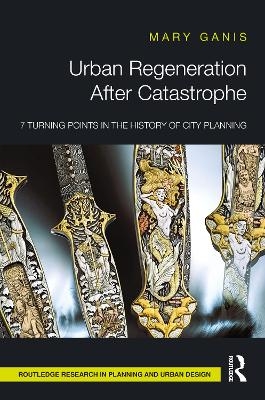
Urban Regeneration After Catastrophe
Routledge (Verlag)
978-1-041-20763-4 (ISBN)
- Noch nicht erschienen (ca. Juni 2026)
- Versandkostenfrei
- Auch auf Rechnung
- Artikel merken
Through historical case studies, the book traces urban responses to catastrophe: the 1755 Lisbon earthquake that accelerated European Enlightenment; Haussmann's Paris redesign addressing cholera and social unrest; Chicago's reinvention following the 1871 fire and economic depression; and New York's expressway developments that sparked community activism. Each case reveals significant shifts in urban planning theory and practice. The book explores how urban planning often begins with promising visions that ultimately betray their original intent. Drawing on Plato's Republic and the myth of Atlantis, urban development is framed as a cycle where destruction is inevitable, yet contains seeds of renewal and innovation. This examination of catastrophe's role in urban transformation offers critical insights for understanding contemporary cities and planning for their futures.
The book will be of interest to researchers and students of architecture, urban design, planning history and planning theory.
Mary Ganis is an Architect and Urban Designer. She has completed qualifications in Fine Art, Architecture and Urban Design, and has completed a PhD at the Queensland University of Technology in a study of exploratory behaviour in architecture and urban design and a PhD at the University of Queensland, Australia in urban design and planning focusing on network theory. Her research in the perception of place and network theory is published her book, Planning Urban Places: Self-organising Places with People in Mind (2015). She has published papers in environment and behaviour journals, and in environment and planning journals and conference proceedings. Mary Ganis’ professional experience is diverse and spans private practice, government, and academia.
Chapter 1. Introduction: Navigating Chaos Chapter 2. The Cycle of Catastrophe: Muthos – Logos Chapter 3. The Great Lisbon Earthquake: A Turning Point Chapter 4. Purity and Disgust: The Biopolitics of Paris Moderne Chapter 5. America is Utopia Chapter 6. Utopian Socialism: Howard’s Vision Chapter 7. Seduction and Propaganda: A Nation on Wheels Chapter 8. The Politicisation of Urban Form Chapter 9. Conclusion: Impacts
| Erscheint lt. Verlag | 17.6.2026 |
|---|---|
| Reihe/Serie | Routledge Research in Planning and Urban Design |
| Zusatzinfo | 1 Tables, black and white; 3 Line drawings, black and white; 43 Halftones, black and white; 46 Illustrations, black and white |
| Verlagsort | London |
| Sprache | englisch |
| Maße | 156 x 234 mm |
| Themenwelt | Naturwissenschaften ► Geowissenschaften ► Geografie / Kartografie |
| Technik ► Architektur | |
| Technik ► Bauwesen | |
| ISBN-10 | 1-041-20763-8 / 1041207638 |
| ISBN-13 | 978-1-041-20763-4 / 9781041207634 |
| Zustand | Neuware |
| Informationen gemäß Produktsicherheitsverordnung (GPSR) | |
| Haben Sie eine Frage zum Produkt? |
aus dem Bereich