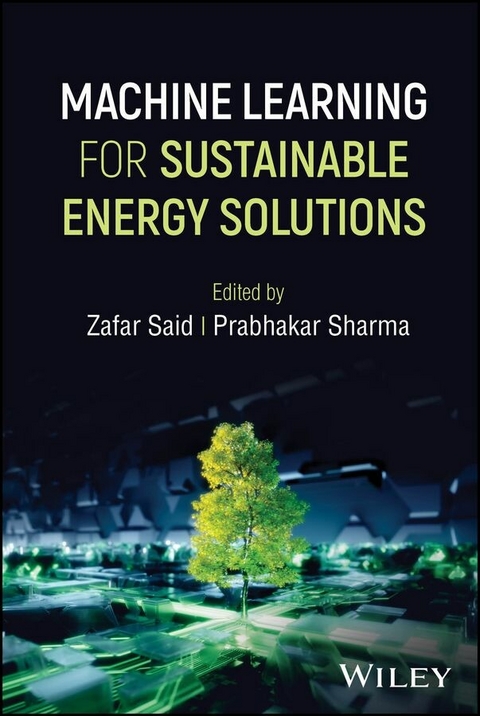
Machine Learning for Sustainable Energy Solutions (eBook)
356 Seiten
Wiley (Verlag)
978-1-394-26741-5 (ISBN)
Comprehensive insights into integrating modern engineering techniques with machine learning and renewable energy to create a more sustainable world
Through an interdisciplinary approach, Machine Learning for Sustainable Energy Solutions provides comprehensive insights into integrating modern engineering techniques such as machine learning (ML), artificial intelligence (AI), nanotechnology, digital twins, and the Internet of Things (IoT) with renewable energy. Each chapter is based on modern research and enhanced by experimental or simulated data.
The book offers a thorough review of several energy storage techniques, helping readers fully grasp the larger background in which chemical, thermal, electrical, mechanical, and machine learning technologies may be used to evaluate, categorize, and maximize different storage systems. The book also reviews the confluence of the Internet of Things (IoT) and machine learning for real-time digestive parameter control and monitoring, along with the cooperative importance of mathematical modeling and artificial intelligence in maximizing reactor performance, gas output, and operational stability.
Machine Learning for Sustainable Energy Solutions includes information on:
- Bio-based energy generation from biomass gasification and biohydrogen
- Usage of hybrid approaches, support vector machines, and neural networks to anticipate and maximize bioenergy production from challenging organic feedstocks
- Hydrogen-powered dual-fuel engines, covering response surface methodology (RSM) for multi-attribute optimization
- Scalable, experimentally confirmed ML-based solutions for long-standing problems like sedimentation, pumping losses, and stability of nanofluids
- The growing and important use of nanotechnology in energy systems, particularly in engine emissions management, energy storage, and heat transfer improvements
Machine Learning for Sustainable Energy Solutions is an essential reference for professionals, researchers, educators, and students working in the fields of energy, environmental science, and machine learning. The book also helps decision-makers in various fields by providing them the required knowledge to make informed choices on sustainable practices and policies.
Zafar Said, PhD, is a Mechanical and Aerospace Engineering Associate Professor at UAE University. With over AED six million in research funding, he has led industry-focused projects with SEWA, Tabreed, and Masdar, advancing innovations in nanofluids, solar energy, AI, and low-carbon fuels.
Prabhakar Sharma, PhD, is an assistant professor at Delhi Skill and Entrepreneurship University, Delhi, India. He has 30 years of combined experience in academia and industry.
1
Green Energy‐Led Sustainable Development: Barriers and Opportunities
Arni Gesselle M. Pornea1 and Hussein Safwat Hasan Hasan2
1 Center for Device Thermography and Reliability, University of Bristol, Bristol, United Kingdom
2 Myongji University, Seoul, Republic of Korea
1.1 Introduction
The ever‐growing energy demand and reliance on fossil fuels have incurred an increasingly severe environmental impact. With an expected future energy consumption escalation of a 3.5% annual increase from 2023 to 2030, the immediate development of sustainable energy is relatively essential for achieving the net‐zero target [1]. Numerous green energy sources serve as viable alternatives to traditional energy sources, including solar, wind, hydropower, biomass, and geothermal energy harvesting, which can help meet and fulfill the rising energy requirements. This shift toward green energy is expected to open up new opportunities to accelerate economic growth. It is expected that clean energy consumption will increase by about ~67% between 2020 and 2030, covering about 80% of global energy consumption [2]. The transition to renewable energy has faced significant challenges that hinder progress, including issues with technological readiness, economic viability, and support across various sectors. As a result, the contribution of renewable energy remains frustratingly stagnant. It is imperative to expedite the transition to green energy sources and increase their energy yield. Hence, numerous barriers impede the dominance of sustainable energy in the global energy grid. For discussion simplification, the dominant barriers and obstructions to green energy implementation were mainly categorized into two main segments: (a) nontechnical hindrances and (b) technical challenges [3].
Barriers in the nontechnical category consist of financial constraints, policy stipulation, and public cooperation, which embodies the reliance of the sustainable development of green energy on the governmental implementation approach and programs. The lack of financial support is one of the hurdles to advancing green energy; it is challenging to secure the initial investment necessary to develop and implement green energy solutions. Restrictions on policy are another obstacle to the green energy transition; most of the government's policies post inconsistent and ambiguous objectives, which restrain long‐term private sector investment and interest. These obscure goals and regulations make implementation difficult, hindering the progress of renewable energy. Furthermore, the obligation to preserve the environment may occasionally be overshadowed by the government's consideration of economic growth. Analogously, social acceptance of alternate energy sources poses hurdles to the propagation of renewable energy as well. Certain schemes must be implemented with awareness promotion to obtain public support and literacy regarding green energy utilization [4].
Moreover, technical challenges are one of the primary obstacles to achieving sustainable development goals (SDGs). Viable green energy sources and options still require research and development to enhance their efficiency and economic viability. The advancement of sustainable energy is highly reliant on the material options (such as photovoltaic [PV] materials and green energy catalytic conversions) that must be selected from a myriad of material candidates and then synthesized efficiently to generate high yields and quality for utilization in energy‐harvesting devices. The primary goal of the material investigation is to develop effective materials that can be readily utilized commercially. The discovery and development of these representative materials span approximately 15–20 years, with consideration given to improvement adjustments. This standard technological progression greatly hampers sustainable energy transformations [5].
Prompted by technological developments in machine learning (ML) and artificial intelligence (AI), these hold the potential to bring resolutions to both technical and nontechnical challenges that sustainable energy is facing [6]. The exploration of these techniques helps address the barriers to sustainable energy development. They can help predict specific material properties, thereby eliminating the lengthy material research and trial process. They can also postulate ideal material attributes with desired characteristics matching the application requirements. The acceleration of material discovery through these technological tools will amplify the immediate commercialization of sustainable energy sources, a phase that has never been seen before. It also explores new frontiers, such as hidden pattern identification and correlations, to generate hypotheses and solutions due to its immense data‐handling capabilities. It can also be used to recognize patterns in renewable energy generation and utilization, which will expedite policy realization. Nonetheless, these green energy innovations not only promise great potential for achieving net‐zero emissions and affirming the long‐term viability of our planet but also imply enhanced economic growth and generate new job opportunities. This communication offers an overview of energy research development, its corresponding barriers and opportunities, and the role of ML and AI technology in directing a sustainable future [5, 7, 8].
1.2 The Current Landscape of Green Energy
1.2.1 Green Energy Types and Technologies
Green energy spans a wide array of sustainable energy sources, each with exceptional technologies and utilization has its advantages and hurdles:
- Solar power: This constitutes PV and solar thermal systems that directly transform sunlight into electrical and thermal energy. Solar energy‐harvesting technology has advanced from the development of bifacial PVs that harvest energy from both sides of the panels to thin‐film solar cells, boosting energy‐harvesting efficiency while reducing installation costs; hence, it is still far from reaching its full potential. There is still more to explore regarding the implementation of solar energy [9].
- Wind power: Wind turbines harness wind energy by converting it into usable forms, such as electric energy. Technological innovations cover the turbine blades, offshore installations of wind turbines, and improvements in turbine efficiency, promoting higher energy harvesting even in areas with lower wind speeds. Innovations encompass larger turbine blades, floating offshore wind farms, and enhanced turbine efficiency, allowing for higher energy yield even in areas with lower wind speeds [1].
- Hydropower: Considered one of the oldest sustainable energy sources, it is now the major source of clean energy. It utilizes water flow to harvest energy. Improvements in hydropower generation focus on enhancing turbine efficiency and installing these facilities in remote areas, thereby reducing ecosystem disturbance [1, 10].
- Bioenergy: Utilizing organic materials, such as plant waste and manure, to generate heat or produce biofuels. The technological enhancement consists of gasification and anaerobic digestion, which raise energy output and reduce emissions [10].
- Geothermal energy: Geothermal systems utilize the Earth's internal heat to generate electricity and provide direct heating. Enhanced geothermal systems (EGS), which involve creating underground reservoirs in dry rock to extract heat, are expanding the potential of geothermal energy beyond natural volcanic regions [1].
1.2.2 Global Green Energy Usage Statistics
The global implementation and production of green energy have grown significantly over the past decade, reaching a record 30% of global renewable electricity generation in 2023. Green energy increased from 19% of overall global electricity in 2000, mainly driven by the expansion of solar and wind electricity, which contributed 0.2% in 2000, to a record high of 13.4% in 2023 [1].
- Solar energy is the dominating contributor to the green energy revolution. It has been the fastest‐growing renewable energy source for 19 consecutive years. The energy produced through solar power has doubled compared to coal's electricity, accounting for 5.5% (1631 TWh) of the overall electricity generation in 2023. Obtaining a 23% increase in solar energy generation (from +307 TWh in 2023 to +307 TWh in 2022) compared to a 9.8% increase in 2022 (from +206 TWh to +227 TWh). This massive increment in solar energy harvesting can be attributed to the surge in solar power plant installations, such as in China, which contributed to 51% additional global solar energy generation [1].
- Wind energy was the new powerhouse of newly introduced clean energy. The combined efforts of sustainability‐leading countries resulted in a power generation capacity exceeding 800 GW, with wind energy accounting for 7.8% (2374 TWh) of the world's electricity in 2023. Likewise, in solar energy, China also uplifts wind energy harvesting by 60% of the overall harvested wind energy [1].
- Given its popularity, hydropower production experienced a downward energy trend, accounting for 14% of global electricity in 2023. The falling trend can be attributed to the extensive droughts of the past few years. Under normal conditions, hydropower production can account for approximately...
| Erscheint lt. Verlag | 17.12.2025 |
|---|---|
| Sprache | englisch |
| Themenwelt | Naturwissenschaften ► Chemie |
| Technik ► Elektrotechnik / Energietechnik | |
| ISBN-10 | 1-394-26741-X / 139426741X |
| ISBN-13 | 978-1-394-26741-5 / 9781394267415 |
| Informationen gemäß Produktsicherheitsverordnung (GPSR) | |
| Haben Sie eine Frage zum Produkt? |
 EPUB (Adobe DRM)
Kopierschutz: Adobe-DRM
Adobe-DRM ist ein Kopierschutz, der das eBook vor Mißbrauch schützen soll. Dabei wird das eBook bereits beim Download auf Ihre persönliche Adobe-ID autorisiert. Lesen können Sie das eBook dann nur auf den Geräten, welche ebenfalls auf Ihre Adobe-ID registriert sind.
Details zum Adobe-DRM
Dateiformat: EPUB (Electronic Publication)
EPUB ist ein offener Standard für eBooks und eignet sich besonders zur Darstellung von Belletristik und Sachbüchern. Der Fließtext wird dynamisch an die Display- und Schriftgröße angepasst. Auch für mobile Lesegeräte ist EPUB daher gut geeignet.
Systemvoraussetzungen:
PC/Mac: Mit einem PC oder Mac können Sie dieses eBook lesen. Sie benötigen eine
eReader: Dieses eBook kann mit (fast) allen eBook-Readern gelesen werden. Mit dem amazon-Kindle ist es aber nicht kompatibel.
Smartphone/Tablet: Egal ob Apple oder Android, dieses eBook können Sie lesen. Sie benötigen eine
Geräteliste und zusätzliche Hinweise
Buying eBooks from abroad
For tax law reasons we can sell eBooks just within Germany and Switzerland. Regrettably we cannot fulfill eBook-orders from other countries.
aus dem Bereich